
Some numbers do not need a governing body to feel heavy.
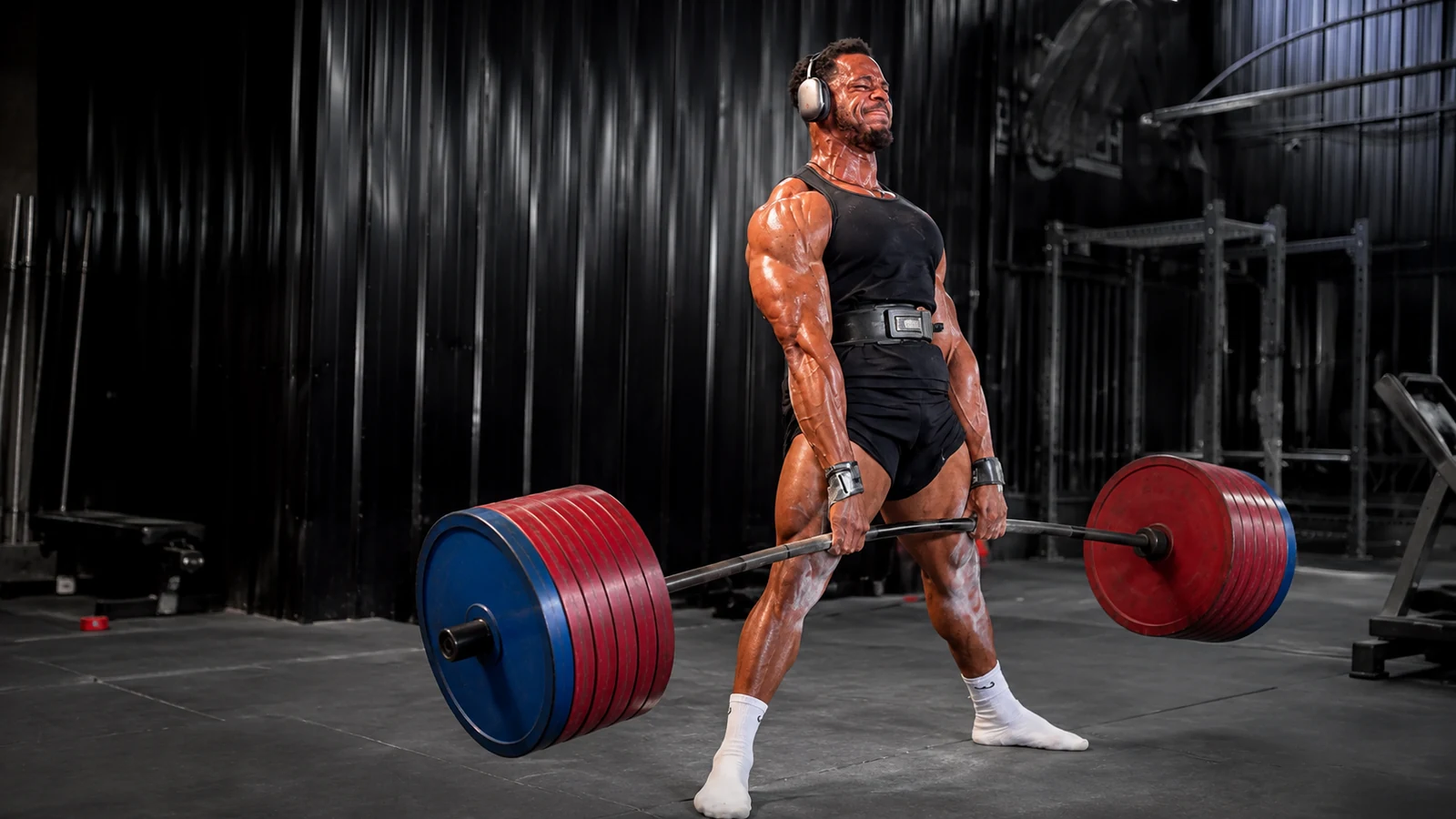
In September 2022, American powerlifter Jamal Browner loaded a barbell to 500 kilograms, or 1,102.31 pounds, and pulled it off the floor in a training session filmed on video.
No federation sanctioned that lift.
It happened outside of competition, wearing straps that are banned in sanctioned powerlifting meets, so it does not count as a world record, a national record, or an official mark of any kind.
This article treats it exactly that way, a real, video-documented training feat, not a certified record, the same distinction WorkoutHealthy draws for actual governing-body certified marks covered elsewhere on this site.
What makes it worth writing about is not the raw number.
Bigger raw numbers exist.
What makes it worth writing about is who lifted it.
Browner competes at 242.51 pounds, roughly 110 kilograms.
The other men who have pulled at least 500 kilograms on camera outweigh him by well over 100 pounds each.
That gap is the real story here, and it says more about how strength scales with body size than any single number on a bar does.
What Happened, and What This Is Not
The pull took place in late September 2022, in a training gym, not on a competition platform.
Video and reporting from FitnessVolt and BreakingMuscle place the date at September 29, 2022, roughly a week after Browner competed at the 2022 USPA Raw Pro meet.
Browner pulled the 500 kilograms sumo style, wearing a lifting belt and lifting straps, using calibrated competition plates.
Straps wrap around the bar and the wrist, and they remove grip as the limiting factor in a heavy pull.
Every major powerlifting federation bans straps in a raw or equipped competition deadlift, precisely because they change what the lift is testing.
That single detail is why this pull cannot be filed next to a meet result, no matter how heavy the plates were.
It also is not the kind of unofficial feat that later gets retroactively certified.
There was no federation official on hand, no formal weigh-in tied to the attempt, and no meet paperwork.
It exists as a training clip, verified by outlets that cover strength sport closely, and that is the correct way to describe it going forward.
The Fourth Man to Pull Half a Ton on Camera
Browner’s pull did not happen in a vacuum.
By the time he loaded 500 kilograms, three other men had already been filmed doing the same thing or more.
Eddie Hall went first, deadlifting 500 kilograms at the 2016 World Deadlift Championships in Leeds, England, an official strongman event that allowed straps and a hitch grip under its own rules.
Hafthor Bjornsson followed in May 2020, pulling 501 kilograms during a filmed strongman feats-of-strength session at his personal gym.
Krzysztof Wierzbicki, a Polish powerlifter, then became the first competitive powerlifter to do it, pulling 502.5 kilograms in a recorded training session in late April 2022.
Browner’s 500 kilogram pull that September made him the fourth man ever filmed lifting that much weight off the floor.
Some later footage reportedly shows Browner attempting an even heavier pull, close to 501 kilograms, in subsequent training.
Available reporting does not confirm that attempt as a clean, completed lift, so this article treats the verified 500 kilogram pull from September 2022 as his documented mark.
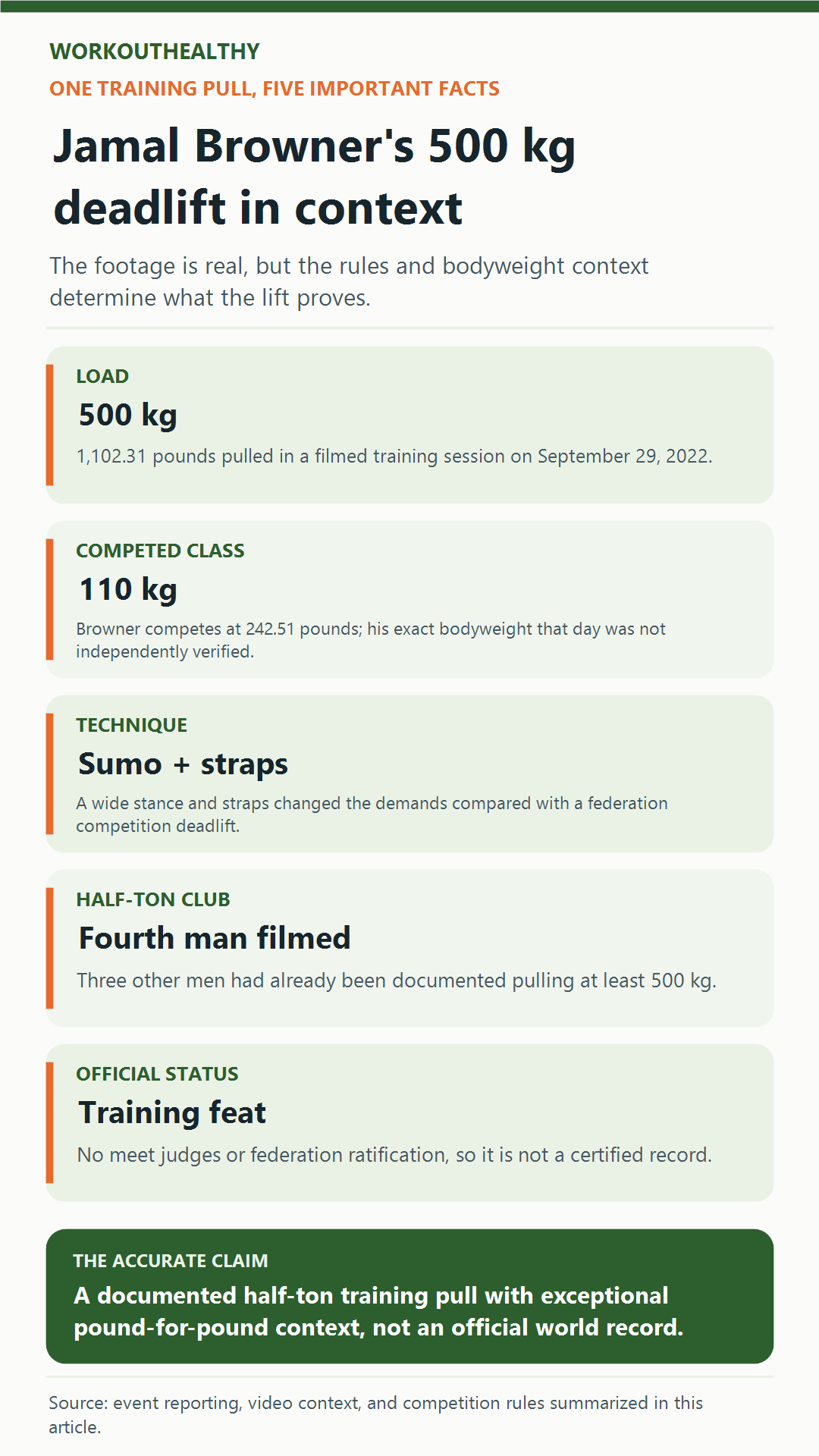
Four men have been filmed pulling half a ton off the floor. They do not share anything close to the same bodyweight.
The Weight Class Nobody Expects at This Number
Here is where Browner’s pull actually separates itself from the other three.
Eddie Hall competed as a strongman in the heaviest class strongman has, and walked around well north of 380 pounds at his peak strength.
Hafthor Bjornsson is a former World’s Strongest Man winner who has weighed well over 400 pounds in competition condition.
Krzysztof Wierzbicki competes in powerlifting’s super heavyweight division, which has no upper weight limit at all.
Browner competes at 242.51 pounds.
That is barely more than half of what Bjornsson or Hall carried into their pulls.
Put another way, Browner moved the same absolute weight as three men who each outweighed him by 100 to 180 pounds.
A 242 pound man and a 420 pound man do not have the same amount of muscle mass to generate force with, even if both trained hard for years.
Muscle cross-sectional area, tendon leverage, and total mass to move the bar with all scale with body size, and a lifter half the bodyweight of his peers has a real physical disadvantage to overcome, not just a smaller number on the scale.
Why Pound-for-Pound Strength Works Differently
Strength does not scale evenly with body size, and that is not just gym folklore.
A study of elite Olympic weightlifting champions found that maximum muscle strength relates to body height and muscle cross-sectional area in a predictable but non-linear way, meaning a lifter does not need to be proportionally twice as strong just because a rival weighs twice as much (Ford et al., 2000).
That scaling effect is exactly why powerlifting invented body-mass adjusted formulas in the first place.
The Wilks formula, and its successors, exist specifically to compare a 165 pound lifter’s total against a 320 pound lifter’s total on a level field, because raw poundage alone favors bigger bodies almost automatically (Vanderburgh & Batterham, 1999).
Under any body-mass adjusted scoring system, Browner’s 500 kilogram pull would score dramatically higher than the same weight lifted by a 400 pound competitor.
None of that makes the training pull an official record.
It does mean the biomechanics behind it are genuinely more impressive than the bare number suggests.
A smaller frame has less leverage advantage off the floor, a shorter torso to generate hip drive through, and a smaller total muscle mass pool to recruit for one maximal effort.
Getting to 500 kilograms from that starting point is a different physical problem than getting there from a 400 pound frame.
A 242 pound man and a 420 pound man do not carry the same amount of muscle to build a pull like this out of. Getting to the same number from a smaller frame is a different physical problem entirely.
What the Sumo Stance and Straps Actually Changed
Browner pulled sumo, with a wide stance and hands inside the knees, rather than conventional, with feet under the hips and hands outside the knees.
Electromyography research comparing the two styles found real differences in which muscles carry more of the load, with sumo pulls generally placing relatively more demand on the quadriceps and hip muscles and relatively less on the lower back compared to conventional pulls (Escamilla et al., 2002).
That does not make sumo an easier lift in absolute terms, but it does change the limiting factor.
A conventional puller often fails because the lower back or grip gives out before the legs do.
A sumo puller with straps removes grip from that equation almost entirely and shifts more of the burden onto hip and leg strength, along with the ability to keep the torso upright through a shorter range of motion.
For a smaller lifter like Browner, stance choice interacts directly with the pound-for-pound story.
Sumo can shorten the bar’s travel distance for a shorter-limbed lifter, which matters more the smaller a lifter’s frame is relative to the weight on the bar.
Straps then remove the one factor, grip endurance, that tends to fail earliest as fatigue builds during a near-maximal single pull.
What This Lift Does Not Prove
It is worth being direct about the limits of a training clip like this one.
Because there was no meet weigh-in, there is no independently verified bodyweight for Browner on the exact day of the pull, only his competed weight class.
Straps also mean this number cannot be compared directly to a raw, no-strap competition total, where grip failure is a real and expected limiter.
A single training pull, however heavy, is not the same evidence as a full competition total across squat, bench, and deadlift under judged conditions.
It also is not proof that Browner could repeat the lift on demand, in a meet, under fatigue from two other lifts already completed that day.
None of that erases what the video shows.
It just means the honest label for this feat is “heaviest filmed training pull by a lifter his size,” not “record,” and readers should treat any headline that uses the word record for this specific lift with real skepticism.
Common Mistakes People Make Reading a Number Like This
The most common mistake is treating every 500 kilogram deadlift clip as equivalent.
Hall’s pull was an official strongman world record, Bjornsson’s was an official strongman feat under WUS rules, and Wierzbicki’s and Browner’s were both training pulls that no federation certified.
Those are four different categories of achievement wearing the same headline number, and collapsing them into one “world record” story flattens real, meaningful differences.
A second mistake is ignoring bodyweight entirely when comparing lifters.
Two athletes lifting the same weight are not accomplishing the same relative feat if one weighs 100 pounds more than the other.
A third mistake, common among newer lifters online, is assuming straps are some kind of shortcut or cheat.
Straps are a normal, widely used training tool that let a lifter train the hips, back, and legs at loads their grip alone could not yet hold, and elite lifters use them constantly outside of competition day.
Who Should Be Cautious Chasing Heavy Pulls
Near-maximal deadlifts, even in a controlled gym setting, are not a beginner activity.
Anyone with a history of disc injury, uncontrolled high blood pressure, or a hernia should talk with a doctor before attempting a heavy single, since the intra-abdominal pressure involved is significant.
People newer to lifting should build technical proficiency at lighter loads for months, not weeks, before testing anything close to a one-rep maximum.
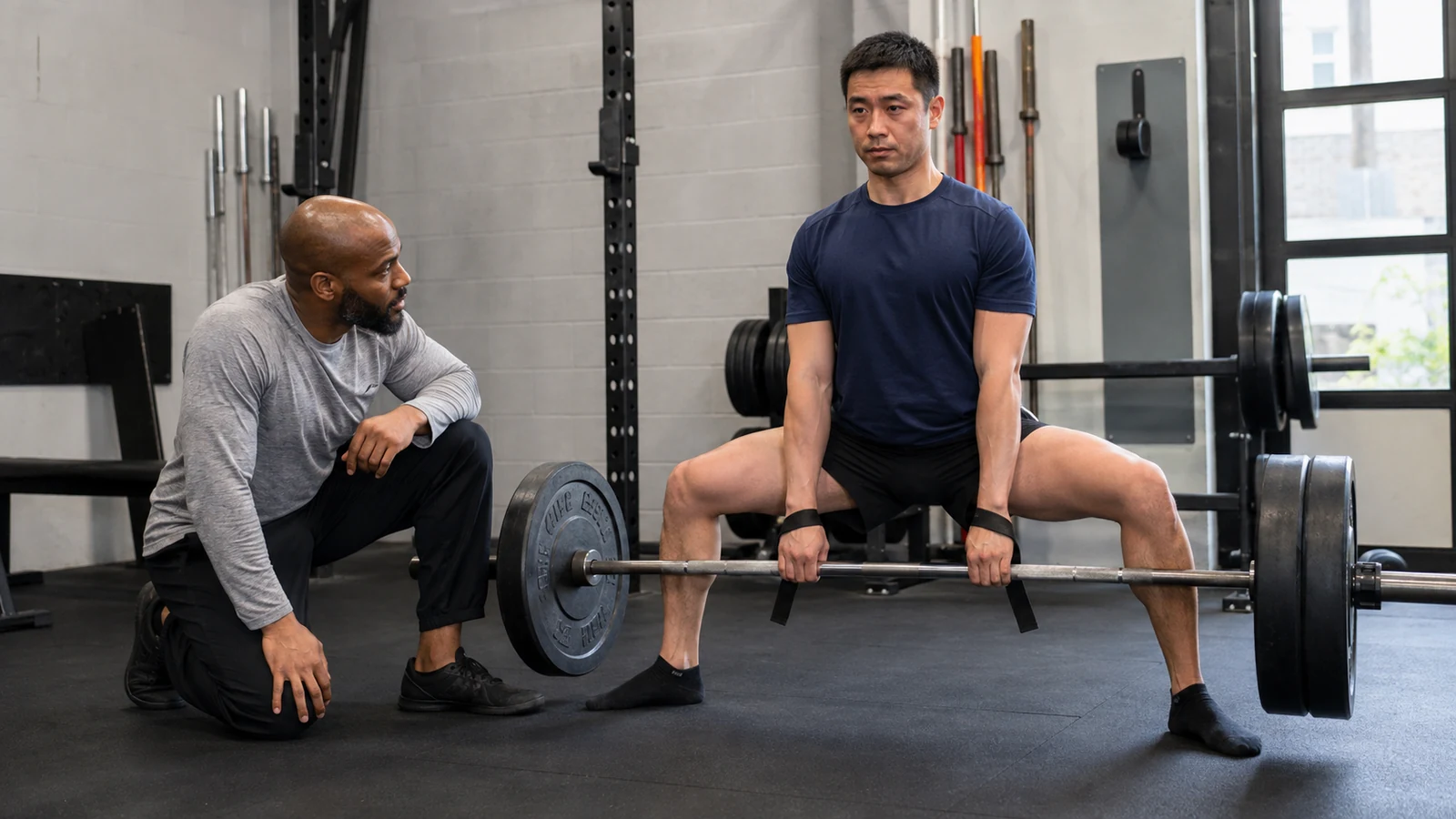
A qualified coach watching your setup, bar path, and bracing matters more at heavy loads than at moderate ones, because small technical breakdowns become injury risks as the weight climbs.
Working with a coach or trainer on deadlift technique before chasing heavier singles is one of the more reliable ways to protect your back while still making real strength progress, and it is worth reading through what a personal trainer actually does before deciding whether to hire one.
Anyone returning from a back injury specifically should be more cautious with deadlifts than almost any other lift in the gym, since the lower back bears real load throughout the entire movement.
How Lifters Actually Build Toward a Pull Like This
Nobody adds 500 kilograms to a deadlift by accident, and the road there is unglamorous.
Progressive overload across months and years, not weeks, is the foundation, with total weekly volume rising gradually as technique solidifies.
Most serious pullers train both stance variations at different points in a training cycle, since conventional and sumo stress the hips, back, and legs differently, and each stance can expose a different weak point.
Strengthening the whole posterior chain matters as much as practicing the deadlift itself, and that is part of why bench and press variations that change leverage, like a floor press, still show up in a well-rounded strength program.
Accessory work for the upper back, hamstrings, and core supports the deadlift without adding fatigue to the lift itself.
Grip work matters too, even for lifters who plan to use straps on their heaviest attempts, since grip strength still limits every lighter working set along the way.
Recovery between heavy pulling sessions needs to be real, not symbolic, since a maximal deadlift attempt taxes the central nervous system more than most other lifts in the gym.
Sleep, protein intake, and spacing heavy pulling days apart by at least a week are unglamorous, unavoidable parts of getting anywhere near this kind of number.
Strength training built consistently over years also carries benefits that go well beyond any single lift, including effects on long-term brain health that make the process worth it independent of any one number on a bar.
Watch the Original Video
Want the real story behind the next viral fitness clip? Subscribe to WorkoutHealthy Insider for practical explanations behind popular fitness claims.
References
Escamilla, R. F., Francisco, A. C., Kayes, A. V., Speer, K. P., & Moorman, C. T., III. (2002). An electromyographic analysis of sumo and conventional style deadlifts. Medicine & Science in Sports & Exercise, 34(4), 682–688. https://doi.org/10.1097/00005768-200204000-00019
Ford, L. E., Detterline, A. J., Ho, K. K., & Cao, W. (2000). Gender- and height-related limits of muscle strength in world weightlifting champions. Journal of Applied Physiology, 89(3), 1061–1064. https://doi.org/10.1152/jappl.2000.89.3.1061
Vanderburgh, P. M., & Batterham, A. M. (1999). Validation of the Wilks powerlifting formula. Medicine & Science in Sports & Exercise, 31(12), 1869. https://doi.org/10.1097/00005768-199912000-00027
This article is for general information only and is not medical advice. If you have an injury, ongoing pain, or a medical condition, talk to a doctor or physical therapist before you change how you train or eat.