
Brooke Shields’ post-surgery workout story is useful because it does not depend on pretending recovery is linear. After knee surgery, she showed training that emphasized what she could do while the joint was still healing.
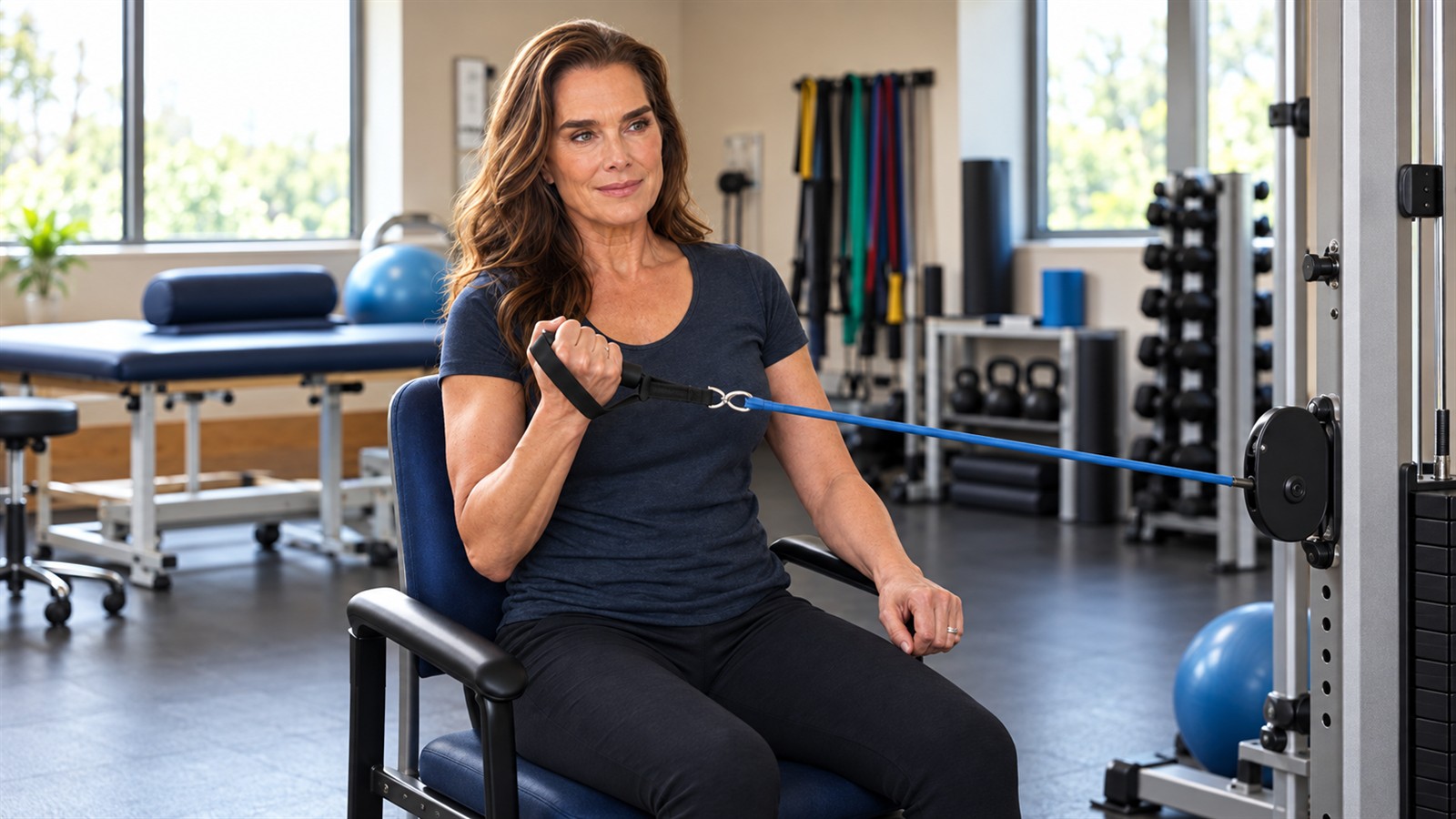
Women’s Health reported on her recovery training, including upper-body, core, leg, and mobility work. The larger lesson is not a specific celebrity exercise. It is the skill of modifying a routine without treating pain as a test of character.
What Shields Shared About Her Recovery
Shields posted parts of the process publicly and worked with professionals. That matters because a short social video rarely shows the full plan, the surgeon’s restrictions, or the therapist’s progression.
Her sessions included focused strength work and stretching rather than a rushed return to everything she had done before surgery. Training other regions helped her keep a sense of routine while the knee’s capacity was rebuilt.
Why Training Around an Injury Can Help
After surgery, many people move less overall. Carefully selected upper-body and trunk exercises can preserve confidence and general capacity without loading the healing area beyond its current limit.
That does not mean the injured joint should be ignored. Rehabilitation is specific. Range of motion, swelling, gait, strength, and tolerance to daily tasks all help determine the next step.
The Medical Team Sets the Boundaries
A surgeon and physical therapist should define restrictions after knee surgery. Different procedures have different timelines, and two people with the same operation may still progress differently.
The American Academy of Orthopaedic Surgeons’ knee conditioning guidance emphasizes restoring strength and flexibility with professional direction. Pain, swelling, and loss of function are feedback, not obstacles to ignore.
Any exercise that causes sharp pain, instability, or a worsening response afterward deserves a pause and a conversation with the care team.
Upper-Body and Core Work Need Modification Too
An exercise can look like upper-body work and still load the knee. Standing presses, heavy carries, and floor transitions all demand support from the legs.
Seated variations, machines, or supported positions may reduce that demand. Core work can also be scaled with breathing drills, supported anti-rotation exercises, and controlled trunk work.
Mobility Is Not the Same as Forcing Range
Recovery often includes repeated, modest range-of-motion work. The purpose is to restore useful movement without provoking unnecessary irritation.
Stretching harder is not automatically better. A knee that is swollen or recently operated on may respond poorly to long, forceful positions. The specific dose should come from the clinician managing rehabilitation.
How Strength Returns After a Knee Procedure
Strength usually returns in stages: re-establishing muscle activation, tolerating bodyweight, adding controlled resistance, and eventually practicing faster or more demanding tasks.
A chair can provide a clear target and support. Our guide to chair squats and lower-body function explains why the movement is practical, although a post-surgery version still needs professional approval.
Progress should be earned by a stable response across several sessions, not by one unusually good day.
The Psychology of Staying Active During Recovery
Injury can remove a familiar outlet for stress. Keeping a modified routine may protect mood and maintain the identity of being an active person.
That benefit can disappear if every session becomes a comparison with pre-injury performance. Recovery training has a different purpose. Small wins count: smoother walking, easier stairs, better sleep, or less apprehension.
Returning to Full Training
A return to sport should be based on function and medical clearance, not a date circled on a calendar. Strength symmetry, movement quality, swelling response, and confidence may all matter.
Low-impact conditioning may help bridge the gap. Once cleared, standing cardio without jumping offers one way to scale heart-rate work.
The Bottom Line
Brooke Shields’ recovery story is not proof that everyone should train through surgery. It is an example of training intelligently around temporary limits.
Keep the routine where possible, let the medical plan control the progression, and treat symptoms as information. Recovery is productive training when the goal is rebuilding capacity rather than proving toughness.