
Gym stereotypes are funny because the behaviors are recognizable: the person guarding three machines, the phone user resting on the only bench, and the regular who makes a new member feel welcome. None is a fixed type of person, and most of us have played more than one role.
This guide keeps the jokes but aims them at changeable habits. It also separates what research actually says about gym anxiety and training partners from observations that are just gym lore.
A quick gym stereotype decoder
| What you see | What you cannot know from across the room | A better response |
|---|---|---|
| Someone checking a mirror between sets. | Whether they are posing, checking technique, or trying to feel comfortable. | Give them space and keep the rack area clear. |
| Someone taking a long rest on a bench. | Whether a long rest is part of a program. | Ask politely how many sets remain and whether you can work in. |
| Someone filming a lift. | Whether they are reviewing technique or making content. | Ask that your image stay out of the frame if you are nearby. |
| Someone new to the free-weight area. | Whether they want help, privacy, or time to learn. | Do not assume; offer space and answer questions when asked. |
The difference matters: a stereotype assigns a motive, while etiquette deals with the behavior in front of you. A crowded floor runs better when members can ask for what they need without mocking one another.
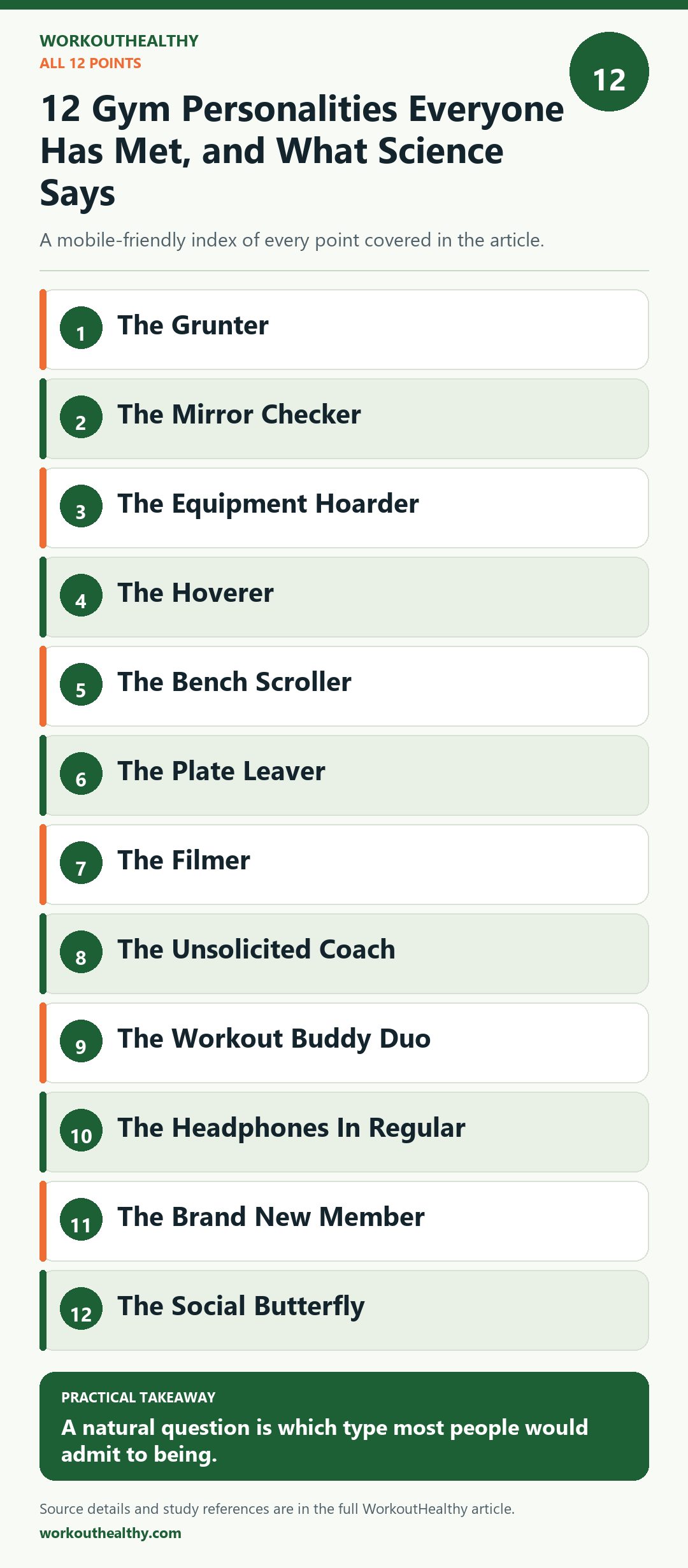
Twelve gym stereotypes, with a better way to handle each
1. The soundtrack
One rep, one dramatic noise, and now the whole room knows it is leg day. Exhaling or making a sound during a demanding lift is normal; shouting across a shared space is a separate choice.
Better move: train as hard as you need while following the room’s noise rules and noticing who is close by.
2. The mirror checker
They glance at their form, their hair, or both, and an observer invents a story about vanity. A mirror can be a training aid, and appearance concerns can also make gyms uncomfortable.
Better move: use the mirror if it helps, then leave the space in front of the weights available to others.
3. The equipment collector
A bench, two dumbbell pairs, and a cable station form one person’s circuit. Supersets can fit a program, but a busy gym cannot reserve several stations indefinitely.
Better move: use one area, invite work-ins when practical, or save the multi-station circuit for a quieter hour.
4. The hoverer
They stand close enough to read your rep count while waiting for a machine. That may feel like pressure even if they meant only to ask about availability.
Better move: ask “How many sets do you have left?” once, then step back and let the person finish.
5. The bench scroller
The screen is lit and the bench looks occupied forever. Long rests can be legitimate after hard sets, so the phone alone does not reveal whether the person is wasting time.
Better move: share an estimated finish time or offer to alternate sets if the setup makes that easy.
6. The plate leaver
The workout ends, but the plates remain on the machine. The next member may have to clear a load they cannot comfortably handle before they can begin.
Better move: unload and return what you used, including small plates and collars.
7. The filmmaker
A video can help someone review a lift, but a wide shot may include people who did not agree to be recorded. A tripod can also turn a walkway into a set.
Better move: follow your gym’s filming policy, frame only yourself, and move the camera if someone needs the space.
8. The surprise coach
An unfamiliar person interrupts a set with advice. They might mean well, but they do not know the lifter’s goal, injury history, or coaching plan.
Better move: ask whether feedback is wanted after the set, and respect “no thanks.” If there is an immediate hazard, alert staff or speak briefly and calmly.
9. The workout pair
They cheer each other on and make a hard session feel easier to start. They can also turn the only rack into a conversation circle.
Better move: keep the encouragement and make room for others when a shared station is in demand.
10. The headphones-in regular
They have a plan, keep their eyes on it, and seem uninterested in small talk. Quiet focus is a preference, not evidence of rudeness.
Better move: respect their space, and remember that a short practical question is easier to answer between sets than during one.
11. The new member
A few pauses at a cable machine can look like confusion from a distance. Everyone starts somewhere, and a person learning the layout does not owe the room a polished performance.
Better move: point them toward staff or show where an item is if they ask, without turning a welcome into unsolicited coaching.
12. The social connector
They know several names and make the gym feel like a place to return to. The same conversation can delay someone else when it happens on the only open machine.
Better move: keep the community, move a long chat off the equipment, and introduce new people only when they seem interested.
What can research tell us about these characters?
No study sorted gym members into these 12 personalities. The useful research concerns specific experiences, especially feeling evaluated and the possible benefits of a partner.
| Research | What it actually did | What it cannot prove |
|---|---|---|
| Hart, Leary, and Rejeski, 1989 | Developed a 12-item scale for anxiety about others observing or evaluating one’s physique. | A mirror or a stranger’s glance does not mean every member feels judged. |
| Quinn, 2026 | Proposed a framework for understanding why some gym users may experience intimidation and suggested possible environmental and social responses. | It is a theory article, not a trial proving that a specific etiquette rule reduces anxiety. |
| Feltz, Kerr, and Irwin, 2011 | Tested exercise-game plank performance with a virtual partner under defined conditions. | It does not show that any real-life gym buddy improves every workout or long-term adherence. |
A member can feel watched even when nobody intends harm, and another member can welcome attention or help. That is a reason to ask before filming or advising and to give people room to train.
Three useful lines for awkward gym moments
- Waiting for equipment: “How many sets do you have left? I can come back or work in if that is easy.”
- Appearing in a video: “Could you angle the camera so I am out of the shot?”
- Receiving unwanted advice: “Thanks, I am following my plan today.”
These are examples of civil boundaries, not lines a study tested. Gym staff can handle repeated filming, harassment, or equipment problems when a direct request is not enough.
If the gym feels intimidating
You do not have to prove that every other member is looking at you to take your discomfort seriously. Try a written first-session plan, ask staff for a short orientation, or choose a quieter time while you learn the layout.
If a particular person repeatedly crosses a boundary, tell staff rather than changing your whole routine around them. A welcoming gym depends on both members’ behavior and management’s response.
The takeaway
Gym stereotypes make a familiar scene funny, but the behavior is more useful than the label. Share space, ask before filming or advising, clear what you use, and let other people have their own reasons for being there.
Sources
- Hart EA, Leary MR, Rejeski WJ. Journal of Sport and Exercise Psychology (1989): measurement of social physique anxiety.
- Quinn F. Frontiers in Sports and Active Living (2026): theory of social gym intimidation and anxiety.
- Feltz DL, Kerr NL, Irwin BC. Journal of Sport and Exercise Psychology (2011): virtual partner and exercise-game plank performance.