

Francis Bacon is best known for helping shape the scientific method.
He also wrote a short essay on staying healthy, and parts of it sound surprisingly current.
Image note: The featured scene is an editorial illustration, not a historical photograph of Bacon.
A popular post says Bacon advised using exercise regularly as part of a health routine, not only turning to medicine when sick.
That is a fair reading of the essay, with a few twists worth knowing.
Who Francis Bacon Was
Bacon was born in London on January 22, 1561, and died on April 9, 1626.
He served as Attorney General and later as Lord Chancellor of England under King James I.
He is often called the father of empiricism, the idea that knowledge should come from observation and experiment.
His Essays came out in three editions: 1597, 1612, and 1625.
The final edition had 58 essays, including one titled “Of Regiment of Health.”
What the Essay Actually Says
“Regiment” here means a regimen, or a way of living for health.
Bacon opens with a very empirical idea.
He writes that “a man’s own observation, what he finds good of, and what he finds hurt of, is the best physic.”
“Physic” was the word for medicine.
He then tells readers to “examine thy customs of diet, sleep, exercise, apparel, and the like.”
And he warns, “Beware of sudden change, in any great point of diet.”
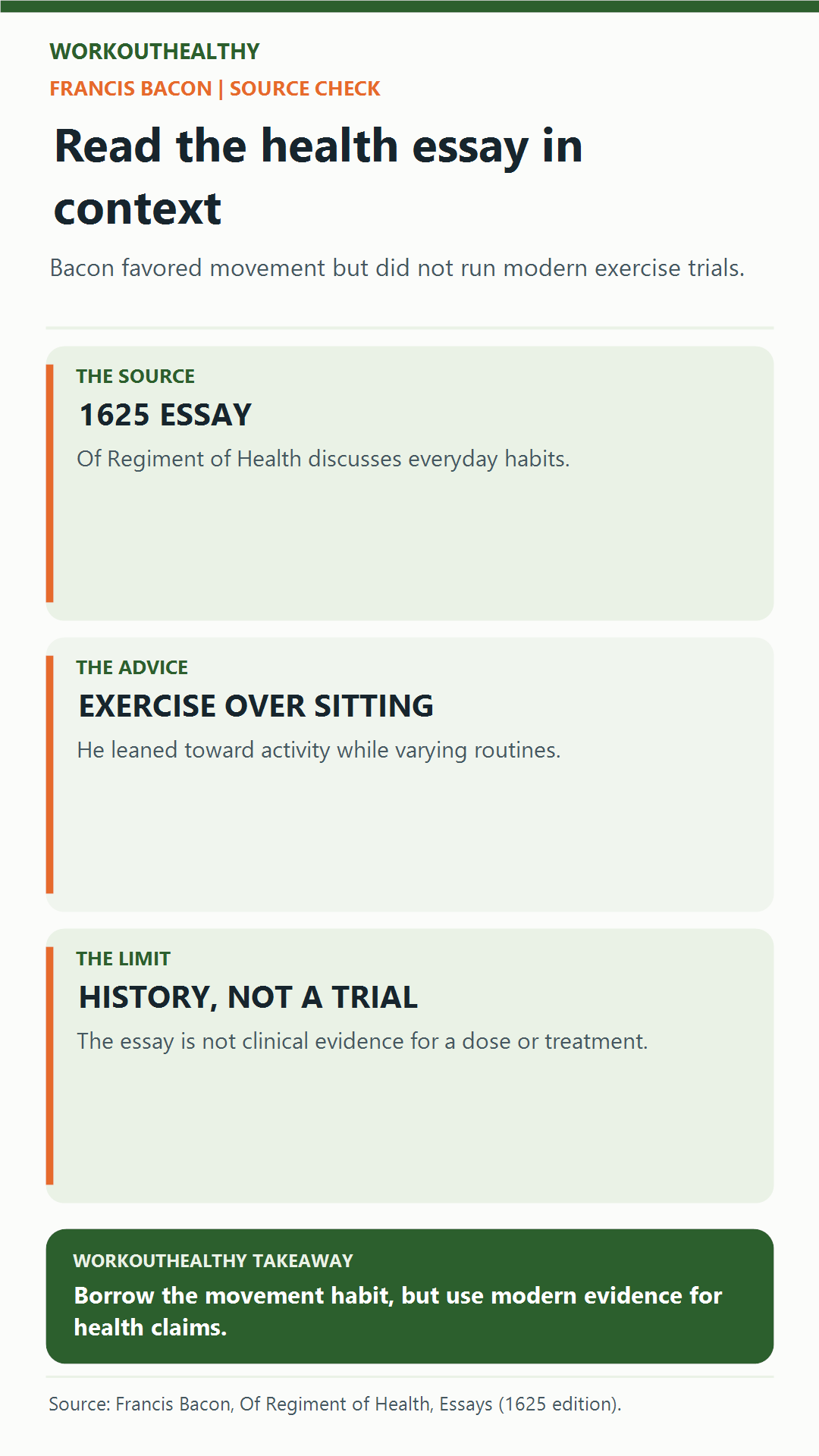
Use fasting and full eating, but rather full eating; watching and sleep, but rather sleep; sitting and exercise, but rather exercise.
Exercise as a Habit, Not a Rescue
The block quote above is the clearest link to the popular claim.
Bacon suggests mixing opposites, but leaning toward the healthier side.
Between sitting and exercise, he leans toward exercise.
He also sums up his view in one short line: “In sickness, respect health principally; and in health, action.”
In plain terms, when you are sick, focus on getting well. When you are well, stay active.
That is close to the modern idea of exercise as everyday prevention.
It treats activity as part of normal life, rather than something saved for a health scare.
The Twist About Medicine
Bacon did not reject medicine in healthy people entirely.
He wrote, “If you fly physic in health altogether, it will be too strange for your body when you shall need it.”
He also said he preferred “some diet for certain seasons, than frequent use of physic.”
So his message was about balance and habit, not about avoiding doctors.
His advice on remedies reflects the medicine of his era and should not be followed today.
Your Own Observation, Updated
Bacon’s first rule is to watch what helps you and what hurts you.
That idea fits well with modern self tracking.
You do not need fancy tools to do it.
A notebook or phone note can record how you slept, how you trained, and how you felt the next day.
After a few weeks, patterns start to appear.
Maybe late workouts hurt your sleep. Maybe a morning walk lifts your mood.
Those notes help you adjust your routine based on your own experience, not on guesswork.
Just remember that personal notes cannot replace medical tests or a doctor’s judgment.
What Modern Research Says
Modern evidence strongly supports regular activity as prevention.
A 2010 systematic review by Darren Warburton and colleagues examined 254 articles for Canada’s activity guidelines.
It found that higher activity levels were associated with a lower risk of premature death from any cause; much of this evidence was observational and does not by itself prove causation.
The average risk reduction for all cause death was 31 percent.
It also found dose response links for seven chronic diseases.
These included heart disease, stroke, high blood pressure, colon cancer, breast cancer, type 2 diabetes, and osteoporosis.
Bacon’s focus on custom also fits habit research.
A 2015 study by Navin Kaushal and Ryan Rhodes followed 111 new gym members for 12 weeks.
In that sample of new gym members, exercising at least four times a week for six weeks was associated with establishing a self-reported exercise habit. This is not a universal minimum for everyone.
Consistency, simple routines, a supportive setting, and enjoying the workout all helped habits form.
For another example of prevention in action, see our look at exercise and influenza and pneumonia risk.
What This Does Not Prove
Bacon was not running studies on exercise.
His essay is advice based on observation, not controlled research.
Evidence on activity and death rates often comes from observational studies, which show links rather than proof of cause.
The habit study involved new gym members, so it may not apply to everyone.
And some of Bacon’s ideas, like his views on medicines, belong to his time.
How to Apply Bacon’s Advice Today
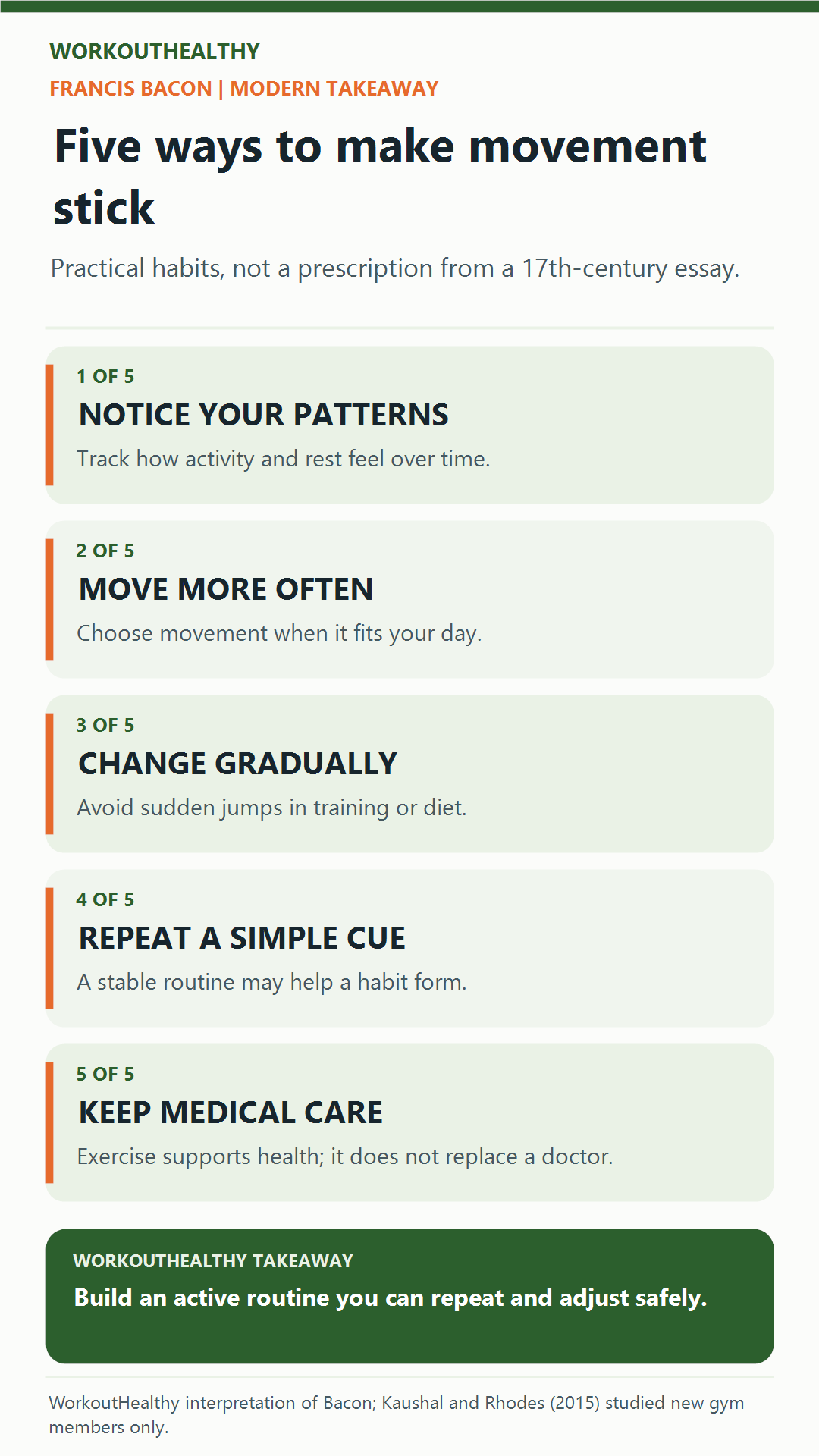
- Observe yourself. Notice which habits leave you feeling better or worse.
- Lean toward movement. When choosing between sitting and moving, pick moving.
- Change gradually. Avoid sudden, drastic shifts in how you eat or train.
- Repeat often. Aim for several short sessions a week to build a habit.
- Keep it simple. Easy routines are easier to repeat.
- Keep seeing your doctor. Exercise supports health, but it does not replace checkups.
Walking is one of the easiest ways to start.
Our article on walking and the gut microbiome looks at one more reason to do it.
If you sit a lot, try these three simple positions that undo a day of sitting.
Who Should Be Careful
People with heart disease, diabetes, or other chronic conditions should get medical advice before starting a new exercise plan.
If you are recovering from an illness, follow Bacon’s own rule and focus on getting well first.
Return to activity slowly, and stop if you feel chest pain, dizziness, or unusual breathlessness.
The Bottom Line
Francis Bacon’s essay “Of Regiment of Health” did favor exercise over sitting and action in times of health.
He also stressed self observation and avoiding sudden changes.
Modern research supports regular activity as prevention and shows that habits form through repetition.
Move regularly while you are well, change things gradually, and keep your doctor in the loop.
Want more stories like this? Subscribe to WorkoutHealthy Insider for practical explanations behind popular fitness claims.
References
- Bacon, F. (1625). Of regiment of health. In Essays. https://classic-literature.co.uk/essay-of-regiment-of-health/
- Kaushal, N., & Rhodes, R. E. (2015). Exercise habit formation in new gym members: A longitudinal study. Journal of Behavioral Medicine, 38(4), 652 to 663. https://doi.org/10.1007/s10865-015-9640-7
- Warburton, D. E. R., Charlesworth, S., Ivey, A., Nettlefold, L., & Bredin, S. S. D. (2010). A systematic review of the evidence for Canada’s Physical Activity Guidelines for Adults. International Journal of Behavioral Nutrition and Physical Activity, 7, 39. https://doi.org/10.1186/1479-5868-7-39
- Wikipedia contributors. (n.d.). Francis Bacon. In Wikipedia. Retrieved September 16, 2026, from https://en.wikipedia.org/wiki/Francis_Bacon
This article is for general information only and is not medical advice. If you have an injury, ongoing pain, or a medical condition, talk to a doctor or physical therapist before you change how you train or eat.