
A YouTube video is making a bold promise.
Its title asks a striking question: does exercise kill cancer cells?
The guest is Professor Robert Newton, a real exercise scientist at Edith Cowan University in Australia.
He has spent decades studying how exercise affects people with cancer.
That background gives the video real credibility.
But headlines built around a question mark still need a careful answer.
This article looks at what Newton’s actual published research shows, and where the video’s framing gets ahead of the science.
What the Video Claims
The video comes from the Medical Centric Podcast.
Its title is “Exercise Kills Cancer Cells? World’s Top Exercise Oncologist Reveals the Science.”
The framing suggests exercise can directly destroy tumor cells inside a person’s body.
That is a dramatic claim, even with a real researcher attached to it.
Professor Newton is a genuine authority in exercise oncology, the study of exercise in cancer care.
He has co-authored dozens of peer reviewed studies on exercise and cancer, many focused on prostate cancer.
The nuance that gets lost in a punchy video title is where his research actually sits.
It is not about exercise curing cancer or replacing treatment.
It is about how exercise changes the body in ways that may support cancer treatment and recovery.
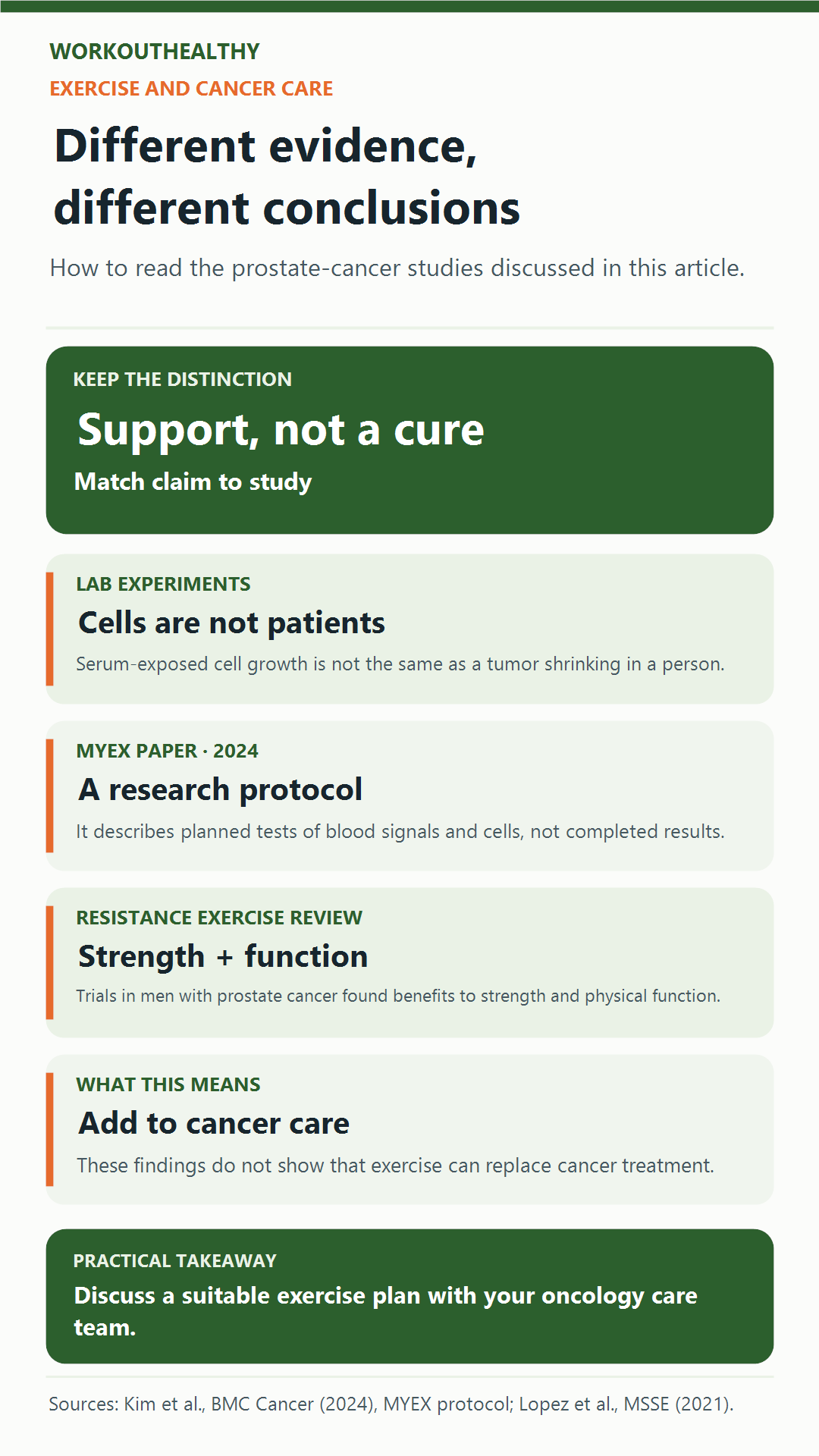
Some of that research does involve exercise slowing cancer cell growth in a lab dish.
That is genuinely interesting science.
It is also a long way from proof that a workout kills a tumor inside a treated patient.
What Real Research Shows About Exercise and Cancer Cell Biology
Newton and colleagues published a major review on this exact topic in 2021.
It appeared in the journal Nature Reviews Urology (Kim et al., 2021).
The review focused on myokines, which are proteins muscle releases during exercise.
The authors identified several specific myokines of interest, including IL-6, IL-15, irisin, and SPARC.
In laboratory studies, these myokines have shown the ability to slow cancer cell growth.
Some appeared to trigger cancer cell death or stop cells from dividing.
That sounds close to the video’s “exercise kills cancer cells” framing.
The key detail is how that evidence was collected.
Much of it comes from applying blood serum, drawn after exercise, directly onto cancer cells growing in a lab dish.
Much of the evidence for exercise slowing cancer cell growth comes from lab dish experiments, not from tumors inside a living, treated patient.
That is a real and useful line of research.
It is not the same as watching exercise shrink a tumor inside a real patient’s body.
The review’s authors were direct about this gap themselves.
They noted that while exercise clearly improves outcomes for cancer patients clinically, the exact biology behind that improvement is still being worked out.
Myokines are one leading explanation researchers are actively testing.
What Real Research Shows About Exercise During Cancer Treatment
A second line of Newton’s research looks at exercise dosage for men with prostate cancer.
A 2021 systematic review and meta-analysis pooled data from multiple resistance training trials (Lopez et al., 2021).
It focused on men with prostate cancer, many undergoing hormone therapy.
Hormone therapy for prostate cancer often causes muscle and strength loss as a side effect.
The review looked at how different amounts of resistance exercise affected those outcomes.
This is the strongest kind of evidence in exercise oncology right now.
It comes from real clinical trials in real cancer patients, not lab dishes.
The findings support structured resistance training as a way to protect strength and function during treatment.
Newton’s team has designed newer patient research to test the myokine idea more directly.
A 2024 BMC Cancer paper describes the MYEX trial protocol, not completed findings (Kim et al., 2024). It proposes recruiting 32 men with prostate cancer: 16 under active surveillance for localized disease and 16 with metastatic castration-resistant disease. The planned comparison involves acute aerobic and resistance exercise sessions and blood samples taken before and after exercise.
This design could help test changes in circulating myokines and the effects of post-exercise serum on cells. The protocol alone reports no new participant results, tumor shrinkage, or survival benefit.
Readers curious about how research separates a real training effect from marketing hype might also want our breakdown of what the evidence actually shows about lifting weights and brain health, a similar case of a promising mechanism outrunning direct human proof.
The Mechanism: How Exercise Might Influence Cancer Biology
Researchers describe a few different pathways connecting exercise to cancer biology.
The first is direct: certain myokines appear able to slow cancer cell division in lab settings.
The second pathway runs through the immune system.
A 2024 review in Sports Medicine International Open focused on this immune connection (Gunasekara et al., 2024).
It described how exercise can mobilize natural killer cells and cytotoxic T cells.
Those are immune cells whose job includes finding and destroying abnormal cells, including cancer cells.
Exercise appears to help move more of these immune cells into circulation and, potentially, into tumor tissue.
A third pathway is more indirect.
Exercise reduces insulin resistance and excess body fat over time.
Both insulin resistance and excess fat tissue are linked to conditions that can favor tumor growth.
By improving those underlying factors, exercise may make the body a less favorable environment for some cancers, even without directly attacking a tumor.
None of these three pathways are mutually exclusive.
Researchers suspect exercise likely works through a combination of all of them at once.
Untangling exactly how much each pathway contributes in humans is still ongoing work.
What This Evidence Does Not Prove
This is the part the video’s title skips over.
A 2024 narrative review of myokines and the tumor microenvironment identified promising links but emphasized that no clear causal connection has been established across the complex pathways reviewed (Gunasekara et al., 2024).
That is not proof that exercise destroys tumors inside living cancer patients.
Lab dish results and blood marker changes are real findings.
They are not the same as clinical proof that exercise shrinks tumors in humans.
Nothing in this research supports using exercise instead of surgery, chemotherapy, radiation, or other prescribed cancer treatment.
Exercise is studied as a partner to cancer treatment, never as a proven replacement for it.
The strongest human evidence covers different outcomes than tumor destruction.
It covers strength, fatigue, treatment tolerance, and quality of life during and after treatment.
Those outcomes matter enormously to real patients.
They are just different from the literal claim in the video’s title.
Skipping this distinction is where a lot of well meaning health content goes wrong.
Common Mistakes People Make With This Research
The biggest mistake is treating a hopeful mechanism as a finished cure.
Cell culture findings are an early step in research, not a final answer.
Many findings that look promising in a lab dish never end up mattering much in real patients.
Another mistake is assuming more exercise is always better.
Cancer treatment already places real stress on the body.
Overtraining during chemotherapy or radiation can worsen fatigue instead of helping.
People also sometimes delay or skip recommended treatment because a video made exercise sound like an alternative.
That is a serious and avoidable mistake, since no research supports that substitution.
A final common mistake is picking one dramatic headline and ignoring the dosage and safety details underneath it.
Our look at daily steps and mortality shows a similar pattern, where a simple headline number hides a lot of nuance about who the research actually applies to.
Who Should Be Extra Careful
Anyone currently in cancer treatment should talk to their oncology team before starting a new exercise program.
This includes people undergoing chemotherapy, radiation, hormone therapy, or recovering from cancer surgery.
Blood counts, fatigue levels, and treatment side effects can change week to week during active treatment.
An oncology team, and ideally a certified exercise oncology specialist, can adjust intensity safely around those changes.
People with cancer that has spread to bone need particular caution around impact and loading.
Bone metastases can raise fracture risk with the wrong kind of exercise.
People with a past cancer diagnosis, even years in remission, should still mention it when starting a new program.
Anyone dealing with low blood counts, a weakened immune system, or a recent surgery needs individualized guidance, not a generic video routine.
Recovery after major medical treatment is rarely one size fits all.
Our piece on Misty Copeland’s hip replacement recovery shows how closely a real recovery plan gets tailored to one person’s medical situation, which is exactly the model cancer patients should expect too.
A Practical Takeaway
The honest summary is more modest than the video’s title, and still genuinely encouraging.
Exercise is not a proven way to kill cancer cells inside a treated human patient.
It is a well supported way to help the body handle cancer treatment better.
For most people cleared by their care team, that means a mix of resistance training and regular walking or other light aerobic activity.
Our guide to how many miles you should walk a day offers a reasonable starting point for the aerobic side of that mix.
Structured resistance exercise has improved strength and function in prostate-cancer trials, but the right frequency, load, and supervision depend on treatment, symptoms, and medical clearance. The cited meta-analysis did not establish one universal schedule for all people with cancer.
Start light, especially during active treatment, and let a doctor or exercise oncology specialist guide any increase in intensity.

The goal is supporting your body through treatment, not chasing a headline about killing cells.
Watch the video
Want more like this? Subscribe to WorkoutHealthy Insider for practical explanations behind popular fitness claims.
References
Gunasekara, N., Clauss, D., & Bloch, W. (2024). Effects of exercise-induced changes in myokine expression on the tumor microenvironment. Sports Medicine International Open, 8, Article a22831663. https://doi.org/10.1055/a-2283-1663
Kim, J. S., Galvão, D. A., Newton, R. U., Gray, E., & Taaffe, D. R. (2021). Exercise-induced myokines and their effect on prostate cancer. Nature Reviews Urology, 18(9), 519 to 542. https://doi.org/10.1038/s41585-021-00476-y
Kim, J. S., Taaffe, D. R., Galvão, D. A., Clay, T. D., Redfern, A. D., Gray, E. S., & Newton, R. U. (2024). Enhancing circulatory myokines and extracellular vesicle uptake with targeted exercise in patients with prostate cancer. BMC Cancer, 24(1), Article 784. https://doi.org/10.1186/s12885-024-12530-0
Lopez, P., Taaffe, D. R., Newton, R. U., & Galvão, D. A. (2021). Resistance exercise dosage in men with prostate cancer: Systematic review, meta-analysis, and meta-regression. Medicine & Science in Sports & Exercise, 53(3), 459 to 469. https://doi.org/10.1249/MSS.0000000000002503
This article is for general information only and is not medical advice. If you have an injury, ongoing pain, or a medical condition, talk to a doctor or physical therapist before you change how you train or eat.