
Prostate cancer is one of the most common cancers doctors diagnose in men.
A Cleveland Clinic video on YouTube explains why strength training can be safe during treatment.
The video is a good starting point for patients and caregivers.
But what does the actual peer-reviewed research say about lifting weights during prostate cancer treatment?
We looked at the exercise oncology studies to find out.
About one in eight men will be diagnosed with prostate cancer at some point in their life.
Many of those men spend months or years on treatments that affect strength and energy.
That makes the exercise question genuinely important, not just a lifestyle preference.
What Cleveland Clinic’s Video Recommends
The video comes from Cleveland Clinic, a respected academic medical center.
It frames strength training as a tool to fight treatment-related fatigue.
It also points out that many men can safely exercise during care.
Because Cleveland Clinic is a legitimate medical institution, we can treat its general framing as credible.
Still, general credibility is not the same as a specific, verified statistic.
So we went looking for real studies on strength training and prostate cancer.
The video does not claim that exercise replaces medical treatment.
It frames movement as something that happens alongside surgery, radiation, or hormone therapy.
That framing matches how exercise oncology researchers describe their own work.
What the Research Actually Shows
The strongest evidence comes from randomized controlled trials in men on androgen deprivation therapy.
Androgen deprivation therapy, or ADT, lowers testosterone to slow prostate cancer growth.
It is also known to cause muscle loss, fatigue, and weight gain.
Doctors sometimes call this pattern sarcopenia, or age-related muscle loss sped up by treatment.
Researchers wanted to know if lifting weights could slow that pattern down.
One early trial randomly assigned 155 men on ADT to resistance training or usual care.
The exercise group did supervised resistance training twice a week for 12 weeks.
By the end, the exercise group reported significantly less fatigue than the control group.
They also had better muscular fitness and better quality of life scores.
That trial ran in the Journal of Clinical Oncology in 2003 (Segal et al.).
This was one of the first randomized trials to test strength training specifically during ADT.
A randomized trial is considered strong evidence because it compares similar groups by chance, not by choice.
A later trial tested exercise started right when ADT begins, not months in.
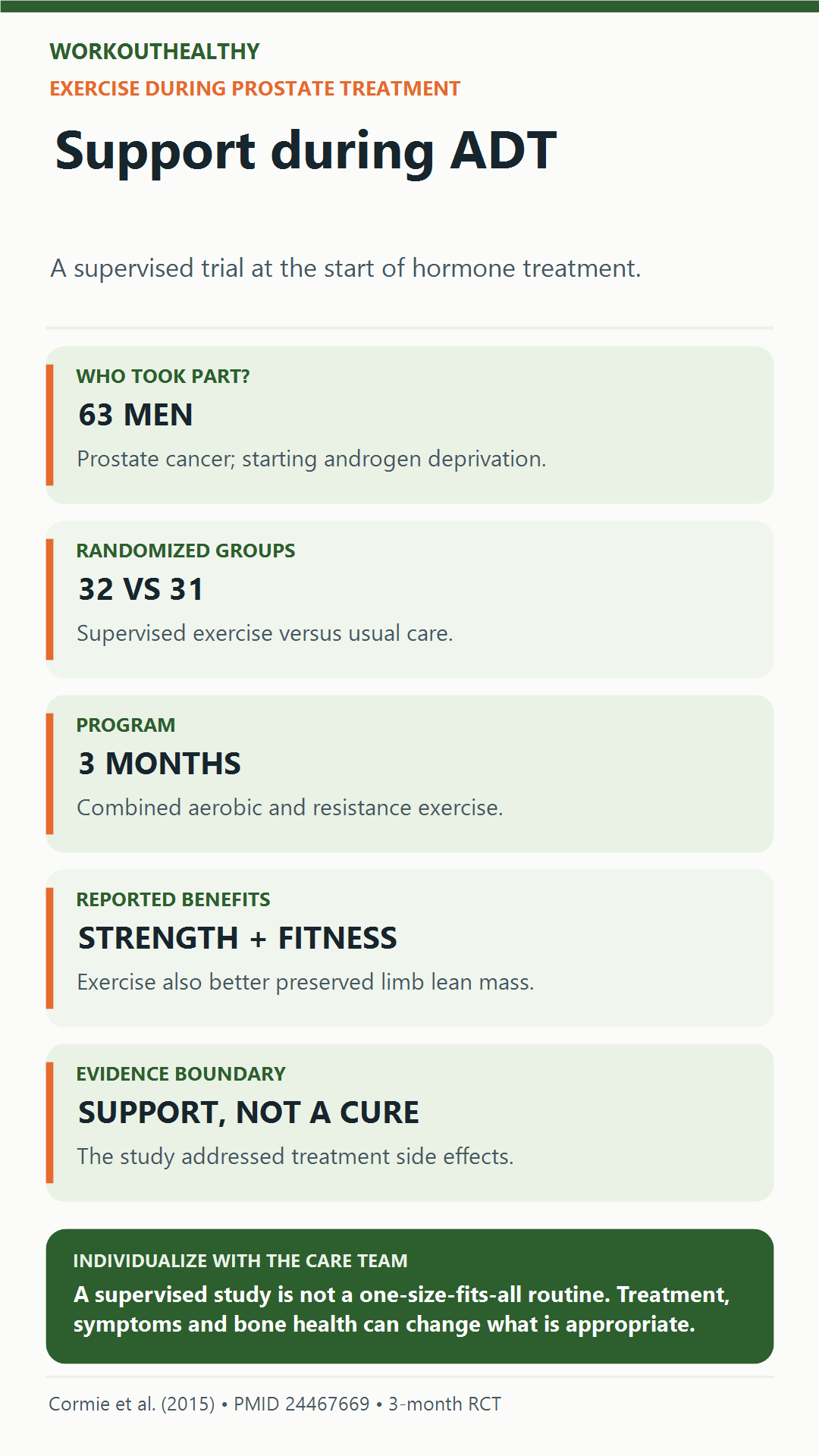
Sixty-three men were split between a 3-month supervised exercise program and standard care.
The exercise group combined aerobic and resistance training under supervision.
Those men kept more lean muscle mass and gained less body fat.
They also improved their cardiovascular fitness, strength, and cholesterol ratios.
Fatigue and psychological distress scores improved too, compared to the group that did not exercise.
This trial ran in BJU International in 2015 (Cormie et al.).
Starting exercise early, right as ADT begins, appeared to prevent problems rather than just treat them.
That prevention angle differs from waiting until fatigue or weight gain has already set in.
A third trial followed men on ADT for a full year, not just a few months.
It compared resistance training, aerobic training, and a combined program.
Programs built around resistance training reduced fatigue more than aerobic exercise alone.
That lines up with a pattern we have seen elsewhere, where more readers favor weightlifting over running for overall results.
This trial ran in European Urology in 2017 (Taaffe et al.).
The year-long timeframe matters, since many ADT regimens last well beyond a few months.
A benefit that holds up for a year is more convincing than one seen after a few weeks.
Across multiple randomized trials, resistance training reduced fatigue more reliably than aerobic exercise alone in men on hormone therapy for prostate cancer.
Why Strength Training Helps: The Mechanism
ADT works by cutting testosterone to very low levels.
Testosterone normally helps maintain muscle mass and bone density.
Low testosterone also tends to worsen insulin sensitivity over time.
That can raise blood sugar and add to cardiovascular strain.
When testosterone drops, muscle breaks down faster than the body rebuilds it.
Fat tissue also tends to increase, especially around the belly.
This shift resembles what can happen when someone loses weight without preserving muscle mass.
Resistance training directly opposes that pattern.
Lifting weight signals the body to build and preserve muscle tissue.
It also places mechanical stress on bone, which may help support bone strength.
Bone responds to load, which is part of why weight-bearing exercise is often recommended broadly.
Stronger muscles support better balance, which matters for fall risk.
ADT is also linked to higher cardiovascular risk over time.
Regular exercise is one of the few tools known to support heart health broadly.
Some clinicians now treat exercise as a standard part of care for heart health during cancer treatment, though practices vary by clinic.
Resistance training may also support mental health during a stressful diagnosis.
In the Cormie trial above, the exercise group had lower psychological distress scores.
That tracks with other research on how lifting weights affects the brain and mood.
What This Research Does Not Prove
None of these trials prove that exercise treats or cures prostate cancer.
They measure fatigue, strength, body composition, and quality of life, not survival.
A 2016 meta-analysis pooled dozens of exercise trials across prostate cancer stages.
It found consistent benefits for quality of life, fatigue, and physical function.
It also found real gaps in the evidence.
Most trial participants had early stage or localized disease.
Men with advanced or metastatic prostate cancer were studied far less.
Trial participants also tended to be relatively healthy going into the study.
Men with several other health conditions at once were often excluded from these trials.
That meta-analysis ran in European Urology in 2016 (Bourke et al.).
Most trials also used supervised programs with trained staff present.
It is not clear that unsupervised, at-home exercise produces the same results.
Study programs were also relatively short, often 12 weeks to a year.
Long-term outcomes beyond a year are less well documented.
Exercise programs across studies also varied in intensity, frequency, and supervision level.
That variation makes it hard to say exactly how much exercise is enough.
None of this means exercise is not worthwhile.
It means the evidence supports exercise as a support tool, not a treatment substitute.
Who Should Check With Their Care Team First
This is the most important section of this article.
Every man in these trials started exercise under medical clearance and supervision.
Anyone with prostate cancer should talk to their oncologist before starting a new program.
Men with bone metastases need special caution around impact and loading.
A doctor can determine which exercises are safe given where the cancer has spread.
Men recovering from recent prostate surgery need clearance before lifting anything heavy.
Men with heart conditions should be screened before starting vigorous exercise.
Men receiving radiation therapy should ask how treatment affects their energy and skin.
Men on chemotherapy may need blood counts checked before intense training.
Low blood counts can raise the risk of infection or bleeding during exercise.
Anyone with new or worsening bone pain should report it before continuing to train.
Fatigue during cancer treatment can also have causes beyond deconditioning, like anemia.
A doctor can rule out those other causes first.
Age, other medical conditions, and overall fitness level all affect what is safe.
A plan that works for one man on ADT may not fit another.
This article cannot tell any individual what is safe for their specific case.
Only a treating oncologist or physical therapist has that full picture.
Exercise should support treatment, never replace or delay it.
Nothing here suggests skipping or postponing recommended cancer treatment in favor of exercise.
Every participant in these trials started exercising only after medical clearance, which is exactly the model patients should follow before starting on their own.
A Safe, Practical Way to Start
Start with a conversation with your oncology team, not with a workout plan.
Ask specifically whether resistance training is appropriate given your treatment stage.
If cleared, many programs begin with light resistance and close supervision.
A physical therapist or oncology exercise specialist can build a safe starting plan.

Many programs start with lighter weights and higher repetitions before progressing.
A short warm-up before lifting can help reduce injury risk.
Two sessions a week was the pattern used in several of the trials above.
Sessions in these trials typically lasted around 45 to 60 minutes, including warm-up and cool-down.
Common mistakes include jumping straight into heavy weights without any supervision.
Another common mistake is skipping medical clearance because exercise feels harmless.
A third mistake is comparing your own pace to someone else’s recovery timeline.
Cancer treatment affects everyone differently, so timelines vary widely.
Pain that changes location or intensity during exercise deserves a call to your doctor.
Walking is often a reasonable complement to strength work, if your care team agrees.
Our guide on how many miles to walk a day covers general walking guidance for comparison.
That walking guidance is not written for cancer patients specifically, so check with your doctor first.
The bigger point from the research is consistency, not intensity.
Steady, supervised training over months produced the benefits seen in these trials.
Short bursts of intense, unsupervised effort were not what researchers tested.
Tracking basic details, like weights used and how you felt afterward, can help your care team adjust the plan.
Progress should be judged by your care team, not by how sore you feel.
Watch the Original Video
Want more like this? Subscribe to WorkoutHealthy Insider for practical explanations behind popular fitness claims.
References
Segal, R. J., Reid, R. D., Courneya, K. S., Malone, S. C., Parliament, M. B., Scott, C. G., Venner, P. M., Quinney, H. A., Jones, L. W., D’Angelo, M. E., & Wells, G. A. (2003). Resistance exercise in men receiving androgen deprivation therapy for prostate cancer. Journal of Clinical Oncology, 21(9), 1653 to 1659. https://doi.org/10.1200/JCO.2003.09.534
Cormie, P., Galvão, D. A., Spry, N., Joseph, D., Chee, R., Taaffe, D. R., Chambers, S. K., & Newton, R. U. (2015). Can supervised exercise prevent treatment toxicity in patients with prostate cancer initiating androgen-deprivation therapy: A randomised controlled trial. BJU International, 115(2), 256 to 266. https://doi.org/10.1111/bju.12646
Taaffe, D. R., Newton, R. U., Spry, N., Joseph, D., Chambers, S. K., Gardiner, R. A., Wall, B. A., Cormie, P., Bolam, K. A., & Galvão, D. A. (2017). Effects of different exercise modalities on fatigue in prostate cancer patients undergoing androgen deprivation therapy: A year-long randomised controlled trial. European Urology, 72(2), 293 to 299. https://doi.org/10.1016/j.eururo.2017.02.019
Bourke, L., Smith, D., Steed, L., Hooper, R., Carter, A., Catto, J., Albertsen, P. C., Tombal, B., Payne, H. A., & Rosario, D. J. (2016). Exercise for men with prostate cancer: A systematic review and meta-analysis. European Urology, 69(4), 693 to 703. https://doi.org/10.1016/j.eururo.2015.10.047
This article is for general information only and is not medical advice. If you have an injury, ongoing pain, or a medical condition, talk to a doctor or physical therapist before you change how you train or eat.