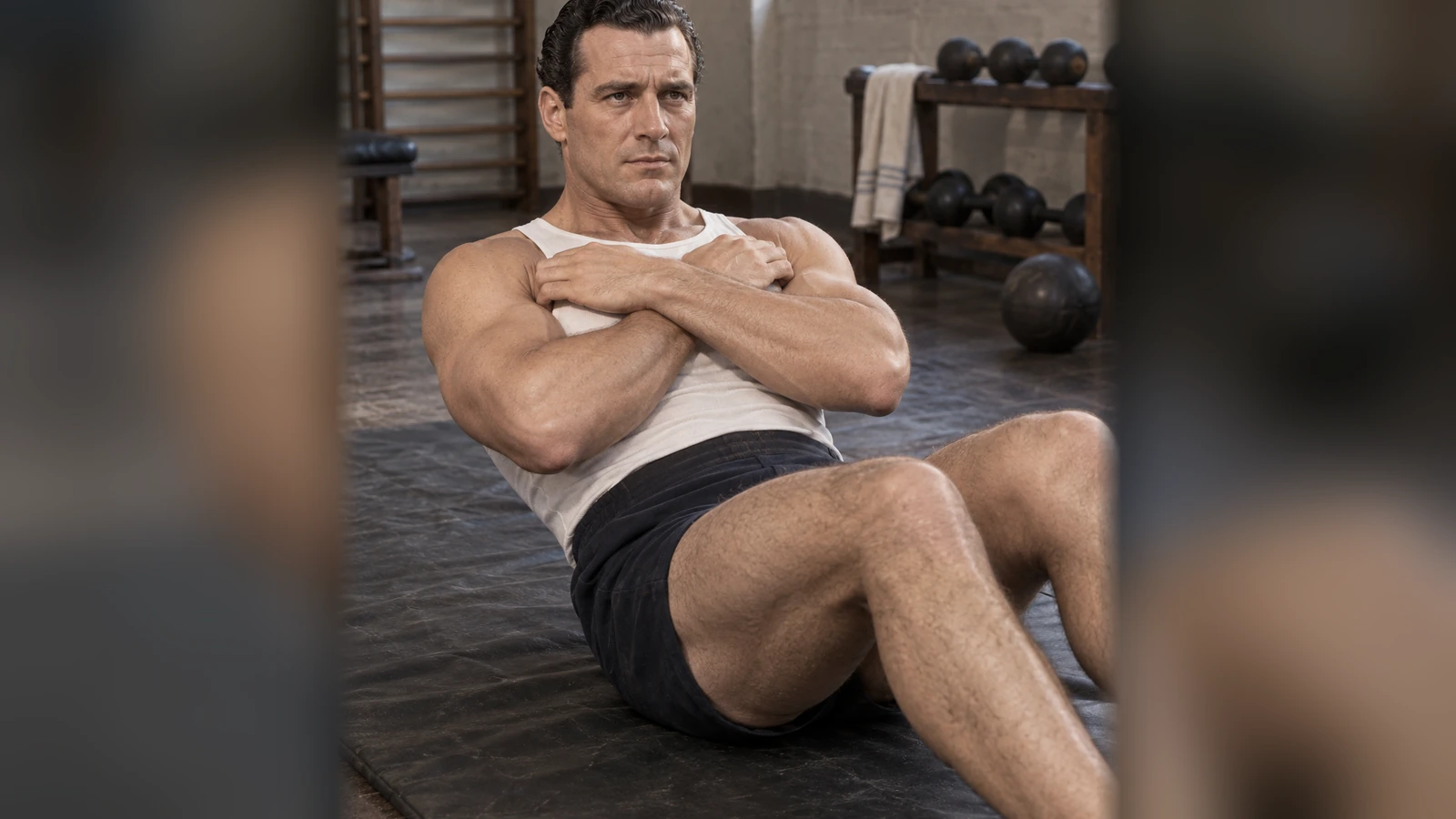

The featured image is an editorial illustration, not a verified archival photograph of Charles Atlas or a demonstration of his course.
A familiar fitness quotation can raise two different questions: where it came from, and whether modern evidence supports the training claims attached to it.
Here, separating those questions changes an often-repeated date and source.
Did Atlas Really Say It?
Smithsonian’s 2009 profile reproduces an abdominal-conditioning statement from an Atlas lesson. It does not date that lesson or identify it as a Family Circle interview.
The profile separately quotes a chest-expansion comment from a 1939 interview. Adjoining quotations should not be treated as one dated statement.
Who Charles Atlas Was
Atlas marketed Dynamic Tension, a home exercise course using one muscle against another.
What the Midsection Does
The muscles of the trunk help transfer force between your legs and arms.
When you press, carry, or throw, your midsection has to stay steady so that force is not lost.
For a practical ranking of exercises, see which core exercise two physical therapists ranked first.
What the Research Says About Core Training and Performance
The research is more modest than gym lore.
A 2012 systematic review by Reed and colleagues looked at 24 studies on core stability training and athletic performance.
The authors defined core stability training as work aimed at improving trunk and hip control.
They found targeted core stability training gave only marginal benefits to athletic performance.
Most studies mixed core work into bigger training programs, which made its own effect hard to separate.
Those mixed studies do not establish that isolated core work reliably improves every sporting task.
What the Research Says About Back Pain
A 2014 review by Smith, Littlewood, and May examined stabilisation exercise for adults with non-specific low back pain.
Across 29 studies, it assessed pain and disability. Long term meant at least 12 months.
Compared with any alternative control, long-term advantages were below the authors’ threshold for clinical importance.
Compared with other active exercise, long-term estimates did not establish a clear advantage. That does not prove identical effects for every patient or exercise.
This is evidence about pain and disability, not sports performance or a test of Atlas’s course.
What This Means for Your Training
Squats, deadlifts, carries, and overhead presses all make your trunk work hard to stay stable.
Direct ab work is still worth doing, but it does not need to be fancy.
Think of it as a supporting role.
How to Train Your Midsection Today
These are general exercise categories, not a reconstruction of Atlas’s course or a tested program.
- Brace during big lifts. Take a breath and tighten your midsection before each heavy rep.
- Add carries. Walking with heavy dumbbells or kettlebells trains the trunk to resist bending.
- Use planks and side planks. Hold good positions for short sets rather than chasing long times.
- Include some flexion. Crunches or hanging knee raises can train the front of the abs directly.
For a harder bodyweight challenge that loads the trunk, see our guide to planche lean form.
Common Mistakes
- Chasing a washboard with sit ups alone. Visible abs depend mostly on body fat, not just ab exercises.
- Ignoring the rest of the body. A strong trunk supports strong limbs. It does not replace them.
- Holding the breath too long. Brief bracing is useful, but long breath holds can spike blood pressure.
Who Should Be Careful
People with a recent back injury, hernia, or abdominal surgery should get guidance before loading the midsection.
Pregnant and postpartum people may need modified ab exercises from a qualified clinician.
Anyone whose back pain spreads down a leg or comes with numbness should see a doctor first.
If exercise makes back pain worse, NHS advice is to stop and seek medical advice. A different core drill is not automatically suitable.
Progress comes from steady practice, not from forcing through discomfort.
The Bottom Line
The abdominal passage comes from a lesson quoted by Smithsonian, whose profile does not supply its date.
The performance and back-pain reviews answer different questions; neither tests Atlas’s course.
Want more stories like this? Subscribe to WorkoutHealthy Insider for practical explanations behind popular fitness claims.
References
- Black, J. (2009). Charles Atlas: Muscle Man. Smithsonian.
- Reed et al. (2012). Core stability training and athletic performance: systematic review.
- Smith et al. (2014). Stabilisation exercises for low back pain: systematic review and meta-analysis.
This article is for general information only and is not medical advice. If you have an injury, ongoing pain, or a medical condition, talk to a doctor or physical therapist before you change how you train or eat.