
Some lifts make an entire competition floor go quiet.
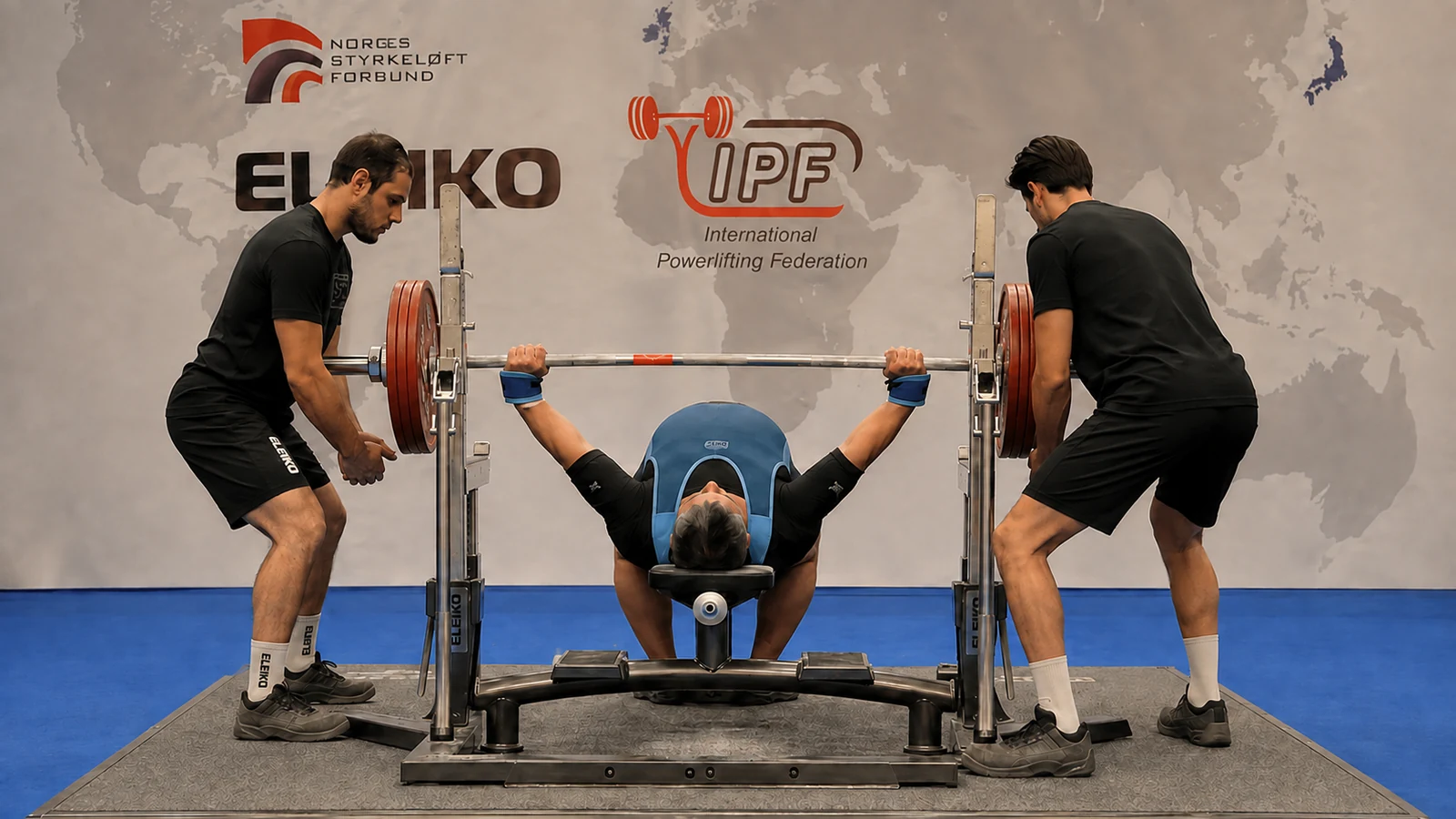
That is what happened when Askar Shokhanov unracked 340 kilograms for an equipped bench press attempt at the 2025 IPF World Classic and Equipped Bench Press Championships.
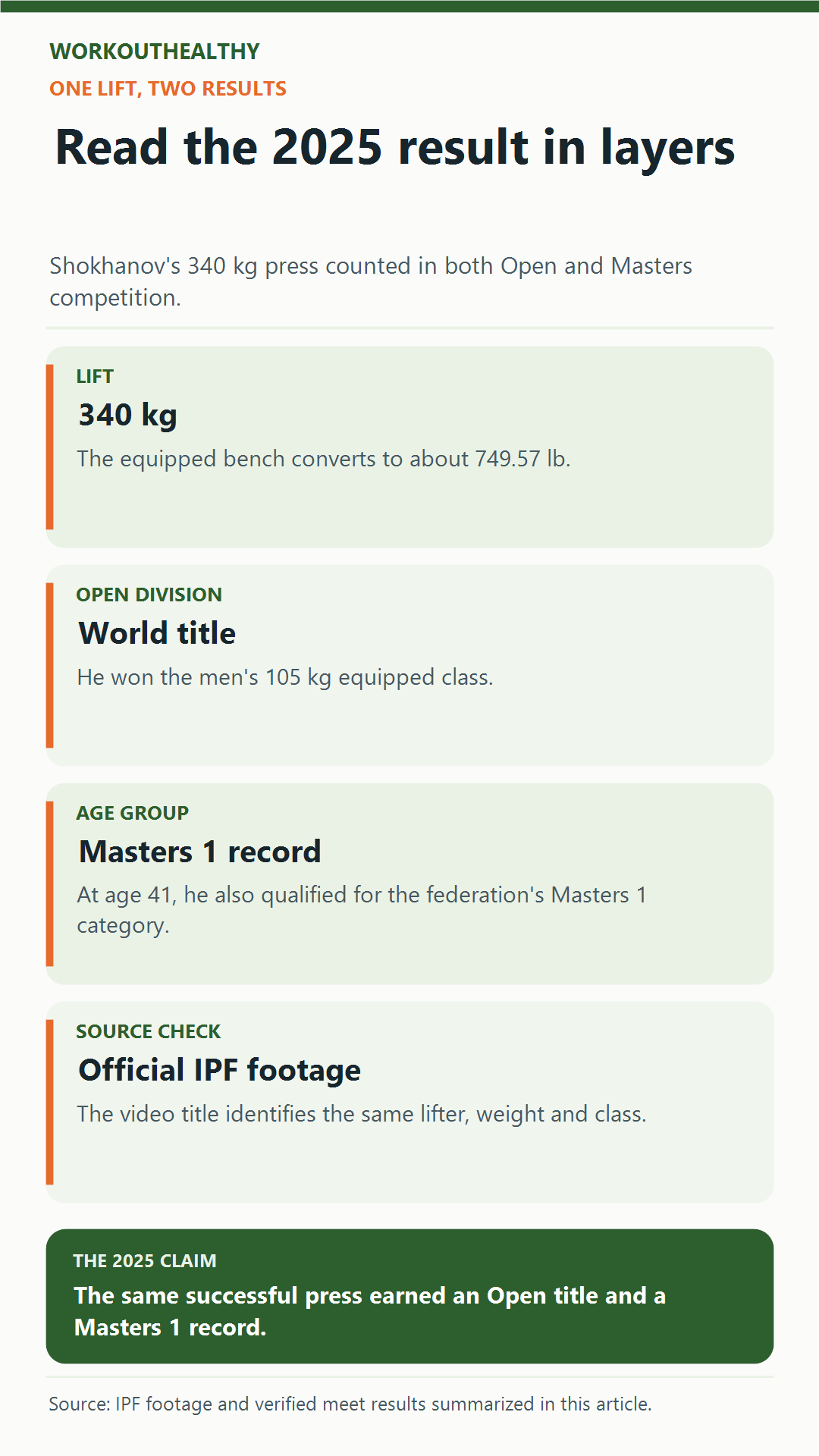
The Kazakhstani lifter locked the bar out clean in the men’s 105-kilogram weight class, a lift that converts to roughly 749.57 pounds.
He walked away with the world title in his class.
Competition records back the number up, and the story behind it is more interesting than the number itself.
This article checks the claim against the sport’s own results database, explains what “equipped” bench pressing actually means for anyone who has only ever benched raw, and looks at what the research says about the mechanics behind a lift this size.
What Actually Happened at the 2025 IPF Worlds
Askar Shokhanov competed at the IPF World Classic and Equipped Bench Press Championships on May 18, 2025.
He entered the Open men’s 105-kilogram equipped class and pressed 340 kg for first place.
That result is logged in OpenPowerlifting.org’s public results database, which archives official meet data submitted by IPF and dozens of other national and international federations, and it lines up exactly with the claim: 340 kg, 105-kg class, equipped, first place, May 2025.
OpenPowerlifting is not the governing body itself.
It is an independent, third-party archive that anyone can audit, which is exactly why it is useful here as a cross-check rather than a rehash of the original claim.
The IPF is the sport’s global governing body, and it is the organization that actually sanctioned this meet and ran the drug testing, judging panel, and weigh-ins that make the result official.
Shokhanov is not a one-meet wonder at this weight.
The same database shows he also finished second at the 2024 IPF Worlds and won Asian equipped bench titles in both 2024 and 2025, so this lift sits inside a long, consistent competition history rather than appearing out of nowhere.
There is also a more recent update worth disclosing.
The same results database shows Shokhanov returned to the 2026 IPF Worlds and pressed 356.5 kg in the same 105-kg equipped class, again winning first place.
The 340-kg lift covered in this article was a genuine, verified world title in its own right.
It simply turned out to be a stepping stone rather than a ceiling, which is worth knowing if you go looking for his current numbers.
What “Equipped” Actually Means
If you have only ever trained bench press with a barbell, a bench, and maybe wrist wraps, “equipped” bench press can sound like a different sport entirely, and in some ways it is.
Equipped lifting uses a supportive bench shirt, a snug, multi-layered garment made of tightly woven polyester or denim that fits across the chest, shoulders, and triceps.
The shirt does not add strength. It stores elastic energy.
As the lifter lowers the bar, the shirt’s fabric stretches tight across the compressed range near the chest, and that stored tension helps drive the bar back up through the hardest part of the lift, the first few inches off the chest.
The lifter still has to control the descent, find the right touch point, and finish the lockout with real triceps and shoulder strength, so a shirt does not turn an untrained lifter into a world champion.
What it does is shift where the effort is hardest, taking some of the load off the bottom of the range and putting more of the burden on timing, bar path, and lockout strength.
The mechanics of a standard bench press already reward a tight setup and a controlled bar path, and equipped lifting raises the stakes on both.
Today’s IPF equipped division uses single-ply gear, meaning a single layer of supportive fabric.
That is a step down from the multi-ply, multiple stacked layers of fabric, that some older powerlifting federations still allow, and it means IPF equipped numbers are already more conservative than what multi-ply federations have historically produced.
Equipped and Raw Are Different Competitions, Not the Same Lift With a Costume
It is tempting to see a 340-kg bench and compare it directly to a raw world record bench press.
That comparison does not really work.
Equipped and raw are separate competitive categories inside powerlifting, each with its own world records, its own governing rules, and its own community of specialists.
A lifter who competes only raw, with nothing but a shirt and maybe wrist wraps, is training and peaking for a completely different bar feel than a lifter who has spent years learning to load and time a bench shirt.
Some of the biggest raw bench numbers on record come from lifters who never touch equipped competition at all, and some of the biggest equipped totals come from lifters who rarely bench heavy without a shirt.
Treating a 749.57-pound equipped press as directly equivalent to a similar raw number misreads both lifts.
The honest way to read Shokhanov’s total is as the best equipped bench in his weight class on that day, judged against other equipped lifters, not as a raw strength claim.
The Numbers, In Both Units
Metric and imperial units can make the same lift look like two different stories, so it helps to line them up.
340 kilograms converts to 749.57 pounds, which is where the “749 pounds” framing comes from.
The weight class itself, 105 kilograms, converts to roughly 231.49 pounds of bodyweight, meaning Shokhanov pressed well over three times his own bodyweight in competition.
For context, that ratio alone puts the lift in rarefied territory even before accounting for the added demand of managing a bench shirt’s timing.
A bench shirt changes where a lift gets hard. It does not erase the need for technique, bracing, or years of practice.
A Masters Record Hiding Inside the Open Title
There is a detail in this lift that the original Facebook framing left out entirely.
Shokhanov was 41 years old at the time of the meet, according to the same OpenPowerlifting results entry.
That age places him inside IPF’s Masters 1 category, an age-based classification the federation tracks in parallel with the Open division for lifters roughly in their forties.
Checking the video’s own provenance turned this up.
The clip embedded later in this article was uploaded by the International Powerlifting Federation’s own official YouTube channel, and its title identifies the lift specifically as a “World Master 1 Record,” not just an Open division win.
That is a meaningful find, because the workbook entry behind this article flagged the source footage as difficult to confirm through ordinary search.
Matching the video’s title, uploader, and thumbnail against the exact weight, weight class, and date in the competition record removes that uncertainty.
This appears to be genuine footage of this specific lift, published by the sport’s own governing body.
In practical terms, Shokhanov’s 340-kg press did double duty on the same day: an Open world title in the 105-kg equipped class, and a Masters 1 world record for a lifter his age at that bodyweight.
Kazakhstan’s Rising Powerlifting Program
Shokhanov’s results history reads like a case study in a national program building itself over more than a decade.
His competition record on OpenPowerlifting stretches back to 2010, when he placed third at an Asian bench press championship in the 75-kg class as a 26-year-old.
From there, the results show a steady climb: national Kazakhstan Powerlifting Federation titles through the early 2010s, followed by Asian titles, followed by IPF World Championship podiums that started as bronze and silver finishes before turning into gold.
He has now represented Kazakhstan at IPF Worlds in some form nearly every year since 2011, moving up through the 74-kg, 83-kg, 93-kg, and now 105-kg weight classes as his career progressed.
That kind of multi-decade, multi-weight-class consistency does not happen by accident.
It reflects a domestic federation, the KPF, that has kept producing and developing competitive lifters long enough for one of them to reach the very top of an Open World Championship podium.
Kazakhstan is not traditionally one of the sport’s headline powerlifting nations the way the United States, Russia, or the United Kingdom are, which makes a result like this a useful marker of where the sport’s competitive depth is actually spreading.
What the Research Says About Lifts Like This One
Bench press research, whether the lifter is raw or equipped, keeps circling back to the same mechanical bottleneck: the sticking region, the point a few inches off the chest where the bar tends to slow down or stall.
Van den Tillaar and Ettema (2009) compared successful and failed maximal bench press attempts and found that failed lifts consistently broke down in that same sticking region, driven by a loss of bar velocity right as the triceps and shoulders take over from the chest.
A follow-up study by the same researchers (van den Tillaar & Ettema, 2010) confirmed that this sticking period is a real, measurable phase of the lift, not just a subjective feeling lifters describe.
That is exactly the phase a bench shirt is built to assist.
A separate study on the Slingshot, a different supportive bench aid used by some raw-adjacent lifters, found that the device measurably changed bar kinematics and reduced muscle activation in the prime movers during the assisted range (Dugdale et al., 2019).
A traditional multi-layer bench shirt works on a similar principle, though with a much stronger and more technical fit than a Slingshot, which is part of why loading and unloading a competition shirt is its own skill that takes years to learn safely.
None of this research is about Shokhanov specifically.
It is about the mechanics his lift depended on, and it explains why “the shirt does the work” is an oversimplification rather than an accurate description.
What This Evidence Does Not Prove
Verifying a competition result confirms that the lift happened and that it happened the way the record says.
It does not prove anything about how much of the 340 kg came from the shirt versus Shokhanov’s own strength, since equipment carryover varies by lifter, shirt brand, and how tightly the garment is set up on a given day.
It also does not make this number directly comparable to a raw bench record, for the reasons already covered above.
And a single verified result, even a world title, does not tell us Shokhanov’s numbers in other lifts or how his equipped total would translate to squat and deadlift, since this was a bench-press-only championship, not a full powerlifting meet.
Common Mistakes People Make Reading a Number Like This
The most common mistake is treating “equipped” and “raw” as the same category with different outcomes, when they are really two different sports that happen to share a barbell.
A second mistake is assuming a supportive shirt is like a costume that does all the lifting, which the research above does not support.
Loading a shirt wrong, or mistiming the bounce off the chest, can end an attempt just as fast as being under-trained.
A third mistake is skipping past the age detail entirely.
A Masters 1 lifter matching or exceeding numbers from lifters in their twenties and thirties is not a footnote.
It is one of the more striking parts of this specific result.
Finally, it is easy to read one headline number and assume it appeared out of nowhere.
Shokhanov’s fourteen-plus years of documented meets tell a very different story, one built on repetition, not a single lucky day.
What This Means If You Are Chasing Your Own Bench Numbers
Almost nobody reading this will ever put on a competition bench shirt, and that is fine, because the lesson from a lift like this travels well without one.
Bracing, bar path, and a consistent touch point matter at every level of bench pressing, not just at the top.
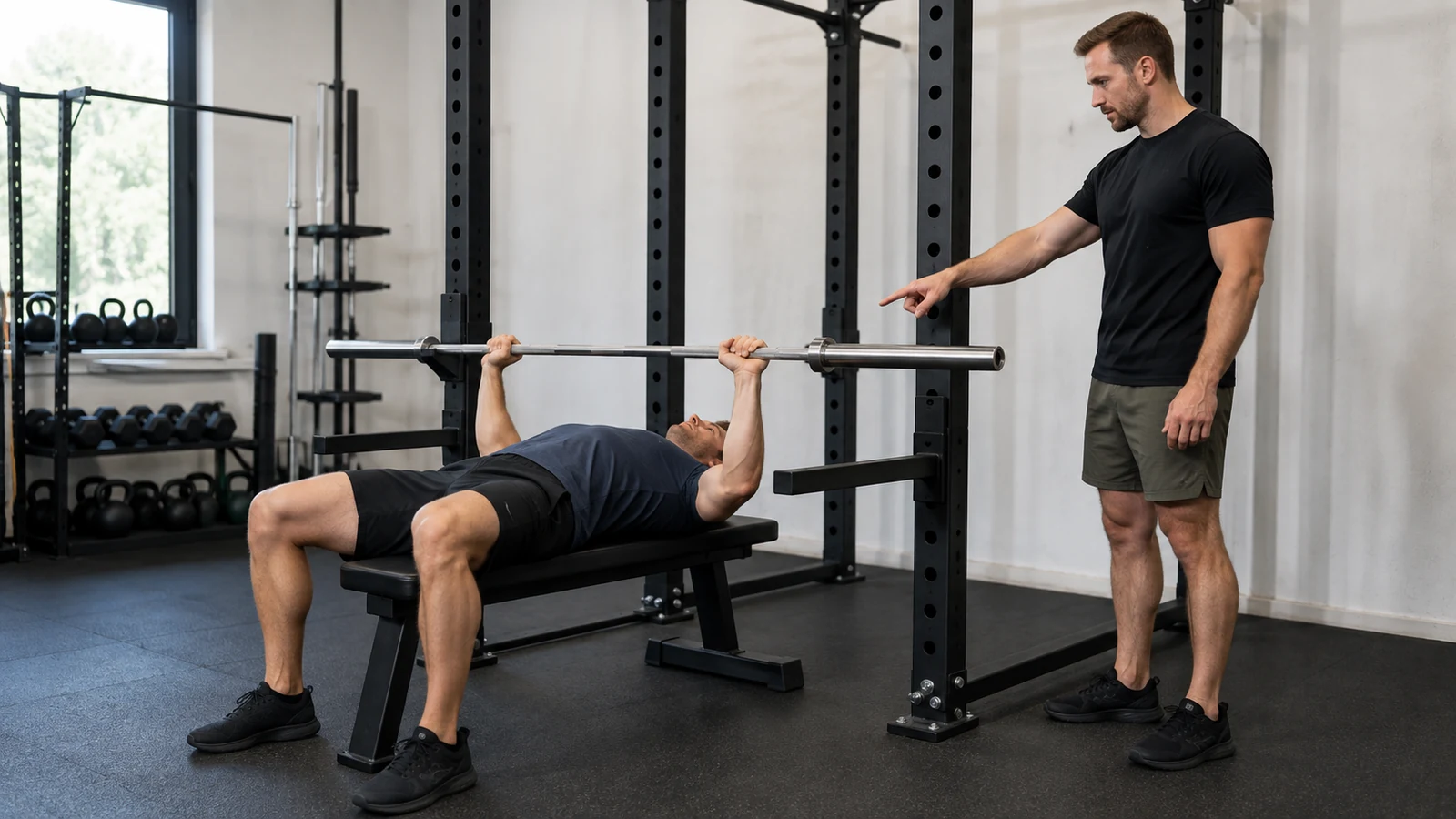
Start by locking your feet flat and driving them into the floor before you unrack the bar, since leg drive contributes real force to a heavy press even without a shirt.
Set your shoulder blades back and down and hold that position through the entire rep, because a shifting upper back changes your bar path and your leverage rep to rep.
Lower the bar to the same spot on your chest every time you train, rather than letting the touch point drift, so your nervous system can actually groove a repeatable pattern.
Pause briefly at the chest on at least some working sets.
It builds control through the exact sticking region the research above keeps identifying as the make-or-break point.
If you are working through a plateau, add close-grip work and controlled eccentrics for triceps and lockout strength, since that is usually the missing piece once your setup is already solid.
Anyone managing a shoulder, elbow, or chest injury should get a physical therapist or doctor to look at their bench technique before adding heavy singles, the same way a competitive equipped lifter works with coaches before pushing a shirt to its limits.
Records like Shokhanov’s do not start with a 340-kg single.
They start with years of ordinary working sets, the same kind anyone can do in a normal commercial gym.
Other verified feats on this site follow the same pattern of patient, repeated effort behind a headline number, from DonnaJean Wilde’s pacing-driven push-up world record to Edith Connor’s Guinness record set well into her seventies.
Age is not automatically a ceiling in strength sports, a point George Foreman’s own late-career comeback made in a very different sport decades earlier.
Watch the Original Video
Want more verified strength feats like this one? Subscribe to WorkoutHealthy Insider for practical explanations behind popular fitness claims.
References
Dugdale, J. H., Hunter, A. M., Di Virgilio, T. G., Macgregor, L. J., & Hamilton, D. L. (2019). Influence of the “Slingshot” bench press training aid on bench press kinematics and neuromuscular activity in competitive powerlifters. Journal of Strength and Conditioning Research, 33(2), 327-336. https://doi.org/10.1519/jsc.0000000000001853
van den Tillaar, R., & Ettema, G. (2009). A comparison of successful and unsuccessful attempts in maximal bench pressing. Medicine & Science in Sports & Exercise, 41(11), 2056-2063. https://doi.org/10.1249/mss.0b013e3181a8c360
van den Tillaar, R., & Ettema, G. (2010). The “sticking period” in a maximum bench press. Journal of Sports Sciences, 28(5), 529-535. https://doi.org/10.1080/02640411003628022
This article is for general information only and is not medical advice. If you have an injury, ongoing pain, or a medical condition, talk to a doctor or physical therapist before you change how you train or eat.