

Adam Woodyatt has played Ian Beale on EastEnders since the show began in 1985.
He is the longest serving cast member in the show’s history, with more than 3,800 episodes to his name.
This year he traded Albert Square for a very different kind of endurance test.
Woodyatt ran the 2025 London Marathon, according to Runner’s World, taking on 26.2 miles of London pavement to raise money for Alzheimer’s Research UK.
The charity funds scientific research into dementia, a condition that slowly affects memory, thinking, and daily life for millions of families.
For an actor best known for playing one character for four decades, lacing up for a marathon is a genuinely different kind of commitment.
Who Is Adam Woodyatt
Woodyatt was born in 1968 and joined EastEnders as a teenager when the soap launched.
He has played Ian Beale through the character’s rise as a local businessman, several marriages, financial collapses, and one of the longest running story arcs in British television.
In 2013 he received the Lifetime Achievement Award at The British Soap Awards for his decades on the show.
He has also taken breaks from Walford over the years, including an extended hiatus that began in January 2021, and has appeared in stage productions outside the soap.
That kind of longevity on a single show has made him one of the most recognized faces in British television, even to viewers who have never followed a single storyline.
It is exactly the kind of name recognition that a charity marathon fundraiser depends on.
Running for Alzheimer’s Research UK
Alzheimer’s Research UK is the country’s leading dementia research charity.
It has committed more than 171 million pounds to research since funding its first project in 1998.
The charity runs an established marathon fundraising program, with runners taking on races including the London Marathon to raise money for its work.
Woodyatt’s run adds his name to a long list of British actors who have used marathon day for something bigger than a finish time.
This is not entirely new territory for him.
Back in 2019, Woodyatt announced plans to run the London Marathon alongside EastEnders co-stars for a dementia campaign honoring former castmate Barbara Windsor, who lived with Alzheimer’s disease before her death in 2020.
A 2025 run for the same cause fits a pattern rather than coming out of nowhere.
Why Dementia Research Needs This Kind of Funding
Dementia is not one single disease.
It is a general term for a decline in memory, thinking, and reasoning severe enough to interfere with daily life, and Alzheimer’s disease is its most common cause.
There is currently no cure for most forms of dementia, and treatment options remain limited compared to other major causes of death and disability.
Research charities like Alzheimer’s Research UK exist to close that gap, funding laboratory studies, clinical trials, and early detection research that governments and drug companies do not always prioritize on their own.
Public fundraising, including marathon runs, makes up a real part of how that research gets paid for.
A single well publicized run cannot fund a cure on its own, but it adds to a funding pool that has already backed more than a hundred million pounds of dementia research since the charity’s founding.
Why Marathon Fundraising Works So Well
Charity marathon running has become one of the most effective ways ordinary people and celebrities alike turn a personal cause into real donations.
A finish line gives supporters something concrete to root for.
A training log gives a cause months of visibility instead of a single day.
For a charity like Alzheimer’s Research UK, a well known face taking on a physical challenge tends to draw attention that a straightforward donation appeal does not.
It also works because finishing a marathon is genuinely hard, especially for someone who did not grow up as a distance runner.
That difficulty is part of what makes the fundraising message land.
What Training for a First Marathon Actually Involves
Most training plans for a first marathon run 16 to 20 weeks.
Long runs build gradually, often peaking around 20 miles a few weeks before race day.
Research on long term runners gives a useful picture of what steady training can do over time.
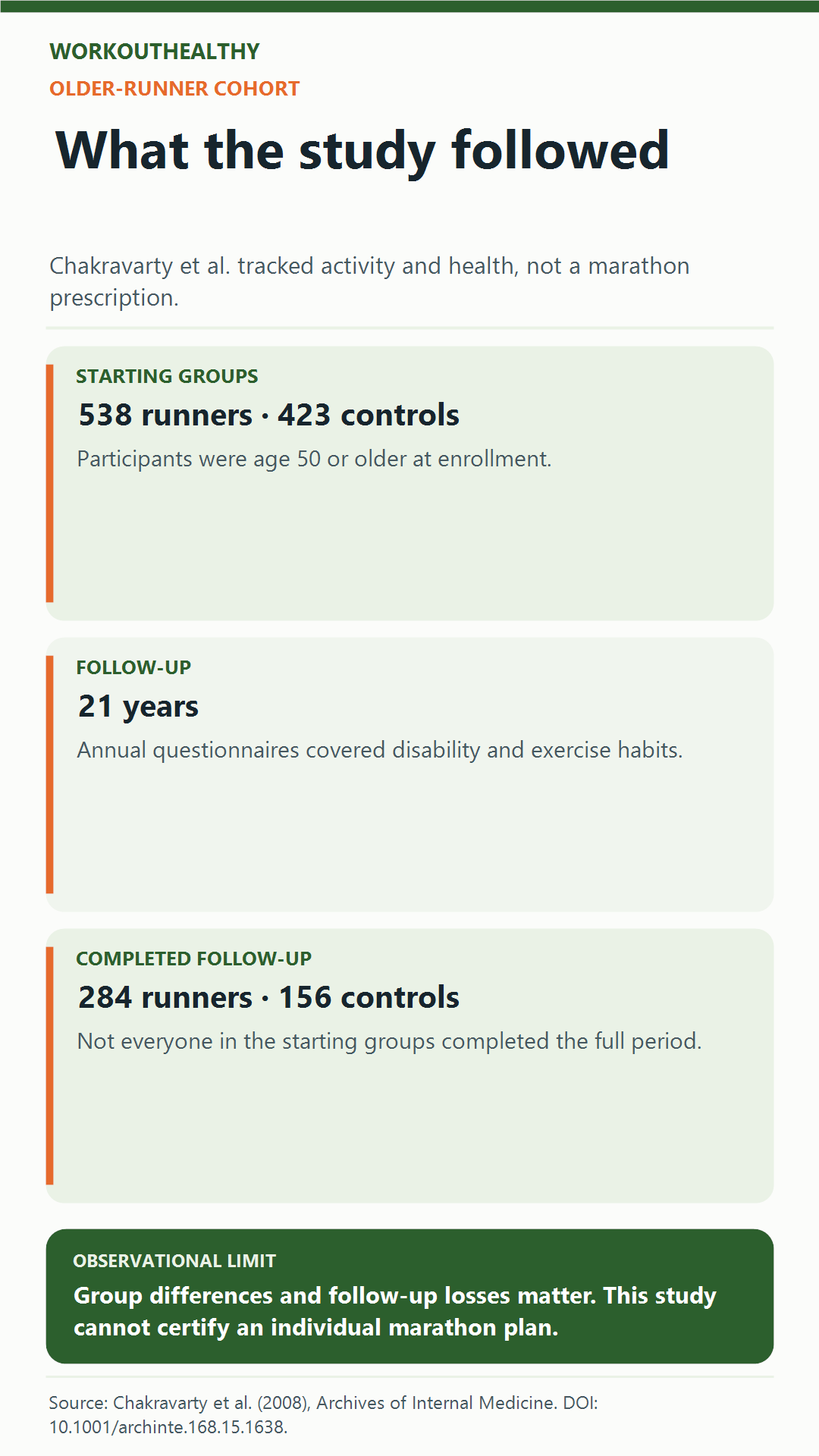
A 21 year longitudinal study published in Archives of Internal Medicine followed runners for two decades and found that older runners had significantly lower disability scores and death rates than non runners of the same age (Chakravarty et al., 2008).
The runners in that study were not all marathoners, but the finding underlines a broader point: consistent aerobic training pays off well into later decades of life, not just in your twenties.
That does not mean marathon training carries zero risk, especially for someone tackling the distance for the first time later in life.
It means the training itself, done sensibly, tends to be a net positive over the long run.
The people most likely to benefit from marathon training are also the people most likely to need a sensible, gradual buildup to get there safely.
What This Evidence Does Not Prove
The Chakravarty study looked at general running habits over decades, not marathon training specifically, and it cannot prove that any one person’s training plan is safe.
It also cannot tell us anything about Woodyatt’s personal fitness history or how his own training went, since that has not been publicly detailed.
What it does show is that the broad pattern, sustained aerobic activity across the decades, is associated with better outcomes for the average older adult.
Marathon running is also just one form of that activity.
Someone who prefers cycling, swimming, or brisk walking is not missing out on the core benefit by skipping the specific distance of 26.2 miles.
Common Training Mistakes First Time Marathoners Make
Ramping up mileage too fast is the most common mistake in marathon training.
A safe general guideline is to increase total weekly distance by no more than about 10 percent from one week to the next.
Skipping strength work is another common gap.
Runners who only run tend to develop weaker hips and core muscles relative to their running volume, which raises the odds of overuse injuries like runner’s knee or shin splints.
Treating every training run as a race is a third mistake.
Most miles in a marathon plan should feel comfortable, not maximal, with only a small portion run at a harder pace.
Under fueling on long run days is a fourth common error.
Runners who do not practice eating and drinking during training often struggle with energy crashes or stomach trouble on race day, since the body needs to learn how to handle fuel while moving.
Who Should Talk to a Doctor First
Marathon running puts a real, sustained load on the heart, especially for someone attempting the distance for the first time.
A widely cited study published in the New England Journal of Medicine reviewed cardiac arrests during long distance running races across more than 10 million runner years of data (Kim et al., 2012).
The researchers found that cardiac arrest during marathons and half marathons is rare, but it happens more often in men and tends to involve underlying heart conditions that had not been previously diagnosed.
Anyone over 40 who has not been exercising regularly should get medical clearance before starting marathon training, especially if they have a family history of heart disease, high blood pressure, high cholesterol, or any chest pain or unusual shortness of breath during physical activity.
A simple checkup and a conversation about training intensity can catch a problem before it becomes serious.
People managing diabetes, asthma, or joint conditions like arthritis should also loop in a doctor or physical therapist before committing to a marathon training block, since the plan may need adjusting around those conditions.
How to Train for a Marathon Safely After 50
Start with a medical checkup if you have not exercised regularly in the past year.
Build a base of regular walking or easy running for at least four to six weeks before starting a structured plan.
This gives joints and connective tissue time to adapt before the harder training begins.
Choose a training plan built for beginners, not one aimed at experienced racers.
Most beginner plans run 16 to 20 weeks and include built in rest days.
Add two short strength sessions a week focused on the hips, glutes, and core.
This is one of the simplest ways to reduce injury risk during a running block.
Practice your race day fueling on long training runs, not for the first time on race morning.
Test the sports drinks, gels, or snacks you plan to use.
Increase weekly mileage gradually and take a lighter recovery week every third or fourth week.
This gives the body a chance to absorb the training rather than simply piling on more.
Listen to pain that does not fade after a short warm up.
Sharp, localized, or worsening pain is a signal to rest or get it checked, not to push through.
Rest and sleep matter as much as the runs themselves.
Training adaptations, from stronger tendons to a more efficient heart, happen during recovery, not during the workout.
Consider training with a partner or a local running group if motivation is a challenge.
Having someone else expect you at the start line on a cold morning is often the difference between a missed run and a completed one, and it gives the charity fundraising side of the effort a social boost too.

If you want more structured guidance, a personal trainer or run coach can help build a plan around your specific health history and schedule.
You can also get a rough read on your current cardiovascular fitness with a simple stair climbing test before you start a training block.
References
- Chakravarty, E. F., Hubert, H. B., Lingala, V. B., & Fries, J. F. (2008). Reduced disability and mortality among aging runners: A 21-year longitudinal study. Archives of Internal Medicine, 168(15), 1638-1646. https://doi.org/10.1001/archinte.168.15.1638
- Kim, J. H., Malhotra, R., Chiampas, G., d’Hemecourt, P., Troyanos, C., Cianca, J., Smith, R. N., Wang, T. J., Roberts, W. O., Thompson, P. D., & Baggish, A. L. (2012). Cardiac arrest during long-distance running races. New England Journal of Medicine, 366(2), 130-140. https://doi.org/10.1056/NEJMoa1106468
- Runner’s World. (2025). Which celebrities are running the London Marathon 2025?
- Alzheimer’s Research UK. About us and our research funding.
This article is for general educational purposes and is not medical advice. Talk to a doctor or qualified health professional before starting a new exercise program, especially if you have an existing health condition or have not exercised regularly in the past year.