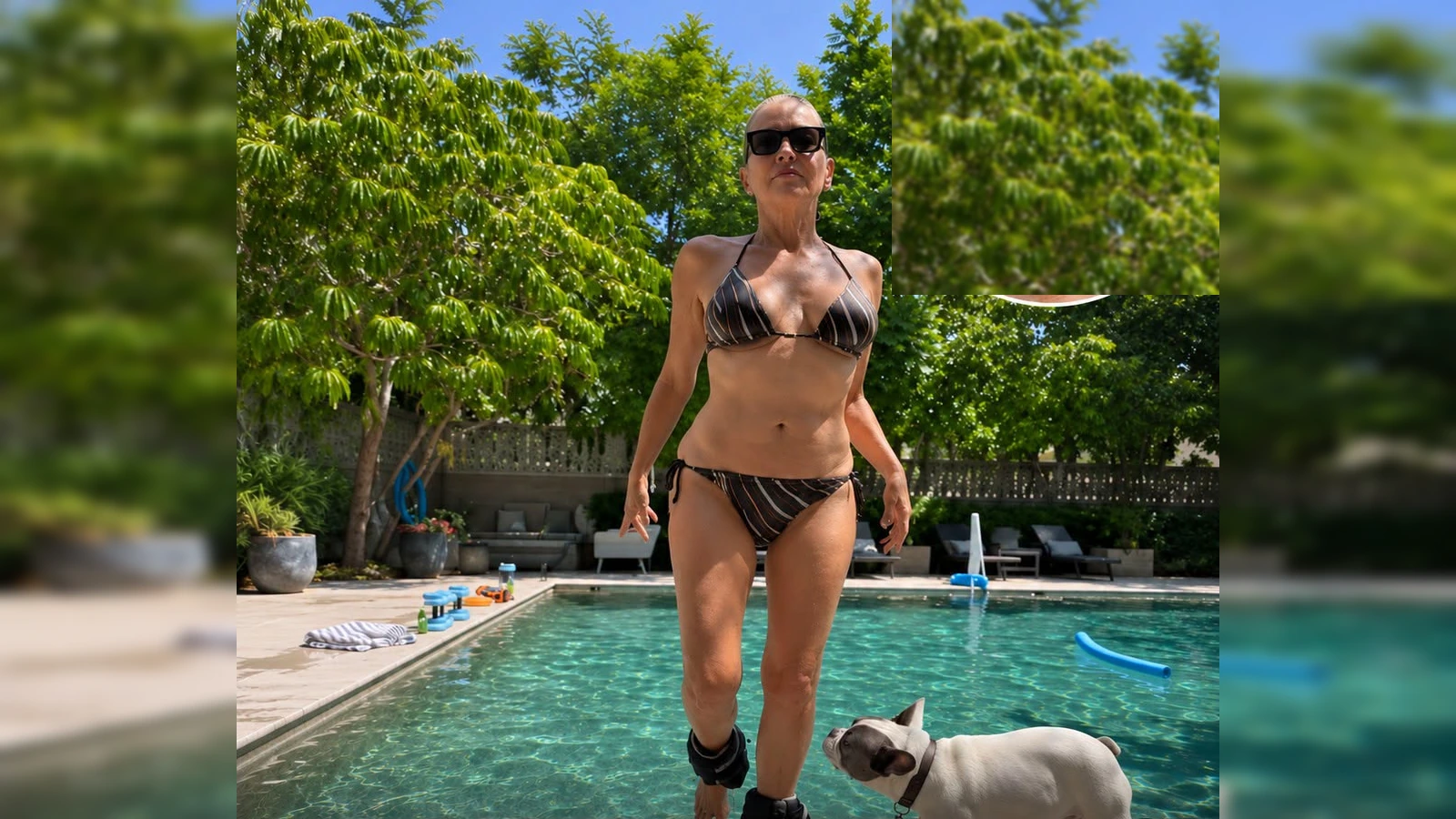

Sharon Stone says much of her current training happens in her swimming pool, where water changes the feel of familiar leg and arm movements.
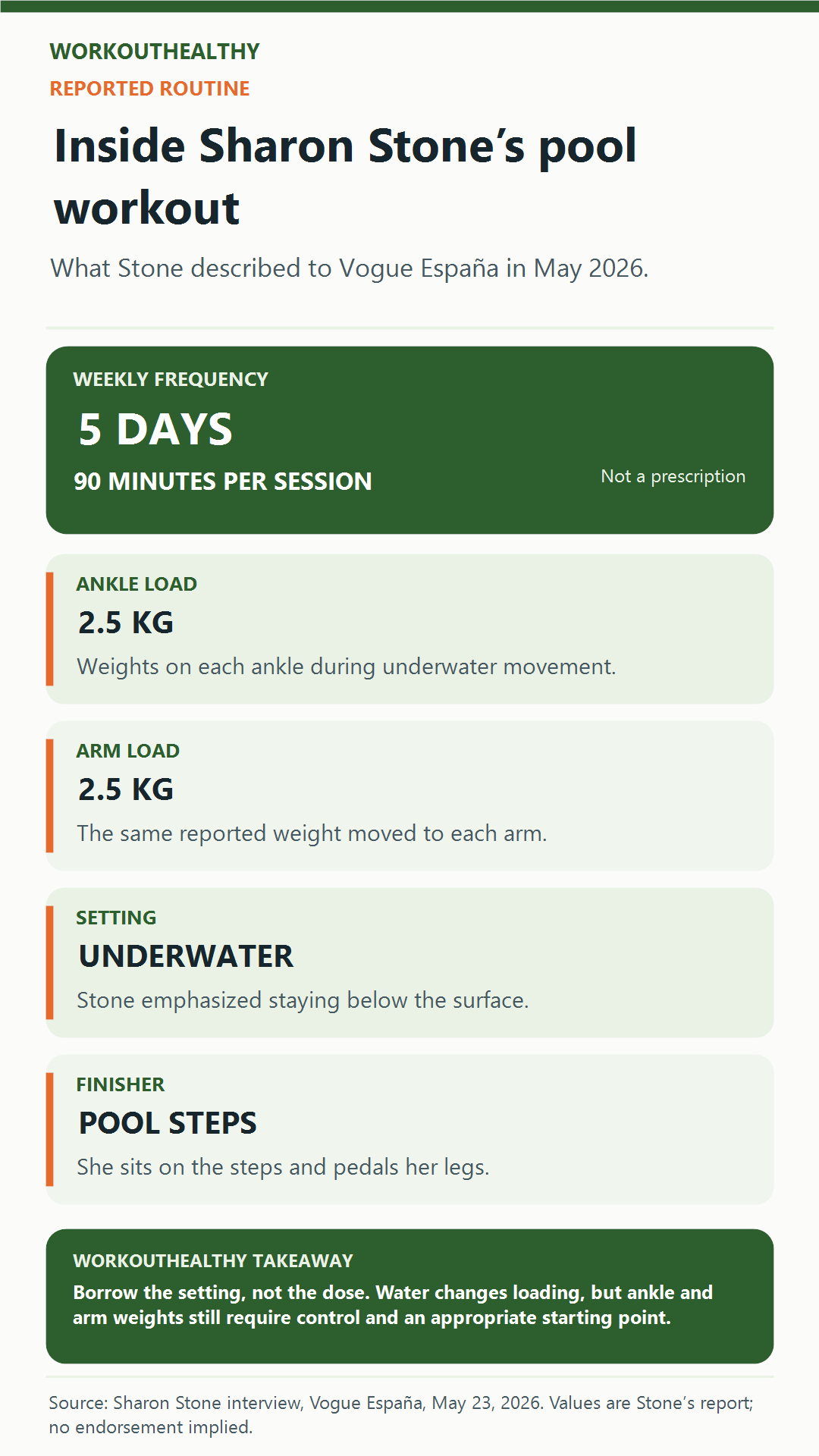
In a May 2026 interview with Vogue España, Stone described 90-minute sessions five days a week. She said she performs underwater aquagym with 2.5-kilogram weights on each ankle and then each arm, before sitting on the pool steps and pedaling her legs.
Those are specific details from one person’s routine, not a beginner template. The useful takeaway is the setting and the consistency—not an instruction to match Stone’s duration or external load.
Borrow the pool, not the dose.
What Stone reported doing
Stone told Vogue España that she trains for an hour and a half, five days per week, in her pool. She described underwater aerobic routines with 2.5 kilograms on each ankle and then each arm.
She also emphasized keeping the movements below the surface and said she finishes her “water ballet” by sitting on the steps and making a pedaling motion with her legs.
The interview provides a dated description of her own practice. It does not publish the full exercise order, repetition count, rest periods, supervision, progression history, or medical context.
How water changes the exercise
Buoyancy can reduce how much body weight the legs must support, while water resistance increases as a limb moves faster or presents more surface area. That combination can make a pool useful for adjustable aerobic and strength-oriented movement.
“Low impact” does not mean “no load.” The feet can still contact the floor, the shoulders still move against resistance, and repeated motion can fatigue muscles. Pool depth, speed, direction, equipment, and technique all change the demand.
Our article on Jo Whiley’s training adaptations makes the same distinction: water can reduce weight-bearing demand, but a movement can still irritate a shoulder, knee, or hip.
Why weights still count in the pool
An ankle or wrist weight adds mass and changes leverage. In water, that added load interacts with drag rather than disappearing. Moving the limb quickly can make control harder, especially when fatigue changes the path.
Stone’s reported 2.5-kilogram load reflects her routine, not a standard starting weight. A person new to aquatic exercise can create meaningful resistance with the water alone, then adjust speed, range, direction, or equipment gradually.
Fast arm movements with external weight can be demanding for the shoulder. Ankle weights can affect balance, the knee, and the hip. Use secure equipment designed for the setting, and keep entry and exit areas clear.
Put the frequency in context
Five 90-minute sessions total 450 minutes per week. That arithmetic describes Stone’s report; it does not tell us the intensity of every minute or how much time is spent resting, changing exercises, or moving gently.
Federal physical-activity guidance says adults can gain substantial benefits from 150 to 300 minutes of moderate aerobic activity per week and muscle-strengthening activity on two or more days. It also says benefits begin below that range.
Those guidelines are population targets, not a reason to turn every pool session into a hard workout. Intensity, recovery, health history, and current activity level still matter.
A celebrity’s consistency can be motivating without becoming your minimum.
The WorkoutHealthy pool starting-point rule
Change only one source of difficulty at a time: speed, range, duration, or equipment. That rule makes it easier to identify what changed if control, symptoms, or recovery worsen.
For example, begin with comfortable water walking or controlled leg and arm patterns without external weights. If that remains manageable across sessions, add a small amount of time before adding speed or equipment.
The four variables form a decision framework, which is why the article includes an infographic of Stone’s reported routine and a clear “not a prescription” warning. The graphic records the source values; this section explains how not to copy them blindly.
How to progress without copying
Use a pace that lets you maintain footing, breathing, and the intended movement path. Progress can mean a few more controlled minutes, a slightly larger range, or a modest change in water speed.
It does not have to mean ankle weights. A foam dumbbell, paddle, or webbed glove can increase drag, but each tool changes the exercise and should be introduced deliberately.
Our story on Michael Chiklis returning to demanding training at 62 offers a broader reminder: build from the current baseline rather than treating an old or famous workload as a debt.
Who should get individualized guidance
Ask a qualified clinician or aquatic exercise professional for help if you have a recent surgery, significant balance problem, uncontrolled heart condition, open wound, infection risk, or symptoms that change in the water.
Stop immediately for chest pain, faintness, unusual shortness of breath, sudden weakness, or new neurological symptoms. Pool exercise can feel cooler and more comfortable than land exercise, so comfort alone is not a perfect measure of intensity.
Stone has also spoken about recovering from a serious stroke. Her current routine should not be interpreted as a rehabilitation protocol or evidence that the same plan is appropriate after a neurological event.
Our short piece on listening to body cues explains why a public figure’s reflection can be a prompt without becoming a private treatment plan.
Bottom line
Sharon Stone’s pool routine combines consistency, water resistance, and external load. The confirmed numbers are striking, but they belong to her reported practice.
For most readers, the practical idea is smaller: water can support a varied movement session, and difficulty can be adjusted through speed, range, duration, or equipment. Change one variable at a time and choose a starting point that fits your health, skill, and recovery.
This article provides general fitness information, not medical advice or rehabilitation guidance. If you have a medical condition, recent surgery, balance concerns, or ongoing pain, consult a qualified health professional before starting aquatic exercise or using weights in a pool.