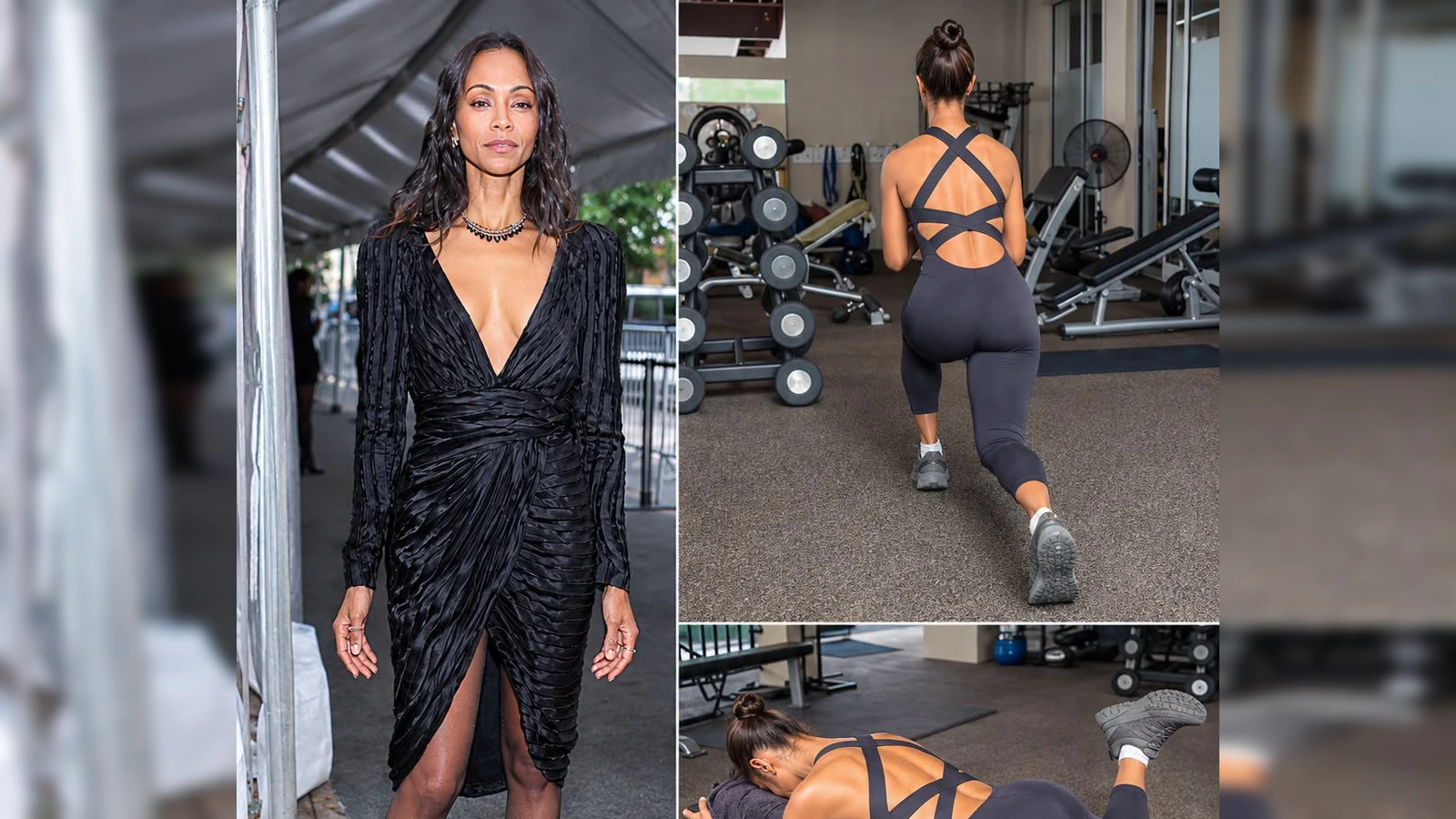

Zoe Saldaña shared a lower-body session built around four familiar strength exercises: a barbell back squat, frog reverse hyper, Romanian deadlift, and walking lunge.
The compact list is appealing because each move has a recognizable job. Together, they include a squat, a supported hip-extension exercise, a hip hinge, and an alternating single-leg pattern.
That variety does not make the post a complete program or a universal prescription. The useful work is understanding how the movements overlap, where they differ, and what to adjust before copying the load or range shown on screen.
Four exercises can cover several movement patterns without answering every programming question.
The verified four-move routine
Woman & Home reported the session on November 7, 2026, using the workout Saldaña shared and identifying the four exercises. The report also notes that she trains with coach Elena Ferretti.
The source gives us the movement list, but it does not establish that this is Saldaña’s only leg workout, her permanent weekly schedule, or the correct volume for another person.
That limit matters. Social posts are good at showing a set; they are less reliable at showing warm-ups, loading history, rest periods, previous injuries, and the wider training week.
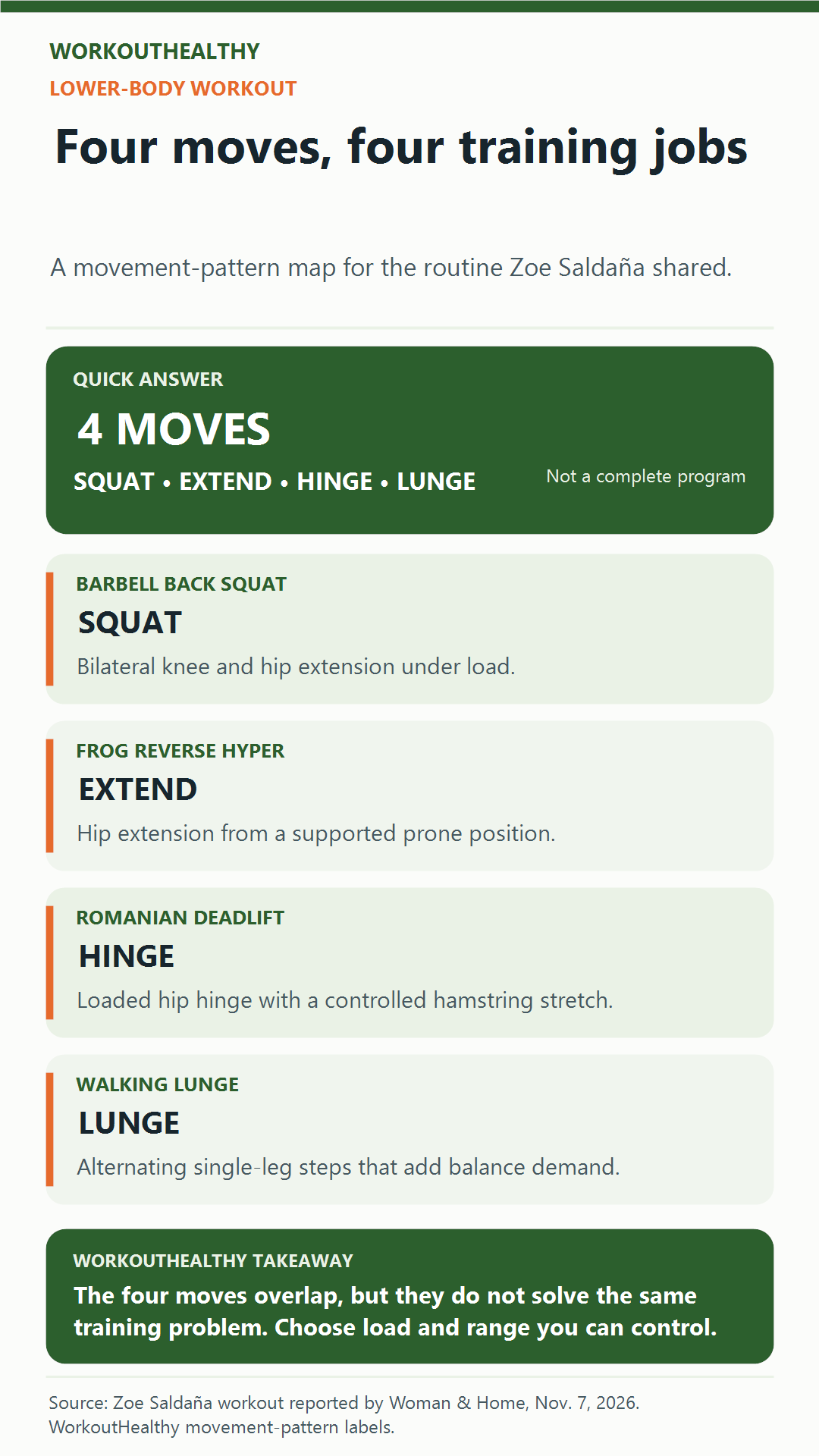
Four moves, four training jobs
The squat and lunge both train knee and hip extension, but the lunge places the legs in an offset stance and adds a step. The Romanian deadlift emphasizes a hip hinge with relatively little knee movement. The frog reverse hyper uses a supported prone position to train hip extension.
Calling the movements different does not mean each isolates one muscle. All four involve multiple joints or stabilizing demands, and the emphasis changes with technique, load, stance, and range.
Barbell back squat
A back squat places the load across the upper back while the hips and knees flex and extend. The exercise can challenge the quadriceps, glutes, trunk, and upper back, with the exact demand shaped by stance, depth, bar position, and anatomy.
The barbell version is not a required entry point. A goblet squat, box squat, or supported bodyweight squat can practice the same broad pattern with a different loading setup.
Our guide to squat alternatives by goal and comfort explains how to replace the function rather than chasing an identical-looking exercise.
Frog reverse hyper
In the shared sequence, the frog reverse hyper is performed face down on a bench with the hips near the edge. The knees stay bent and the soles turn toward each other while the hips extend to lift the legs.
The bench supports the torso, but the movement still requires control. A higher leg position is not automatically better if it comes from arching the lower back or swinging.
Because equipment dimensions and individual hip motion vary, use a stable setup and a range you can control. If the position causes back or hip pain, stop and choose a more suitable exercise rather than forcing the published version.
Romanian deadlift
The Romanian deadlift is a loaded hip hinge. The knees remain softly bent while the hips move backward and the weight stays close to the legs. The set ends when the lifter reaches a controlled range, not when the plates reach an arbitrary height.
A barbell can be replaced with dumbbells, and a shorter range can be used while learning the hinge. The goal is not to maximize the hamstring stretch at the expense of trunk control.
Our comparison of circuit and rested strength training shows why the same movement can feel and perform differently depending on exercise order and recovery.
The right range is the one you can repeat without borrowing motion from somewhere else.
Walking lunge
A walking lunge alternates legs as the body travels forward. Compared with a stationary split squat, it adds a transition between repetitions and can make balance the limiting factor before the working muscles are fully challenged.
Use a shorter step, light hand support, or a reverse lunge if the moving version feels rushed. Bodyweight is a legitimate load while learning the path.
The knee does not have to freeze behind the toes, but it should track in a direction you can control. Step length, torso angle, and ankle motion all change how the repetition feels.
How to build a manageable version
The WorkoutHealthy rule is to choose one version from each job only when you can explain why it is there. You may not need all four in one day.
Start with the most technical or heavily loaded movement while fresh. Then use a simpler hinge, lunge, or hip-extension variation that does not duplicate the same limiting factor. Keep enough rest to repeat your intended form.
Record the exercise version, load, repetitions, and any support used. Progress one variable at a time rather than adding weight, depth, volume, and speed together.
Our article on three controllable movement positions provides examples of choosing range and support without turning discomfort into a test of toughness.
Bottom line
Saldaña’s shared routine is useful because the four exercises are not interchangeable. The squat, frog reverse hyper, Romanian deadlift, and walking lunge ask the lower body to produce force in different positions.
Borrow the movement-pattern idea before borrowing the load. Choose versions you can control, give technical movements enough rest, and treat the social clip as a starting point for programming—not the program itself.
This article provides general fitness information, not individualized medical advice. If you have an injury, ongoing pain, balance concerns, or a medical condition, ask a qualified clinician or trainer for an appropriate exercise plan.