

Walking is a practical way to accumulate physical activity, and several large cohorts report lower cancer risk among people who move more. That is promising. It is also easy to turn a population-level association into a claim the data did not test. One social graphic says that sustaining 7,500 daily steps for two years was linked to notably lower advanced-cancer risk. We could not substantiate that exact number, two-year exposure, and outcome as a single published finding in the step-count studies checked for this article. It should not be treated as a validated personal target or a cancer-prevention guarantee.
A companion Facebook post makes a more careful point: walking-and-cancer research deserves genuine interest alongside epidemiological caution. Here we bring those two messages together. We look at what a large wearable-based study actually measured, why all-cause mortality is not the same as cancer incidence, how confounding works, and what a reasonable walking habit can look like without replacing screening or medical care.
The 7,500-step, two-year claim
Numbers in a graphic can sound as though they came from one experiment. To validate this one, a source would need to measure roughly 7,500 steps each day over two years and then compare the incidence of advanced-stage cancer with an appropriate reference group. We did not find that combination in the studies behind the common walking headlines. The fact that another study may use a nearby step threshold or follow participants for years does not make the sentence true as written.
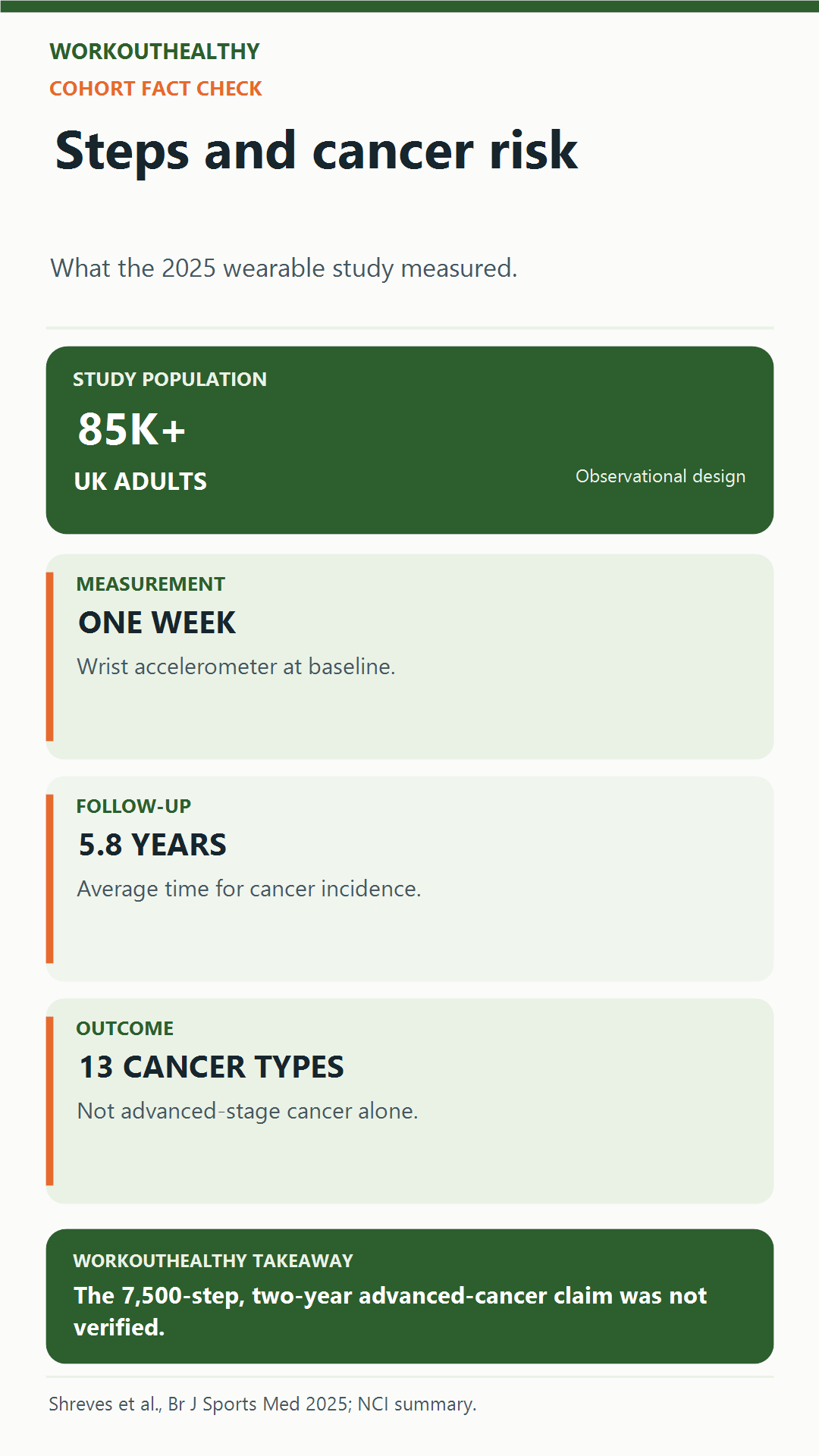
For example, the 2025 National Cancer Institute analysis used one week of wrist-worn accelerometer data and followed participants for an average of 5.8 years. Its outcome was the incidence of 13 cancers previously linked to physical activity, not specifically advanced-stage disease. It compared modeled step levels such as 5,000, 7,000 and 9,000 daily steps. Those design details matter: a one-week baseline measure does not prove that someone maintained the same daily count for two years, and a cancer diagnosis is not interchangeable with an advanced-cancer diagnosis.
The graphic’s underlying broad message—that regular walking may be associated with lower cancer risk—is compatible with this research. The exact 7,500/two-year/advanced-cancer wording is not established by it. We are flagging the distinction rather than silently replacing the graphic’s number with a different one.
What the NCI cohort measured
Researchers from the National Cancer Institute and University of Oxford analyzed more than 85,000 UK Biobank adults, median age 63. Participants wore wrist accelerometers for one week. The team characterized total activity, its intensity and daily steps, then followed records for cancer incidence. After a mean 5.8 years, 2,633 participants were diagnosed with one of 13 physical-activity-related cancers. The highest total-activity group had a 26 percent lower risk than the lowest group after statistical adjustment.
For step count, the National Cancer Institute reported an 11 percent lower risk at 7,000 versus 5,000 steps per day and a 16 percent lower risk at 9,000 versus 5,000. The modeled association began to flatten around 9,000 steps. Pace was not the key signal in that analysis. These are relative associations, not an individual’s chance of avoiding cancer and not proof that a specific step count caused the difference. The study was observational, and its activity measurement represented a short baseline window.
One useful implication is that a person who currently moves very little does not need to wait until a round-number target appears on a tracker before doing something worthwhile. More ordinary movement, including errands and easy walking, was relevant to the observed pattern. But the study did not assign people to take extra steps, so it cannot by itself calculate what will happen when a particular individual changes their routine.
Why the 2022 steps paper is different
The first walking post cites a 2022 meta-analysis led by Amanda Paluch. That project combined 15 international cohorts and examined all-cause mortality: death from any cause. It found lower mortality rates among people taking more steps, with the shape of the association differing by age. The American Cancer Society’s summary emphasizes that the study cannot set a universal daily step number. It does not provide a result showing that two years at 7,500 steps lowers advanced-cancer incidence.
All-cause mortality, cancer mortality and cancer incidence answer different questions. A lower risk of dying from any cause might reflect fewer cardiovascular deaths, fewer cancer deaths, other outcomes, or a mixture. Cancer mortality concerns death after a cancer diagnosis; incidence concerns new diagnoses. Advanced-stage incidence narrows the outcome further. Moving a statistic between those categories can change its meaning even if the number itself looks familiar.
Similarly, one prospective cohort of older women reported step-count associations with selected cancer outcomes, but its population, comparison groups and endpoints are not a substitute for the specific 7,500-for-two-years claim. A trustworthy post should point readers to the exact cohort and endpoint rather than combine parts of different studies into a single sentence.
What “advanced cancer” means here
Advanced cancer generally refers to disease that has spread or is otherwise at a later stage, although definitions depend on cancer type and study design. It is not the same as “any cancer.” Studies of people who already have advanced cancer may use daily steps as a marker of physical function or prognosis; they cannot be used to infer that steps prevent a person from developing advanced cancer. Mixing these two situations is a particularly serious mistake because the direction of cause can be reversed: illness itself may reduce movement.
We found no basis to prescribe 7,500 steps for exactly two years as a threshold that prevents advanced disease. If a future study establishes an association with that specific endpoint, it still would need careful interpretation: what was measured, who was studied, what confounders were addressed, and whether stage at diagnosis was reliably recorded. Until then, use the broad evidence for motivation, not the graphic’s precision as a clinical rule.
Why association is not proof
People who walk more can differ from people who walk less in ways that also influence cancer risk. They may smoke less, have different diets, body weight or income, receive different preventive care, or be healthier at baseline. Researchers statistically adjust for many measured factors, as the NCI team did. Adjustment is valuable, but it cannot guarantee that every important factor was measured accurately or that no unmeasured factor remains.
Reverse causation is another concern. A developing illness may make a person tired and less active before it is diagnosed. A low step count could partly be an early consequence rather than a cause of the disease. Long follow-up and sensitivity analyses help, but cannot eliminate the issue completely. The distinction is why we say “linked with lower risk,” not “walking alone prevented this percentage of cancers.”
Randomized trials that assign people to years of different movement levels and observe cancer diagnoses would be difficult and expensive. That does not make observational research worthless. It means the evidence should be triangulated with other cohorts, short-term intervention trials on relevant biology, and a careful look at alternative explanations.
Biological plausibility and its limits
Physical activity can influence body composition, insulin regulation, inflammation and immune function. Those pathways give researchers reasons to investigate effects on cancer development. Yet a plausible biological pathway cannot, by itself, tell us the size of a real-world cancer-prevention effect from walking or identify one step threshold. Different cancers have different causes; one mechanism will not apply equally to all of them.
There are also benefits that need no cancer-specific promise. Walking can support cardiovascular fitness, mood and daily function. Our after-meal walking explainer looks at one separate metabolic outcome. Neither article says walking is a treatment for cancer.
A practical walking habit
Start with a level that fits your current capacity. That might be a short walk after a meal, an extra errand on foot, or a few minutes on a flat route. Add time or steps gradually enough that the habit can survive workdays, weather and recovery needs. A tracker can help you see your own pattern, but its round numbers are tools, not diagnoses or guarantees. If walking causes chest pain, unusual breathlessness, dizziness or worsening symptoms, stop and get appropriate medical advice.
For people with mobility limitations or during cancer treatment, the safest plan is individualized. The goal may be maintaining function, not meeting a public step goal. If you already walk regularly, additional benefit may depend on the rest of your activity, health and preferences. The NCI study’s modeled curve flattened around 9,000 steps, but that does not set a universal ceiling or a prescription for everyone.
Walking alongside cancer prevention
Physical activity is one piece of a broader prevention picture. Recommended cancer screening, avoiding tobacco, vaccinations where indicated, nutrition, sleep and access to medical evaluation also matter. A walking habit does not replace a mammogram, colon cancer screening, symptom evaluation or treatment. The 2025 NCI cohort can justify attention to daily movement; it cannot guarantee that a person who reaches a chosen step count will avoid cancer.
For readers interested in how exercise fits after a diagnosis, our exercise-and-cancer-treatment evidence review handles that distinct question. Prevention and treatment are not interchangeable, just as cancer incidence and mortality are not interchangeable.
Bottom line
The strongest defensible message is simple: regular activity, including walking, is associated with lower risk for several health outcomes, and wearable-based cancer research is encouraging. The exact claim that 7,500 daily steps sustained for two years lowers advanced-cancer risk was not verified in the primary studies reviewed here. Build a sustainable habit for its broad benefits, keep preventive care in place, and read striking risk numbers with attention to the study’s people, timeframe and actual outcome.
References
- Shreves AH, et al. Amount and intensity of daily total physical activity, step count and risk of incident cancer in the UK Biobank. British Journal of Sports Medicine. 2025. Primary study; NCI summary.
- Paluch AE, et al. Daily steps and all-cause mortality: a meta-analysis of 15 international cohorts. The Lancet Public Health. 2022. American Cancer Society study explanation.
- Associations of steps per day and step intensity with the risk of cancer: findings from the Women’s Health Accelerometry Collaboration cohort. Primary study.
- National Cancer Institute. Cancer Causes and Prevention Research. Research overview.