

A workout can feel crowded when you want cardio, strength, and core work but have only one visit to the gym. Jessica Alba’s trainer Ramona Braganza has a concise answer: a 3-2-1 structure that gives each quality a place. The method is real, but the exact celebrity workout and its results should not be overstated.
This article separates the trainer’s documented formula from social-media inference, then turns it into a reader-friendly template grounded in exercise research. The goal is to leave you with a useful plan, not a fantasy that one celebrity session is a shortcut.
The 3-2-1 format is a way to allocate time—not proof that one exact workout creates one exact body.
What Jessica Alba’s trainer actually documented
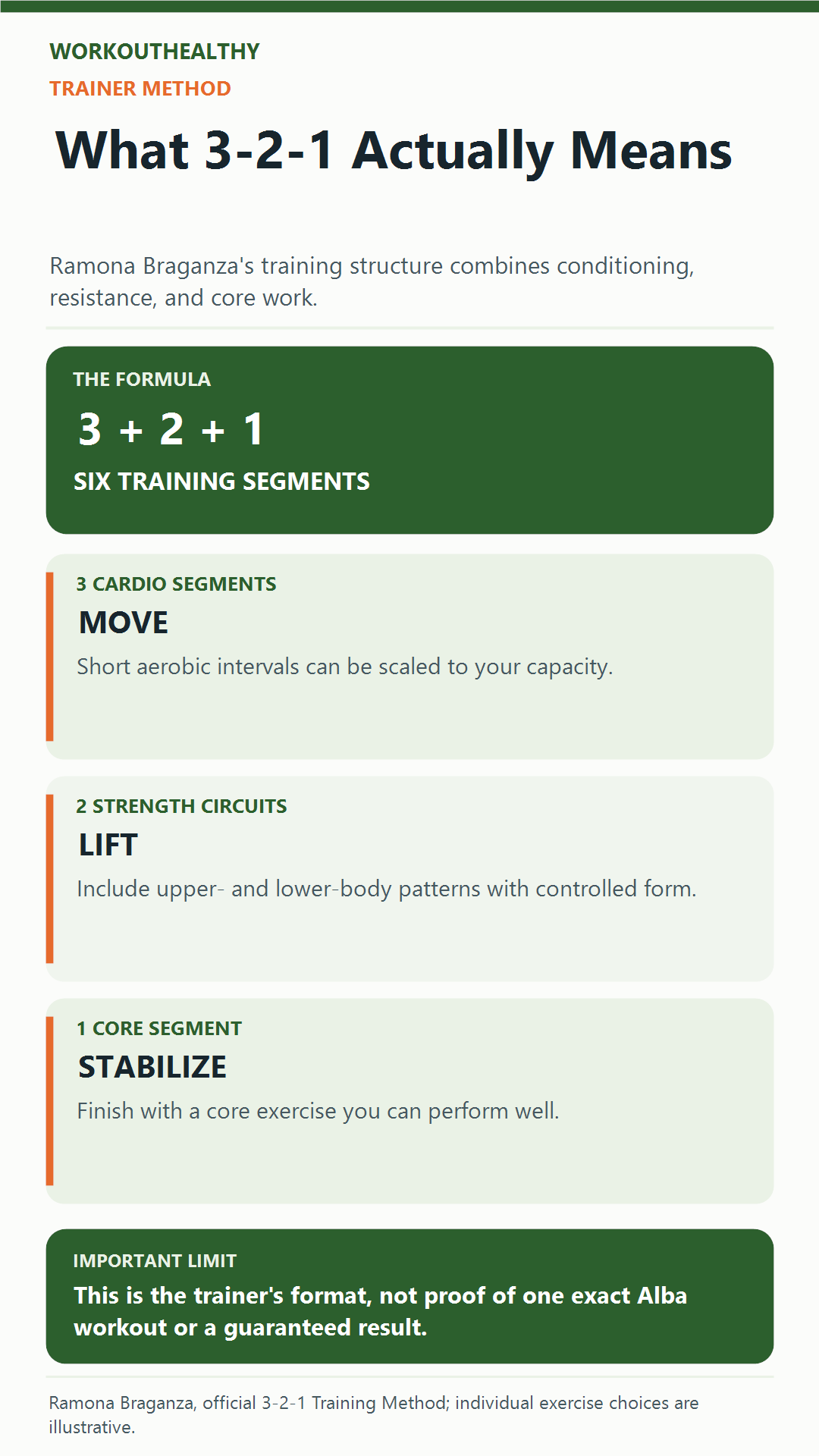
The Facebook post describes a gym session that mixes short cardio bursts, upper-body and lower-body resistance work, and a core finisher. The most reliable anchor is not an unverified minute-by-minute celebrity diary. It is trainer Ramona Braganza’s published 3-2-1 Training Method: three cardio segments, two strength circuits, and one core segment. Braganza identifies Jessica Alba as a longtime client on her own site, and Alba’s testimonial describes mixing cardio and weights.
That gives us a useful structure, not proof that Alba performed every exercise shown in a particular graphic or on a particular date. The accompanying social image is an editorial illustration. It is not footage from the workout. This distinction matters because celebrity-fitness posts often turn a trainer’s general method into a falsely precise “secret routine.” The interesting part here is the combination of training goals in a constrained block of time.
Why the 3-2-1 format can fit a busy schedule
Braganza says the method was designed for movie-location work, when time and equipment are limited. A single session can cover a cardiovascular stimulus, repeated resistance exercises, and deliberate trunk work without requiring three separate gym visits. That is an efficiency argument, not a promise that every goal will be maximized at once.
Three cardio segments can be as simple as cycling, brisk walking on an incline, or low-impact stepping. The two circuits can cover a squat or hinge, a push, and a pull. The final core segment can focus on resisting unwanted motion rather than racing through sit-ups. How hard each block should be depends on conditioning, technical skill, and the reason the person is training.
Our 20-minute full-body guide offers another short-session comparison. The workout is also flexible. Someone returning to exercise could use gentle intervals and bodyweight patterns; an experienced lifter could use heavier resistance and longer rest. Both might be using the same organizing principle without doing the same workout. That is more useful than copying a celebrity load, rep count, or pace that was never reliably reported.
The cardio pieces: enough stimulus without chaos
The trainer’s formula calls for three cardio segments, but it does not prescribe one compulsory machine or intensity for everyone. Short intervals can raise breathing rate and heart rate; they can also add fatigue before a lift if they are too hard. Begin with a gradual warm-up and select a pace at which movement quality remains sound.
For a new exerciser, “cardio burst” may mean two or three minutes of comfortable cycling or marching. A trained person might choose a harder interval, then recover fully enough to perform the next strength movement with control. The target is not to make the entire session feel frantic. It is to give conditioning its own place in the plan while keeping the resistance work worth doing.
If strength is the main priority, keep the early cardio moderate and reserve the most technical or heavy lifts for a fresher state. If aerobic fitness is the main priority, the ordering can change. The 2022 concurrent-training meta-analysis found that combining aerobic and strength work did not meaningfully compromise muscle size or maximal-strength gains overall, but explosive-strength development may be more vulnerable when both occur in one session. That result concerns programs over weeks, not a direct test of Alba’s routine.
The two strength circuits: cover patterns, not body-part labels
“Upper body” and “lower body” are helpful labels, but a good circuit is built from movement patterns. One block might pair a squat or split squat with a row. Another could pair a hip hinge with a push-up or press. Choose loads that allow controlled repetitions and enough rest to maintain technique. You do not need to copy an exercise that aggravates a joint simply because it looks efficient on screen.
Resistance circuits can improve more than one capacity, especially in beginners or moderately trained adults. A systematic review of resistance-circuit training found improvements in measured aerobic capacity and upper-body one-repetition maximum across included studies. The protocols varied, so the review cannot guarantee the same result from any short celebrity circuit. It does support the basic idea that a properly dosed circuit can give both systems useful work.
For a deeper look at this tradeoff, see our circuit-training evidence guide. The tradeoff is specificity. A short mixed session may be ideal for general fitness and adherence, while a powerlifter or sprinter may need more dedicated strength or speed training. If your goal is to lift heavier over time, record the load and repetitions and make sure the cardio intervals are not stealing the recovery needed to progress.
The core segment: stability over punishment
The final “one” in 3-2-1 is a core segment. Core work is not synonymous with hundreds of crunches or a promise of visible abdominal definition. The trunk helps transmit force between the upper and lower body and maintain posture under load. A well-chosen core exercise should match the person’s current control and tolerance.
A short finisher could include a dead bug, a side plank, or a controlled carry. Those are examples for readers, not confirmed details from Alba’s session. Hold positions or move slowly enough that breathing and spinal control remain intact. If a variation causes pain, regress it or seek a professional assessment rather than assuming discomfort is the point.
For many people, the strength circuits already challenge the trunk. The separate core block can be used to practice a weaker quality or add a small amount of focused volume. Its value comes from purposeful execution, not from making the last minutes of the session look especially dramatic.
A mixed session succeeds when each segment is demanding enough to matter and recoverable enough to repeat.
A 30-minute reader version—not a claimed Alba transcript
Here is an original WorkoutHealthy adaptation of the method, not Braganza’s proprietary program and not a record of one Alba workout. Spend five minutes warming up with easy movement and rehearsal of the first strength exercise. Then alternate three short cardio blocks with two resistance circuits, allowing transitions and rest. Finish with three or four minutes of controlled core work and an easy cool-down.
One practical sequence is: three minutes brisk walking or cycling; a circuit of squat-to-chair and supported row; three minutes cardio; a circuit of hip hinge and elevated push-up; three minutes cardio; then dead-bug and side-plank variations. Make each circuit one or two rounds at a comfortable starting effort. This is an example, not a medical prescription; adjust total time or omit moves as needed.
If you cannot keep form after the first interval, shorten or soften the cardio. If a lift is so light that it never challenges you, progress the resistance gradually rather than trying to create more fatigue by moving faster. A useful session should leave you able to repeat the work and improve over weeks.
How to progress the mixed session
Do the same basic session two or three times a week if it fits your recovery and other training, leaving enough time between harder efforts. First learn the movement patterns. Then increase one variable at a time: a little more resistance, one more quality repetition, a slightly longer aerobic interval, or a shorter—but still adequate—rest period. Keeping every variable fixed makes progress hard to judge; changing everything at once makes it hard to know what helped.
Record a few simple measures: the weight or variation used, clean reps, approximate effort, and whether the cardio pace was sustainable. If these improve while aches and fatigue stay manageable, the session is doing its job. A long-term program also needs enough overall weekly activity, not merely one fast circuit that leaves you exhausted.
People with cardiac symptoms, recent injury, pregnancy-related restrictions, or a medical condition should individualize the plan with a qualified professional. Stop and seek care for chest pain, fainting, or unusual shortness of breath. Efficient should never mean skipping a needed safety check.
What this method cannot prove
Alba’s use of Braganza’s method does not prove that one specific six-part session built her physique, that three cardio bursts are uniquely superior, or that everyone should train at the same intensity. Celebrity routines also reflect access to coaching, scheduling flexibility, nutrition, recovery, and years of practice that a short social post cannot show.
The trainer’s own materials describe a flexible format that can last twenty minutes, thirty minutes, or an hour. That range is another reason not to treat a diagram as a universal timetable. The science on concurrent training and circuits supports the possibility of useful gains, but it tests training interventions, not a celebrity endorsement.
The most honest takeaway is that you can combine multiple goals intelligently when time is limited. You still need enough stimulus for each goal and enough recovery to repeat it. If the plan feels sustainable and measurable, it is likely more valuable than a “perfect” workout you abandon after one week.
Bottom line
Jessica Alba’s trainer Ramona Braganza has publicly described a 3-2-1 method: three cardio segments, two resistance circuits, and one core segment. The Facebook post’s broad description aligns with that method, but its illustration is not a documentary record of one workout.
For readers, the formula offers a practical way to organize a full-body session. Keep intervals proportional to your fitness, train basic strength patterns with control, and use the core block for a clear purpose. Make progress over time rather than chasing a high heart rate for its own sake. A mixed session can be efficient; it should still be tailored to your actual goal.
Get the next evidence check.
Five practical fitness stories worth your time, every Friday.
One email a week. No product pitches. Unsubscribe in one click.
References
- Braganza, R. (n.d.). 3-2-1 Training Method. Official trainer method and stated time/equipment rationale.
- Braganza, R. (n.d.). Ramona Braganza: Celebrity trainer. Trainer bio and Jessica Alba client testimonial.
- Schumann, M., et al. (2022). Compatibility of concurrent aerobic and strength training for skeletal muscle size and function: An updated systematic review and meta-analysis. Sports Medicine, 52, 601–612.
- Muñoz-Martínez, F. A., Rubio-Arias, J. Á., Ramos-Campo, D. J., & Alcaraz, P. E. (2017). Effectiveness of resistance circuit-based training for maximum oxygen uptake and upper-body one-repetition maximum improvements: A systematic review and meta-analysis. Sports Medicine, 47(12), 2553–2568. https://doi.org/10.1007/s40279-017-0773-4.
Medical disclaimer: This article is general information, not individualized medical advice. Ask a qualified clinician or exercise professional to adapt activity if you have a medical condition, injury, or concerning symptoms.