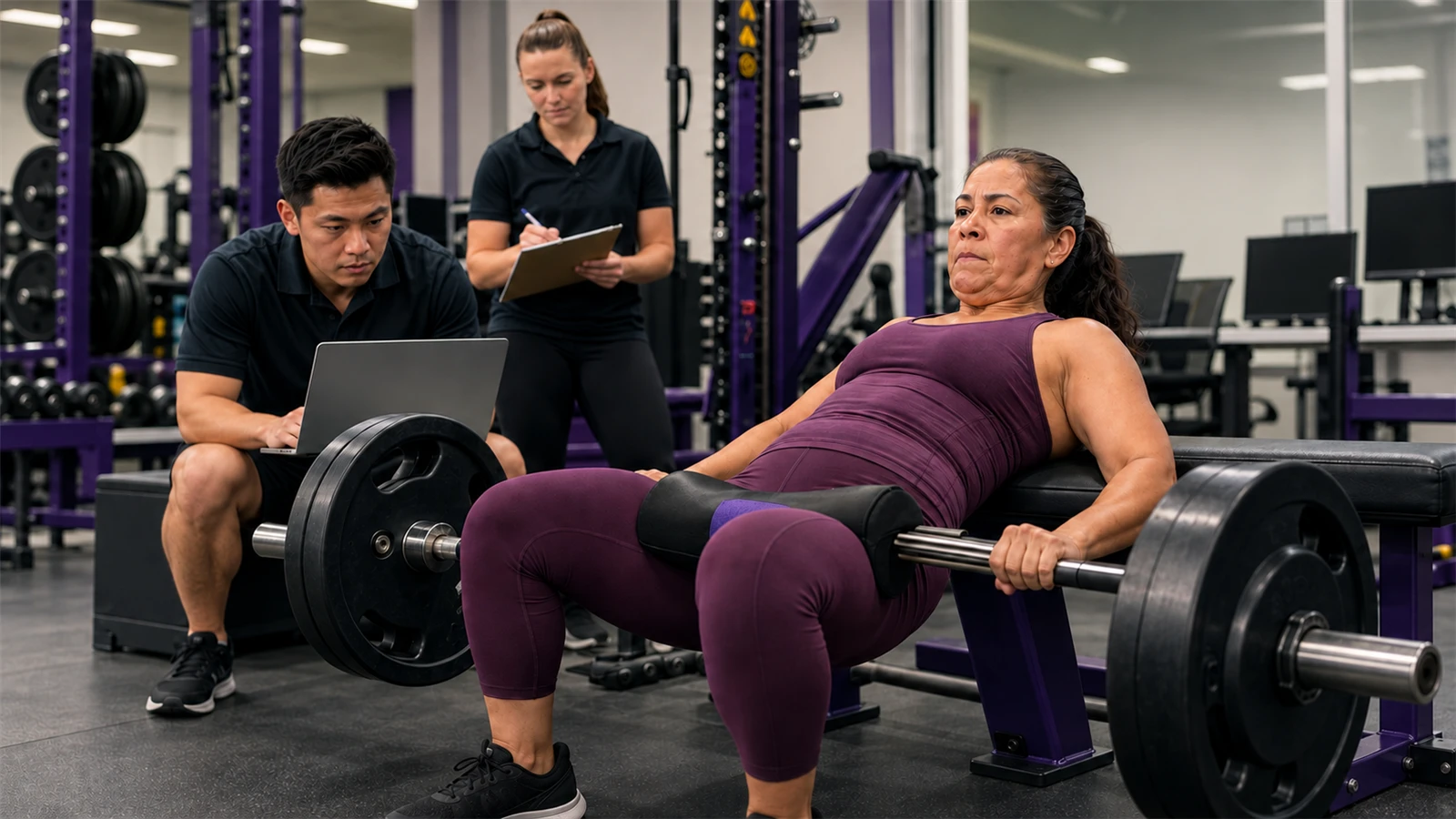

A stronger hip thrust is not a guaranteed faster sprint. That is the take-home from a small randomized trial in collegiate athletes, and it is more useful than either “hip thrusts are magic” or “hip thrusts are useless” (Jarvis et al., 2019).
After eight weeks, the athletes who trained the lift became markedly stronger at the lift. Their measured 40-meter sprint performance, however, did not clearly improve.
Here is what the researchers actually tested, why other studies have not all landed in exactly the same place, and how to build a speed plan without confusing gym strength with on-track results.
What the Eight-Week Trial Actually Tested
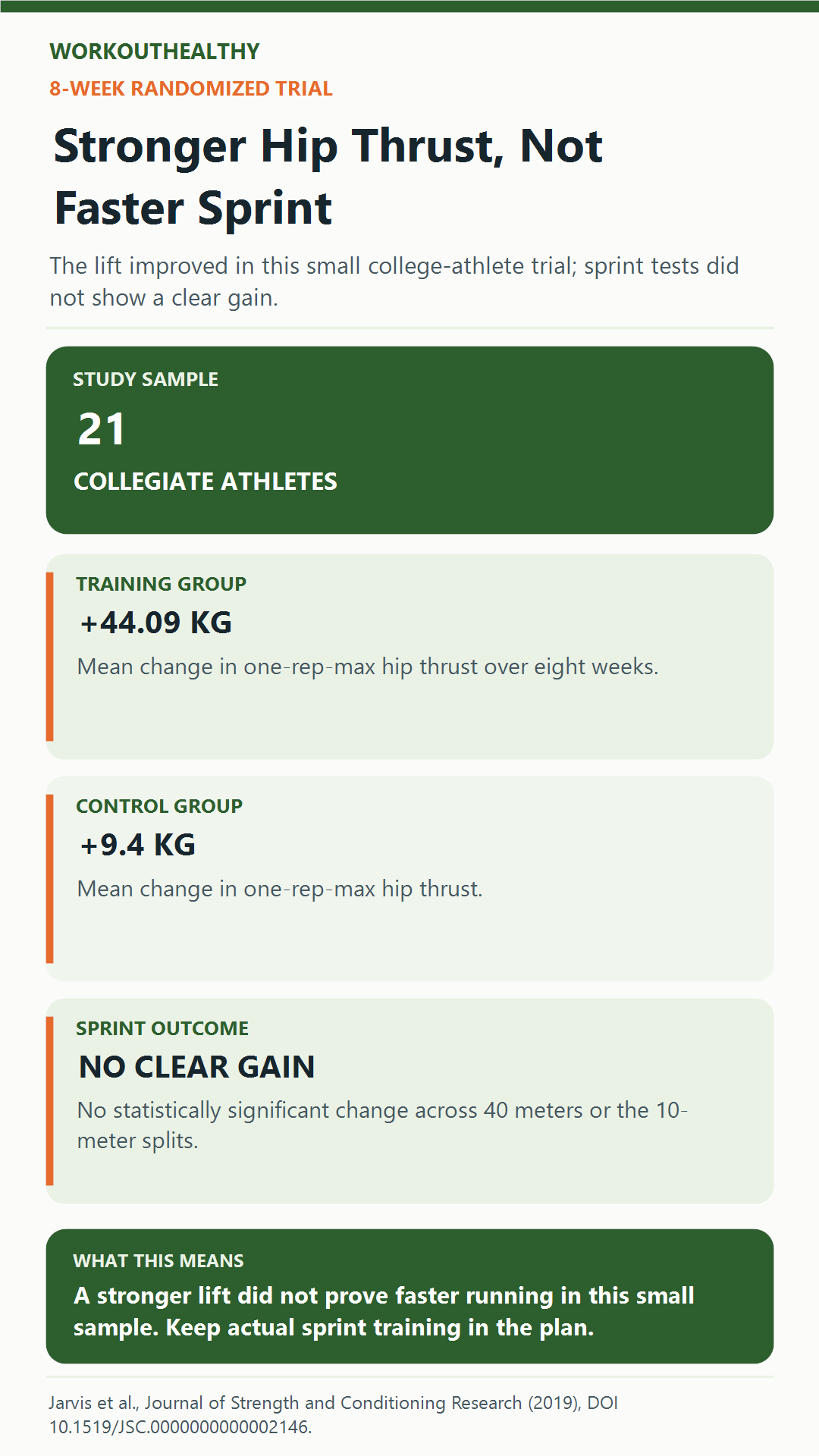
The central experiment was an eight-week randomized study of 21 collegiate athletes, including 15 men and six women (Jarvis et al., 2019).
Eleven were assigned to a heavy barbell hip-thrust program. Ten were controls.
The researchers tested each athlete before and after the study. They measured a one-repetition maximum hip thrust, a 40-meter sprint, and each 10-meter segment of that sprint.
That design asks a narrower question than the headline “Are hip thrusts good for athletes?” It asks whether becoming stronger in one specific lift, under this particular program, produced detectable changes in short sprint times in this sample.
The distinction matters. A resistance exercise can be useful for muscle development or general strength without producing a measurable eight-week speed improvement. It can also help one population more than another.
The sample was small. The athletes were not an international cohort of elite sprinters, and the study cannot establish what would happen with a longer intervention or a different mixture of speed practice and lifting.
The Result: Strength Rose, Sprint Time Did Not Clearly Change
The intervention group increased its hip-thrust one-repetition maximum by a mean 44.09 kilograms. The control group’s mean increase was 9.4 kilograms (Jarvis et al., 2019).
The difference is substantial for the exercise the group practiced. It confirms that the training stimulus improved the tested lift.
Yet the researchers did not detect statistically significant changes in the 40-meter sprint or any of the four 10-meter segments. Their published conclusion was specific: stronger hip thrusts did not appear to transfer to better sprint performance in these collegiate athletes (Jarvis et al., 2019).
“No statistically significant change” does not prove that the true effect is exactly zero. With only 21 people, a modest effect might be hard to distinguish from normal variation.
It does mean the trial does not justify promising that a heavier hip thrust will make a runner faster. That is the key correction to a common gym claim.
The Facebook caption cites a 2015 electromyography comparison. That paper measured muscle electrical activity during hip thrusts and squats, not eight-week sprint outcomes. It should not be used as the source for this trial’s result.
A stronger lift is a real training result. It is not automatically a faster sprint.
Why Exercise Strength Is Not the Same as Running Speed
A one-repetition maximum is a test of how much load a person can move once in a particular position. Sprinting is a fast, coordinated task with very short ground-contact times.
Both tasks involve the hip extensors, but sharing muscles is not enough to guarantee transfer. The nervous system must organize force at the right moment, in the right direction, while the body is moving quickly.
Resistance training can build useful capacity. Sprint practice teaches the athlete to express that capacity in running. These are related jobs, not interchangeable ones.
The 2026 systematic review by Lin and colleagues pooled 20 randomized studies of hip-thrust training and performance. It found a clear improvement in hip-thrust strength but much weaker evidence of independent transfer to sprint acceleration. The authors rated the overall certainty low to very low (Lin et al., 2026).
This does not mean hip thrusts are pointless. It means a coaching plan should judge the exercise by its purpose. Building strength, adding glute training volume, and improving measured sprint time are different outcomes.
For a closer look at exercise selection, our squat-versus-hip-thrust evidence review explains why similar-looking leg exercises can produce different adaptations.
How Other Studies Complicate the Picture
The Jarvis trial is not the only experiment, and the evidence is not perfectly uniform.
A six-week randomized study compared hip-thrust and front-squat training in adolescent males. Its design and age group differ from Jarvis and colleagues’ college-athlete trial, so its findings should not be treated as a direct replication (Contreras et al., 2017).
More broadly, a meta-analysis of lower-body strength training found that improvements in squat strength were associated with improvements in sprint performance across 15 studies and 510 participants (Seitz et al., 2014).
That result supports the general idea that strength can matter for speed. It does not prove every exercise transfers equally, or that a single lift can substitute for running.
The newer hip-thrust review found a small or borderline sprint effect depending on which protocols were included. Its authors emphasized the low certainty and advised using hip thrusts as a complement rather than a replacement for a complete athletic program (Lin et al., 2026).
Differences in training age, sprint distance, program duration, resistance load, and whether athletes also practiced sprinting can all change what a study is capable of detecting. That is why one trial should guide expectations rather than become a universal rule.
A Simple Transfer Audit for Your Own Program
The useful question for an athlete is not “Did my hip thrust go up?” It is “Did the performance I care about improve under comparable test conditions?”
WorkoutHealthy’s practical audit uses three measures: the hip-thrust load, a short acceleration split such as 10 meters, and a longer sprint such as 40 meters. Choose the distances that match your sport, then keep them consistent.
Record baseline tests after a normal warm-up. Retest after a planned training block with the same timing equipment, surface, footwear, and roughly similar recovery.
For sprint time, calculate change = follow-up time minus baseline time. A negative number is faster. For lift load, calculate change = follow-up load minus baseline load. A positive number is stronger.
For example, a 0.04-second lower 10-meter time would be a potential improvement, while a 20-kilogram higher hip-thrust maximum would show a strength gain. Those example numbers are illustrations, not results from the Jarvis trial.
Do not overinterpret one hand-timed run. Repeat trials when possible and look for a consistent pattern larger than your usual day-to-day noise.
In the published trial, the mean hip-thrust gain was 44.09 kilograms in the training group versus 9.4 in controls. Subtracting those reported changes yields 34.69 kilograms. That is a WorkoutHealthy arithmetic comparison of group averages, not an individual prediction or an estimate of faster sprinting (Jarvis et al., 2019).
Test the movement you care about, under conditions you can repeat.
Where Hip Thrusts Fit in a Sprint Plan
Keep the exercise when it solves a real programming problem. It can offer a high-load hip-extension movement and a way to progress glute strength.
But if the goal is acceleration, the program also needs actual fast running, sound technique, and enough recovery to sprint with quality. The hip thrust cannot rehearse the full foot strike, posture, rhythm, and timing of a sprint.
An athlete returning from a layoff might need a different starting point from one who has already spent years lifting. Some people may respond well to adding hip thrusts; others may already have enough posterior-chain work.
Use a gradual progression. Begin with a stable bench or pad setup, controlled movement, and a manageable load before chasing a personal record.
Separate strength and speed sessions when fatigue would compromise running quality, or place the fastest work first when both occur in one session. Exact scheduling depends on the athlete and coach.
Our outdoor track session guide shows how a running session can emphasize speed while keeping claims about calorie burn in perspective.
The best test of a sprint program remains the sprint, not an accessory-lift number.
What the Study Cannot Prove
A small randomized study can show that one intervention did not produce a detectable average benefit under its conditions. It cannot settle every plausible use of the exercise.
Jarvis and colleagues studied 21 collegiate athletes for eight weeks. That limits precision and makes it risky to extend the result to children, master athletes, elite sprinters, or rehabilitation patients (Jarvis et al., 2019).
The study also tested a particular heavy hip-thrust protocol. Different loads, volumes, or combinations with sprint drills could produce different outcomes.
Timing methods matter too. Small changes in acceleration are difficult to measure reliably without consistent equipment and procedures.
The 2026 review found the broader hip-thrust evidence had low to very low certainty. That means uncertainty is not just a caveat attached to one trial; it is a feature of the current literature (Lin et al., 2026).
Likewise, an acute performance effect after a hip-thrust warm-up is a different question from whether months of training make a person faster. The review distinguishes these, and readers should too.
Use the study to reject a guarantee, not to ban a useful lift.
Bottom Line for Lifters and Runners
Heavy hip thrusts improved hip-thrust strength in the eight-week trial, but the investigators did not see a clear improvement in 40-meter sprint time or its 10-meter segments.
The fairest conclusion is that stronger performance in one exercise did not automatically become faster running for this sample (Jarvis et al., 2019).
That conclusion fits a practical coaching rule: train the capacity you need, then practice the skill where you need to express it. Strength work and sprint work can belong in the same plan without pretending they are the same stimulus.
If your main goal is speed, keep a measured sprint outcome in the program. If your main goal is strength or glute development, a rising hip-thrust load may be a valuable result on its own.
When the two disagree, trust the result that matches your actual goal.
For research-grounded training explanations like this, subscribe to WorkoutHealthy Insider.
References
Contreras, B., Vigotsky, A. D., Schoenfeld, B. J., Beardsley, C., McMaster, D. T., Reyneke, J. H. T., & Cronin, J. B. (2017). Effects of a six-week hip thrust vs. front squat resistance training program on performance in adolescent males: A randomized controlled trial. Journal of Strength and Conditioning Research, 31(4), 999 to 1008. https://pubmed.ncbi.nlm.nih.gov/27253835/
Jarvis, P., Cassone, N., Turner, A., Chavda, S., Edwards, M., & Bishop, C. (2019). Heavy barbell hip thrusts do not effect sprint performance: An 8-week randomized controlled study. Journal of Strength and Conditioning Research, 33(1S), S78 to S84. https://doi.org/10.1519/JSC.0000000000002146
Lin, S., Cheng, M., Yi, X., Li, Y., & Liu, R. (2026). Acute and long-term effects of hip thrust training on athletic performance: A systematic review and meta-analysis. PeerJ, 14, e20785. https://doi.org/10.7717/peerj.20785
Seitz, L. B., Reyes, A., Tran, T. T., Saez de Villarreal, E., & Haff, G. G. (2014). Increases in lower-body strength transfer positively to sprint performance: A systematic review with meta-analysis. Sports Medicine, 44, 1693 to 1702. https://doi.org/10.1007/s40279-014-0227-1
This article is for general information only and is not medical advice. If you have an injury, ongoing pain, or a medical condition, talk to a doctor or physical therapist before you change how you train or eat.