

Stress can affect immune function, but “weaker immunity” does not describe every effect. Human research links threatening experiences with altered inflammatory regulation and illness after viral exposure, while other experiments examine different pathways and outcomes.
That distinction matters when a headline turns a mouse experiment, a cortisol measurement and a common cold into one story. None gives you a personal immune score or proves that getting sick means you handled stress badly.
The featured desk scene is an AI illustration, not a study participant or a diagnostic image.
What does it mean for stress to weaken immunity?
A useful answer names the response being measured: resistance to infection, inflammatory signaling, symptoms or wound healing. Those outcomes are related, but they are not interchangeable.
Inflammation helps the body respond to a threat, and regulation helps keep that response appropriate. More inflammation is not automatically better protection, just as less inflammation is not automatically evidence of a healthier immune system.
In its explanation of the human cold studies, Carnegie Mellon University describes cortisol as one signal involved in inflammatory control. Reduced sensitivity to that signal offers a different explanation from an immune system simply switching off.
Keep three questions together when reading a claim: who was studied, what changed and what outcome followed? A headline that answers only one of them leaves much of the finding unexplained.
Four findings that should stay separate
The following comparison separates two human cold studies from a mouse infection experiment and a small wound-healing study. It is a guide to the evidence, not a checklist for diagnosing yourself.
| Study | What researchers examined | Outcome | What it cannot tell you |
|---|---|---|---|
| Cohen 2012, study 1: 276 healthy adults | Stress interviews and relationships between cortisol and circulating immune-cell counts before rhinovirus exposure. | A clinical cold required evidence of infection plus objective signs of illness. | Whether stress caused a particular person’s cold. |
| Cohen 2012, study 2: 79 described participants | A laboratory assay of glucocorticoid responsiveness before viral exposure. | Local nasal inflammatory signals; particular analyses used smaller samples. | A general measure of every immune defense or an individual treatment response. |
| Wieduwild 2020: mice | Experimental changes to beta-2 adrenergic signaling during mouse cytomegalovirus infection. | Antiviral responses and survival in that experimental model. | A human infection probability or a reason to change medication. |
| Marucha 1998: 11 dental students | Small standardized palate wounds during vacation and before examinations. | Time to healing in those two periods. | A personal healing delay or an estimate for every kind of surgery. |
Sources: Cohen and colleagues, Wieduwild and colleagues and Marucha and colleagues.
Infection, a clinical cold and inflammation are different outcomes
In the first cold study, participants were followed in quarantine for five days after exposure. A clinical cold required infection plus objective illness measures, rather than a stress rating or feeling run-down.
The second study focused on nasal inflammatory signaling after exposure. Its Table 3 reports 75 people overall and 68 infected participants, so the paper’s headline sample of 79 should not be treated as the denominator for every analysis.
These measurements help explain a possible mechanism, but stress itself was not randomly assigned. Measuring stress before illness strengthens the sequence of the finding without removing every alternative explanation.
The practical reading rule is simple: identify the actual endpoint before accepting a broader conclusion. A change in a laboratory inflammatory marker is not automatically a demonstrated change in clinical illness.
Cortisol amount is not the same as cortisol responsiveness
The first study used an indirect marker based on relationships between cortisol and immune-cell counts; the second tested cells’ responses to dexamethasone in the laboratory. A cortisol concentration and a response to a regulatory signal are different measurements.
Cortisol concentration itself did not predict a clinical cold in the first study. Reading the paper as “more cortisol means your defenses are weaker” therefore misses an important distinction.
Feeling tense, looking tired or having a difficult week cannot establish glucocorticoid resistance. Nor do these experiments validate a home interpretation of a hormone result.
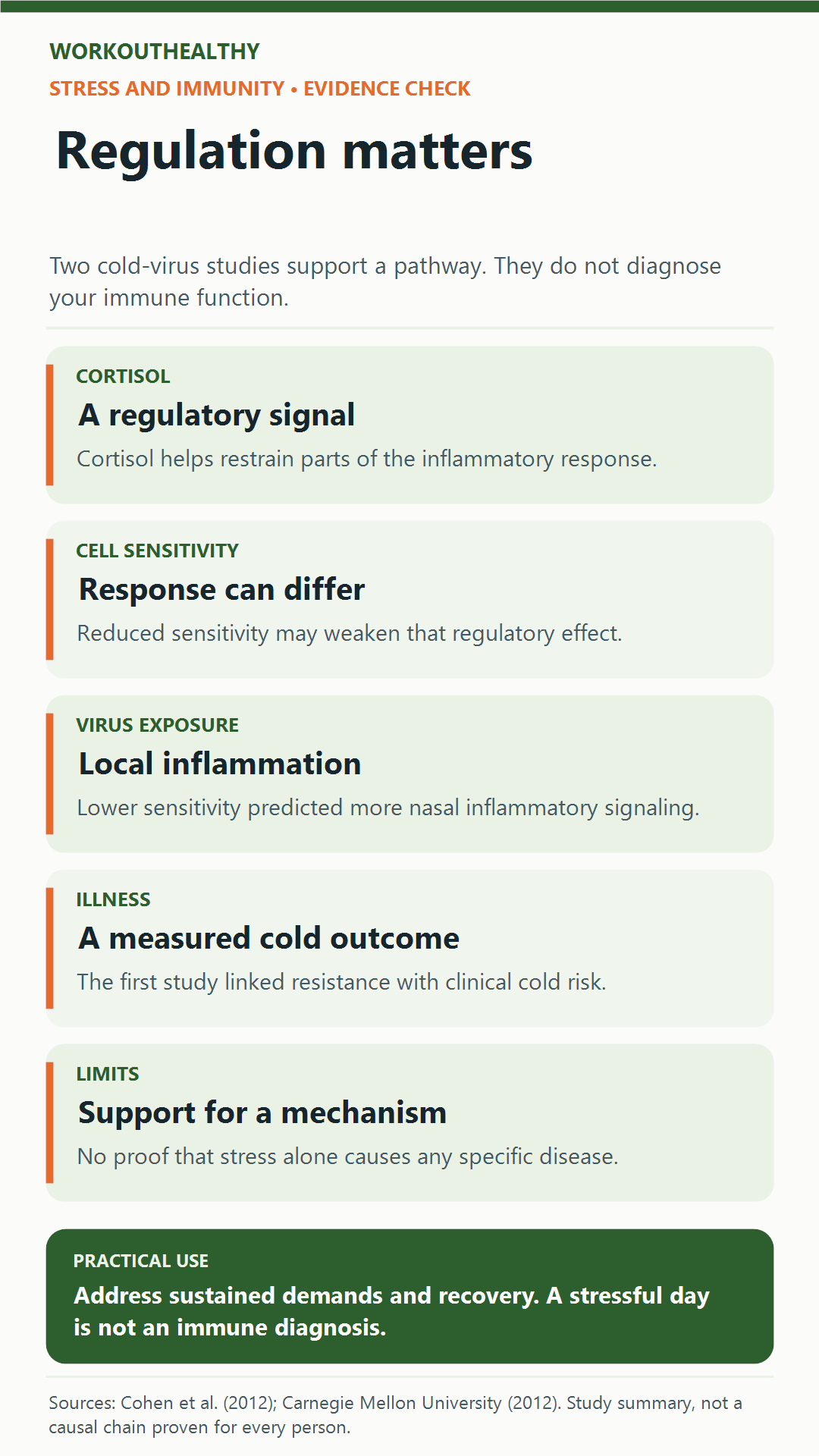
If you have a health concern, describe the symptoms and circumstances to a qualified professional. A mechanism from a paper is useful context, not a diagnosis to bring to the appointment as a settled fact.
Why the mouse experiment needs its own explanation
The 2020 mouse study involved a different signaling system: beta-2 adrenergic receptors, associated with adrenaline and noradrenaline signaling. It was not a repeat of the human cortisol-responsiveness experiments.
One experiment used a receptor-stimulating drug before and during infection; another compared receptor-deficient and control mice. The primary paper reports different outcomes for these different comparisons.
That is why a survival percentage needs its comparator, species and intervention attached. A number from experimentally infected mice cannot be converted into your chance of catching or recovering from a human virus.
The work helps investigate biological mechanisms, while leaving human treatment questions open. It does not establish that changing a medicine, taking a supplement or practicing relaxation reproduces the result in people.
Stress timing and wound healing add context
Dhabhar’s 2014 review explains that short and prolonged stress responses can have different immune effects. The timing, cells and type of response matter, so “all stress is harmful” is also too simple.
This does not make acute stress universally beneficial or establish a fixed number of stressful days that diagnoses immune dysfunction. The cold paper’s assessment concerned experiences rated for long-term threat, not a rule that every busy afternoon produces the same pathway.
The wound-healing study asked another question entirely. Eleven dental students received a small palate wound during vacation and another before examinations, with healing taking about three days, or 40 percent, longer during the exam period.
Every participant experienced the vacation condition first, so order was not randomized. “Forty percent longer to heal” describes time in that small study, not a universal percentage reduction in healing speed.
If you are recovering from a procedure, discuss your actual recovery needs with your clinical team. Help with appointments, caregiving or work may be more relevant than trying to calculate a healing delay from a stress score.
A quick way to check an immune-health claim
Use this comparison when an article or product makes a large promise from a small finding. The examples are editorial interpretations of common claim patterns, not quotations from patients or study participants.
| Claim pattern | Question to ask | A more careful conclusion |
|---|---|---|
| A hormone change proves weak immunity. | Was hormone amount measured, cell responsiveness tested or illness actually observed? | Name the measurement without converting it into a diagnosis. |
| A mouse survival result predicts your risk. | Which species, infection, intervention and comparison produced the percentage? | Keep the result within the experimental model. |
| Less stress means fewer infections. | Did a stress-management trial measure infections, or did an observational study examine a pathway? | A mechanism alone does not prove prevention. |
| Getting sick means recovery habits failed. | Does the evidence establish the cause of this individual’s illness? | Do not use illness as a judgment about someone’s coping. |
The same discipline applies to everyday technology claims. Our article on social media, stress and immunity explains why a multitasking experiment cannot establish an immune outcome it did not measure.
Make a stress plan about daily function
Taking persistent demands seriously does not require turning your day into an immune-repair project. Begin with a practical problem you can describe, then decide what support or change would make it more manageable.
The examples below are planning illustrations, not tested treatments for glucocorticoid resistance. Their purpose is to make the next step observable without using illness as the score.
| Situation | One possible next step | Useful review question |
|---|---|---|
| Work messages repeatedly interrupt your evening. | Discuss expectations and an agreed response window where feasible. | Did the agreement reduce interruptions? |
| A caregiving task leaves no transition between responsibilities. | Ask whether a specific task can be shared or scheduled differently. | Was help available, and what barrier remains? |
| A relaxation practice feels uncomfortable or becomes another obligation. | Choose a more tolerable approach or discuss suitable support. | Does the approach fit your day without adding pressure? |
NCCIH describes several relaxation approaches, including guided imagery, progressive muscle relaxation and breathing techniques. Evidence varies by condition, and relaxation should not replace care for a medical problem.
Breath-focused practice is optional, and forcing a method that makes you feel worse is not a requirement. Our box-breathing guide covers that specific technique and its limitations separately.
A short note about what helped and what remained difficult is enough for a practical review. Having a cold during that period does not prove failure, and avoiding one does not prove that a cellular pathway was repaired.
When to seek more support
If stress persists, is hard to manage or interferes with daily responsibilities, seek professional support. New or concerning physical symptoms deserve assessment rather than an automatic explanation of stress.
Bring concrete information: what is happening, how long it has lasted, what daily activities have become harder and what you have already tried. Ask what assessment or support fits, and how to follow up if the first approach is not enough.
The useful message is to take sustained demands seriously while keeping health claims tied to their actual evidence. You do not have to eliminate every stressor before you deserve care.
Get the next evidence check.
Five practical fitness stories worth your time, every Friday.
One email a week. No product pitches. Unsubscribe in one click.
Sources and further reading
- Cohen et al. (2012), Chronic stress, glucocorticoid receptor resistance, inflammation, and disease risk. Human cold-challenge studies.
- Carnegie Mellon University (2012), How stress influences disease. The university’s explanation of the human research.
- Wieduwild et al. (2020), beta-2 adrenergic signals downregulate the innate immune response and reduce host resistance to viral infection. A mouse infection model.
- Dhabhar (2014), Effects of stress on immune function. Review of timing and context.
- Marucha et al. (1998), Mucosal wound healing is impaired by examination stress. A small dental-student study.
- NCCIH, Relaxation techniques: What you need to know. General guidance, evidence and cautions.
- NCCIH (2024), Mind and body approaches for stress. Official evidence summary.
Medical disclaimer: This article provides general health information, not medical advice or a diagnosis. Discuss persistent stress, symptoms or health concerns with a qualified health professional who can assess your circumstances.