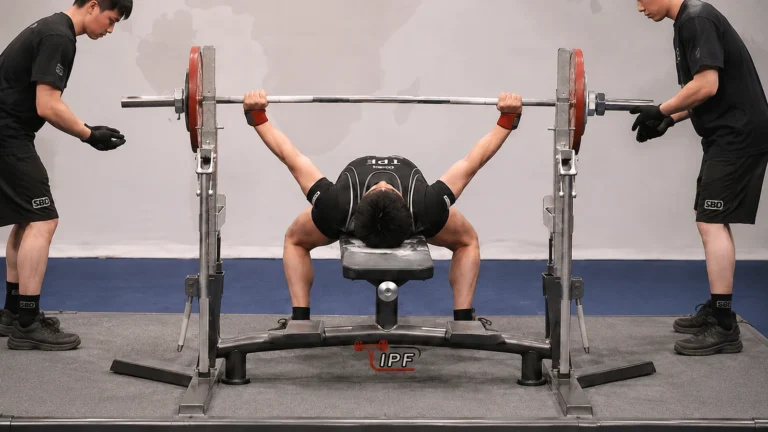

Chad Wesley Smith’s strength block is a bridge between higher-volume hypertrophy work and the highly specific demands of a powerlifting peak.
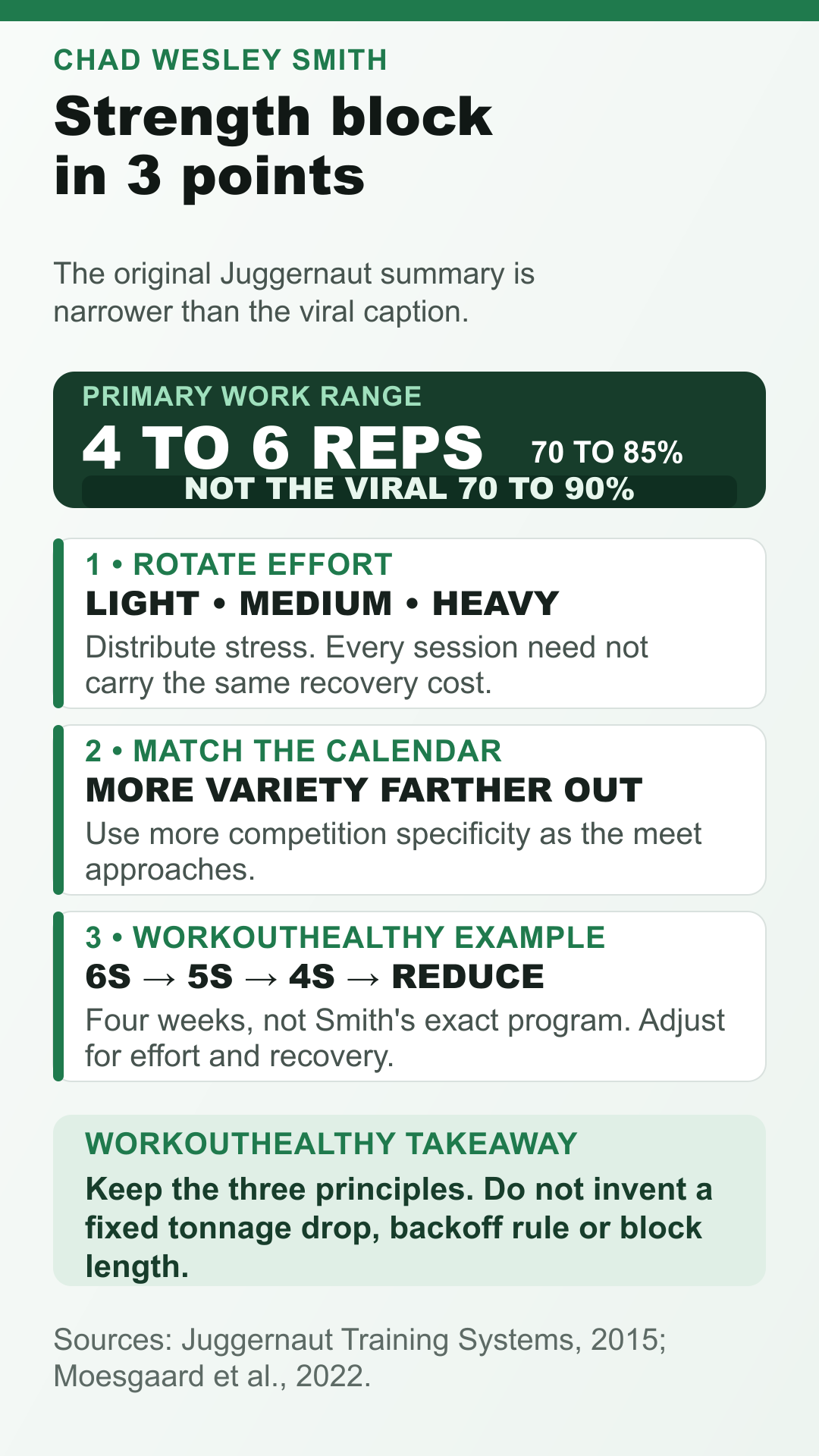
The original Juggernaut Training Systems source recommends 4 to 6 reps at roughly 70 to 85 percent, not a universal 3 to 6 reps at 70 to 90 percent.
The core idea is simple: intensity rises, the competition lifts matter more, and training stress still has to be recoverable.
Smith also recommends rotating relatively light, medium, and heavy efforts and using more exercise variation when the meet is farther away.
The Short Answer
A strength block concentrates on expressing more force in the lifts that matter.
It usually follows a hypertrophy phase and precedes a peaking phase, but those labels describe training priorities rather than rigid formulas.
Smith’s published summary gives three takeaways: work mainly in the 4 to 6 rep range at 70 to 85 percent, rotate light through heavy efforts, and allow more variation when competition is distant.
Everything else must be fitted to the lifter, calendar, and response to training.
A strength block should raise the force you can express while leaving enough recovery to practice the lifts that matter.
How a Strength Block Works
What a Strength Block Is Supposed to Change
A hypertrophy block generally tolerates more repetitions, more exercise variety, and more total volume because its main goal is building tissue and work capacity.
A strength block shifts the balance toward heavier practice while preserving enough volume to keep adaptation moving.
The peaking phase is different again.
It prepares a lifter to express a one-repetition maximum under competition standards while accumulated fatigue falls.
These phases overlap because muscle does not disappear when the rep range drops, and strength does not switch off during hypertrophy work.
The block label tells you which quality receives the strongest emphasis, not the only adaptation that can occur.
The Correct Rep and Percentage Range
The scheduled Facebook caption widens Smith’s range to 3 to 6 reps at roughly 70 to 90 percent.
Juggernaut’s own published summary is narrower: 4 to 6 reps at 70 to 85 percent.
That distinction matters because 90 percent is usually near a three-repetition maximum for many lifters and creates a different fatigue profile from 70 to 85 percent work.
Smith’s range leaves more room for repeatable technique practice and enough total repetitions to build strength without simulating a peak every week.
Percentages are starting points rather than biological guarantees.
The number of repetitions a lifter can perform at a given percentage varies with the exercise, training history, body proportions, and current readiness.
Why Light, Medium, and Heavy Rotation Matters
Smith recommends rotating relatively light, medium, and heavy efforts to facilitate recovery.
That can happen across sessions in one week or across successive weeks, depending on training frequency.
The purpose is not novelty for its own sake.
It is to expose the lifter to meaningful intensity without asking every session to carry the same recovery cost.
A heavy squat day and a medium bench session may coexist comfortably, while repeated heavy exposures for all three lifts can bury technical quality.
Rotation lets the program distribute stress rather than merely count sets.

Specificity and Variation
Competition Lifts Still Need to Anchor the Block
Powerlifting measures the squat, bench press, and deadlift under defined rules, so the strongest transfer comes from practicing those lifts or very close versions of them.
Research on resistance training consistently finds that strength gains are specific to the trained task, joint angles, and movement pattern.
That does not mean every session must use the exact competition version.
It means variations should solve a reasoned problem without replacing the skill the athlete will eventually be tested on.
A paused squat can reinforce control at depth, and a close-grip bench can add pressing volume while changing the demand.
The variation earns its place only if it supports the competition lift or manages fatigue better than another dose of the competition movement.
How Much Variation Belongs in the Plan
Juggernaut’s summary says more variation is useful farther from a meet because it can reduce staleness, manage specific fatigue, and support higher volumes.
As competition approaches, the plan should usually become more specific.
The caption lists high-bar, paused, and safety-bar squats, then several bench and deadlift variations.
Those are reasonable examples, but they are a menu rather than a required checklist.
Select one variation because it addresses a technical limitation, trains a weak range, or permits productive work with less irritation.
Adding every variation at once makes it difficult to learn which one helped.
Volume and Autoregulation
Does Volume Need to Fall to 75 Percent?
No universal rule says strength-block tonnage must equal three quarters of the preceding hypertrophy block.
Total repetitions often decline as load rises, but tonnage alone does not capture effort, range of motion, exercise difficulty, or recovery cost.
Use the hypertrophy phase as context, then adjust volume until bar speed, technique, and week-to-week performance remain stable.
A large lifter with years of training may need a greater reduction than an intermediate athlete who recovers quickly.
The strongest signal is not a predetermined percentage drop.
It is whether the lifter can complete the planned work, recover, and improve the targeted rep performance without accumulating persistent pain or regression.
Where RPE and Backoff Sets Fit
A top set at a planned rating of perceived exertion followed by lighter backoff sets is a useful way to autoregulate strength work.
It is not the only valid loading structure, and it is not the definition of Smith’s strength block.
Research suggests that load and volume autoregulation can improve strength at least as well as fixed percentage approaches in many settings.
The practical advantage is that the day’s work can reflect readiness instead of pretending that every Monday produces identical performance.
The caption’s 10 to 20 percent drop is a plausible range, but it should not be treated as a universal quote from the 2015 source.
Choose the reduction that turns the backoff work into crisp, repeatable volume rather than another disguised top set.
A Practical Four-Week Example
The example below applies Smith’s verified principles without claiming to reproduce his exact program.
It assumes an intermediate lifter with one primary exposure for each competition lift and additional lighter technique or variation work.
| Week | Primary work | Intent |
|---|---|---|
| 1 | 4 to 5 sets of 6 near 70 to 75 percent | Build repeatable volume and technique |
| 2 | 4 sets of 5 near 75 to 80 percent | Raise intensity while keeping clean reps |
| 3 | 3 to 4 sets of 4 near 80 to 85 percent | Practice heavier force production |
| 4 | Reduced sets at light to medium effort | Recover and evaluate the next block |
These percentages should move if the prescribed repetitions no longer match the intended effort.
A lifter who turns the final week into repeated grinders has created an early peak rather than a sustainable strength block.
How to Choose the Main-Lift Variations
Squat
Use the competition squat often enough to preserve setup, depth, and bar-path skill.
A paused squat can target loss of position at the bottom, while a high-bar or safety-bar variation can add leg work with a different torso and shoulder demand.
Bench Press
Keep competition-grip benching in the plan if meet performance is the goal.
Close-grip, longer-pause, feet-up, tempo, board, or assisted overload variations should be selected for a specific range or recovery need.
Deadlift
Competition pulls preserve setup and timing from the floor.
Paused, deficit, halting, block, or Romanian deadlifts can target different positions, but extra pulling volume becomes expensive quickly.
The best variation is not the most dramatic one.
It is the movement the lifter can repeat, measure, recover from, and connect to a known limitation.
Timing and Evidence
How Long Should the Block Last?
There is no single one-to-four-month prescription that fits every intermediate lifter.
Block length depends on the competition date, recent training, rate of progress, and how long the athlete can benefit before fatigue or staleness overtakes adaptation.
Four to eight weeks is a practical planning window, but it is an example rather than a law.
Beginners may need less formal sequencing, while advanced lifters often use more individualized exposures and longer calendars.
Our review of Sydney Hunter’s simple strength advice makes the same point in plainer language: progression depends on a repeatable plan, not a magic exercise list.
Consistency gives the coach enough data to decide whether the block is actually working.
What the Research Says About Periodization
A 2022 systematic review and meta-analysis found a small advantage for periodized training over non-periodized training for one-repetition maximum strength when total volume was equated.
Hypertrophy did not clearly differ between the approaches.
That result supports planned changes in volume and intensity, but it does not crown one block sequence as universally best.
Research studies use different populations, exercises, durations, and definitions of periodization.
Smith’s model works as a decision framework because it clarifies the priority of each phase.
The coach still has to match the framework to the athlete rather than force the athlete into a template.
The Difference Between Strength Work and Peaking
A strength block builds the quality that a peak later reveals.
The peak increases competition specificity and reduces fatigue so the lifter can express strength on one day.
A review of powerlifting tapers suggests reducing volume by roughly 30 to 70 percent while maintaining meaningful intensity, then using a short period of training cessation.
Those taper choices belong near testing or competition, not across every week of the strength block.
Trying to hit maximal singles throughout the strength phase can make normal training feel like repeated auditions.
The lesson in our fact-check of Arnold Schwarzenegger’s famous rep quote is relevant here: effort matters, but constant failure is not the same as productive training.
Who Should Use This Model
An intermediate powerlifter who has already built basic technique and muscle can use a strength block to convert that base into heavier, more specific performance.
It also suits general strength trainees who want a focused cycle without testing a max every week.
It is less appropriate as written for a true beginner who is still learning consistent setup and movement standards.
Beginners often progress well with a simple full-body or upper-lower plan and small, regular load increases.
Anyone training around persistent pain needs more than percentage changes.
Lou Schuler’s knee-injury training lessons show why exercise selection, range, and recovery should follow the person’s current capacity.
Bottom Line
Chad Wesley Smith’s verified strength-block guidance is narrower and more useful than the viral summary.
Build most work around 4 to 6 reps at 70 to 85 percent, rotate light through heavy stress, preserve the competition lifts, and use more variation when the meet is distant.
Do not turn the framework into fixed laws about 75 percent tonnage, a mandatory backoff percentage, or one block length.
The block succeeds when heavier, more specific practice improves while technique and recovery stay intact.
Watch the Original Video
Get the next evidence check.
Five practical fitness stories worth your time, every Friday.
One email a week. No product pitches. Unsubscribe in one click.
References
- Juggernaut Training Systems. (2015). Creating A Strength Block.
- Smith, C. W. (2015). Creating A Strength Block. YouTube.
- Moesgaard, L., Beck, M. M., Christiansen, L., Aagaard, P., & Lundbye-Jensen, J. (2022). Effects of periodization on strength and muscle hypertrophy in volume-equated resistance training programs: A systematic review and meta-analysis. Sports Medicine, 52(7), 1647–1666. https://doi.org/10.1007/s40279-021-01636-1.
- Morrissey, M. C., Harman, E. A., & Johnson, M. J. (1995). Resistance training modes: Specificity and effectiveness. Medicine & Science in Sports & Exercise, 27(5), 648–660. https://doi.org/10.1249/00005768-199505000-00006.
- Hickmott, L. M., Chilibeck, P. D., Shaw, K. A., & Butcher, S. J. (2022). The effect of load and volume autoregulation on muscular strength and hypertrophy: A systematic review and meta-analysis. Sports Medicine – Open, 8, 9. https://doi.org/10.1186/s40798-021-00404-9.
- Travis, S. K., Mujika, I., Gentles, J. A., Stone, M. H., & Bazyler, C. D. (2020). Tapering and peaking maximal strength for powerlifting performance: A review. Sports, 8(9), 125. https://doi.org/10.3390/sports8090125.
- Currier, B. S., McLeod, J. C., Banfield, L., Beyene, J., Welton, N. J., D’Souza, A. C., Keogh, J. A. J., Lin, L., Coletta, G., Yang, A., Colenso-Semple, L., Lau, K. J., Verboom, A., & Phillips, S. M. (2023). Resistance training prescription for muscle strength and hypertrophy in healthy adults: A systematic review and Bayesian network meta-analysis. British Journal of Sports Medicine, 57(18), 1211–1220. https://doi.org/10.1136/bjsports-2023-106807.
- Refalo, M. C., Helms, E. R., Trexler, E. T., Hamilton, D. L., & Fyfe, J. J. (2023). Influence of resistance training proximity-to-failure on skeletal muscle hypertrophy: A systematic review with meta-analysis. Sports Medicine, 53(3), 649–665. https://doi.org/10.1007/s40279-022-01784-y.
Medical disclaimer: This article is for general information only and is not medical advice. If you have an injury, ongoing pain, or a medical condition, talk to a doctor or physical therapist before you change how you train or eat.