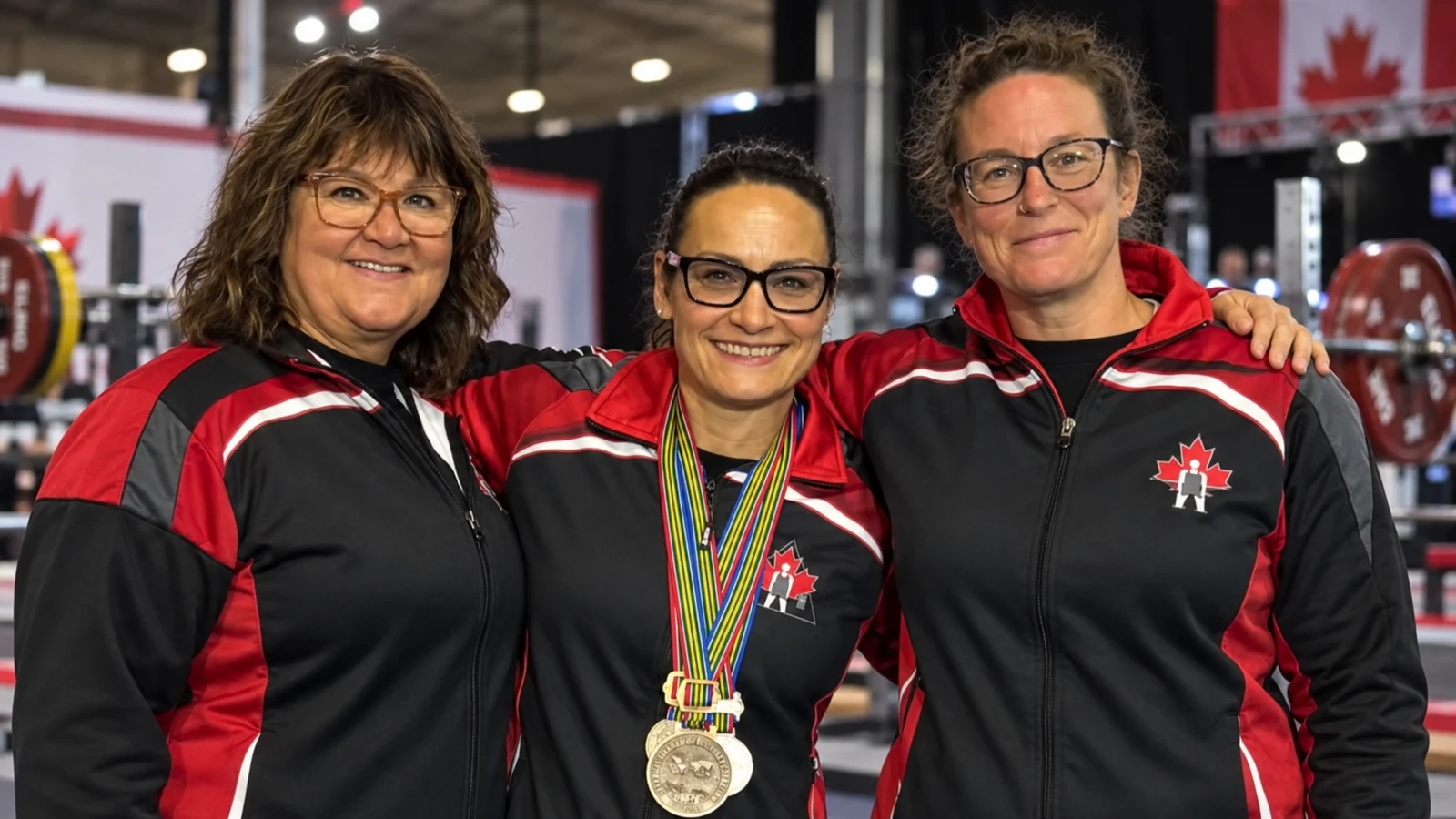

Three Saskatchewan lifters stood on the podium at the 2025 International Powerlifting Federation World Masters Championships in Cape Town. Sherry McEachern won silver. Sandi Klempner and Emmannuelle Archambault won bronze in their respective weight and age classes.
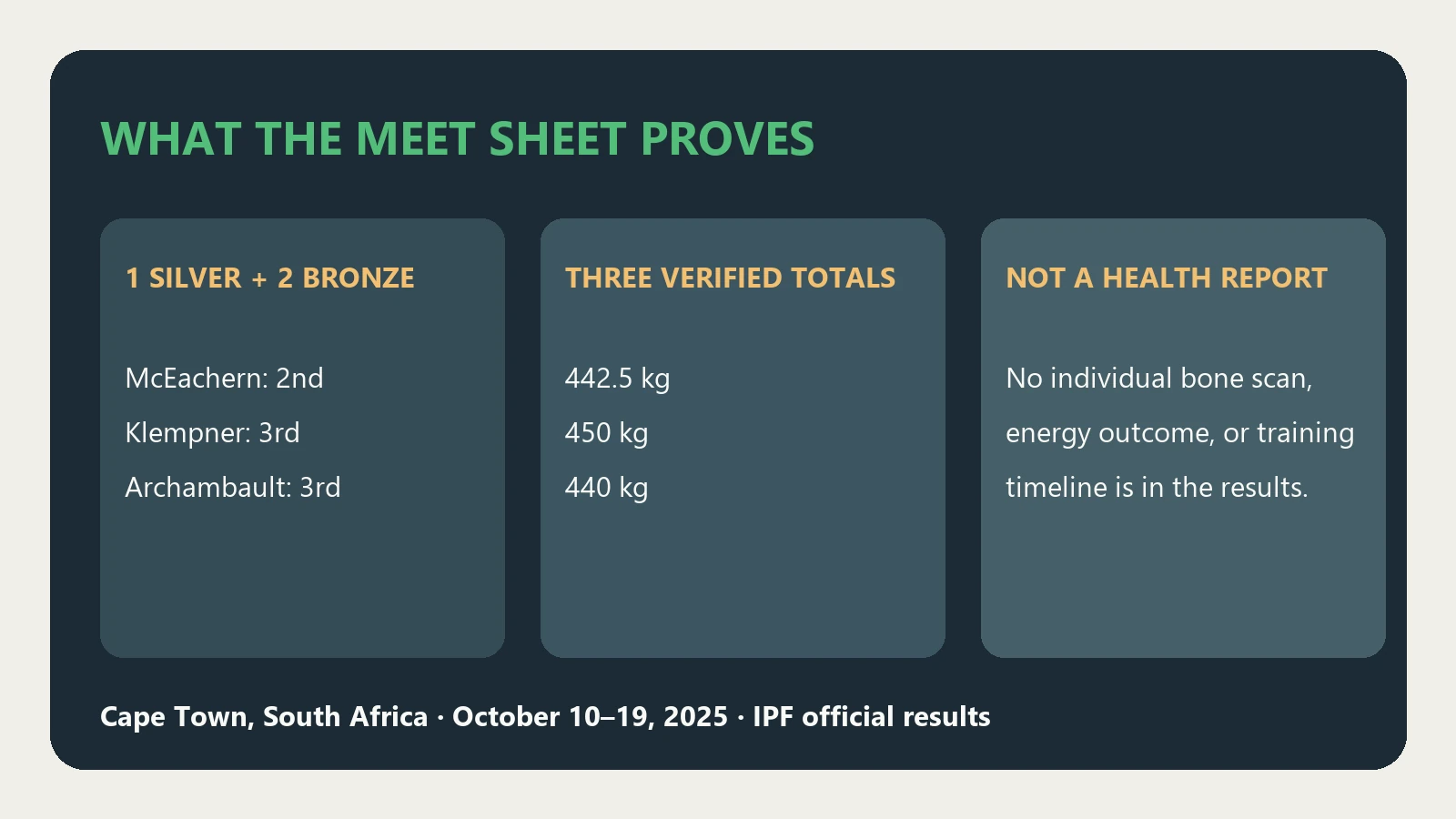
The event took place October 10–19, 2025. The date matters: this is a documented championship result, rather than a new October 2026 record. The IPF’s official women’s classic scoresheet lists each athlete, successful lifts, total, and placing.
A social post about the trio also describes their family lives, training histories, and personal health changes. Those claims may be meaningful, but the official result sheet cannot verify them. Here is the achievement we can check, followed by the training lesson that does not require inventing their stories.
The Three Verified Results
In classic powerlifting, a total is the best successful squat, bench press, and deadlift added together. Competitors are ranked within their own age and body-weight classes, so three medals here do not mean the three women competed against one another.
The official IPF scoresheet records these best lifts. The table uses kilograms because that is how the meet reports results; pound figures below are conversions rounded to one decimal place.
| Lifter | Class | Squat | Bench | Deadlift | Total | Place |
|---|---|---|---|---|---|---|
| Sherry McEachern | Masters 2, 84+ kg | 167.5 kg | 90 kg | 185 kg | 442.5 kg | 2nd |
| Sandi Klempner | Masters 1, 84 kg | 175 kg | 97.5 kg | 177.5 kg | 450 kg | 3rd |
| Emmannuelle Archambault | Masters 1, 76 kg | 145 kg | 97.5 kg | 197.5 kg | 440 kg | 3rd |
Combined, their three competition totals add to 1,332.5 kilograms. That arithmetic is a useful way to appreciate the amount of lifting represented, although combined totals are not an IPF team ranking. Each podium place belongs to its own class.
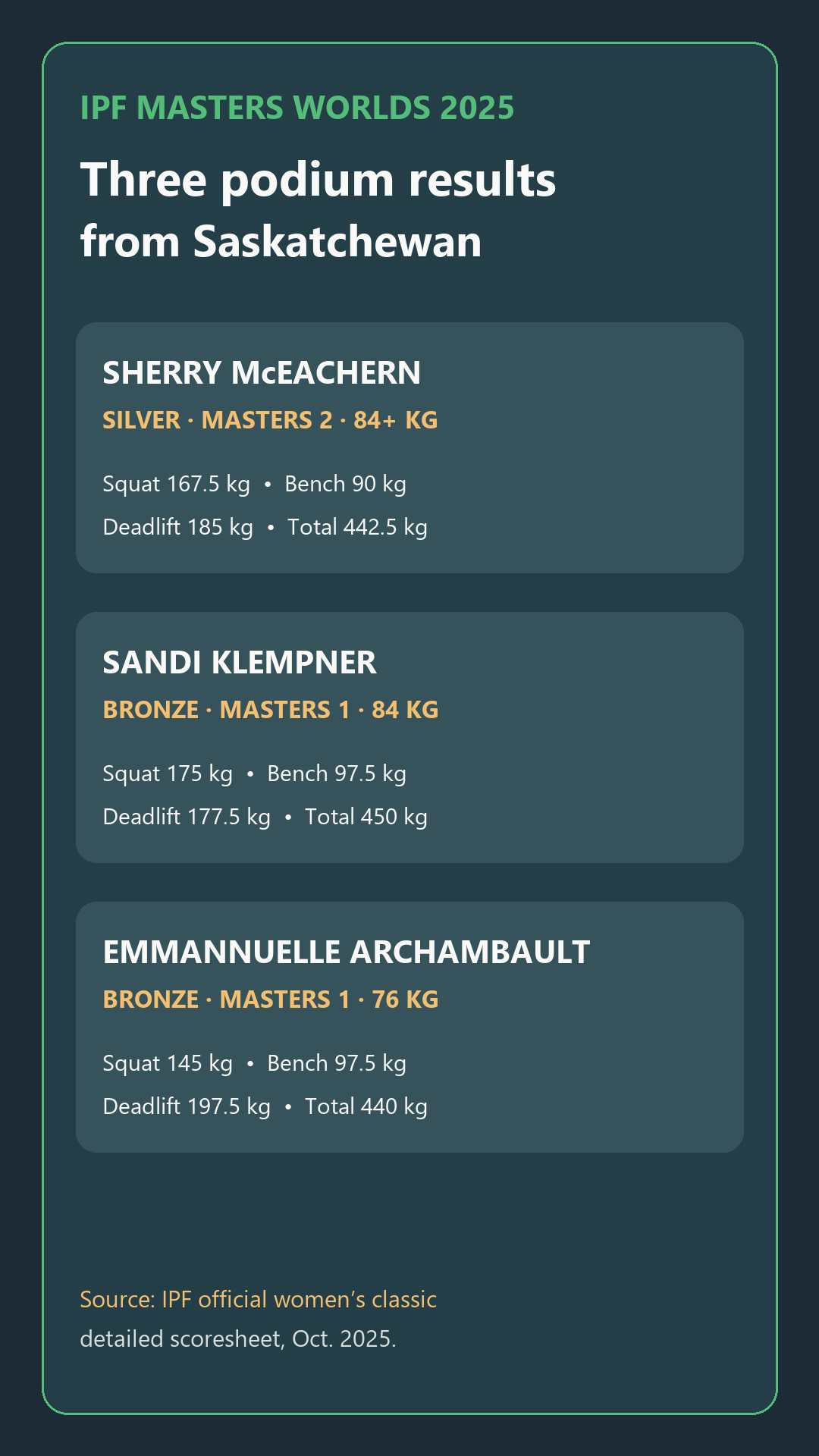
One silver and two bronze medals are confirmed by the meet sheet. The bigger story needs no unverified biography to make it impressive.
Sherry McEachern’s Silver
McEachern competed in the women’s Masters 2, 84+ kilogram class. Her best squat was 167.5 kilograms, her bench press was 90, and her deadlift was 185. That produced a 442.5-kilogram total and second place.
Her deadlift converts to about 407.9 pounds. That is well above the “300-plus pound” shorthand in the Facebook image, but it is the precise meet result that matters. A lift counted only after passing the judges’ standards, not merely because the bar left the floor.
The scoresheet lists her year of birth as 1967, placing her in the age band represented by Masters 2. The social image describes her as 58, which is consistent with the year of the 2025 championship, depending on her birthday.
What the meet sheet does not establish is how long she had trained before Cape Town. A claim that she entered the sport only two years earlier needs an interview or other independent documentation. Her silver medal stands on its own without that origin story.
Sandi Klempner’s 391-Pound Deadlift and Bronze
Klempner competed in Masters 1 at 84 kilograms. Her best squat was 175 kilograms, bench press 97.5, and deadlift 177.5. Her 450-kilogram total placed third in the class.
Multiply 177.5 kilograms by 2.20462 and the deadlift is approximately 391.3 pounds. The social post’s “over 390 pounds” claim is therefore supported by the official result. The 450-kilogram total also represents almost 992 pounds across the three best lifts.
That total is not a single lift, and it should not be described that way. Powerlifting rewards the full competition: successful squat, bench, and deadlift attempts, sensible attempt selection, and a total large enough to stay on the podium.
The scoresheet gives her birth year as 1983. A precise age on meet day cannot be calculated from a birth year alone. The caption says 42; the result we can independently verify is her Masters 1 bronze and the lifts that earned it.
Emmannuelle Archambault’s Bench and Bronze
Archambault competed in Masters 1 at 76 kilograms. She squatted 145 kilograms, benched 97.5, and deadlifted 197.5. The resulting 440-kilogram total secured third place in her class.
Her bench press converts to about 214.9 pounds, matching the widely circulated figure. Her deadlift was approximately 435.4 pounds, the largest deadlift of the three Saskatchewan totals listed here. Those are two different lifts; the meet sheet makes the distinction clear.
The caption calls the bench a Canadian record. A current record table cannot alone prove what the record was on the day of the 2025 meet, and record claims depend on the exact age, weight, and equipment division. The verified claim is strong enough: a 97.5-kilogram bench contributed to a world championship bronze.
Archambault’s birth year is listed as 1976, consistent with the social post’s age-49 framing for 2025. As with the other athletes, an exact age on the competition date requires a full date of birth that the public scoresheet does not provide.
What the Social Caption Cannot Prove
The Facebook post calls all three women mothers and adds details about occupations, personal barriers, years in the sport, and changes in energy or bone density. None of those facts appears in the IPF results table. They should not be repeated as verified athlete biography without direct interviews or reliable reporting.
Bone density in particular is an individual medical measurement. A medal, even an impressive one, does not show a person’s bone scan before and after training. Population research can help answer whether resistance training may support bone health, but it cannot tell us what happened to any of these three athletes.
It is also easy to mistake a world championship medal for a world record. The official sheet records the trio’s places and lifts; it does not identify their performances as three world records. The article title therefore says exactly what happened: three women won medals at Masters Worlds.
These limits improve the story. They give readers real names, classes, weights, and podium finishes instead of an inspirational caption that is difficult to audit.
What a Masters World Medal Means
Masters competition groups adults by age, while weight classes further narrow whom each athlete competes against. A bronze in Masters 1 is a placing in that division, not a ranking among every lifter at the event. Likewise, McEachern’s Masters 2 silver reflects her own class.
The competition still demands substantial skill. Lifters must train the three lifts, choose attempts within the rules, and perform under meet-day pressure. The final total depends on lifts that judges accept, not on gym estimates or partial repetitions.
That is why the figures on the official sheet are more useful than a dramatic pound figure alone. The totals show rounded strength across squat, bench, and deadlift. The placings show how that strength compared with peers in the same category.
For another example of how a single powerlifting number needs its class and context, see our report on Jennifer Thompson’s 142.5-kilogram bench record. Precise event and division labels make major achievements easier to understand, rather than less exciting.
What Strength Research Can Say Beyond the Platform
World championship lifting is a sport, and it is not a health prescription for the average reader. Still, the broader evidence gives a sound reason to take resistance training seriously throughout adulthood.
A 2023 systematic review and meta-analysis examined resistance training in adults aged 60 and older. It reported gains in measured muscle strength and several quality-of-life subscales, while finding no benefit for the six-minute walk distance or overall quality-of-life score. Those findings describe study groups, not the health histories of these medalists.
The U.S. Physical Activity Guidelines recommend muscle-strengthening activity on at least two days each week for adults. The recommendation does not require a competition barbell. Machines, free weights, body-weight movements, and other appropriately challenging forms can all be ways to train muscle.
Progress is also more specific than a general “age is no limit” slogan. A newer lifter may gain strength with a much lighter load than an international competitor uses. A person with pain, osteoporosis, or another medical concern may need a modified plan and qualified guidance.
Sydney Hunter’s advice on simple strength training is a useful companion for readers interested in consistency rather than a meet total. The connection to the Saskatchewan results is practical: repeated, measurable training is more useful than treating one spectacular lift as a starting target.
A Practical Way to Begin Strength Training Later
Start with movements you can perform under control: a squat or sit-to-stand pattern, a hinge, a push, a pull, and a carry. Choose a load you can move through a comfortable range while keeping technique steady. The first session should leave room to train again.
Two sessions a week can provide a workable starting rhythm. Record the exercise, load, repetitions, and how hard the set felt. After several successful sessions, add a small amount of weight or another repetition. Progress need not be dramatic to be real.
When equipment or time is limited, use the same principle with body weight, resistance bands, or a machine circuit. For someone who wants to compete, a knowledgeable coach and an established powerlifting club can help with lift commands, safe spotting, and a realistic first-meet plan.
Do not copy the exact loads in a world championship scoresheet. Those numbers reflect individual preparation and years of skill. The relevant lesson is that adults can build a training practice with goals they can measure, even if the goal is simply carrying groceries more comfortably.
Steve Shaw’s “PR-Zero” idea offers another useful prompt: stop waiting for the perfect plan before you begin. Starting small does not diminish what McEachern, Klempner, and Archambault accomplished. It makes their achievement a source of perspective rather than a demand for imitation.
The verified inspiration is specific: three athletes, three divisions, one silver, two bronze medals, and the judged lifts that put them there.
References
- International Powerlifting Federation. 2025 World Masters Powerlifting Championships results and women’s classic detailed scoresheet.
- Kashi SK, et al. Resistance training in adults aged 60 years or more: systematic review and meta-analysis. 2023.
- U.S. Department of Health and Human Services. Physical Activity Guidelines for Americans, 2nd edition. 2018.
Medical disclaimer: This article provides general information, not personal medical advice. Ask a qualified clinician or physical therapist about training changes if you have an injury, pain, or a medical condition.