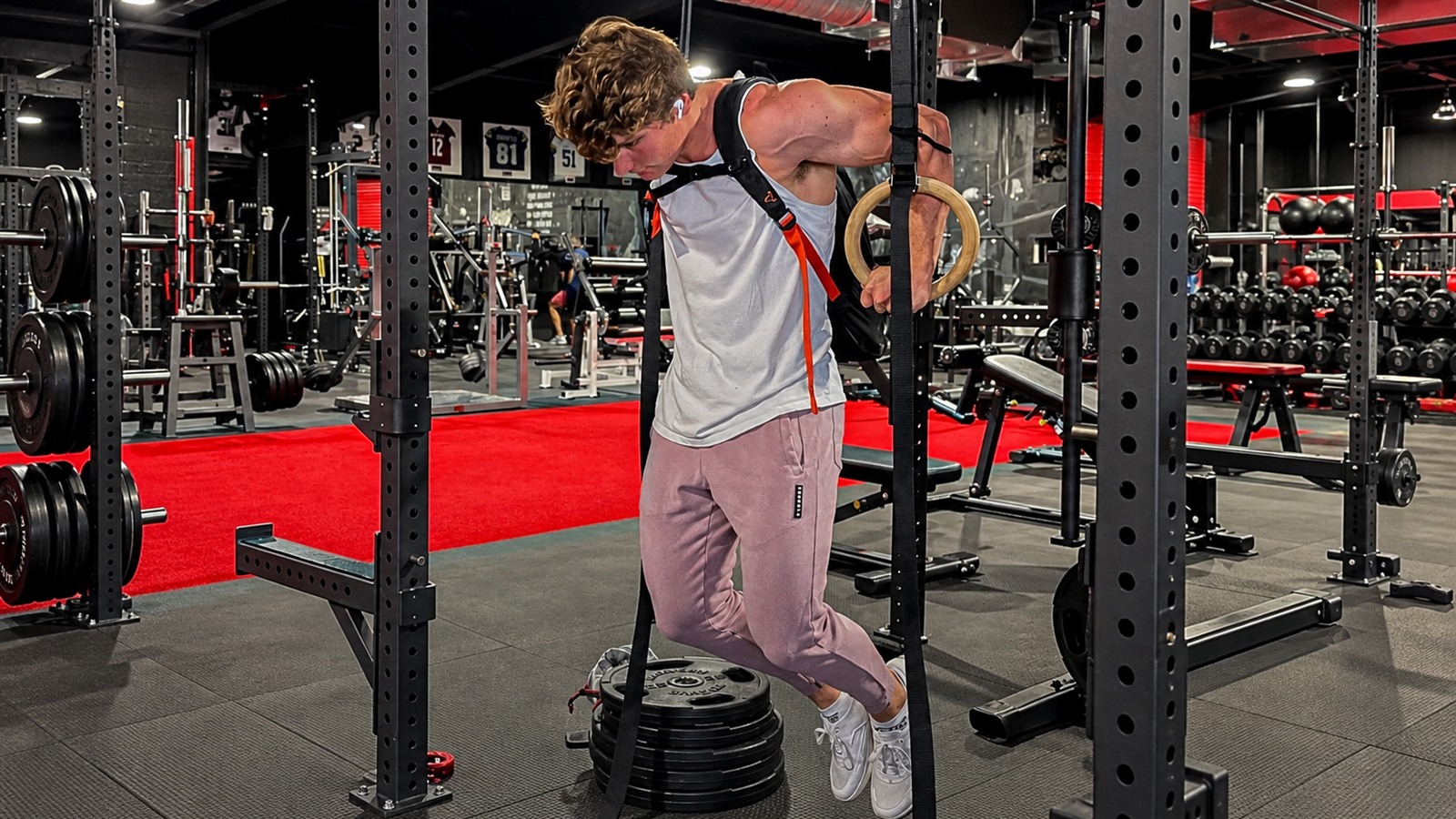

Jake Rintoul completed 312 ring dips while carrying a 100-pound (45.4-kilogram) pack in one hour in Fountain Valley, California, on July 27, 2024. Guinness World Records still lists that mark for the men’s category on its public page, although it warns that newer records may not appear online immediately.
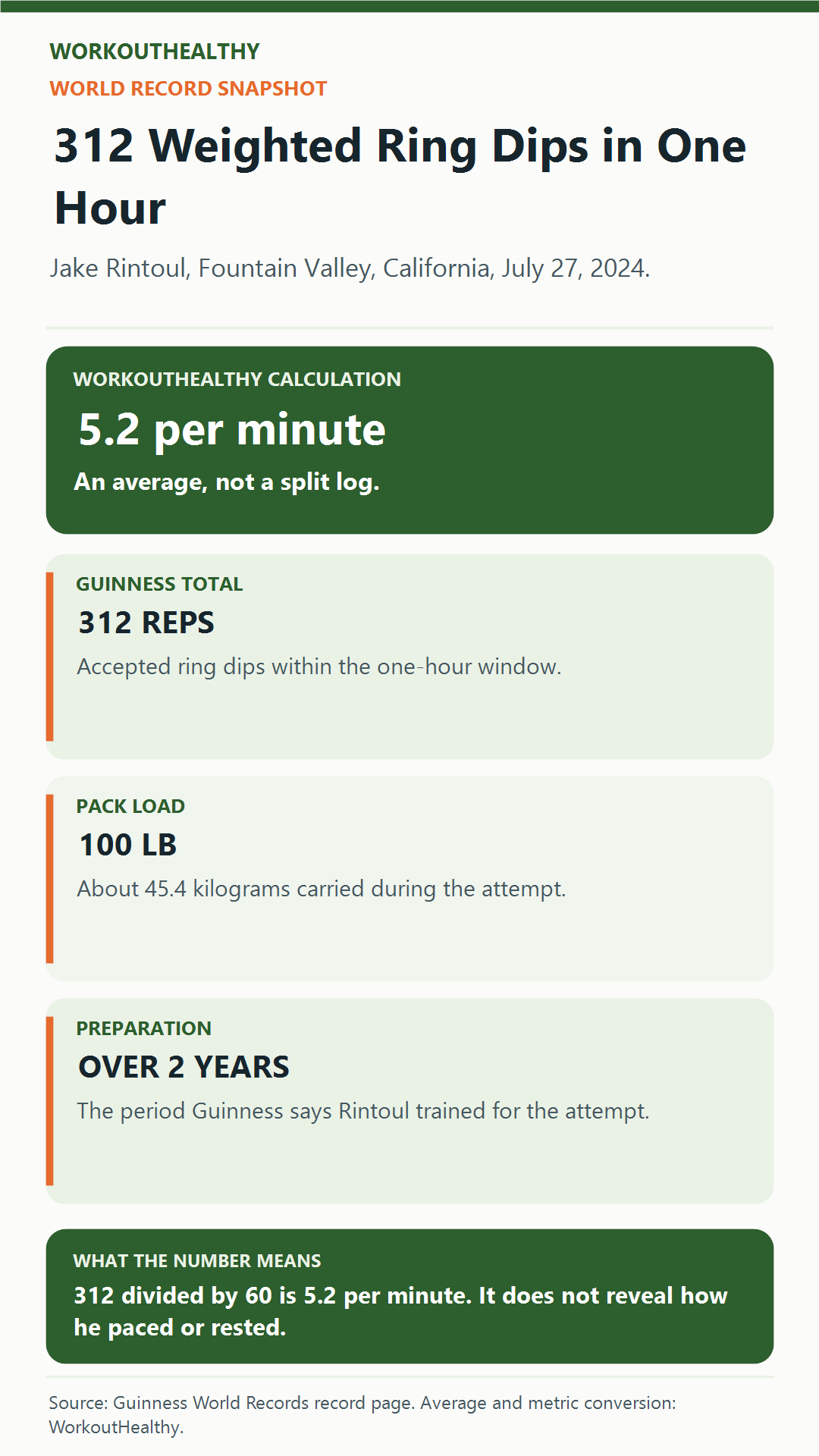
That is an average of 5.2 accepted repetitions per minute, or one every 11.54 seconds across the entire hour. Guinness also confirms that Rintoul trained for more than two years before the attempt.
The caption’s central number is correct. Its claim that he moved more than 66,000 pounds is not verifiable from the public record.
The record was not one enormous effort. It was 312 technically acceptable repetitions, paced well enough to survive the full hour.
Guinness Confirms 312 Repetitions
| Record detail | Verified information |
|---|---|
| Athlete | Jake Rintoul, United States |
| Record | Most ring dips carrying a 100 lb pack in one hour, male |
| Result | 312 accepted repetitions |
| Location | Fountain Valley, California |
| Date | July 27, 2024 |
| Current status | Listed by Guinness as the current record |
Guinness’s public page does not publish every judging detail, but the title specifies rings, a 100-pound pack, a one-hour window, and accepted repetitions.
Those constraints make the performance different from ordinary bodyweight ring dips, a maximum weighted dip, or an hour of dips on fixed parallel bars.
The category wording is important.
Guinness did not certify the heaviest single weighted ring dip or the most unweighted dips in an hour.
It certified a repetition count while the athlete carried the specified pack for the specified time.
The public summary does not say how many attempts were rejected, so 312 should be read as the accepted total rather than an estimate of every movement he made.
The Pace Was One Rep Every 11.54 Seconds
An average does not mean Rintoul performed a dip at exactly the same interval all hour. He could work in clusters, rest, and adjust as long as accepted repetitions accumulated before the clock expired.
At five reps per minute, he would finish with 300. His final total required an extra 12 repetitions beyond that already demanding pace.
The hard part of an hour record is preventing early speed from destroying the final quarter. Muscles fatigue, grip and support position become harder to control, and each transition back onto the rings consumes time.
Rintoul’s two years of preparation likely mattered most as accumulated specific tolerance, not as one secret session.
An hour also changes the role of rest.
Pauses are not evidence that the athlete failed to work continuously. They are part of pacing inside a fixed-time event.
The useful question is whether each work bout protected enough pressing strength and ring control for the next one.
Guinness counts accepted repetitions before the deadline, not uninterrupted motion for all 60 minutes.
The 66,000-Pound Claim Does Not Have a Defined Formula
The backpack alone contributed 31,200 repetition-pounds: 312 multiplied by 100 pounds. That arithmetic still does not measure mechanical work because it ignores movement distance.
A dip also moves much of the athlete’s body mass, but Rintoul’s bodyweight is not included on the public Guinness page. Adding an assumed bodyweight to every repetition would create a larger number without making it verified.
Even with bodyweight, “total load” would remain an estimate. The center of mass does not travel the same distance as the shoulders, and the feet, pack, and torso move through different paths.
The record total of 312 is the meaningful measurement. A dramatic tonnage figure adds less clarity than it appears to.
Rings Add a Stabilization Demand
Unlike fixed bars, rings can move apart, rotate, and swing. The athlete must keep them controlled while lowering and pressing the body.
A biomechanics study comparing bench, bar, and ring dips found that experienced exercisers used similar shoulder stabilization demands in ring and bar variations, with some muscle activation differences. The study involved only four bodyweight repetitions under low fatigue.
That protocol cannot be stretched into proof that 312 weighted repetitions are safe or superior. The authors specifically warned that added load and fatigue may raise injury risk.
Readers who want controlled tendon loading can review our guide to six-second isometric holds. A Guinness endurance attempt is a different training problem.
What the Official Count Lets Us Calculate
The official page provides a total and a one-hour time limit, not a rep-by-rep log. Dividing 312 by 60 produces an average of 5.2 accepted repetitions per minute, which is a summary of the finished attempt rather than a schedule Rintoul necessarily followed.
A pace of five accepted reps each minute would yield 300 by the deadline. To reach 312, the average had to be slightly higher across the hour, but the public record does not tell us when he banked those extra repetitions.
Ten-minute and quarter-hour splits would be interesting because fatigue can change a repetition attempt. Without an official split sheet, however, any claimed late surge, early burst, or exact rest period would be a story invented from one final number.
The record also reports accepted reps, not every time the athlete lowered himself. We cannot calculate a success rate because the page does not say whether a judge rejected any attempts.
These limits make the arithmetic more useful, not less. Readers can appreciate the sustained average while recognizing that a mean conceals the shape of a long performance.
Two Years of Preparation Are Not a Published Program
Guinness says Rintoul trained for more than two years before his attempt. That statement establishes a long preparation period, but it supplies no weekly schedule, progression, bodyweight, recovery plan, or coaching details.
Specific practice is a reasonable interpretation because the test demanded both ring control and pressing endurance with a fixed pack. It remains an interpretation, not a verified description of what he did each Monday or how he increased his load.
A coach preparing an athlete for a one-hour record would have to think about the event’s exact rules and the ability to keep making acceptable repetitions when tired. That does not mean every reader needs an hour-long dip session.
Progress also has several dimensions. A trainee may first need a steady support position, then a repeatable unweighted dip, then a carefully chosen amount of extra resistance, with fatigue managed along the way.
Those are possible stages in a general exercise progression, not milestones that Guinness attributes to Rintoul. His achievement cannot validate one universal sequence or a promise that two years of similar training will produce the same result.
Our push-up progression guide shows another way to think about pressing progress when maximal repetition counts are not the goal.
Why This Attempt Is Not a Workout Target
The biomechanics study in this article tested a few repetitions by experienced men who did not report a recent upper-body injury. Its measurements describe movement and muscle activity under those laboratory conditions, not injury rates during a weighted one-hour record.
In the study, two participants lacked regular ring-dip experience and were excluded from that variation. That detail alone is a warning against treating rings as an automatic next step after someone learns fixed-bar dips.
Adding a 100-pound pack and repeating the skill hundreds of times changes the task dramatically. The available study cannot tell us what load or volume would be suitable for an individual reader.
A sensible personal target starts with the reason for training. General upper-body strength, muscle gain, sport practice, and a judged endurance record can each favor a different exercise and dose.
Someone with shoulder symptoms, a recent injury, or uncertainty about technique should seek individualized guidance rather than use this article as a loading prescription. Pain is not evidence that a repetition is more effective.
Even a healthy exerciser gains little from comparing their routine directly with a specialized record attempt. The useful example is preparation matched to a clear test, while the exact performance remains Rintoul’s alone.
No Exact Record Video Was Reverified
No public video was matched with enough confidence to Rintoul’s complete official attempt, the correct date, the 100-pound pack, and the final Guinness count.
For that reason, this article does not embed a generic weighted-dip clip or a short social excerpt as proof of all 312 repetitions.
The record page establishes the result. Video would be useful only if the athlete, event, load, and continuous attempt could be confirmed.
What the Record Does Not Prove
The Guinness total measures accepted repetitions in one hour under this record title. It does not measure the safest way to train, the ideal number of dips for muscle growth, or Rintoul’s strength in another exercise.
The public record page does not publish his bodyweight, a minute-by-minute pace chart, or a full technical breakdown of every repetition. Those gaps matter when someone tries to turn the result into a total-load claim or a training prescription.
Our evidence review of low and high repetition training explains why more repetitions are not automatically better for every goal.
What is known is impressive on its own: Rintoul completed 312 accepted ring dips with a 100-pound pack in one hour after more than two years of preparation, according to Guinness.
Get the next evidence check.
Five practical fitness stories worth your time, every Friday.
One email a week. No product pitches. Unsubscribe in one click.
References
- Guinness World Records. (2026). Most ring dips carrying a 100 lb pack in one hour.
- McKenzie, A., et al. (2022). Bench, bar, and ring dips: Do kinematics and muscle activity differ?
Medical disclaimer: This article is for general information only and is not medical advice. If you have an injury, ongoing pain, or a medical condition, talk to a doctor or physical therapist before you change how you train or eat.