
Kerry Washington has described herself as a Pilates devotee and has trained with several well-known instructors across years of film and television work. She has also spoken about yoga and hiking, which makes the familiar story of strength plus stillness sound plausible.
The problem is that celebrity routines are often rewritten as perfect formulas. Pilates becomes the source of every physical result, yoga becomes guaranteed emotional clarity, and a flexible practice becomes an exact weekly schedule that the celebrity never published.
What Washington Has Actually Said About Pilates
Washington told Allure that she was a true Pilates devotee, and she told another interviewer that the practice felt like both a mind and body workout. A 2015 SELF profile described a long working relationship with Pilates teacher Julie Turner and a schedule that could range from two to six sessions in a week depending on production demands.
Washington has also worked with instructor Nonna Gleyzer. Gleyzer told Shape that Washington trained three or four times per week for about an hour when her schedule allowed, with sessions tailored around a previous neck and shoulder nerve problem.
Those accounts support consistency, individual coaching, and a focus on full-body movement. They do not support copying one fixed set of exercises because the teachers adjusted sessions for Washington’s condition, schedule, and current work.
The individualized approach is more important than the celebrity label. A movement that helps one person manage training around an old injury may be inappropriate for someone with a different diagnosis or no diagnosis at all.
Her Yoga History Is More Complicated Than Calm
Washington has practiced yoga, but she has also used a yoga memory to describe the pressure of comparison. In a 2023 Marie Claire interview, she recalled being in a shoulder stand in her twenties and looking around the room to see whether she was extending as high as other people.
That story is not a neat example of immediate peace. It shows that a mind-body practice can still become another place to compare appearance, ability, or worth.
Yoga may help some people notice breathing, attention, and tension, but the class does not automatically remove self-judgment. The way a person approaches the practice, the teacher, the environment, and existing mental-health needs all matter.
A recent meta-analysis of randomized trials in stressed adults found short-term reductions in perceived stress compared with passive controls, but it rated the evidence as low quality. Another review found possible benefits for anxiety symptoms while concluding that evidence for diagnosed anxiety disorders remained inconclusive.
That is enough to call yoga a possible support, not a treatment promise. A person with persistent anxiety, depression, trauma, or an eating disorder may need professional care alongside or instead of a class.
What Pilates Can and Cannot Promise
Pilates uses controlled movement, breathing, alignment, and progressive challenges that can improve skill and muscular endurance. Depending on the exercise, equipment, and difficulty, it can train the trunk, hips, shoulders, arms, and legs.
A 2024 systematic review of 13 studies reported evidence that Pilates may improve some posture-related outcomes, although only six studies were rated high quality or better and the authors called for more detailed research. Posture is also not one fixed ideal that every body must hold all day.
A separate systematic review comparing Pilates with other exercise found no clear advantage for dynamic strength, isometric strength, or muscular endurance. Pilates can build strength, especially for a beginner or through harder progressions, but it is not automatically superior to resistance training.
The phrase “lean muscle” is also misleading because exercise does not create a separate tissue type called lean muscle. Muscle can grow, strength can improve, and body fat can change, but the long, toned look associated with celebrity Pilates also reflects genetics, nutrition, lighting, clothing, and the person’s starting body.
Readers can explore the broader evidence in our article on Pilates for older adults. The findings are not limited to celebrities and help separate documented benefits from marketing promises.
Mindfulness Is a Skill, Not a Look
Washington has said a good workout can make her feel healthy, alive, and ready for the other parts of life that need her. That statement describes a personal experience, not a guarantee that every session will produce the same mood.
Mindfulness means paying attention to present experience with less automatic judgment. Pilates and yoga can create opportunities to practice it through breath, body sensation, and precise movement, but a person can also rush through either class while focused entirely on appearance.
The goal can therefore change the experience. Training to notice control, comfort, effort, and breathing is different from checking whether every movement makes the body look smaller.
This distinction connects with Elena Ramos Goode’s focus on mental fitness, where movement is valuable for what it supports beyond a mirror. It also leaves room for days when the practice feels ordinary rather than transformative.
Why Variety Can Help Without Becoming a Formula
Pilates, yoga, hiking, and conventional strength or cardio training create different demands. Pilates may emphasize controlled trunk and joint movement, yoga may include mobility, balance, breath, and sustained positions, and hiking develops locomotion and aerobic capacity.
Combining them can make a week more enjoyable and spread stress across different tissues and skills. It can also become too much if every activity is treated as mandatory or performed at a high intensity.
Washington’s reported routine changed with pregnancy, filming, injuries, travel, and available time. That flexibility is more realistic than assigning every day of the week a celebrity-approved class.
It also shows why frequency numbers need context. Two carefully coached sessions during a demanding production week may be more useful than six rushed sessions copied from an interview, and the right amount can change as sleep, soreness, work, and health change.
For beginners, skill usually improves before dramatic physical changes appear. Learning how to control the pelvis, ribs, shoulders, and breathing can make later progressions safer and more productive, even when the first several sessions do not feel like a hard calorie-burning workout.
Equipment does not settle the question either. A reformer adds springs, support, and many exercise options, while mat work uses body weight and gravity, yet either format can be easy or difficult depending on leverage, tempo, range, and coaching.
People with osteoporosis, recent surgery, pregnancy-related concerns, severe joint pain, or neurologic symptoms should seek qualified guidance before using advanced spinal flexion, loaded rotation, inversions, or aggressive stretching. A celebrity instructor’s cue cannot replace an assessment.
A person who wants greater maximal strength may need progressive resistance beyond Pilates. Someone preparing for a long hike needs enough walking and climbing, while a person who mainly wants a calming ritual may choose a gentler class and judge success by attendance rather than calories.
A Practical Pilates and Yoga Week
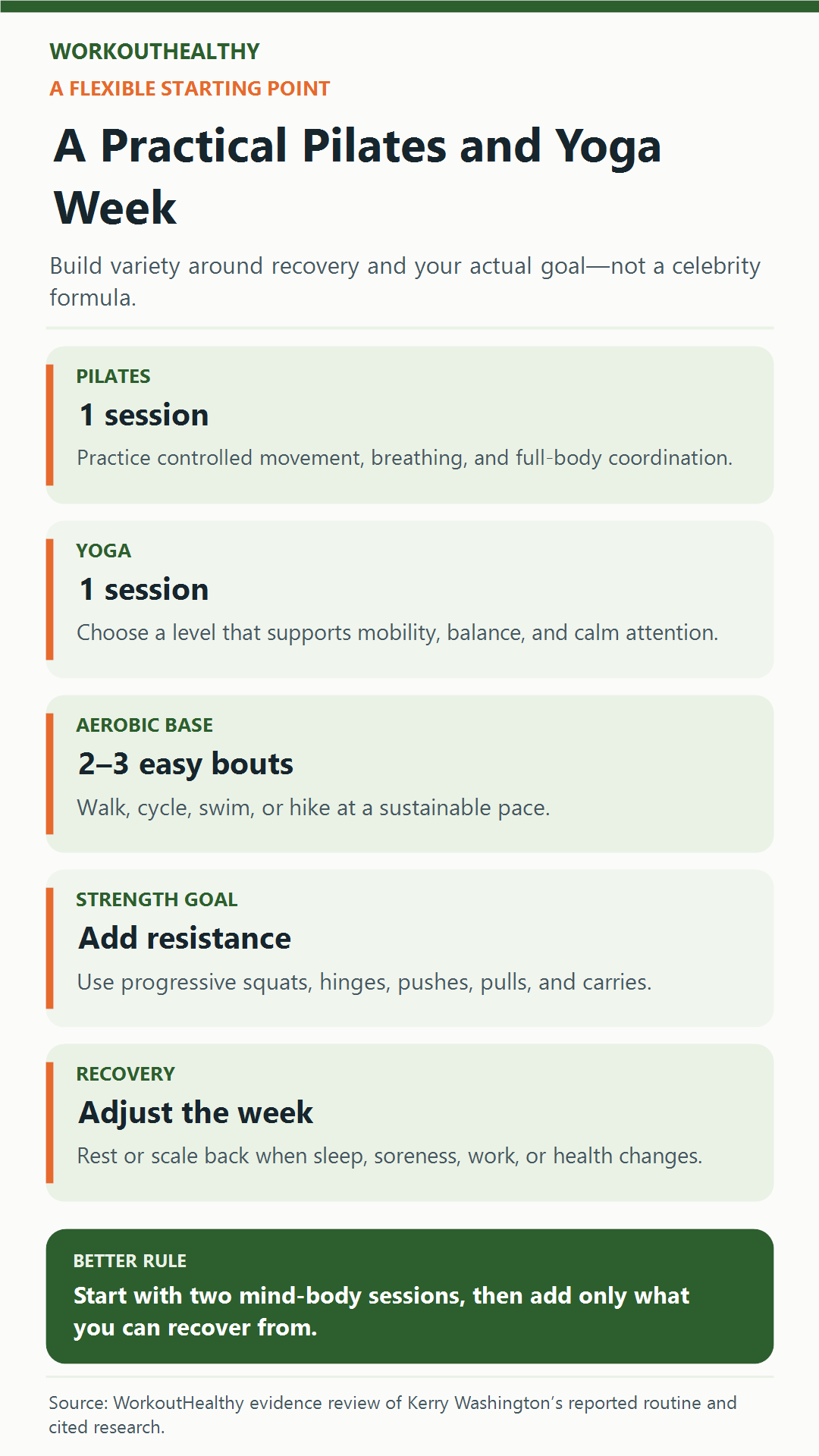
- Start with two sessions. One Pilates session and one yoga session can reveal how the body responds before adding more.
- Keep a separate aerobic base. Walking, cycling, swimming, or hiking can supply steady conditioning that a technique-focused class may not.
- Add resistance if strength is the goal. Progressively loaded squats, hinges, pushes, pulls, and carries can complement mat or reformer work.
- Choose progressions, not pain. Increase leverage, range, load, or control only when the current variation feels stable.
- Use breath as feedback. Breathing can help pace effort, but dizziness, chest symptoms, or sharp pain are reasons to stop.
- Protect recovery. A rest day, easier session, or short walk can support consistency better than forcing another demanding class.
The Better Lesson From Washington’s Routine
Kerry Washington’s long commitment to Pilates is real, and she has used yoga and other movement as parts of a broader life rather than as a single branded transformation. Her teachers have repeatedly emphasized tailoring work to the individual.
The evidence supports Pilates as a valid form of exercise and yoga as a possible tool for stress management. It does not show that the combination guarantees a particular body shape, cures emotional distress, or replaces all strength and aerobic training.
The most useful part of Washington’s example is the willingness to adjust. A sustainable routine can include precision and calm, but it should still serve the body, goal, and day of the person doing it.
Get the next evidence check.
Five practical fitness stories worth your time, every Friday.
One email a week. No product pitches. Unsubscribe in one click.
References
- SELF. (2015). Kerry Washington profile and Pilates routine.
- Allure. (2014). Kerry Washington on being a Pilates devotee.
- Marie Claire. (2023). Kerry Washington on identity and comparison in yoga.
- Li, F., Dev, R. D. O., Soh, K. G., and colleagues. (2024). Effects of Pilates on body posture. Archives of Rehabilitation Research and Clinical Translation.
- de Oliveira, N. T. B., and colleagues. (2022). Is Pilates better than other exercise for increasing muscle strength?. Heliyon.
- Schleinzer, A., Moosburner, A., Anheyer, D., and colleagues. (2024). Effects of yoga on stress in stressed adults. Frontiers in Psychiatry.
Medical disclaimer: This article is for general information only and is not medical advice. If you have an injury, ongoing pain, or a medical condition, talk to a doctor or physical therapist before you change how you train or eat.