
Walk into almost any gym and you will hear some version of the same claim.
Free weights are for real lifters, and machines are for people who do not know better.
It is a confident argument, and the research does not support most of it.
When scientists have actually compared the two over weeks of training, the results come out far closer than gym folklore predicts.
Here are six reasons machines deserve more respect, plus a clear answer about where free weights genuinely win.
The short version is that the tool matters much less than the effort you put through it.
Where the Free Weights Are Always Better Idea Came From
The claim is not invented from nothing.
Free weights require you to stabilize the load yourself, which recruits more supporting muscle and demands coordination that a fixed path does not.
That is a real difference, and nobody in the research disputes it.
The leap people make is assuming that extra stabilizing demand automatically means more muscle and more strength.
That is the part the studies have tested, and that is the part that does not hold up.
Extra stabilizer activity is a cost as well as a benefit, since those smaller muscles fatigue before the big ones do.
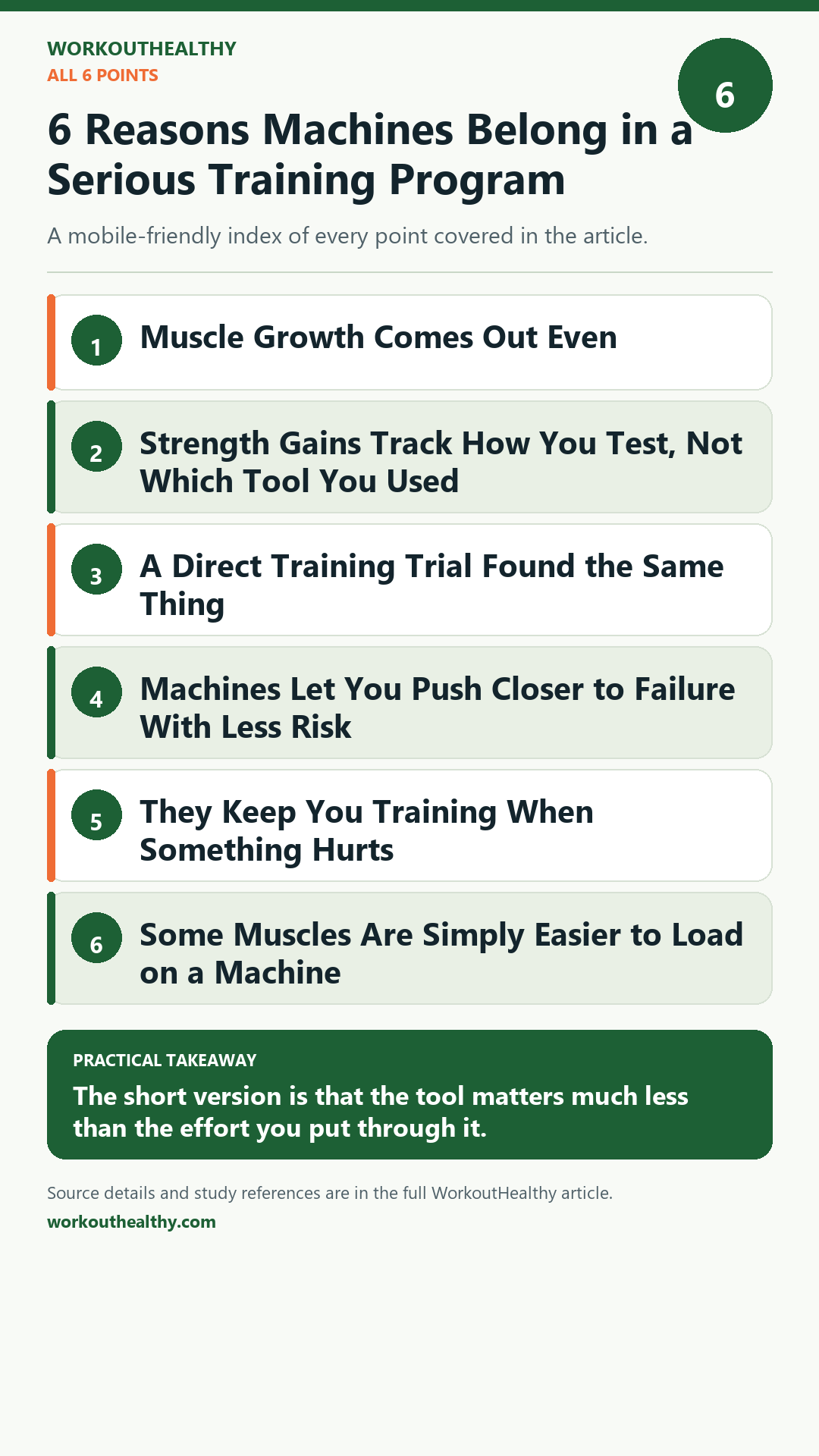
1. Muscle Growth Comes Out Even
This is the finding that ends most of the argument.
Haugen and colleagues pooled 13 studies covering 1,016 participants comparing free weight training against machine based training.
When they compared the two modes directly on muscle growth, there was no meaningful difference between them.
Heidel and colleagues reached the same conclusion in a separate meta-analysis, reporting no differences in hypertrophy between exercise modes.
Two independent research teams, two separate pools of studies, and the same answer.
If machines really built less muscle, this is exactly where that gap would have shown up.
Instead the muscle does not appear to know which piece of equipment moved it.
2. Strength Gains Track How You Test, Not Which Tool You Used
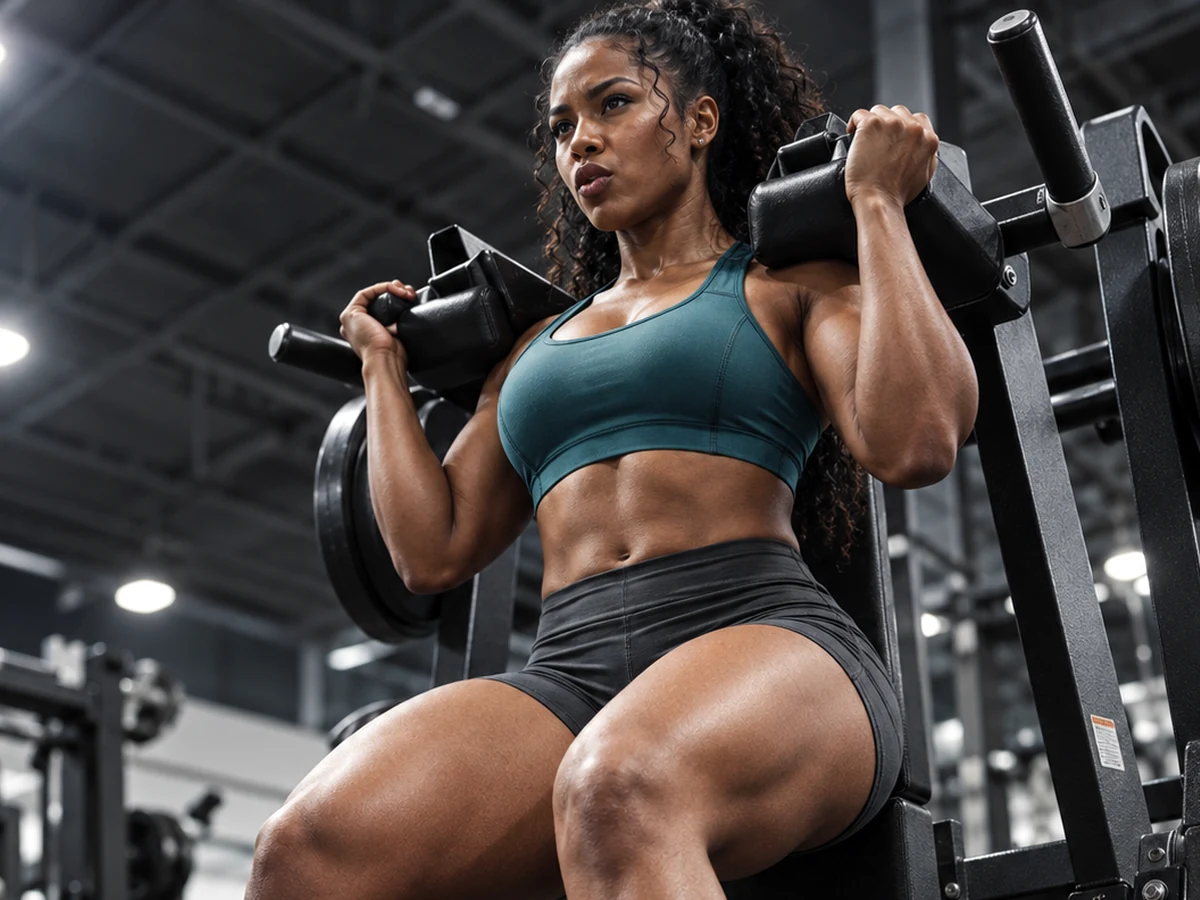
This is the most useful thing in the whole literature and almost nobody mentions it.
Heidel and colleagues found that people who trained with free weights gained more strength when tested on a free weight exercise.
People who trained on machines gained more strength when tested on a machine.
When strength was measured on a neutral device that favored neither group, the gains were similar.
In other words, you get good at the thing you practice, which is specificity rather than superiority.
Haugen’s group found the same pattern and concluded that strength changes are specific to the training modality.
This matters for how you choose, because the right question is what you want to be strong at.
A powerlifter should train the competition lifts, and someone who just wants to be stronger and bigger has no obligation to.
When the test is neutral, the tool stops mattering. Most of the free weights versus machines argument is really an argument about what people chose to measure.
3. A Direct Training Trial Found the Same Thing
Meta-analyses pool other people’s studies, so it helps to look at a single well run trial too.
Schwanbeck and colleagues randomized 46 participants, including 26 women, to train with either free weights or machines for eight weeks.
Biceps and quadriceps muscle thickness increased similarly in both groups.
Machine bench press strength rose more in the machine group, by 13.9 percent against 8.6 percent, which is the specificity effect again.
The authors concluded that training with free weights or machines produced similar increases in muscle mass and strength.
One trial is never the last word, but it lines up neatly with both meta-analyses.
4. Machines Let You Push Closer to Failure With Less Risk
Effort is one of the strongest drivers of muscle growth, and effort is exactly what people back away from when a set feels dangerous.
A leg press or a chest press can be abandoned mid rep without anything landing on you.
A barbell squat taken to genuine failure without a spotter or safety pins is a different situation entirely.
If you train alone, machines let you take the last few hard reps that actually change something.
That is not a compromise, it is often the difference between a productive set and a cautious one.
The same logic applies to drop sets and other techniques that need you to keep going after failure.
5. They Keep You Training When Something Hurts
Most training careers are interrupted by a cranky shoulder, a tweaked back, or a sore wrist rather than by lack of motivation.
A fixed path lets you load a muscle while working around the joint that is complaining.
You can train quads on a leg extension when a hip hurts too much to squat.
You can train the chest on a machine press when a barbell path aggravates a shoulder.
Our guide to squat alternatives by goal covers how to make those swaps without losing the training effect.
Weeks you do not lose are weeks that still count.
Consistency over years beats optimal equipment choices over a single month.
6. Some Muscles Are Simply Easier to Load on a Machine
This is where the caption’s promise about specific muscle groups gets an honest answer.
Haugen’s analysis included a subgroup comparison, and upper body strength gains slightly favored machine training.
Lower body strength showed no difference between the two modes.
Beyond the meta-analysis, there is a practical version of this point that any coach will recognize.
Lats, hamstrings, rear shoulders, adductors, and calves are all awkward to load well with a barbell and straightforward on a cable or machine.
Calves in particular are a good example, and our piece on why calves are hard to grow explains why the loading tool matters there.
With a barbell, the limit on those muscles is usually your grip, your balance, or your lower back rather than the target muscle itself.
Remove that bottleneck and the muscle gets the stimulus it was supposed to get.
What This Evidence Does Not Prove
None of this says free weights are pointless, and reading it that way would be a mistake.
Free weights train balance, bracing, and coordination in a way machines cannot reproduce, and that transfers to sport and to awkward real world lifting.
The upper body subgroup finding in Haugen’s analysis is about tested strength, not muscle size, and subgroup results within a meta-analysis are weaker evidence than the main comparison.
So treat it as a hint rather than a rule.
The average study in Haugen’s pool lasted under nine weeks, which is short compared to a training career.
Most participants were men, and older adults and athletes are underrepresented.
And no trial has tested whether a person’s long term consistency differs between the two tools, which may matter more than any of the numbers above.
Anyone claiming a decisive winner in this debate is going well past what has actually been measured.
How to Build a Week That Uses Both
Start each session with one or two free weight compound lifts while you are fresh and coordinated.
Use machines and cables for the accessory work after that, when fatigue makes stabilizing harder anyway.
Pick machines for the muscles that are awkward to load with a barbell, such as lats, hamstrings, and calves.
Take machine sets closer to failure than you would take a heavy barbell set.
If a joint is irritated, substitute the machine version of that movement rather than skipping the muscle for a month.
Keep progressing the load or reps on machines exactly as you would on free weights, since the growth signal works the same way.
Our guide to building a complete training program shows how to fit both into a week without doubling your time in the gym.
Common Mistakes With Machine Training
- Never adjusting the seat, so the pivot point does not line up with your joint.
- Treating machines as automatically easy and never taking a set close to failure.
- Using six machines that all train the same movement pattern and skipping the rest.
- Assuming the printed weight stack numbers mean the same thing across different brands.
- Dropping every free weight lift and losing the balance and bracing those provide.
- Judging progress by how many plates the stack shows rather than by reps and control.
Seat position is worth checking first whenever a machine feels wrong on a joint.
Spend ten seconds setting the seat height before every set and most of that problem disappears.
Write your settings in your training notes so you are not guessing again next week.
Who Should Talk to a Doctor or Physical Therapist First
Machine training is generally gentle, but a fixed path is not automatically a safe path for everyone.
If a machine forces your joint into a position it cannot comfortably reach, that is worth getting assessed rather than pushing through.
Talk to a professional before loading up if you have had joint replacement surgery, since some machines place the new joint at awkward angles.
The same applies with a recent hernia repair, spinal surgery, or an unhealed fracture.
Anyone with uncontrolled high blood pressure or heart disease should ask about straining and breath holding, which happens easily on heavy machine work.
If you have osteoporosis, ask which loading patterns are appropriate before choosing between machines and free weights.
A short conversation usually produces a modification rather than a restriction.
A physical therapist can often name the exact machine setting that makes a movement comfortable again.
Watch the Original Video
Curious what else the gym gets wrong? Subscribe to WorkoutHealthy Insider for practical explanations behind popular fitness claims.
References
Haugen, M. E., Vårvik, F. T., Larsen, S., Haugen, A. S., van den Tillaar, R., & Bjørnsen, T. (2023). Effect of free-weight vs. machine-based strength training on maximal strength, hypertrophy and jump performance: A systematic review and meta-analysis. BMC Sports Science, Medicine and Rehabilitation, 15(1), Article 103. https://doi.org/10.1186/s13102-023-00713-4
Heidel, K. A., Novak, Z. J., & Dankel, S. J. (2022). Machines and free weight exercises: A systematic review and meta-analysis comparing changes in muscle size, strength, and power. The Journal of Sports Medicine and Physical Fitness, 62(8), 1061 to 1070. https://doi.org/10.23736/S0022-4707.21.12929-9
Schwanbeck, S. R., Cornish, S. M., Barss, T., & Chilibeck, P. D. (2020). Effects of training with free weights versus machines on muscle mass, strength, free testosterone, and free cortisol levels. Journal of Strength and Conditioning Research, 34(7), 1851 to 1859. https://doi.org/10.1519/JSC.0000000000003349
This article is for general information only and is not medical advice. If you have an injury, ongoing pain, or a medical condition, talk to a doctor or physical therapist before you change how you train or eat.