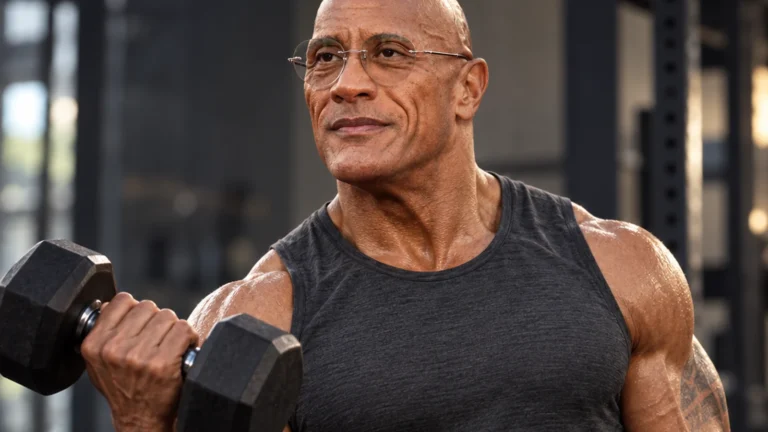

The supplement aisle is one of the few places where the marketing budget is easy to see and the research budget is not.
Bright labels, aggressive names, a stack of five star reviews, and a promise that this is the thing that was missing.
Behind most of it is a simple business fact.
Supplements in the United States do not need to prove they work before they go on sale, so the money that would have gone into trials can go into ads instead.
That is not a conspiracy, it is just how the rules are written, and it shapes everything you see on the shelf.
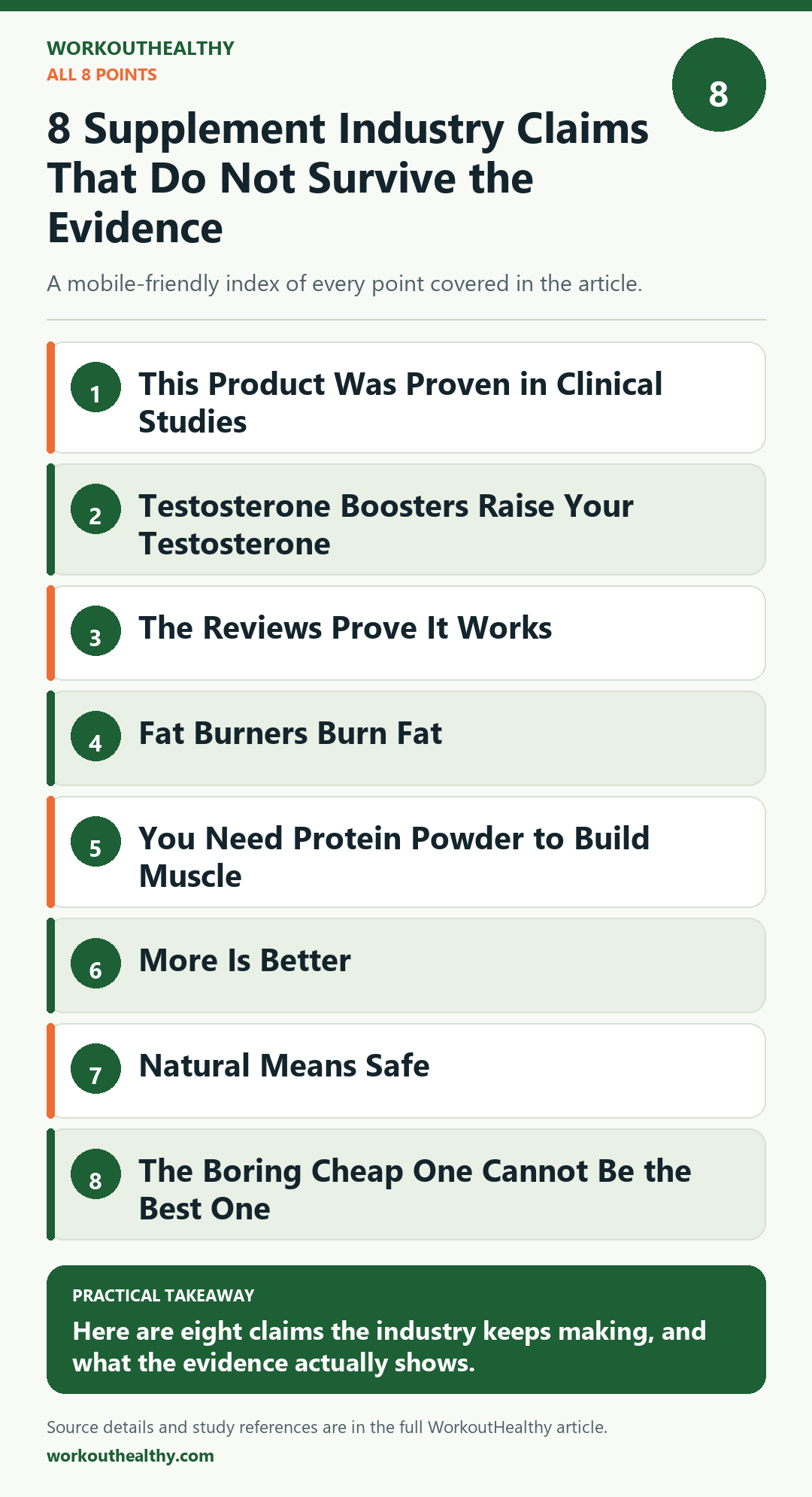
Here are eight claims the industry keeps making, and what the evidence actually shows.
1. This Product Was Proven in Clinical Studies
Read that sentence again and notice what it does not say.
Almost always the studies tested one ingredient in isolation, often at a different dose, sometimes in rats.
The finished product with eleven ingredients in it has usually never been tested at all.
An ingredient with research behind it is not the same thing as a product with research behind it.
Watch for the phrase clinically studied ingredients, which quietly moves the claim from the bottle to the powder inside it.
Watch too for studies funded by the company selling the product, which are disclosed in the paper but never in the ad.
2. Testosterone Boosters Raise Your Testosterone
Researchers looked at the top selling testosterone boosting supplements sold online and traced their ingredients back to the literature.
Across nineteen unique ingredients they found 191 studies, but only 37 were done in humans.
Of those human studies, 30 percent showed an increase in testosterone, 3 percent showed a decrease, and 46 percent showed no effect at all.
That is not a proven category, and the authors concluded there were no definitive findings of efficacy.
Many of those products also contained large doses of vitamins and minerals that do nothing for testosterone in people who are not deficient.
The ones that move testosterone at all tend to do so in men who were low on a specific nutrient to begin with.
3. The Reviews Prove It Works

The same research team ran the product reviews through software that flags suspicious patterns.
After filtering, reports of increased libido fell by 91 percent and reports of improved strength or endurance fell by 93 percent.
Almost the entire wall of glowing testimony did not survive a basic screen.
Reviews are the cheapest form of evidence to manufacture and the most persuasive form to read, which is a bad combination.
If a product’s strongest support is its star rating, treat that as a warning rather than a recommendation.
When ninety percent of the enthusiasm disappears the moment you filter for suspicious reviews, the reviews were the product.
4. Fat Burners Burn Fat
Most fat burners are caffeine plus a handful of botanicals with thin evidence behind them.
Caffeine does raise energy expenditure slightly and it does improve exercise performance, but the effect on body fat over months is small and fades as tolerance builds.
The bigger problem is that the rest of the formula is usually hidden inside a proprietary blend, so you cannot tell how much of anything you are taking.
Thermogenic is a marketing word, not a measured outcome, and no supplement has been shown to remove fat from a specific area of your body.
If caffeine is what you are after, coffee is cheaper and the dose is knowable, which we walked through in our piece on caffeine before a workout.
5. You Need Protein Powder to Build Muscle
Protein supplements do help, but far less dramatically than the packaging implies.
A review pooling 49 studies found that protein supplementation produced a modest additional gain in lean mass and strength during resistance training.
Crucially, the benefit largely disappeared above roughly 1.6 grams of protein per kilogram of body weight per day.
Powder is a convenient way to hit that number, not a magic ingredient, and food counts exactly the same.
Protein also cannot do the job alone, as we explained in our look at why protein by itself does not stop muscle loss after menopause.
For a person weighing 80 kilograms, that ceiling is roughly 128 grams of protein a day, which is reachable with ordinary meals.
6. More Is Better
This is the assumption that sells the biggest tubs, and the protein research contradicts it directly.
Past a certain intake, extra protein simply stopped producing extra muscle.
The same ceiling shows up with creatine, where the body saturates and additional doses do nothing but cost money.
Some ingredients also carry real risk at high doses, especially stimulants and fat soluble vitamins.
Doubling a scoop rarely doubles a benefit and sometimes just doubles the side effects.
7. Natural Means Safe
Plants make some of the most powerful drugs we know, and nothing about growing in soil makes a compound gentle.
Because supplements are regulated as food rather than medicine, testing happens mostly after something goes wrong.
Products have been pulled for containing unlisted stimulants and, in some cases, actual pharmaceuticals.
Third party testing programs exist for exactly this reason, and for competitive athletes they are not optional.
Drug tested athletes have failed tests because of contaminated products they bought in good faith.
8. The Boring Cheap One Cannot Be the Best One
This is the lie that keeps the whole industry standing, because creatine monohydrate is boring, cheap and the best supported supplement on the shelf.
The International Society of Sports Nutrition position stand describes creatine monohydrate as the most effective supplement available for increasing high intensity exercise capacity and lean body mass during training.
It has decades of safety data in healthy people.
Caffeine is the other one with a strong position stand behind it, with consistent benefits for endurance, strength endurance and some power tasks.
Two ingredients, both cheap, both unglamorous.
Protein powder makes a reasonable third, judged as convenient food rather than as a supplement.
None of them needs a proprietary blend, a hologram sticker or a name that sounds like a weapons system.
That is exactly why they are rarely the products with the biggest advertising budgets behind them.
What This Evidence Does Not Prove
It does not prove every supplement is useless.
Vitamin D, iron and B12 matter enormously if you are deficient, and a blood test rather than a label should decide that.
The testosterone booster analysis looked at the top sellers on one retailer at one point in time, so it cannot speak for every product ever made.
The protein review pooled studies with different training programs and diets, and the average it produced hides a lot of individual variation.
Position stands are written by researchers who study these compounds, and while they are peer reviewed, some authors have industry ties that are disclosed in the papers.
Absence of evidence for a new ingredient is also not proof that it fails, only that nobody has checked properly yet.
And none of this tells you whether a given product will help you personally, because studies report group averages rather than individual results.
How to Judge a Supplement in Five Minutes
Turn the bottle around and read the ingredient panel rather than the front.
If you see the words proprietary blend, you cannot know the doses, and you should treat the product as unproven.
Compare the dose on the label to the dose used in research, because underdosing a real ingredient is the most common trick in the category.
Look for a third party testing seal such as NSF Certified for Sport or Informed Sport.
Ask what this would cost per month and whether that money would buy more food, better sleep or a coach instead.
Then change one thing at a time and give it eight weeks before deciding whether it did anything.
For most people the honest answer is that the training plan matters more, which is why we keep returning to how protein and training interact as people age.
Common Mistakes People Make Here
The most common is buying a stack of six products while eating poorly and sleeping five hours.
The second is starting several new supplements in the same week, which makes it impossible to tell what did anything.
The third is assuming that a supplement working for a competitive bodybuilder will do the same thing for a beginner.
A fourth is ignoring that many popular products are simply expensive caffeine.
A fifth is treating a supplement as a substitute for something a doctor should be looking at, which is especially common with fatigue and low libido.
A sixth is stopping a supplement that genuinely helps, such as vitamin D in winter, because a video called supplements a scam.
Who Should Talk to a Doctor Before Taking Anything
Anyone on prescription medication should check for interactions, because supplements can change how drugs are absorbed and cleared.
That applies particularly to blood thinners, thyroid medication, antidepressants and blood pressure drugs.
People with kidney disease, liver disease, heart rhythm problems or uncontrolled high blood pressure should ask before starting stimulants or creatine.
Pregnant and breastfeeding women should assume a supplement is off limits until a clinician says otherwise.
And if you are considering a testosterone booster because you feel tired and flat, ask for a blood test first, because those symptoms have real causes worth finding.
Watch the Original Video
Tired of guessing at labels? Subscribe to WorkoutHealthy Insider for practical explanations behind popular fitness claims.
References
Balasubramanian, A., Thirumavalavan, N., Srivatsav, A., Yu, J., Lipshultz, L. I., & Pastuszak, A. W. (2019). Testosterone imposters: An analysis of popular online testosterone boosting supplements. The Journal of Sexual Medicine, 16(2), 203 to 212. https://doi.org/10.1016/j.jsxm.2018.12.008
Guest, N. S., VanDusseldorp, T. A., Nelson, M. T., Grgic, J., Schoenfeld, B. J., Jenkins, N. D. M., Arent, S. M., Antonio, J., Stout, J. R., Trexler, E. T., Smith-Ryan, A. E., Goldstein, E. R., Kalman, D. S., & Campbell, B. I. (2021). International Society of Sports Nutrition position stand: Caffeine and exercise performance. Journal of the International Society of Sports Nutrition, 18(1), Article 1. https://doi.org/10.1186/s12970-020-00383-4
Kreider, R. B., Kalman, D. S., Antonio, J., Ziegenfuss, T. N., Wildman, R., Collins, R., Candow, D. G., Kleiner, S. M., Almada, A. L., & Lopez, H. L. (2017). International Society of Sports Nutrition position stand: Safety and efficacy of creatine supplementation in exercise, sport, and medicine. Journal of the International Society of Sports Nutrition, 14(1), Article 18. https://doi.org/10.1186/s12970-017-0173-z
Morton, R. W., Murphy, K. T., McKellar, S. R., Schoenfeld, B. J., Henselmans, M., Helms, E., Aragon, A. A., Devries, M. C., Banfield, L., Krieger, J. W., & Phillips, S. M. (2018). A systematic review, meta-analysis and meta-regression of the effect of protein supplementation on resistance training-induced gains in muscle mass and strength in healthy adults. British Journal of Sports Medicine, 52(6), 376 to 384. https://doi.org/10.1136/bjsports-2017-097608
This article is for general information only and is not medical advice. If you have an injury, ongoing pain, or a medical condition, talk to a doctor or physical therapist before you change how you train or eat.