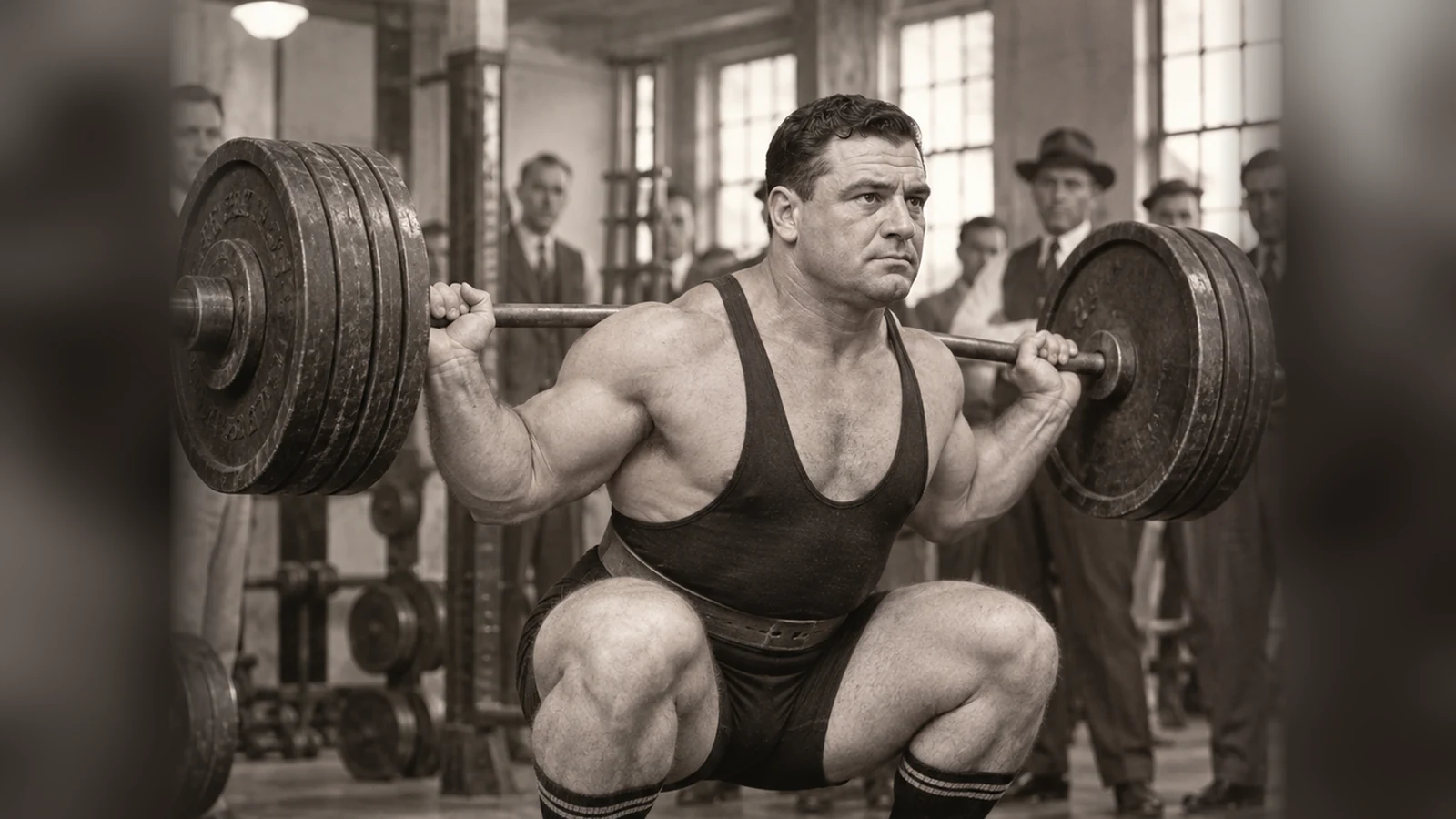

Squat racks are so common now that it is hard to picture lifting without one.
Early strongmen often had no such equipment.
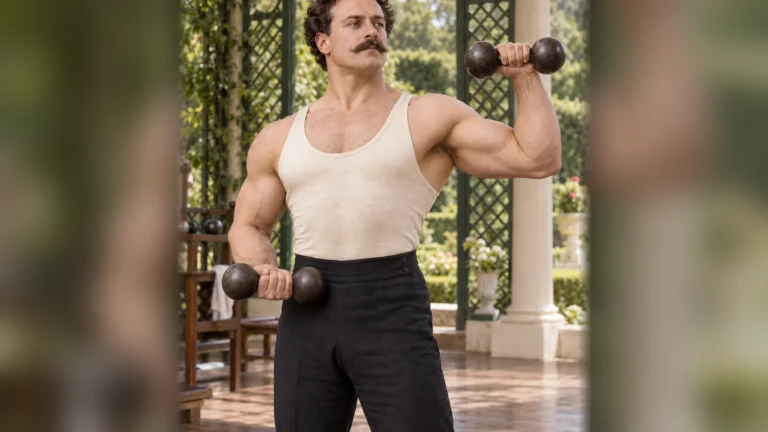
A popular post says Henry “Milo” Steinborn tipped a barbell loaded with hundreds of pounds onto his own shoulders, then squatted it for reps.
The lift is real, and it now carries his name. The details, and the risks, deserve a closer look.
Who Milo Steinborn Was
According to BarBend, Steinborn was born in Germany in 1893.
He spent four and a half years as a prisoner of war during World War I.
After placing second at the 1920 German national weightlifting championships, he moved to the United States.
By 1921, he was well known in the American strength world.
He went on to wrestle more than 300 matches between 1922 and 1953.
He also performed strongman acts, including a leg bridge that a car full of people drove over.
He opened a gym in Orlando in 1960 and died in 1989 at age 95.
How the Steinborn Lift Works
The lifter stands a loaded barbell on one end, so it is upright.
Then the lifter sinks into a deep squat and lets the bar tip onto the upper back.
From that bottom position, the lifter stands up with the weight.
To finish, the process is reversed to bring the bar back down.
BarBend describes it as receiving the bar at the bottom of the squat, in a back squat position.
The hardest part is not only the squat. It is controlling a heavy, tipping bar with no rack to catch it.
Timing, balance, and grip all have to be right at the same moment.
Old strongmen made do without equipment. Today, the smart move is to use the equipment they never had.
How Much Did He Lift?
BarBend reports that Steinborn squatted 553 pounds without a rack while weighing about 205 to 210 pounds.
A 2026 article on Lift Big Eat Big repeats the 553 pound figure.
It also says he was required to do an unassisted back squat with at least 400 pounds at every wrestling event.
That article says he did the lift “again, and again,” but it does not list sources or give set and rep details.
So we could confirm the lift and the headline weight in secondary sources, but not the exact rep counts in the popular post.
We also found no official record sheet for the 553 pound lift.
Why the Lift Mattered
BarBend calls Steinborn one reason we squat the way we do today.
Without a rack, a lifter has to get the bar onto the back some other way, which limits how much can be used.
Steinborn’s method got around that limit.
Once squat racks became common, lifters could load the bar far more safely.
The Steinborn lift survives today mainly as a strongman feat and a party trick among strength fans.
His story also shows how equipment shapes training.
Many limits that early lifters faced were about getting the weight into position, not about leg strength alone.
What Research Says About Lifting Injury Risk
No study has tested the Steinborn lift itself.
Research on heavy lifting in general gives useful context.
A 2017 systematic review by Aasa and colleagues looked at injuries in weightlifters and powerlifters.
The spine, shoulder, and knee were the most common injury sites in both sports.
Powerlifters had about 1.0 to 4.4 injuries per 1,000 hours of training.
The authors said injury risk was similar to other non contact strength sports and low compared with contact sports.
A 2018 survey by Strömbäck and colleagues found that 70 percent of responding powerlifters were currently injured.
Most kept training, since only 16 percent of those injured had to stop completely.
The lumbopelvic region, shoulder, and hip were most often affected.
What These Studies Do Not Show
Both studies looked at competitive lifters doing standard training and competition lifts.
The survey relied on self reports from a limited group of athletes, so it may not reflect all lifters.
Neither study tells us the risk of tipping a heavy bar onto your back.
It is reasonable to think that removing a rack and adding an awkward loading step raises the danger, but that has not been measured.
Why You Should Not Copy It
- There is no safe bail out. Without a rack or safety bars, a missed rep has nowhere to go.
- The loading step is risky. A tipping bar can twist the spine or strike the neck.
- The bottom position is the hardest. You start the lift where you are weakest.
- Balance is tricky. A heavy bar standing on end is awkward to hold steady.
Safer Ways to Honor the Idea
- Use a power rack. Set safety pins just below your lowest squat depth.
- Build bottom position strength. Pause squats and box squats train the hardest part of the lift.
- Work on mobility. A comfortable deep squat helps. See our look at the deep resting squat.
- Train your hips. This hip drill used by fighters and dancers can support deeper positions.
- Leave strongman feats to trained athletes. Only try specialty lifts under expert supervision.
Who Should Be Careful
Beginners should never attempt to tip a loaded bar onto their backs.
People with spine, neck, shoulder, hip, or knee problems should avoid awkward loading and deep heavy squats unless cleared by a clinician.
Anyone who feels sharp pain, numbness, or tingling during a squat should stop and get checked.
Even experienced lifters should use spotters, safety bars, and a clear space when trying specialty lifts.
The Bottom Line
Milo Steinborn was a German born strongman and wrestler who squatted very heavy weights without a rack.
Secondary sources report a 553 pound Steinborn lift, but we could not confirm the rep counts that often appear with the story.
Research shows heavy lifting has a real, manageable injury risk when done with proper equipment.
Admire the feat, then squat in a rack.
Want more stories like this? Subscribe to WorkoutHealthy Insider for practical explanations behind popular fitness claims.
References
- Aasa, U., Svartholm, I., Andersson, F., & Berglund, L. (2017). Injuries among weightlifters and powerlifters: A systematic review. British Journal of Sports Medicine, 51(4), 211 to 219. https://doi.org/10.1136/bjsports-2016-096037
- Boly, J. (2023, July 31). Milo Steinborn is one reason we squat the way we do today. BarBend.
- de Lacey, J. (2026, July 8). Milo Steinborn: The man who squatted 550 pounds with no rack by inventing his own lift. Lift Big Eat Big.
- Strömbäck, E., Aasa, U., Gilenstam, K., & Berglund, L. (2018). Prevalence and consequences of injuries in powerlifting: A cross-sectional study. Orthopaedic Journal of Sports Medicine, 6(5), 2325967118771016. https://doi.org/10.1177/2325967118771016
This article is for general information only and is not medical advice. If you have an injury, ongoing pain, or a medical condition, talk to a doctor or physical therapist before you change how you train or eat.