
“A sound mind in a sound body” may be the most quoted fitness phrase in history.
It comes from Juvenal, a Roman poet who wrote biting satire almost 2,000 years ago.
A popular post says Juvenal wished for a sound mind in a sound body, tying mental health directly to physical fitness.
He did write the line.
But he was not giving workout advice, and the full context is more interesting than the slogan.
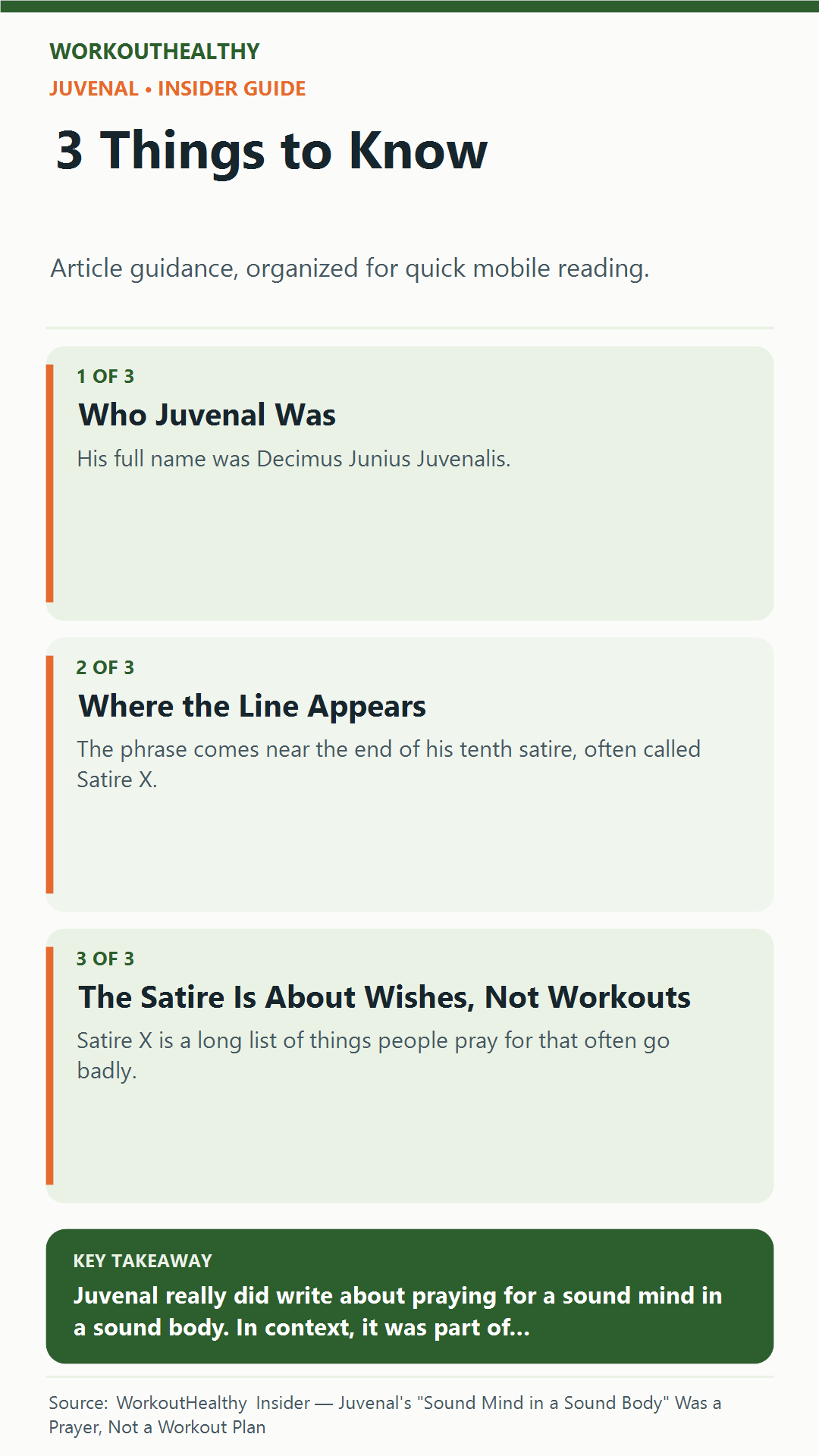
Who Juvenal Was
His full name was Decimus Junius Juvenalis.
He is usually dated to roughly AD 55 to 128 and linked to Aquinum, a town in Italy.
Very little about his life is certain.
Much of the traditional biography was pieced together from his own poems, so scholars treat it with caution.
He wrote at least 16 satires, grouped into five books.
Their comic, exaggerated style makes them a rich but tricky source on daily life in ancient Rome.
Where the Line Appears
The phrase comes near the end of his tenth satire, often called Satire X.
In Latin, the key words are “orandum est ut sit mens sana in corpore sano.”
That roughly means “you should pray for a sound mind in a sound body.”
“Then you might pray for a sound mind in a healthy body.”
He goes on to suggest asking for a brave heart that does not fear death.
He ends by saying that virtue is the one true path to a peaceful life.
The Satire Is About Wishes, Not Workouts
Satire X is a long list of things people pray for that often go badly.
Juvenal points to Sejanus, a powerful Roman official whose rise ended in a spectacular fall.
He mocks the military glory of Hannibal and Alexander.
He notes that the eloquence of the great speakers Demosthenes and Cicero led to their deaths.
He even warns that a long life, like that of the legendary kings Nestor and Priam, can bring years of grief.
This same satire contains another famous phrase. It says the Roman crowd now cares about only two things, bread and circuses.
So the “sound mind” line is his answer to a bigger question: if you must pray for something, what is actually worth having?
His answer is health of mind and body, courage, and good character.
What the Popular Version Gets Wrong
The popular post is right that Juvenal paired a healthy mind with a healthy body.
It goes too far in saying he tied mental health “directly” to physical fitness.
Juvenal listed two separate blessings side by side.
He did not claim that exercise improves mood, and he did not describe any training at all.
The link between the two was added by later readers.
That does not make the modern reading wrong. It just means the science came later, not from Juvenal himself.
How the Line Became a Fitness Motto
For centuries the phrase lived mostly in education and philosophy.
The English thinker John Locke opened his 1693 book on education with it.
Its first known use in an athletic setting came from John Hulley in December 1861.
In 1862, Hulley made it the motto of the Liverpool Athletic Club.
Today it even hides inside a brand name.
The sportswear company ASICS takes its name from an acronym of a variant phrase, “anima sana in corpore sano.”
What Modern Research Adds
Science has since tested the idea that Juvenal only hinted at.
A 2024 network meta analysis in The BMJ, led by Michael Noetel, looked at exercise as a treatment for depression.
It included 218 studies with 14,170 participants.
Walking or jogging, yoga, and strength training stood out as more effective than other types, especially when done at higher intensity.
The authors concluded that exercise should be considered alongside psychotherapy and antidepressants as a core treatment.
Strength training has its own evidence.
A 2018 meta analysis by Brett Gordon and colleagues pooled 33 randomized trials with 1,877 participants.
Resistance training was linked to a significant, moderate reduction in depressive symptoms.
That benefit held regardless of participants’ health status or how much training was prescribed.
What the Research Does Not Prove
These studies show that exercise can ease symptoms of depression. They do not show that fitness guarantees mental health.
The trials in these reviews varied a lot in design and results.
Gordon’s team found smaller benefits in trials where allocation or assessment was blinded.
Exercise is one useful tool, not a cure for every mental health problem.
How to Apply Juvenal’s Idea Today
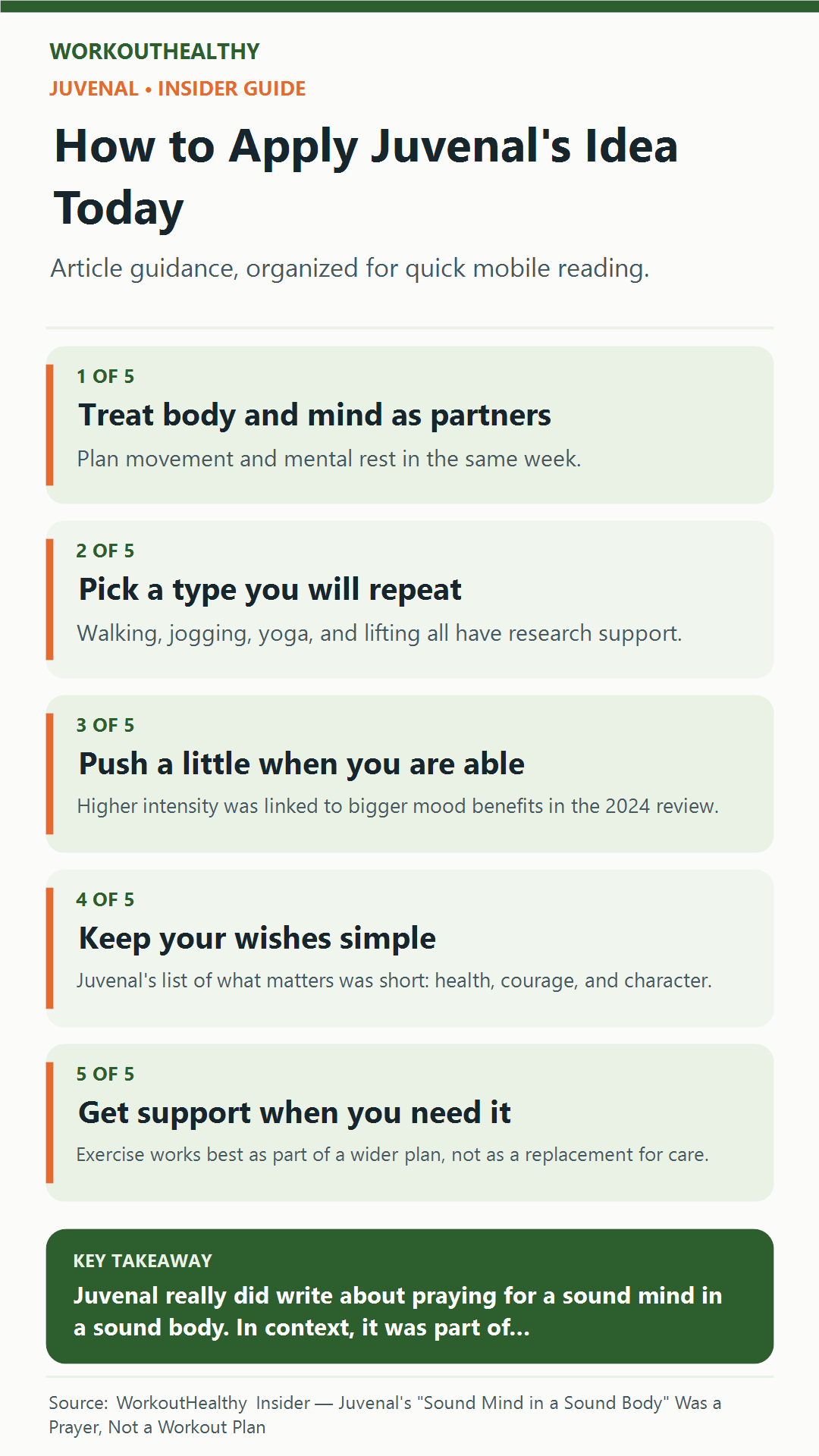
- Treat body and mind as partners. Plan movement and mental rest in the same week.
- Pick a type you will repeat. Walking, jogging, yoga, and lifting all have research support.
- Push a little when you are able. Higher intensity was linked to bigger mood benefits in the 2024 review.
- Keep your wishes simple. Juvenal’s list of what matters was short: health, courage, and character.
- Get support when you need it. Exercise works best as part of a wider plan, not as a replacement for care.
Group running is one way to pair movement with connection, as seen in the running club chef Daniel Humm leads before work.
Regular exercise may also support your body’s defenses, as covered in our look at exercise and influenza and pneumonia risk.
Who Should Be Careful
If you have depression, anxiety, or thoughts of self harm, reach out to a doctor or mental health professional.
Exercise can help, but it should not delay proper care.
People with heart conditions or other health issues should get medical advice before starting intense training.
The Bottom Line
Juvenal really did write about praying for a sound mind in a sound body.
In context, it was part of a satire on foolish wishes, not a training philosophy.
Later readers turned it into a fitness motto, and modern research gives that motto real support.
Move your body, care for your mind, and remember his larger point about what is truly worth wanting.
Want more stories like this? Subscribe to WorkoutHealthy Insider for practical explanations behind popular fitness claims.
References
- Gordon, B. R., McDowell, C. P., Hallgren, M., Meyer, J. D., Lyons, M., & Herring, M. P. (2018). Association of efficacy of resistance exercise training with depressive symptoms: Meta-analysis and meta-regression analysis of randomized clinical trials. JAMA Psychiatry, 75(6), 566 to 576. https://doi.org/10.1001/jamapsychiatry.2018.0572
- Juvenal. (n.d.). Satire X (A. S. Kline, Trans.). Poetry in Translation. https://www.poetryintranslation.com/PITBR/Latin/JuvenalSatires10.php
- Noetel, M., Sanders, T., Gallardo-Gómez, D., Taylor, P., del Pozo Cruz, B., van den Hoek, D., Smith, J. J., Mahoney, J., Spathis, J., Moresi, M., Pagano, R., Pagano, L., Vasconcellos, R., Arnott, H., Varley, B., Parker, P., Biddle, S., & Lonsdale, C. (2024). Effect of exercise for depression: Systematic review and network meta-analysis of randomised controlled trials. BMJ, 384, e075847. https://doi.org/10.1136/bmj-2023-075847
- Wikipedia contributors. (n.d.). Mens sana in corpore sano. In Wikipedia. Retrieved September 16, 2026, from https://en.wikipedia.org/wiki/Mens_sana_in_corpore_sano
This article is for general information only and is not medical advice. If you have an injury, ongoing pain, or a medical condition, talk to a doctor or physical therapist before you change how you train or eat.