
Owen Hubbard is not a household name outside competitive powerlifting.
Inside the raw bench press world, though, his name sits next to one of the heaviest numbers ever recorded in the 83 kilogram class.
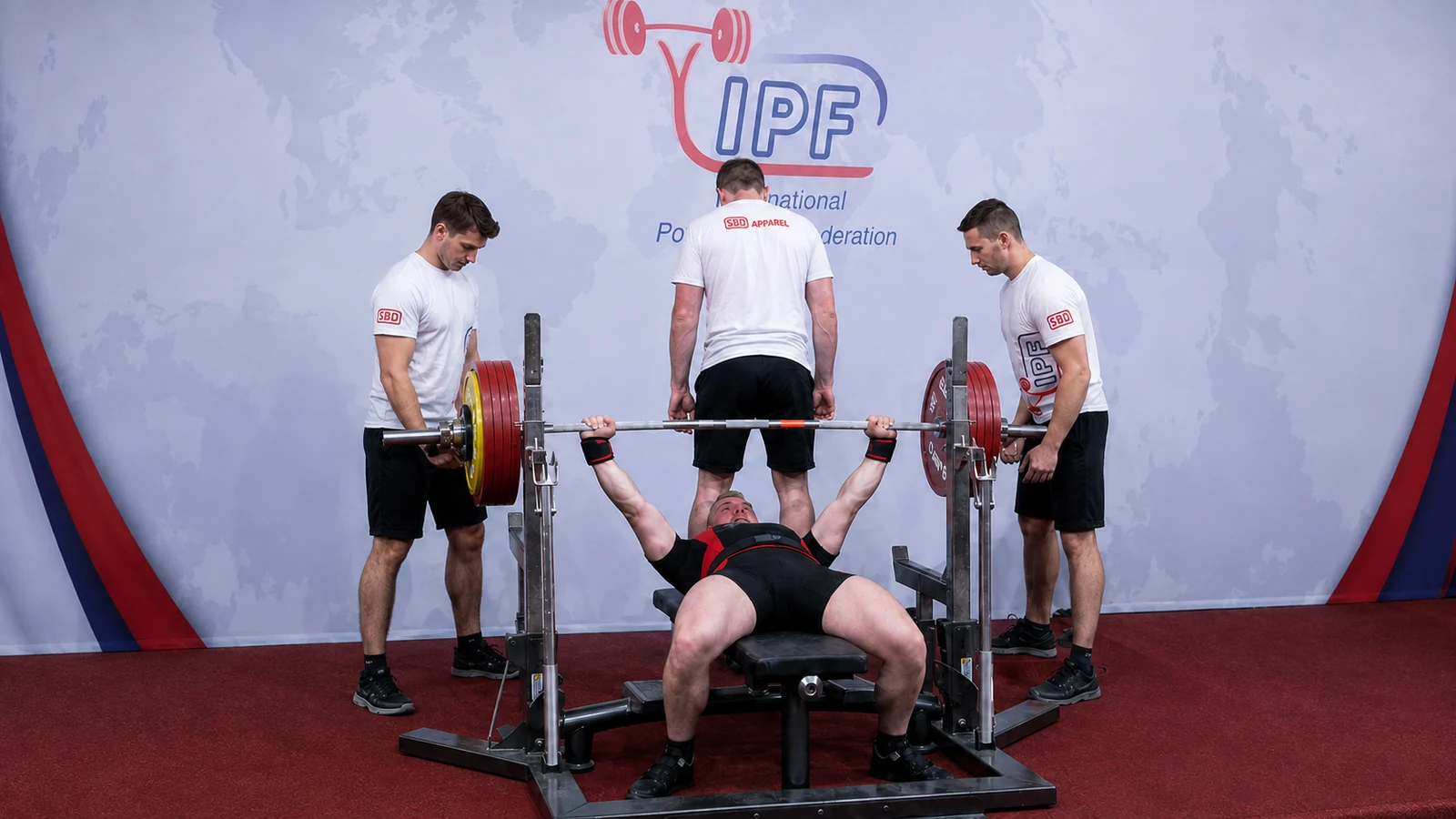
In November 2019, the British lifter pressed 218.5 kilograms off his chest at the European Classic Powerlifting Championships.
That works out to 481.71 pounds, with no bench shirt and no supportive gear beyond a standard raw setup of wrist wraps and a belt.
Just a bar loaded past 480 pounds, a competitor weighing close to the 83 kilogram, or about 183 pound, class limit, and a lockout clean enough to stand as a world record.
The lift was filmed and posted by the European Powerlifting Federation, the continental body that sanctions competitions across Europe under the International Powerlifting Federation.
The video calls it a world record, and the number holds up against public competition results from that meet.
What makes Hubbard’s story worth a closer look is not only the single lift.
It is how he got there, and what pressing more than twice bodyweight actually asks of a lifter’s shoulders, chest, and training patience.
What Owen Hubbard Actually Lifted
Hubbard set his 218.5 kilogram raw bench press at the European Classic Powerlifting Championships on November 29, 2019, competing in the men’s 83 kilogram weight class.
The meet was sanctioned by the European Powerlifting Federation, known as the EPF.
The EPF is the International Powerlifting Federation’s official continental affiliate for Europe, not a separate or unaffiliated organization, which matters for anyone trying to trace where a record actually came from.
Video titles and workbook notes often shorten the sourcing to just “world record” without naming which federation ratified it, and that shorthand can make a real record look unofficial to a skeptical reader.
In Hubbard’s case, the record was set at an EPF championship, one level below the IPF’s own World Championships, but still fully sanctioned under the same drug testing, judging, and equipment rules that govern every IPF affiliate meet.
Raw, in powerlifting terms, means no bench shirt.
A bench shirt is a tight, supportive garment that can add well over 100 pounds to a lifter’s max by storing elastic energy at the bottom of the movement.
Raw lifters use wrist wraps for joint support and sometimes a belt, but nothing that assists the press itself.
That makes a raw 218.5 kilogram bench a different kind of achievement than an equipped lift of the same number, and it is worth keeping the two categories separate when comparing records across federations.
Is This Still the Record?
Records in a sport this active rarely stay records forever, and this project has already found several cases where a workbook’s “current” claim was stale by the time it reached publication.
For Hubbard’s mark, the honest answer is more careful than a flat yes or no.
Public competition results tracked through OpenPowerlifting show no bench press exceeding 218.5 kilograms recorded for any lifter in the men’s 83 kilogram raw class since Hubbard’s 2019 lift, including in his own later competitions.
His raw bench numbers in that weight class have stayed below the mark he set that November in every meet since.
That is the extent of what could be independently confirmed for this article.
The IPF’s own official records page could not be reached during research for this piece, so this article cannot state with full certainty that no other federation or lifter has posted a higher number somewhere outside the dataset checked here.
What can be said honestly is that 218.5 kilograms remains, as far as the publicly available competition results show, the highest raw bench press documented in the men’s 83 kilogram class.
Readers who want the current, IPF confirmed record should check the federation’s own published list, since record books do change.
A record like this is really a snapshot of the highest verified number on file at a given moment, not a permanent title. Treating it that way, rather than as a fixed fact, is the more accurate way to read any strength world record.
The Long Road to 218.5 Kilograms
The story behind this lift is not a single lucky day under the bar.
Public meet results place Hubbard in the low 470s in bench-only pounds, in the 214 to 216 kilogram range, in competitions earlier in the same stretch of his career, well before he ever touched 218 kilograms.
Meet records also show him missing an attempt right around 218 kilograms at an earlier European Classic Championships, a near miss that came before his successful 218.5 kilogram lift a year later at that same competition.
That sequence matters more than the final number by itself.
A lifter who jumps straight to a world record on a first serious attempt is rare, and usually a sign the previous “best” was set well below true capacity.
Hubbard’s path looks more like the normal one: a string of competitive meets, each adding a small amount of working weight, one real miss along the way, and then a return trip to the same competition to finish what the miss interrupted.
That pattern is worth remembering for anyone chasing a personal record, not just an elite one.
Progress in a heavy compound lift is rarely a straight line upward.
It usually looks like several attempts near a ceiling, at least one that does not go up, and then a later attempt that finally does.
More Than Twice His Bodyweight, Off the Chest
The 83 kilogram weight class caps competitors at 83 kilograms, or about 183 pounds, at the official weigh in.
A raw bench press of 218.5 kilograms from a lifter at or near that limit works out to roughly 2.6 times bodyweight.
A genuinely strong recreational lifter who trains bench press seriously for years might reach 1.5 times bodyweight raw.
Reaching double bodyweight is considered an elite benchmark in most raw lifting circles, the kind of number that separates a strong gym lifter from a competitive one.
Hubbard’s lift clears that benchmark by a wide margin.
Strength built to that level does not come from bench press sets alone.
Progressive overload research, most notably the American College of Sports Medicine’s long standing position stand on resistance training, describes strength gains at this level as the product of systematically increasing training load, volume, and specificity over years, not weeks (Kraemer & Ratamess, 2009).
A raw bench press world record is the visible endpoint of that kind of long, deliberate loading history, built through cycles of heavier singles, accessory pressing work, and structured recovery between max effort attempts.
The pressing mechanics matter too.
A raw lift at this weight typically relies on a stable arch to shorten the bar’s travel distance, tight leg drive through the floor, and a controlled bar path through the sticking point.
Readers who want to see how small changes in bench mechanics affect the lift itself can compare the standard bench press to a variation like the floor press, which removes leg drive and shortens the range of motion.
What This Record Does Not Prove
A number this large invites some sloppy conclusions, so it is worth being specific about what this record does and does not show.
It does not mean an untrained lifter can safely attempt a near maximal single without years of technical practice first.
It does not mean the 83 kilogram class is unusually strong compared to other classes, since relative bench strength varies by weight class for reasons tied to leverage and limb length, not just training quality.
It also does not mean equipped and raw numbers are directly comparable.
An equipped 218.5 kilogram bench and a raw 218.5 kilogram bench are different achievements entirely, since the shirt itself can account for a meaningful share of the total weight moved.
And it does not prove that heavier is automatically safer or riskier in isolation.
Injury risk in powerlifting has more to do with how weight is added over time, and how well technique holds up under increasing load, than with the raw number on the bar.
A verified record deserves the same scrutiny this project applies to every claim it publishes, the same way an unusual age related feat like Edith Connor’s Guinness World Record needed its own competition details confirmed before it could be reported as fact.
The Real Injury Risk Behind a Near Maximal Bench
The most serious acute injury tied to heavy bench pressing is a pectoralis major tear, an injury that happens almost exclusively during near maximal or maximal effort lifts rather than lighter training sets.
A comprehensive classification review of pectoralis major tears found that the vast majority occur during bench press training or competition, typically in the lowest portion of the lift where the chest muscle is under the greatest stretch and load at the same time (ElMaraghy & Devereaux, 2012).
That combination, a fully stretched muscle under near maximal tension, is exactly the position a lifter is in during the bottom of a heavy competition attempt.
It is a rare injury relative to the number of bench press repetitions performed worldwide, but it is far more common at the elite end of the sport, where lifters regularly test loads close to their absolute ceiling.
The low back carries its own share of risk in powerlifting more broadly.
A meta-analysis pooling data across multiple studies of competitive powerlifters found that roughly one in four reported lower back pain, with back related injuries accounting for more than a third of all injuries tracked across the sport (Preinl & Stolarz, 2024).
Bench press itself does not load the lower back the way a squat or deadlift does, but the arched setup competitive lifters use to shorten the bar path still places real demand on the spine.
Common Mistakes Lifters Make Chasing a Bigger Bench
Most lifters who stall well below their potential make a small set of predictable mistakes, not one dramatic one.
The first is adding weight to the bar faster than technique can absorb it, which tends to show up as a collapsing arch, a bar path that drifts toward the face, or elbows that flare wide enough to shift stress onto the shoulder joint.
The second is skipping accessory work for the triceps and shoulders, the muscles that finish a heavy press once the chest has done its share of the work.
The third is testing true one rep maxes too often.
Competitive lifters like Hubbard build toward a handful of true maximal attempts a year, timed around competitions, while training the rest of the year at lower percentages that still add up to real strength.
The fourth is training bench press in isolation from the rest of a lifter’s program.
A raw total near world record level, like Hubbard’s, comes from a squat, bench, and deadlift program built together, not a bench only routine chasing one number.
How to Build Toward a Bigger Raw Bench Safely
Anyone working toward a heavier raw bench press, even far below world record territory, benefits from the same basic structure elite lifters use.
Progressive overload research supports increasing training load gradually and cycling between higher volume phases and lower volume, higher intensity phases, rather than adding weight every single session without a plan (Kraemer & Ratamess, 2009).
A practical version of that looks like several weeks of moderate weight for higher reps to build technical consistency, followed by a shorter block of heavier singles and doubles closer to a competition or test date.
Technique coaching matters as much as raw effort at this level.
A small flaw in bar path or setup that costs almost nothing at moderate weight can turn into a missed lift, or a genuine injury risk, once the bar gets close to a true maximum.
Working with a qualified coach, even for a handful of sessions focused specifically on bench technique, is one of the higher value investments a serious lifter can make, and it is worth reading what to look for before hiring one in this guide to deciding whether you need a personal trainer.
A spotter is not optional at heavy weights.
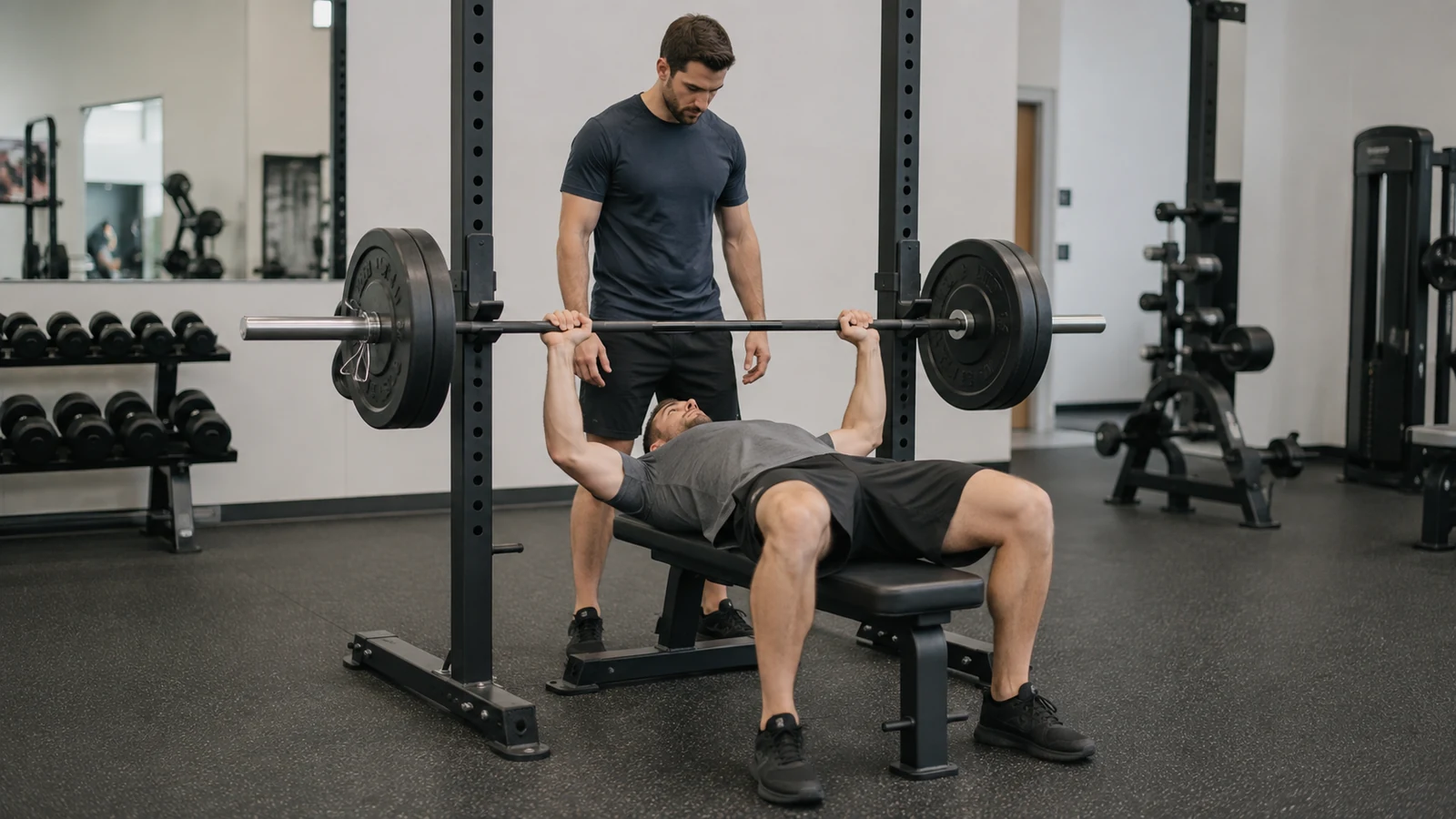
Competition bench press always uses at least one, and often two or three, spotters positioned to catch a missed lift immediately, and the same setup belongs in any serious training session approaching a true maximal attempt.
Recovery between heavy sessions also deserves more attention than it usually gets.
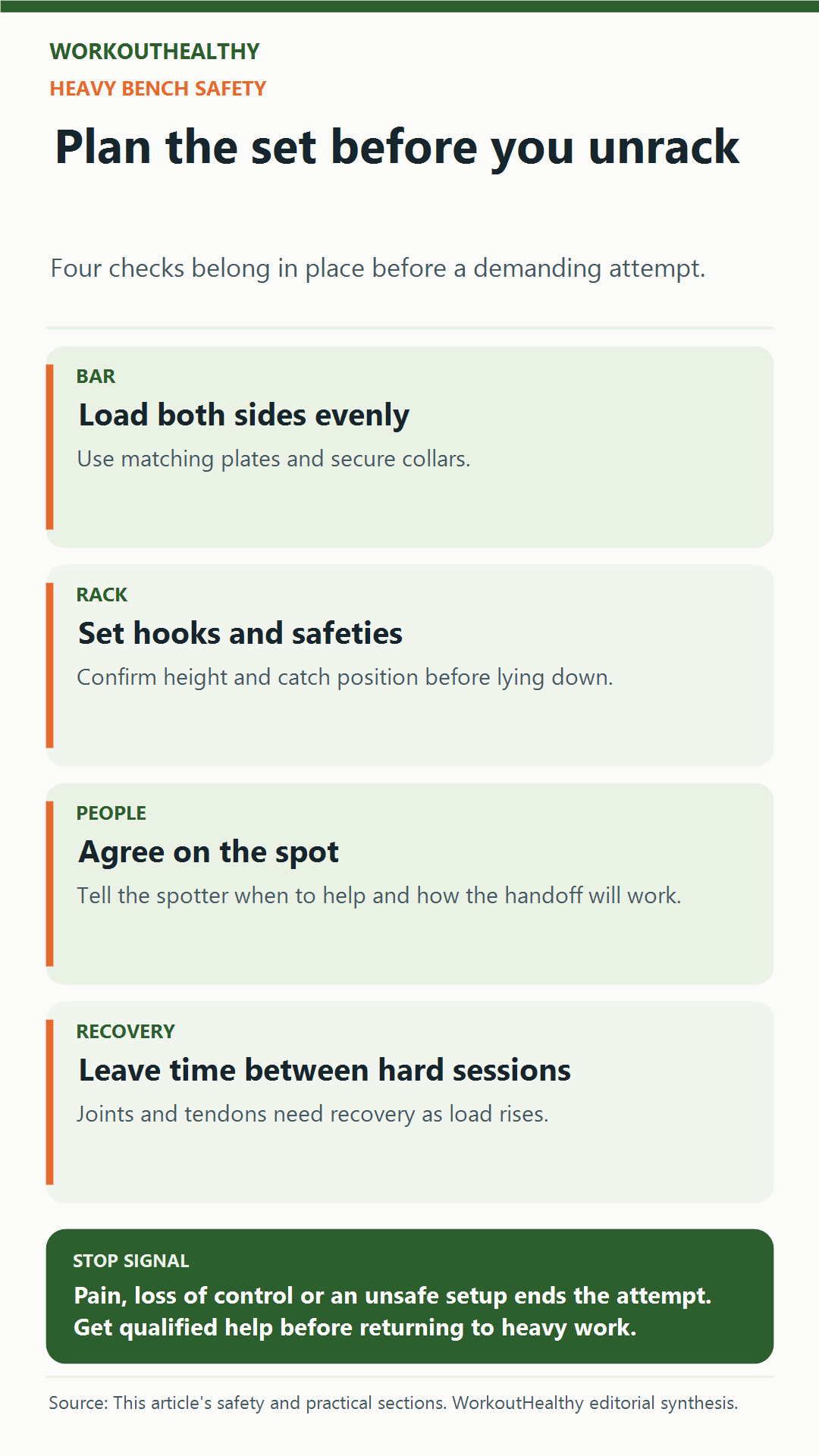
The shoulder and elbow joints, along with the pectoral and tricep tendons, need real time to adapt to increasing load, and lifters who push near maximal attempts too frequently tend to plateau, get hurt, or both.
Who Should Be Extra Cautious
Near maximal bench pressing is not the right training tool for everyone, even among people who lift regularly.
Anyone with a history of shoulder instability, a prior pectoral strain, or ongoing elbow pain should have that area evaluated by a physical therapist or sports medicine doctor before attempting heavy singles.
Those histories raise the odds of a repeat or worse injury under load.
Lifters returning from any kind of upper body surgery, and anyone newer to structured strength training who has not yet built a technical foundation, should build up gradually with supervision rather than testing a near maximal single early in a training career.
People managing cardiovascular conditions should also talk to a doctor before attempting true maximal lifts, since the sustained breath holding and blood pressure spike involved in a competition style attempt is a meaningful physiological event, not just a strength test.
Watch the Original Video
Enjoyed this breakdown? Subscribe to WorkoutHealthy Insider for practical explanations behind popular fitness claims.
References
ElMaraghy, A. W., & Devereaux, M. W. (2012). A systematic review and comprehensive classification of pectoralis major tears. Journal of Shoulder and Elbow Surgery, 21(3), 412–422. https://doi.org/10.1016/j.jse.2011.04.035
Kraemer, W. J., & Ratamess, N. A. (2009). Progression models in resistance training for healthy adults. Medicine & Science in Sports & Exercise, 41(3), 687–708. https://doi.org/10.1249/mss.0b013e3181915670
Preinl, M., & Stolarz, K. (2024). Injuries of the lower back in powerlifting: A literature review with meta-analysis. Polish Journal of Sports Medicine, 40(2), 17–27. https://doi.org/10.5604/01.3001.0054.6539
This article is for general information only and is not medical advice. If you have an injury, ongoing pain, or a medical condition, talk to a doctor or physical therapist before you change how you train or eat.