

A lot of very strong lifters are surprisingly slow.
A video from the channel Lyfestyle Athletics, “Why Being Strong Doesn’t Make You Fast,” points to a real and well-studied reason why.
Building a bigger squat or deadlift does not automatically translate into a faster sprint.
Sprinting depends on how quickly muscles can produce force, not just how much force they can eventually produce given enough time.
That distinction has a name in sports science, and it has been studied for decades.
What the Video Claims
The video argues that raw strength alone will not make an athlete fast.
Its reasoning is that explosive speed depends on how fast muscles can create force, not on how much force they can eventually produce.
Lyfestyle Athletics presents itself as a strength and speed training channel, not a peer reviewed research source.
No specific study or credential is cited in the video itself.
That does not make the underlying idea wrong.
It just means the claim is worth checking against the actual sports science literature, which this article does below.
Why Strength and Speed Are Not the Same Skill
Researchers have tested this exact question directly.
Cronin and Hansen (2005) measured strength and power in a group of athletes, then compared those numbers to how fast each athlete could sprint over short distances.
Maximum strength, tested with a 3-repetition-max squat, did not correlate significantly with sprint speed.
Power based tests told a very different story.
Jump squat height, jump squat power output, and countermovement jump height all showed meaningful correlations with sprint speed.
Maximum strength predicted almost nothing about sprint speed on its own. The speed at which force got produced told a much clearer story.
The researchers concluded that plyometric and loaded jump squat training, which both train the speed of force production, may do more for sprint speed than traditional heavy strength training alone.
That conclusion lines up closely with what the video argues, even though the video does not cite this specific study.
A heavier squat max is still useful for an athlete.
It just is not the same physical quality that determines how fast someone accelerates out of the blocks or down a field.
The Mechanism Behind Explosive Force
The reason strength and speed split apart like this comes down to timing.
A sprinter’s foot is only in contact with the ground for roughly 100 milliseconds during a fast stride.
That is barely a tenth of a second to produce useful force against the ground.
A detailed review by Maffiuletti and colleagues (2016) looked at exactly what determines how much force a muscle can generate inside that kind of short window.
This review is considered a foundational paper in this specific area of sports science.
It found that maximum voluntary strength explained only about 18 percent of the difference between people in how much force they produced in the first 10 milliseconds of a contraction.
By 200 milliseconds, a much longer window than a sprinting foot ever actually gets, maximum strength explained roughly 78 percent of that same difference.
In the first tenth of a second of a muscle contraction, how strong someone is barely matters. What matters most is how fast the nervous system can turn that muscle on.
In other words, early explosive force comes mostly from how quickly the nervous system activates muscle, not from how much muscle mass or maximum strength a person has built.
Researchers call this specific quality rate of force development, often shortened to RFD.
It reflects nervous system factors, like how fast motor units get switched on and how quickly they fire in sequence.
A lifter can spend years building a huge one rep max and still have mediocre RFD if that specific quality was never trained directly.

How Researchers Actually Measure This
Sprint speed and jump height are useful field measures, but researchers also test RFD more directly inside a lab.
A common lab test asks someone to push or pull as hard and as fast as possible against a fixed, immovable object, like a bar locked at knee height in an isometric mid-thigh pull.
A force plate under the feet records exactly how much force builds up, and exactly how fast it builds, in tiny slices of time.
Researchers then look at how much force was produced in specific early windows, often the first 50 to 100 milliseconds, and compare that to the total peak force a person can eventually reach.
Those early and late numbers rarely match up cleanly, which is the whole point of testing them separately.
A one rep max back squat cannot capture any of this.
The bar moves slowly, especially near the sticking point, and the whole lift takes several seconds from start to finish.
That is nothing like the roughly 100 milliseconds a sprinter’s foot actually spends on the ground.
This is a large part of why Cronin and Hansen (2005) found only a weak link between a 3RM squat and sprint speed, but a strong link between jump based power tests and sprint speed.
A jump squat or countermovement jump still takes only a fraction of a second, which lines up far better with what a sprinting stride actually demands from the body.
What This Evidence Does Not Prove
This research does not mean maximum strength is useless for speed.
Both studies above involved already trained athletes, not complete beginners starting from zero.
A person with very little strength at all likely does need some baseline strength before RFD training pays off.
Neither study proves that strength training cannot help sprint speed at all.
What the evidence shows is that once a reasonable strength base exists, more raw strength stops being the limiting factor for speed.
The video’s own framing, that being strong “doesn’t make you fast,” simplifies a more nuanced relationship.
Strength and RFD are related qualities, not opposites, and most genuinely fast athletes have solid strength along with excellent RFD.
Neither study tested this specific video’s exact training method, since no published study exists for any single video’s program.
Common Mistakes People Make Chasing Speed
A common mistake is treating heavy lifting as a complete speed program by itself.
Heavy squats and deadlifts build the strength base that RFD training draws from, but they do not directly train the speed of force production.
Another mistake is doing plyometric or ballistic work with too little rest between sets.
RFD training depends on staying close to maximal effort on every single rep.
Fatigue defeats the entire purpose of the session.
Some athletes also skip a strength foundation entirely and jump straight into heavy jump training.
Without any base strength, joints and tendons may not tolerate the forces involved in true ballistic work.
Another frequent error is choosing loads that are too heavy for speed focused lifts.
A load that is too heavy turns a speed exercise into a slow, grinding strength exercise instead.
Many people also expect fast results from RFD training.
Neural adaptations happen faster than muscle growth, but real transfer to sprint speed still takes weeks of consistent, focused work.
Who Should Be Extra Careful
Anyone new to lifting should build basic strength and movement control before adding fast, ballistic training.
Jump training and sprint work put high forces through tendons and joints in a very short amount of time.
People with a current knee, hip, ankle, or lower back injury should get cleared by a doctor or physical therapist first.
Older adults returning to explosive training after time away should also progress slowly.
Tendons adapt to fast loading more slowly than muscles do.
Anyone with a heart condition or uncontrolled blood pressure should also check with a doctor before adding maximal effort sprint or jump work.
This kind of training raises heart rate and blood pressure quickly.
How to Actually Train Rate of Force Development
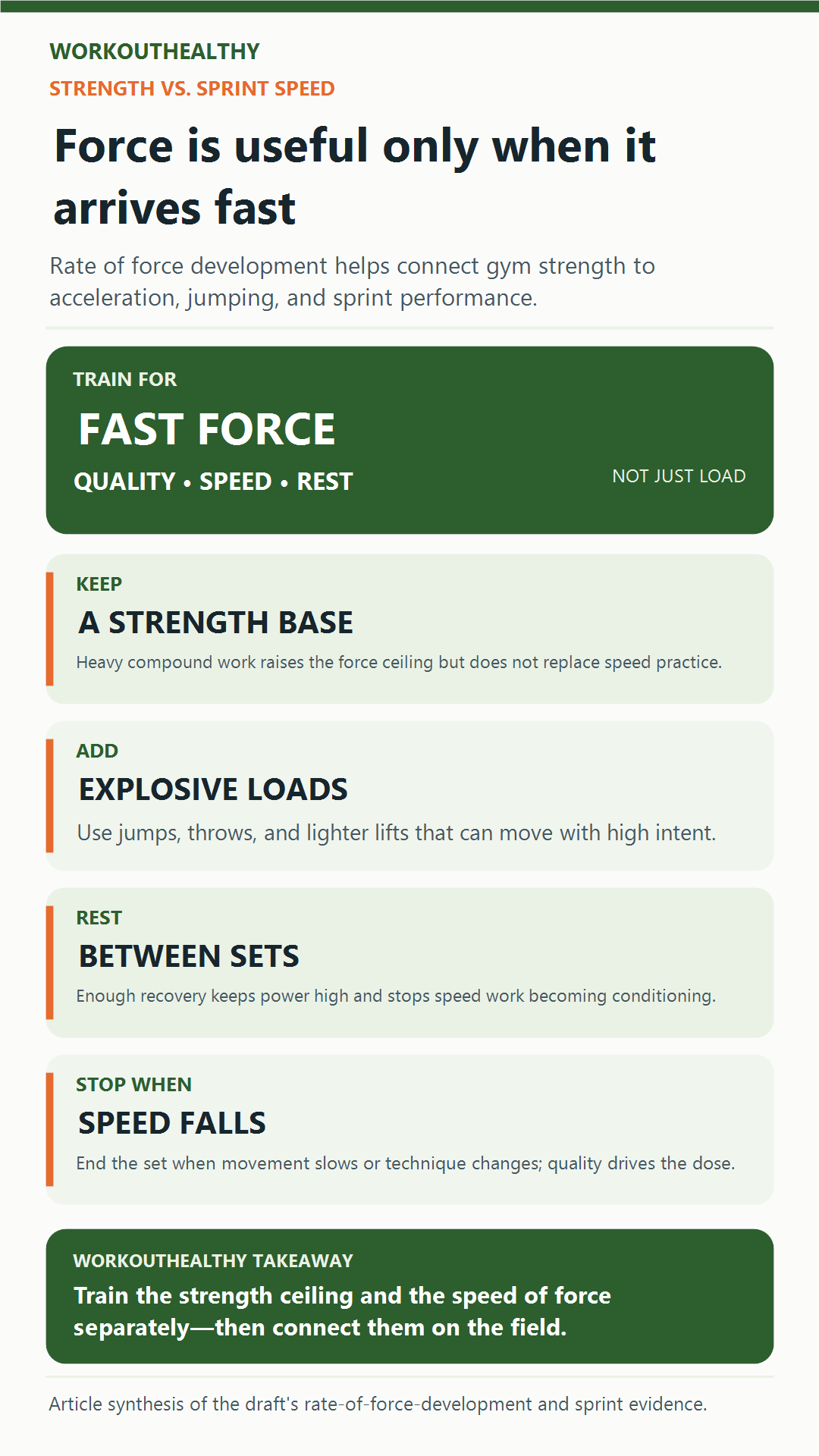
Training RFD looks different from typical hypertrophy or strength programming.
Start with a foundation of basic strength training two or three times a week, using compound lifts like squats, deadlifts, and presses.
A reasonable target before adding heavy RFD work is being able to squat close to bodyweight for a few clean reps.
Once that foundation exists, add explosive movements on separate days, or at the very start of a session before fatigue sets in.
Loaded jump squats, done with a light to moderate load, are one option directly supported by the research above.
Keep the load light enough that the bar or dumbbells actually move fast on every rep.
Sets of three to five reps work well, since RFD training depends on quality, not fatigue.
Rest two to three minutes between sets to keep each set close to maximal speed.
Plyometric drills, like bounds and short depth jumps, are another option once basic jump mechanics are solid.
Readers who want a deeper look at how this style of training affects the body can see our review of whether box jumps build muscle.
Keep total ballistic training volume low, since quality drops off fast once fatigue starts to build.
A useful weekly structure is two RFD focused sessions, paired with two or three strength sessions on separate days.
Readers deciding between pressing variations for that strength work can compare the mechanics in our piece on the floor press versus the bench press.
Track actual sprint times or jump height every few weeks, not just the weight loaded on the bar.
If jump height or sprint times stop moving, the training plan needs adjusting, not just heavier weights.
Many lifters lean heavily toward one style of training and skip the other almost entirely, a pattern our own audience shows in reader data on weightlifting versus running preferences.
Real speed development usually asks for both strength work and dedicated speed work, not a choice between the two.
Watch the Original Video
Want more like this? Subscribe to WorkoutHealthy Insider for practical explanations behind popular fitness claims.
References
Cronin, J. B., & Hansen, K. T. (2005). Strength and power predictors of sports speed. Journal of Strength and Conditioning Research, 19(2), 349 to 357. https://doi.org/10.1519/14323.1
Maffiuletti, N. A., Aagaard, P., Blazevich, A. J., Folland, J., Tillin, N., & Duchateau, J. (2016). Rate of force development: Physiological and methodological considerations. European Journal of Applied Physiology, 116(6), 1091 to 1116. https://doi.org/10.1007/s00421-016-3346-6
This article is for general information only and is not medical advice. If you have an injury, ongoing pain, or a medical condition, talk to a doctor or physical therapist before you change how you train or eat.