
Half a kilogram.
That is the entire gap between two world records set by the same lifter, in the same weight class, at the same annual championship, one year apart.
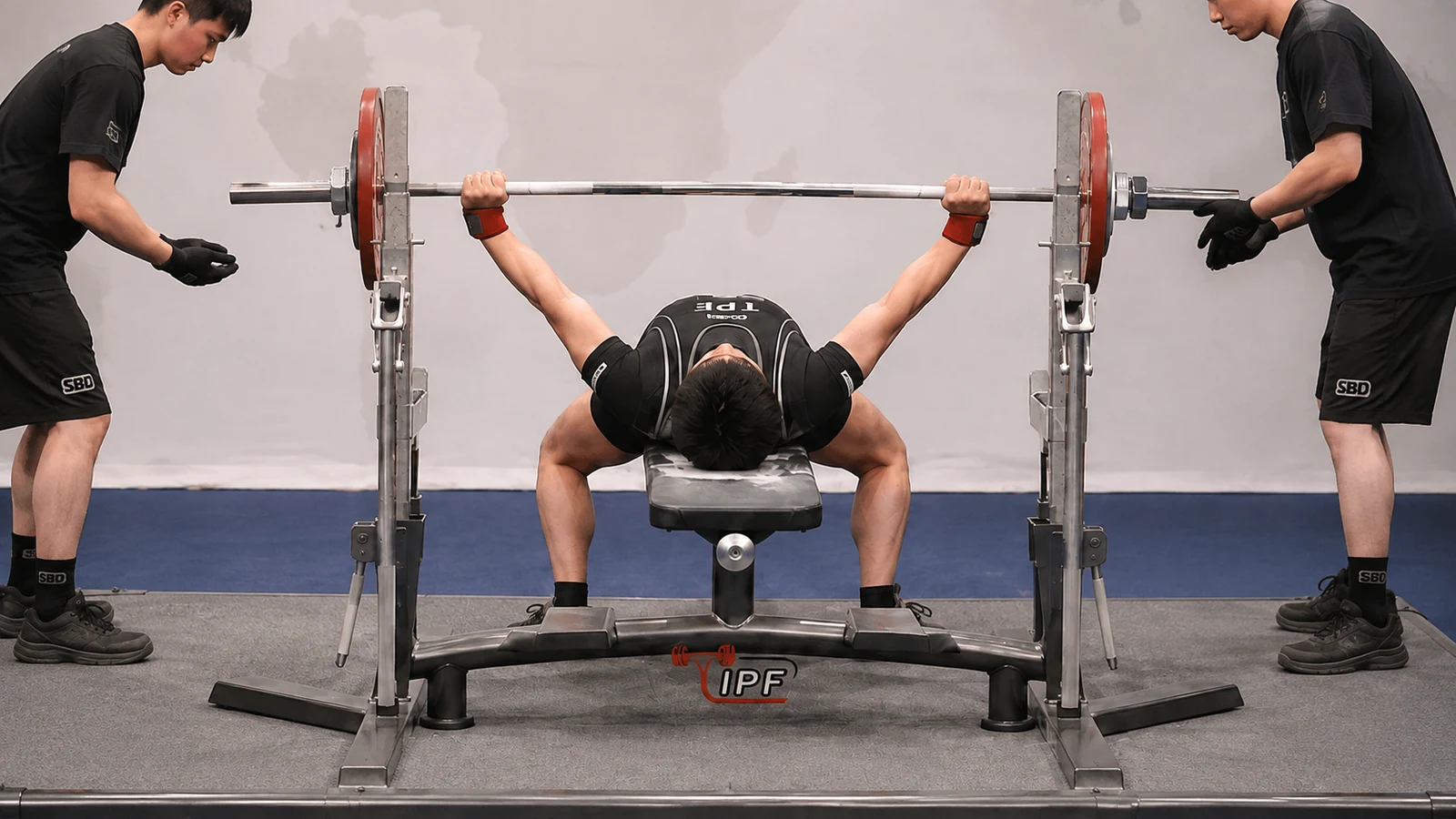
In June 2025, Taiwan’s Fan Chun-Chia bench pressed 215.5 kg, about 475.1 lb, in the men’s 74 kg raw division at the IPF World Classic Powerlifting Championships.
It was a world record.
A year later, at the same championship, he pressed 216 kg, about 476.2 lb, and broke his own record by roughly one pound.
That is not a story about a single huge number.
It is a story about what happens once a lifter is already standing at the edge of what a 74 kg raw bench press can do, and the small, unglamorous work it takes to move that edge forward at all.
What Fan Chun-Chia Actually Did
Fan’s first world record came on June 8, 2025, at the IPF World Classic Powerlifting Championships in Chemnitz, Germany.
Competing in the Open men’s 74 kg class at a bodyweight of 73.9 kg, he locked out 215.5 kg for the new raw bench press world record.
The International Powerlifting Federation’s own YouTube channel titled the upload of that lift plainly: a world record, 215.5 kg, by Chun-Chia Fan of Chinese Taipei, in the 74 kg class.
Almost exactly one year later, on June 13, 2026, the championship moved to Druskininkai, Lithuania.
Fan competed again in the 74 kg class, this time at 73.6 kg bodyweight, and pressed 216 kg.
That lift broke his own year-old record.
Both lifts happened at the same meet, in the same weight class, under the same federation, roughly 365 days apart.
The gap between them is 0.5 kg, or about 1.1 lb.
How Close Is Half a Kilogram at This Level?
To most gym-goers, adding a single kilogram to a bench press over a full year would feel like a bad year, not a world record.
For Fan, it was the opposite, and a genuine ceiling-pushing achievement.
OpenPowerlifting’s competition history for Fan shows a clear, verifiable climb: 200 kg at an IPF meet in June 2023, 202.5 kg at the IPF World Classic Championships in June 2024, 210 kg at a national-level CTPA meet that July, then 215 kg at an AsianPF continental championship that December.
Then came the two IPF world records, 215.5 kg in June 2025 and 216 kg in June 2026.
Laid out that way, the pattern is obvious.
He added 2.5 kg in the year between 2023 and 2024.
He added another 12.5 kg over the following six months, competing against national and continental fields instead of the world’s best.
Then, once he actually reached the world record, his gains nearly stopped: half a kilogram in a full year, at the very top of the field he had just climbed into.
The closer a lifter gets to the actual limit of what a weight class allows, the smaller each new record tends to get. Half a kilogram, defended for a full year against the entire world, is not a small result. It is what the top of the curve looks like.
The Mechanism: Why the Last Few Kilograms Are the Hardest to Find
Elite raw bench pressing is not simply a matter of building bigger chest and triceps muscles and hoping the number goes up.
A 2026 study in Applied Sciences examined how technique itself limits or unlocks a lifter’s top-end bench press, independent of raw muscle size (Montenegro et al., 2026).
Researchers had 15 recreational powerlifters train the bench press alongside an antagonist row exercise, deliberately varying how the two movements were sequenced in training.
The group that trained with more variation between the two exercises showed a bigger improvement in one very specific skill: scapular adduction and retraction, meaning how tightly and consistently a lifter can pull their shoulder blades together and hold them against the bench.
The researchers described that shoulder-blade control as a trainable motor skill, not a fixed trait, and one that directly affects upper-back stability and the pressing bar path.
In plain terms, at a lifter’s absolute ceiling, technique refinements like this can be the difference between a made lift and a missed one.
Readers curious about how small setup changes affect a bench press’s mechanics can see a related comparison in our floor press vs. bench press breakdown, which walks through how removing leg drive changes what the lift actually tests.
Nearly Three Times His Own Bodyweight, Raw
The other number worth sitting with is the ratio, not just the total.
At his 2026 record, Fan weighed 73.6 kg and bench pressed 216 kg.
That works out to roughly 2.93 times his own bodyweight, lifted with no bench shirt and no supportive equipment beyond a standard raw setup.
That ratio is the real headline, arguably more than the raw kilogram figure.
A heavier lifter in a super-heavyweight class can post a larger absolute number while still lifting a smaller multiple of their own bodyweight.
A 2020 analysis published in the International Journal of Exercise Science tested exactly this kind of cross-weight-class comparison, running 26,472 real competitive results from the Open Powerlifting database through several scoring formulas (Ferland et al., 2020).
The study found that simple bodyweight ratios and raw totals were poor tools for comparing strength fairly across weight classes.
Formulas built specifically to account for body mass, like the Wilks and IPF GL formulas, did a meaningfully better job.
That is the exact reason a 74 kg lifter’s bench press can be a legitimate world record while carrying a smaller absolute number than what a much heavier lifter can put up.
Pound for pound, close to 2.93 times bodyweight raw is an extremely rare number, at any weight class.
Taiwan’s Quiet Rise in a Sport the West Rarely Covers
Fan competes for Chinese Taipei, the designation Taiwan competes under in IPF and Olympic-affiliated sport.
His own results trail shows the pathway that produced a world record: a domestic CTPA meet in mid-2024, an AsianPF continental championship that December, and then straight into the IPF’s own World Classic Championships within six months.
That is a genuinely fast climb from national competition to a world title.
It is also a climb that mainstream English-language strength media rarely covers in real time.
Most Western powerlifting coverage still concentrates heavily on North American and European lifters, leaving fast-rising Asian federations underreported even when their athletes are setting the actual world records.
Readers who enjoy tracking under-the-radar record stories like this one may also want to see how a completely different kind of pacing challenge produced a world record in our coverage of DonnaJean Wilde’s push-up world record.
What This Record Does Not Prove
A world record bench press is a real, verified competitive result.
It is not a complete picture of everything that produced it.
OpenPowerlifting’s public results and the IPF’s own upload independently confirm the lift, the weight, the date, and the federation.
What they cannot show from the outside is the specific training program, coaching relationships, or genetic factors that made this particular lifter capable of a nearly 3x bodyweight raw press.
It is also worth being precise about what “raw” means here.
The IPF’s Classic division allows a bench shirt-free setup with only a belt, wrist wraps, and knee sleeves.
That is different from the sport’s separate Equipped division, where supportive bench shirts can add well over a hundred kilograms to a lifter’s number.
Comparing Fan’s 216 kg to an equipped lifter’s total would be comparing two different sports wearing the same name.
Common Mistakes Lifters Make Chasing a Bigger Raw Bench
Most lifters trying to add kilograms to their bench press make the same handful of errors.
Benching heavy too often, without planned lighter weeks, is the most common one, and it tends to stall progress rather than accelerate it.
Chasing a bigger number by adding more sets and more frequency, while ignoring technique work like the scapular control described above, is another.
So is training the bench press in isolation, without the back and shoulder stability work that actually supports a heavier top-end lift.
Strength gains do not only come from doing more of the same movement.
Varied training stimulus, the kind examined in our look at whether box jumps can build muscle, is a useful reminder that different types of loading can each contribute to a lifter’s overall strength and power in ways a single exercise cannot.
Who Should Be Cautious Before Attempting a Heavy Raw Max
A true one-repetition maximum attempt is a maximal, all-out effort, and it is not something every lifter should build toward without guidance.
Anyone with a history of shoulder impingement, a labral tear, wrist pain, or an unaddressed pectoral strain should get cleared by a doctor or physical therapist before working toward a heavy single.
The same caution applies to anyone with uncontrolled high blood pressure or a cardiovascular condition, since a true max-effort lift involves a Valsalva maneuver that briefly spikes blood pressure.
Newer lifters are usually better served spending months building technique at moderate weights before ever testing a true max, rather than rushing toward a personal-record attempt.
How Lifters Actually Build Toward a Number Like This
Elite raw bench pressing at Fan’s level is built on periodized training, not a single big workout.
A typical approach cycles through phases: a hypertrophy block focused on building total muscle mass in the chest, shoulders, and triceps, followed by a strength block using heavier weights and lower reps, followed by a shorter peaking phase where volume drops and intensity rises toward a competition-specific single.
Technique work, like the scapular retraction training described earlier, typically runs throughout every phase rather than being saved for the end.
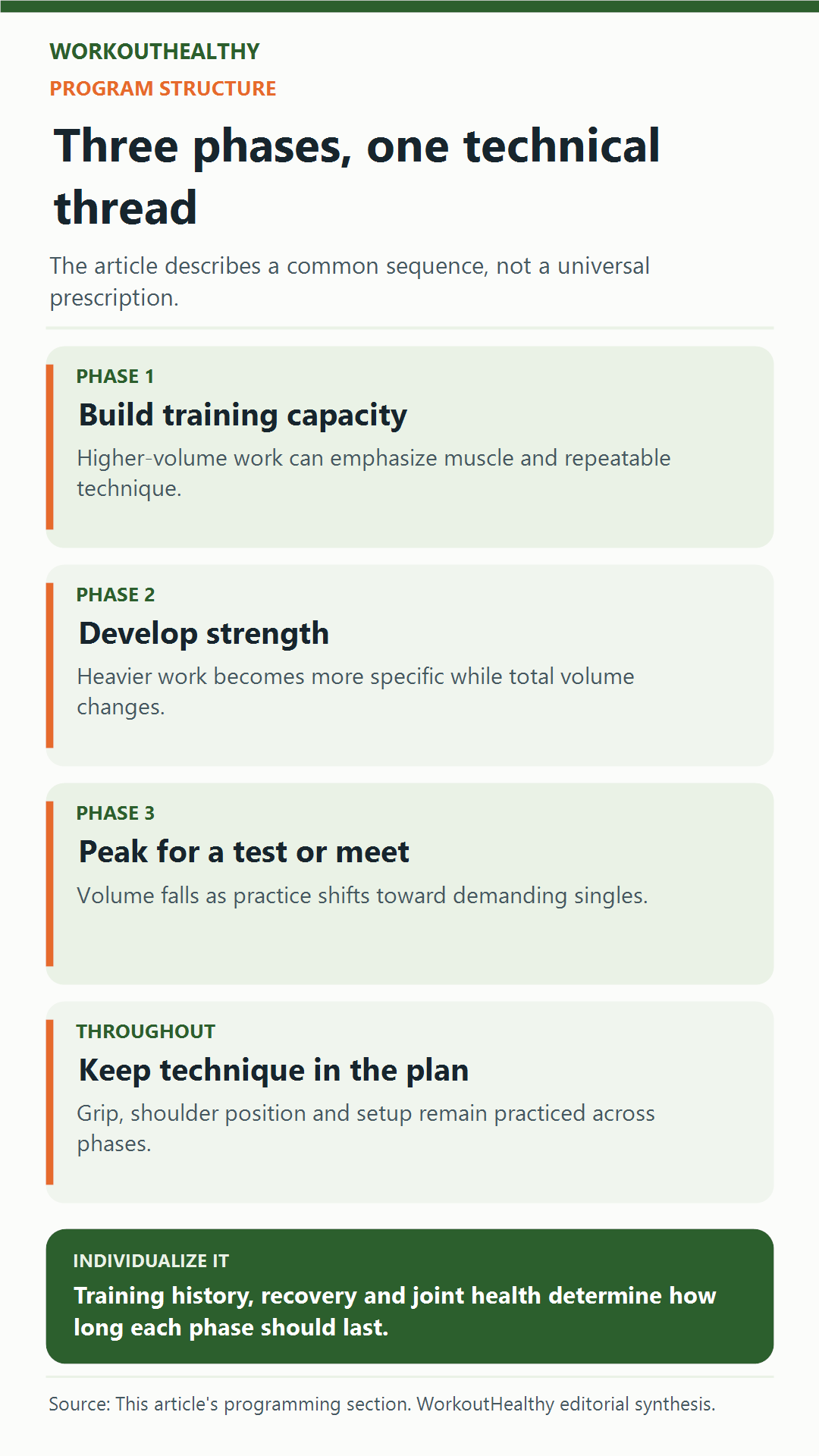
Grip width, foot position, and the amount of arch a lifter uses are all individually tuned variables, refined over years of competition rather than set once and left alone.
For most lifters without a competitive powerlifting background, working with a qualified coach is the fastest way to avoid wasted training cycles while chasing a heavier bench press.
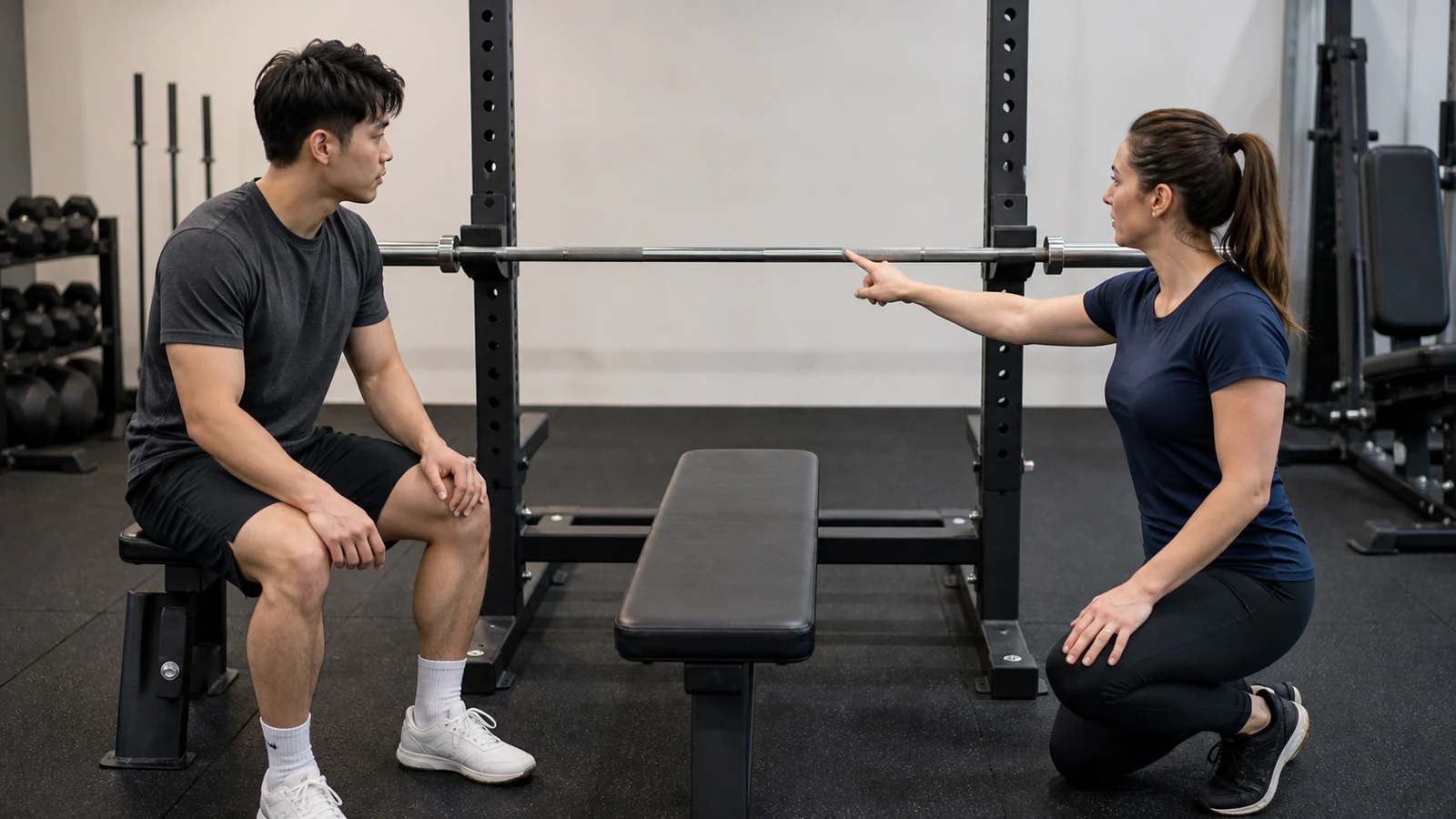
Our guide on whether you need a personal trainer and how to hire one walks through how to tell whether coaching is worth the investment at your current level.
Watch the Original Video
Want more verified record breakdowns like this one? Subscribe to WorkoutHealthy Insider for practical explanations behind popular fitness claims.
References
Ferland, P.-M., Allard, M.-O., & Comtois, A.-S. (2020). Efficiency of the Wilks and IPF Formulas at comparing maximal strength regardless of bodyweight through analysis of the Open Powerlifting database. International Journal of Exercise Science, 13(4), 567–582. https://doi.org/10.70252/xghm8852
Montenegro, S., Izzicupo, P., Prestanti, I., Serafini, S., Fusco, A., & Sartor, F. (2026). Optimizing powerlifting bench press technique using contextual interference via antagonist task selection. Applied Sciences, 16(11), Article 5511. https://doi.org/10.3390/app16115511
This article is for general information only and is not medical advice. If you have an injury, ongoing pain, or a medical condition, talk to a doctor or physical therapist before you change how you train or eat.