
Some deadlifts change what a weight class means.
Some change what an entire sport thinks a woman can lift, full stop.
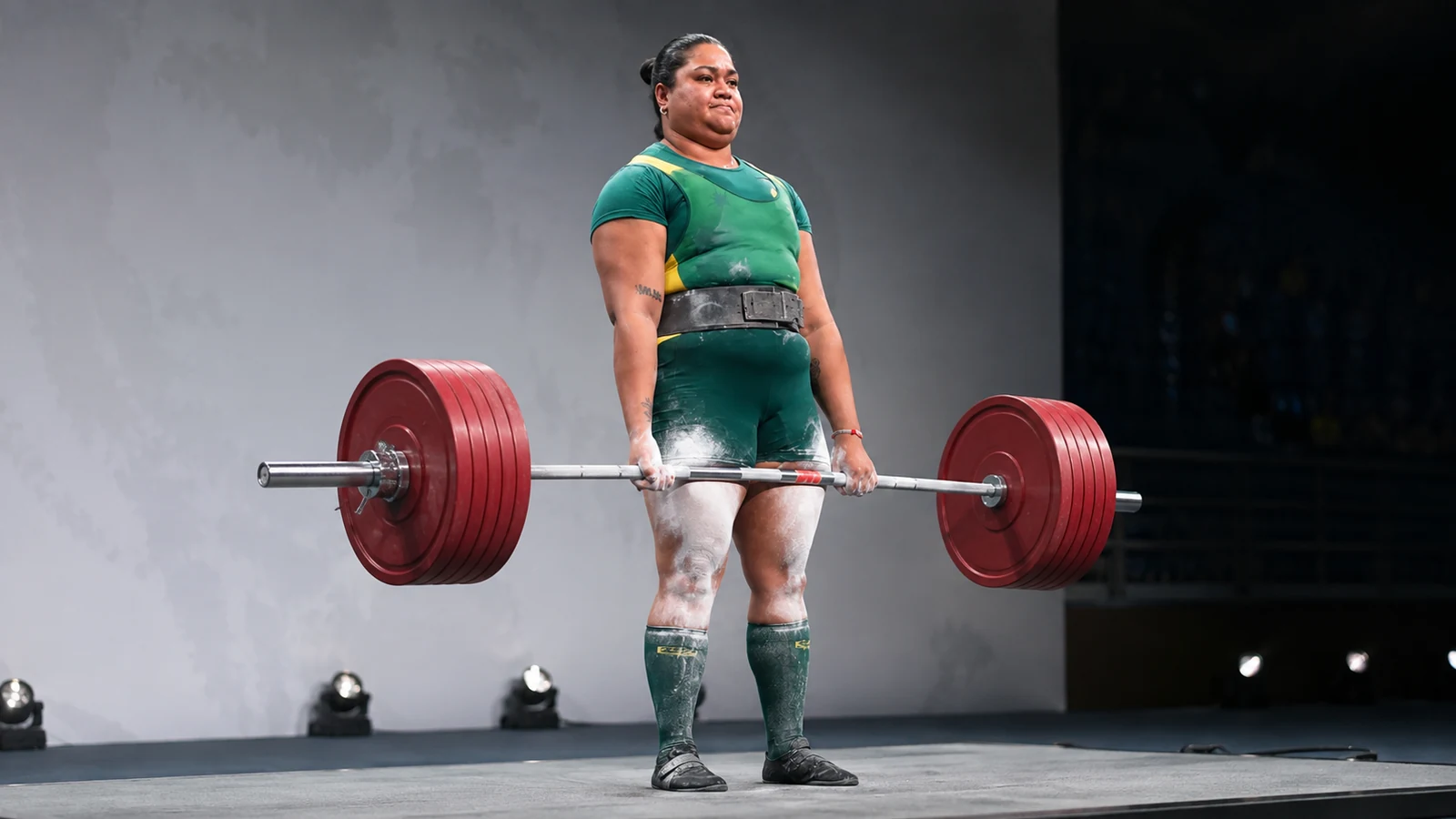
On June 27, 2025, at the IPF World Classic Powerlifting Championships in Chemnitz, Germany, Natalie Laalaai locked out a 285.5 kilogram deadlift.
That is 629.4 pounds.
She pulled it in the 84+ kilogram class, the women’s super heavyweight division with no upper bodyweight limit.
No suit. No straps.
Just a belt, chalk, and a bar loaded past most men’s max.
The International Powerlifting Federation did not describe this as merely a class record.
In its own closing statement from the championships, the federation called it the biggest deadlift ever recorded in IPF history by a woman, in classic or equipped competition combined.
Not the biggest in her weight class.
The biggest, period, across every women’s division and every equipment category the IPF has ever sanctioned.
That distinction matters.
Weight classes exist so lifters of different sizes can compete fairly against each other.
A record inside one class, even a demanding one, is still bounded by that class.
Laalaai’s 285.5 kilograms was not bounded by anything.
It stood above every equipped lift too, the category that allows supportive deadlift suits engineered to add leverage a raw lifter does not get.
What the IPF Itself Said About It
Federation closing statements tend toward dry, official language.
This one did not stay dry when it reached Laalaai’s name.
“The biggest deadlift ever done in IPF history by a woman, either in classic or equipped, Natalie Laalaai with an incredible 285.5kg deadlift.”
The 2025 World Classic Championships were not a small meet.
They drew 387 athletes from 60 countries, and women made up 46 percent of the field.
Forty-seven world records fell across the week.
Laalaai’s deadlift was singled out, by name, inside all of that.
It also carried her to a 688 kilogram total, made up of a 267.5 kg squat, a 135 kg bench, and the 285.5 kg deadlift.
That total was good for bronze, her first individual podium finish at an IPF World Championships.
Inside the 84+ KG Class: Why “No Upper Limit” Actually Matters
Powerlifting sorts women into bodyweight classes so a 60 kilogram lifter is never scored against a 100 kilogram one.
Most classes have a floor and a ceiling.
The 84+ kilogram class has a floor and nothing else.
Anyone heavier than 84 kilograms competes in the same field, whether they weigh 90 or 150.
That structure means the 84+ class produces the heaviest absolute numbers in women’s powerlifting almost by design.
It is also why a raw deadlift record set inside it, without a supportive suit, carries weight beyond its own division.
There is no larger class waiting to eventually top it.
The 84+ record, in a very literal sense, is the ceiling.
Other elite lifters hold real, legitimate records in the capped classes below it.
Those records matter and reflect exceptional strength relative to a defined bodyweight limit.
Laalaai’s record answers a different question entirely.
Not “who is strongest at this bodyweight,” but “what is the single heaviest raw pull any woman has completed under IPF rules.”
As of her June 2025 lift, per the federation’s own words, the answer was her name.
The Third Attempt: How a “Downward Motion” Can Cost a World Record
Laalaai was not finished chasing weight that day.
She loaded a third attempt at 296.5 kilograms, roughly 653.7 pounds, a jump that would have pushed the record even further.
The bar came off the floor.
Referees ruled the lift no good for a downward motion partway through the pull, a violation of the rule requiring one continuous upward movement from start to finish.
That single technical detail explains a lot about why maximal deadlifts fail even when the weight technically leaves the ground.
Research on deadlift mechanics describes the lift as a series of connected phases, from the initial pull off the floor through the transition past the knee to full hip lockout (Hales, 2010).
Each phase places different demands on the lifter’s back, hips, and grip.
A stall or dip at any point in that chain, even a small one, can turn a legal lift into a failed one under strict judging.
Elite raw lifters live right at that edge on their heaviest attempts.
Laalaai’s 285.5 kilogram second attempt cleared the bar cleanly.
Her third attempt found exactly where that edge was.
Nothing Sudden About It: Laalaai’s Climb to 285.5 KG
A 629 pound deadlift can look like it appeared out of nowhere to someone scrolling past the clip.
It did not.
Competition results show a deliberate, multi-year climb through the same 84+ kilogram class, meet after meet.
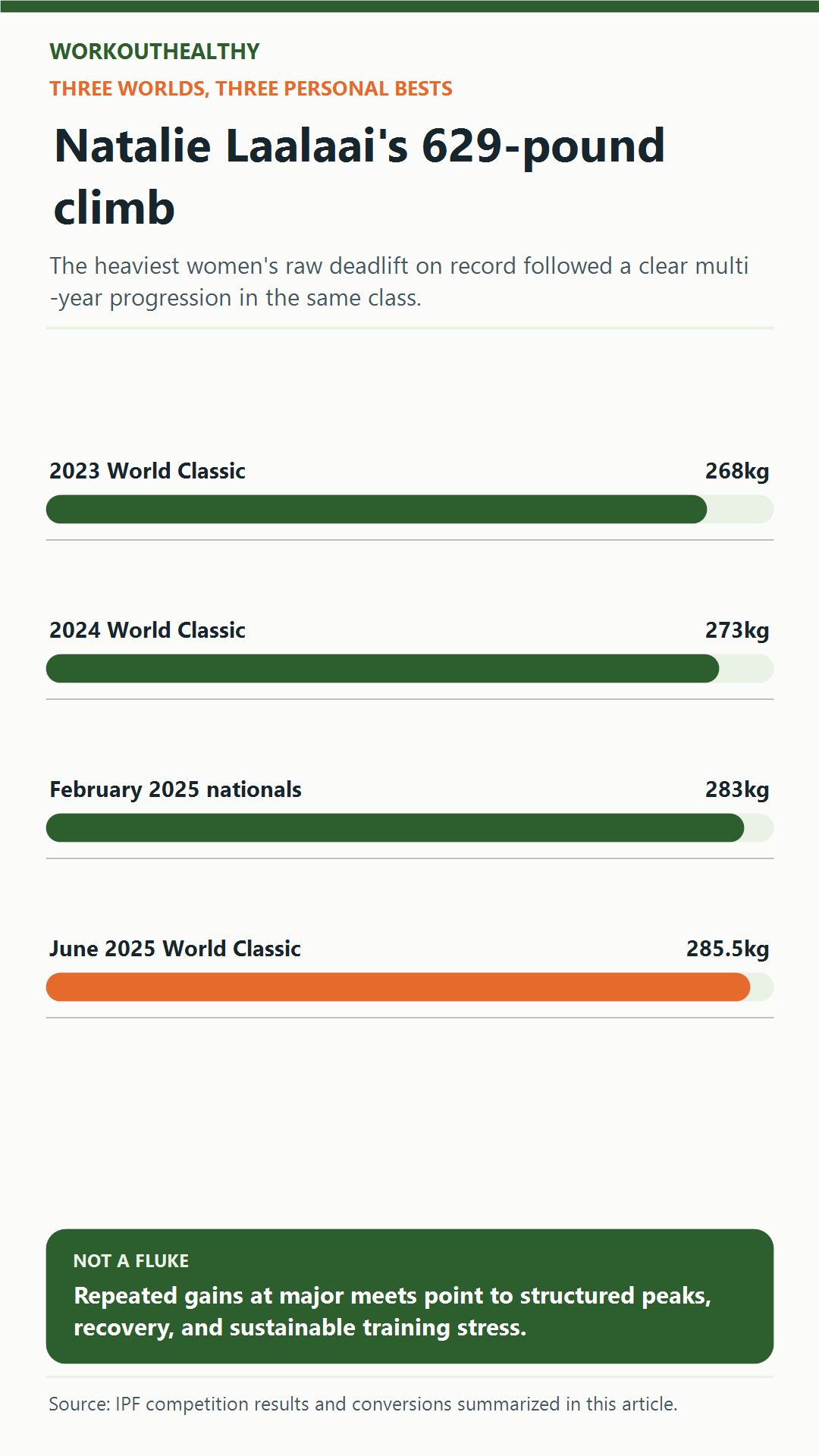
At the 2023 IPF World Classic Championships, Laalaai deadlifted 268 kilograms, about 590.8 pounds.
That pull was part of a 640.5 kilogram total.
A year later, at the 2024 World Classic Championships, she added five kilograms to pull 273 kilograms, roughly 601.9 pounds.
That was the class’s own IPF deadlift record at the time.
Then came 2025.
She opened the year with 283 kilograms at her national Open Championships in February.
Four months later in Chemnitz, she added another 2.5 kilograms to reach 285.5.
Three straight IPF World Classic Championships.
Three straight increases in the same lift, in the same weight class, each one a new personal best.
That is not a fluke performance.
It is a training program working exactly as intended, year over year.
She Kept Going: What Laalaai Has Done Since Chemnitz
Records in a sport this competitive rarely sit still for long, and Laalaai’s own is a good example of why.
Roughly six weeks after Chemnitz, powerlifting made its debut at the 2025 World Games in Chengdu, China.
Laalaai competed there too.
She pulled 287.5 kilograms, about 634 pounds, on her way to a 692.5 kilogram total and a third place finish.
That lift was announced from the platform as a new world deadlift record in her division.
It landed two kilograms past what she had done in Chemnitz just weeks earlier.
Other athletes covered in this same World Records series show the same pattern.
DonnaJean Wilde’s own push-up world record worked the same way, built one improved attempt at a time rather than arriving fully formed.
The honest way to describe Laalaai’s record, then, is not a single frozen number.
It is a moving one, and she is the one moving it.
The 285.5 kilogram pull in Chemnitz is the one this article is built around.
It is the moment, documented in the IPF’s own official statement, that made her the outright heaviest raw deadlifter in the federation’s history.
It was not her last word on the subject.
Based on available results, it was not even her last word that year.
Why the Story Behind the Number Matters
It is tempting to read a headline like “heaviest raw deadlift by a woman in IPF history” as trivia.
The research on sex differences in human performance suggests there is a more interesting story underneath it.
Men, on average, carry more absolute muscle mass and produce more absolute force than women (Hunter & Senefeld, 2024).
That gap is driven by differences in muscle fiber size, hormonal profile, and typical body composition.
That average gap is real.
It is also just an average, describing population-level tendencies, not a hard ceiling on any individual.
Elite strength athletes on the far right tail of the female distribution routinely outlift the vast majority of untrained or moderately trained men, Laalaai included.
A 629 pound raw pull would be a genuinely rare feat for almost any man walking into a commercial gym.
The IPF is also a drug-tested federation, which adds real weight to a record like this one.
A 2025 scoping review of the sport science behind powerlifting and para powerlifting noted that testing status is a meaningful variable across the sport’s competitive landscape (Silverthorne et al., 2025).
It shapes both training approaches and how a given result should be interpreted.
A record set under that kind of scrutiny is not the same claim as an unverified lift filmed in a private gym.
What It Actually Takes to Peak for a Meet Like This
Nobody walks onto a competition platform and pulls a lifetime best by accident.
Elite powerlifters build toward a specific meet through a planned reduction in training volume in the weeks beforehand, commonly called a taper (Travis et al., 2020).
A taper is designed to shed accumulated fatigue while keeping strength and technical sharpness intact.
Get that taper wrong in either direction and a lifter shows up either still fatigued from training or detrained from resting too long.
Get it right, and a lifter can produce a number on the platform that training numbers alone did not fully predict.
Laalaai’s three-year progression through the same annual championship suggests a program built around exactly that kind of yearly peak, not a single lucky day.
If you are working toward your own strength goals, the same underlying principle applies at a smaller scale, whether or not competition is part of the plan.
Programmed variation in training stress, with real recovery built in, tends to produce better results than constant maximal effort week after week.
For a deeper look at how structured strength training pays off over the long run, our piece on whether lifting weights keeps your brain young covers benefits that extend well past the platform.
Common Mistakes Lifters Make Chasing a Heavier Pull
Watching a 629 pound deadlift can make anyone want to load a bar and test their own ceiling immediately.
A few common mistakes show up again and again in lifters trying to chase heavy pulls too quickly.
Skipping a real warm-up is one of the most common.
Working straight up to a near-maximal attempt without a graded series of lighter sets leaves connective tissue and technique both underprepared for the load ahead.
Rounding the lower back under heavy load is another.
A rounded spine under a maximal deadlift shifts stress away from the hips and hamstrings and concentrates it on the lumbar spine instead.
That is exactly the kind of pattern coaches spend years correcting in developing lifters.
Chasing a number before the technique is ready is the biggest one.
Laalaai’s near miss at 296.5 kilograms is a reminder that even elite, highly trained lifters can lose a lift to a technical break under enough load.
A lifter years into training loses far more than an attempt when the same mistake happens on an untrained back.
Who Should Be Careful With Maximal Deadlifts
Maximal or near-maximal deadlifting is not appropriate for everyone, no matter how inspiring a record like this one is.
Anyone with a current lower back injury, an unresolved disc issue, uncontrolled high blood pressure, or a recent abdominal or pelvic surgery should get individualized medical clearance before attempting heavy pulls.
Beginners benefit far more from months of technique work at light to moderate loads than from an early attempt at a personal record.
Strength built on solid technique tends to last.
Strength chased before the technique is ready tends to end in an injury that sets a lifter back much further than the record would have moved them forward.
A qualified coach who can watch your bar path and bracing in person is worth more than any article, including this one.
Records like Edith Connor’s, who did not start competitive strength sport until her sixties and still walked away with a Guinness World Record of her own, tell a similar story from the opposite end of a career.
Technique and patience, more than raw ambition, are what let a lifter’s ceiling keep rising safely.
Watch the Original Video
Want more stories like this one? Subscribe to WorkoutHealthy Insider for practical explanations behind popular fitness claims.
References
Hales, M. (2010). Improving the deadlift: Understanding biomechanical constraints and physiological adaptations to resistance exercise. Strength & Conditioning Journal, 32(4), 44–51. https://doi.org/10.1519/SSC.0b013e3181e5e300
Hunter, S. K., & Senefeld, J. W. (2024). Sex differences in human performance. The Journal of Physiology, 602(17), 4129–4156. https://doi.org/10.1113/JP284198
International Powerlifting Federation. (2025, June 27). World Open & Classic Powerlifting Championships closing statement [News release]. https://www.powerlifting.sport/about-ipf/news/news-for-epf/world-open-classic-powerlifting-championships-closing-statement
Silverthorne, K., Morrison, M., Cowley, N., Munteanu, G., Creaby, M. W., Timmins, R. G., Chiang, C.-Y., & Weakley, J. (2025). The applied sport science and medicine of powerlifting and para powerlifting: A systematic scoping review with recommendations for future research. Sports Medicine, 55(11), 2849–2877. https://doi.org/10.1007/s40279-025-02305-3
Tabakovic, V. (2025, June 27). Natalie Laalaai (+84KG) scores 285.5-kg (629.4-lb) raw deadlift world record at 2025 IPF World Powerlifting Championships. Fitness Volt. https://fitnessvolt.com/natalie-laalaai-285-5-kg-raw-deadlift-world-record-2025-ipf-world-powerlifting-championships/
Travis, S. K., Mujika, I., Gentles, J. A., Stone, M. H., & Bazyler, C. D. (2020). Tapering and peaking maximal strength for powerlifting performance: A review. Sports, 8(9), 125. https://doi.org/10.3390/sports8090125
This article is for general information only and is not medical advice. If you have an injury, ongoing pain, or a medical condition, talk to a doctor or physical therapist before you change how you train or eat.