

Oliver Phelps spent a decade on movie sets playing George Weasley in the Harry Potter film series.
He worked alongside his identical twin brother James, who played George’s fictional twin, Fred.
Since the franchise wrapped, Phelps has kept a full schedule.
That includes a podcast he co-hosts with his brother, along with other media and business projects.
He had never run a marathon before this year.
According to Runner’s World’s coverage of the 2025 New York City Marathon, Phelps signed up for the race as his debut at the distance.
That is a serious jump for a first timer already managing a busy career.
He ran to support the Matt Hampson Foundation.
Former rugby player Matt Hampson founded the charity after his own catastrophic injury.
A scrum collapsed during a training session in 2005 and left him paralyzed from the neck down.
The foundation supports young people who have been seriously injured through sport.
It helps them rebuild their lives after a catastrophic accident.
Training for 26.2 miles alongside a full working schedule is not simple on its own.
Doing it for a cause built around the risks of physical sport adds a certain weight to the effort.
It also raises a practical question that applies well beyond one actor’s race calendar.
How much does a demanding schedule actually raise injury risk for a first time marathoner, and what does the research say about training smart instead of just training hard?
The Real Time Cost of a First Marathon
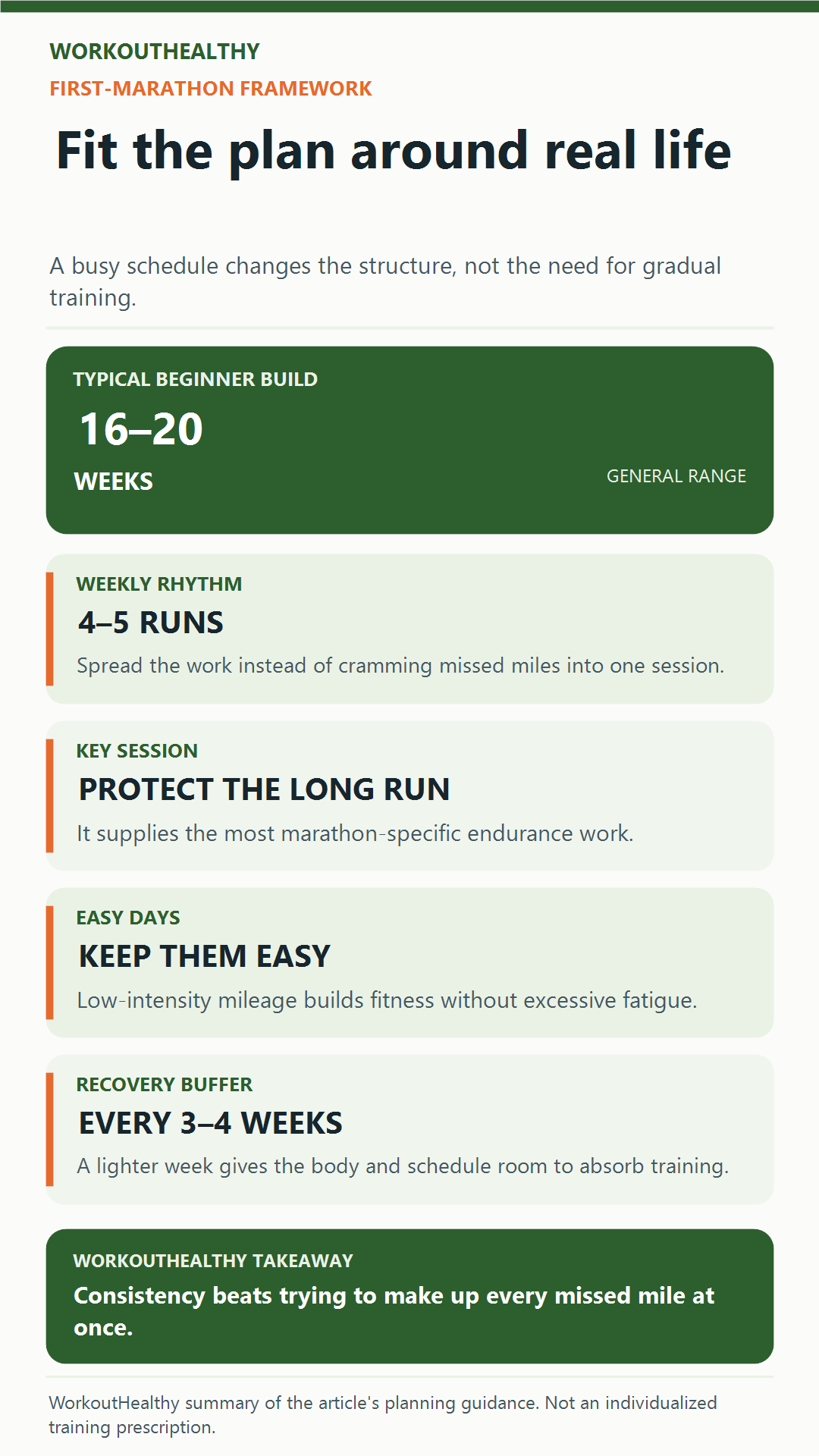
Marathon training plans for first timers typically run 16 to 20 weeks.
They call for four to five runs a week.
Mileage builds gradually from a modest starting point up toward a peak of 20 or more miles in a single long run.
For someone already balancing a demanding job, fitting that schedule in is its own challenge, separate from the running itself.
Most plans are built around three shorter runs during the week and one long run on the weekend.
That structure is designed to work around a normal work schedule rather than replace it.
The bigger risk for busy first timers is usually not finding the time.
It is trying to compress the same total training volume into fewer, harder sessions instead of spreading it out the way the plan intends.
A runner who misses two midweek runs and then tries to make up the mileage on the weekend is not following the same plan anymore.
They are running a different, riskier one.
Why Novice Runners Get Hurt More Often Than Experienced Ones
Researchers led by Bregje Kluitenberg studied exactly this population in a large Dutch project called the NLstart2run study.
Their work was published in the Journal of Science and Medicine in Sport.
The research tracked new runners as they began a structured running program.
It measured how often running related injuries occurred over the course of that program.
They found injury rates were meaningfully higher among runners who increased their training load quickly.
Injury rates were also higher among those with less prior experience managing their own training volume.
The study’s central finding was straightforward.
New runners are not more fragile than experienced ones in some fixed, permanent way.
They are simply more likely to make training errors.
They have not yet learned to read their own body’s signals or pace their own progression the way an experienced runner has.
That finding matters directly for someone attempting a marathon debut on a compressed schedule.
The instinct to cram missed training days into a single long weekend run is exactly the kind of load spike the research flags as a leading injury risk factor.
A sudden jump in weekly mileage, even a single oversized long run, asks tendons, joints, and connective tissue to adapt faster than they actually can.
Muscles tend to get stronger within days of a new stress.
Tendons and bone adapt much more slowly, often over several weeks.
That mismatch is a big part of why running injuries so often show up in tendons and joints rather than muscle itself.
What Actually Happens Inside an Untrained Body During Marathon Buildup
A body with no running background goes through real, measurable change during a first marathon buildup.
The heart gradually increases its stroke volume, meaning it pumps more blood with each beat.
Resting heart rate typically drops as that adaptation takes hold over the training block.
Muscles increase their density of mitochondria, the structures that turn fuel into usable energy during aerobic exercise.
Capillary networks around muscle fibers also expand, improving the delivery of oxygen during sustained effort.
Those adaptations are exactly why gradual, consistent training beats compressed, intense training for a beginner.
The body needs weeks, not days, to build the cardiovascular and muscular base a marathon actually demands.
Skipping steps in that process does not just raise injury risk.
It also means race day arrives with an engine that was never fully built.
What the Charity’s Mission Reveals About Physical Risk in Sport
The Matt Hampson Foundation exists because of a catastrophic injury during a routine rugby training drill.
Researchers have studied how injuries like that one happen.
A review by researchers Kenneth Quarrie, Robert Cantu, and David Chalmers examined rugby union injuries to the cervical spine and spinal cord.
Their review was published in the journal Sports Medicine.
Their review found that the scrum was consistently identified as one of the highest risk phases of play for serious spinal injury.
The scrum is the exact kind of drill involved in Hampson’s accident.
Their review is a reminder that sport carries real physical risk.
That risk is not evenly distributed across every activity.
Marathon training, by comparison, carries a very different injury profile.
Most marathon injuries are overuse injuries from repeated stress, rather than the sudden, catastrophic mechanism behind a scrum collapse.
Phelps running a marathon for a foundation built around that kind of injury does not connect the two activities directly.
It does connect two different, real conversations about how physical activity carries risk, and how that risk can be managed rather than ignored.
What This Evidence Does Not Prove
None of this research proves that a busy schedule causes running injuries on its own.
It also does not prove that Phelps followed any specific training plan.
The Dutch novice runner study found associations between training errors and injury.
It did not find a guaranteed outcome for every busy first timer.
Plenty of people with demanding jobs complete marathon training programs without injury.
Plenty of people with more free time still get hurt by ramping up too quickly.
The rugby spinal injury research, similarly, describes patterns across a sport with a specific, well documented injury mechanism.
It says nothing directly about marathon running’s own risks, which come from a very different kind of physical stress.
Common Mistakes First Time Marathoners With Busy Schedules Make
People training for a first marathon while working full time tend to fall into a few predictable traps.
Skipping easy runs to save time is a common one.
Easy runs build aerobic fitness without adding much fatigue.
Cutting them out often means the remaining hard sessions get harder than intended.
Cramming missed sessions into the weekend is another frequent mistake.
A single oversized long run does not replace several missed midweek runs.
It raises injury risk instead of making up lost fitness.
Treating sleep as the first thing to sacrifice is a third mistake.
Training adaptations, including the muscle repair that prevents injury, happen largely during sleep.
That makes sleep one of the worst places to cut corners during a demanding training block.
Ignoring early aches because there is no time to address them is a fourth common error.
A minor issue addressed early is usually a quick fix.
The same issue ignored for weeks can turn into a real injury that costs far more training time later.
Skipping a warmup to save five minutes is a fifth mistake many busy runners make.
Cold muscles and stiff tendons are more prone to strain in the first mile of any run.
How to Train for a Marathon Around a Full Schedule
A busy schedule does not rule out a first marathon.
It just changes how the plan needs to be built.
Start with a realistic weekly time budget.
Knowing exactly how many hours are actually available each week prevents the plan from being unrealistic from day one.
Protect the long run above everything else.
If only one session a week is guaranteed, it should be the weekend long run, since it builds the specific endurance a marathon actually demands.
Keep easy runs genuinely easy.
A slower pace on non-key days lets the body absorb training without adding unnecessary fatigue to an already full schedule.
Build in a buffer week every three or four weeks.
A lighter training week gives both the schedule and the body room to recover before the next push.
Treat sleep as part of training, not separate from it.
Even an extra 30 minutes of sleep during a heavy training block can meaningfully support recovery.
Add two short strength sessions a week if time allows.
Even 20 minutes focused on hips, glutes, and core can measurably lower injury risk over a full training block.
Batch prepare food and gear the night before key runs.
Removing small decision points in the morning makes it easier to protect an early training session on a busy day.

Pick a cause or a goal that makes the early morning alarms worth it.
Phelps’s connection to the Matt Hampson Foundation gave his training a purpose beyond the finish line.
That kind of motivation tends to matter most on the days the schedule feels impossible.
References
- Kluitenberg, B., van der Worp, H., Huisstede, B. M. A., Hartgens, F., Diercks, R., & Verhagen, E. (2016). The NLstart2run study: Training-related factors associated with running-related injuries in novice runners. Journal of Science and Medicine in Sport, 19(8), 642-646.
- Quarrie, K. L., Cantu, R. C., & Chalmers, D. J. (2002). Rugby union injuries to the cervical spine and spinal cord. Sports Medicine, 32(10), 633-653. https://doi.org/10.2165/00007256-200232100-00003
- Runner’s World. 2025 New York City Marathon celebrities. https://www.runnersworld.com/news/g69178419/2025-new-york-city-marathon-celebrities/
- Matt Hampson Foundation. About Matt’s story. https://www.matthampsonfoundation.org
This article is for general educational purposes and is not a substitute for individualized advice from a doctor or a certified running coach. Anyone new to distance running should build mileage gradually and consult a doctor before beginning an intense training program, especially if they have a pre-existing injury or health condition.