

On July 16, 1988, Florence Griffith-Joyner stepped onto the track at the US Olympic Trials in Indianapolis for a 100 meter quarterfinal.
She crossed the line in 10.49 seconds.
No woman has run faster since.
Thirty-eight years later, in a sport where sprint marks usually fall within a season or two, that gap alone makes the run worth examining closely.
This article checks the specific numbers against World Athletics’ own records, walks through the wind-reading controversy that has followed the time since the day it was set, and looks at what sprint science says about why it has held up this long.
The Record: 10.49 Seconds, Verified
World Athletics, the global governing body for track and field, lists 10.49 seconds as Griffith-Joyner’s personal best and the current world record in the women’s 100 meters.
The run happened in the quarterfinal round of the 1988 US Olympic Trials, not the final, on July 16 of that year.
It broke the previous world record by nearly three tenths of a second, a margin almost unheard of at the sprint distance.
World Athletics, not Guinness World Records, is the organization that actually ratifies and maintains official track and field world records, and its own athlete database confirms both the time and the date directly.
Griffith-Joyner also set the women’s 200 meter world record that same year, running 21.34 seconds at the Seoul Olympics that September.
Both records still stand today, and World Athletics lists her as a two-time reigning world record holder in the sprints.
A Career That Peaked in One Extraordinary Season
Griffith-Joyner’s 1988 season is one of the most dominant single years any sprinter has produced.
She won three Olympic gold medals in Seoul that fall, in the 100 meters, the 200 meters, and the 4×100 meter relay, plus a silver in the 4×400 relay.
She retired from competition the following February, at the height of her fame, and never lowered either time again.
Griffith-Joyner passed away in 1998, at age 38, after a seizure linked to a congenital brain condition.
Her world records have now outlived her by decades, and they remain the standard every elite female sprinter is still measured against.
The Wind Reading That Still Sparks Debate
The controversy around 10.49 has nothing to do with Griffith-Joyner’s training or her competitors that day.
It is about the wind gauge.
Official readings that afternoon showed a wind speed of 0.0 meters per second, comfortably inside the legal limit of 2.0 meters per second for a time to count as a record.
Multiple people at the track described visibly gusty conditions, with flags and banners moving noticeably throughout the session.
Omega, the company supplying the timing and wind equipment for that meet, had installed a newer three-cup anemometer capable of reading wind speed and wind direction together.
A technician from Omega later explained that the wind that day was blowing across the track at close to a right angle to the runway, not down it, which is how the system could register a strong crosswind as a flat “0.0” tailwind reading.
That explanation accounts for how the number could be technically accurate and still misleading about the conditions a sprinter actually felt on the track.
What a Later Technical Review Found
The question did not stay settled after that afternoon.
In 1995, biomechanist Nicholas Linthorne conducted an independent technical review of the Indianapolis wind data for the sport’s governing body at the time.
His analysis concluded the readings reflected a fault in how the gauge calculated wind direction, and he estimated the true tailwind component that day likely fell somewhere between 5.0 and 7.0 meters per second, well over the legal limit.
Linthorne’s broader published research on wind and sprinting modeled exactly how much a legal tailwind can shave off a sprinter’s time, and the effect is not small (Linthorne, 1994).
A tailwind at the legal limit of 2.0 meters per second can improve a 100 meter time by roughly a tenth of a second compared to still air conditions.
Stronger tailwinds cut deeper than that.
If Linthorne’s 1995 estimate of the actual wind that day holds up, it would describe conditions far outside anything a record is allowed to count under.
A record like this does not need to be free of controversy to matter. It only has to remain the fastest verified time on the books, and by that standard, 10.49 still is.
Why the Record Still Stands
None of that technical review changed the official result.
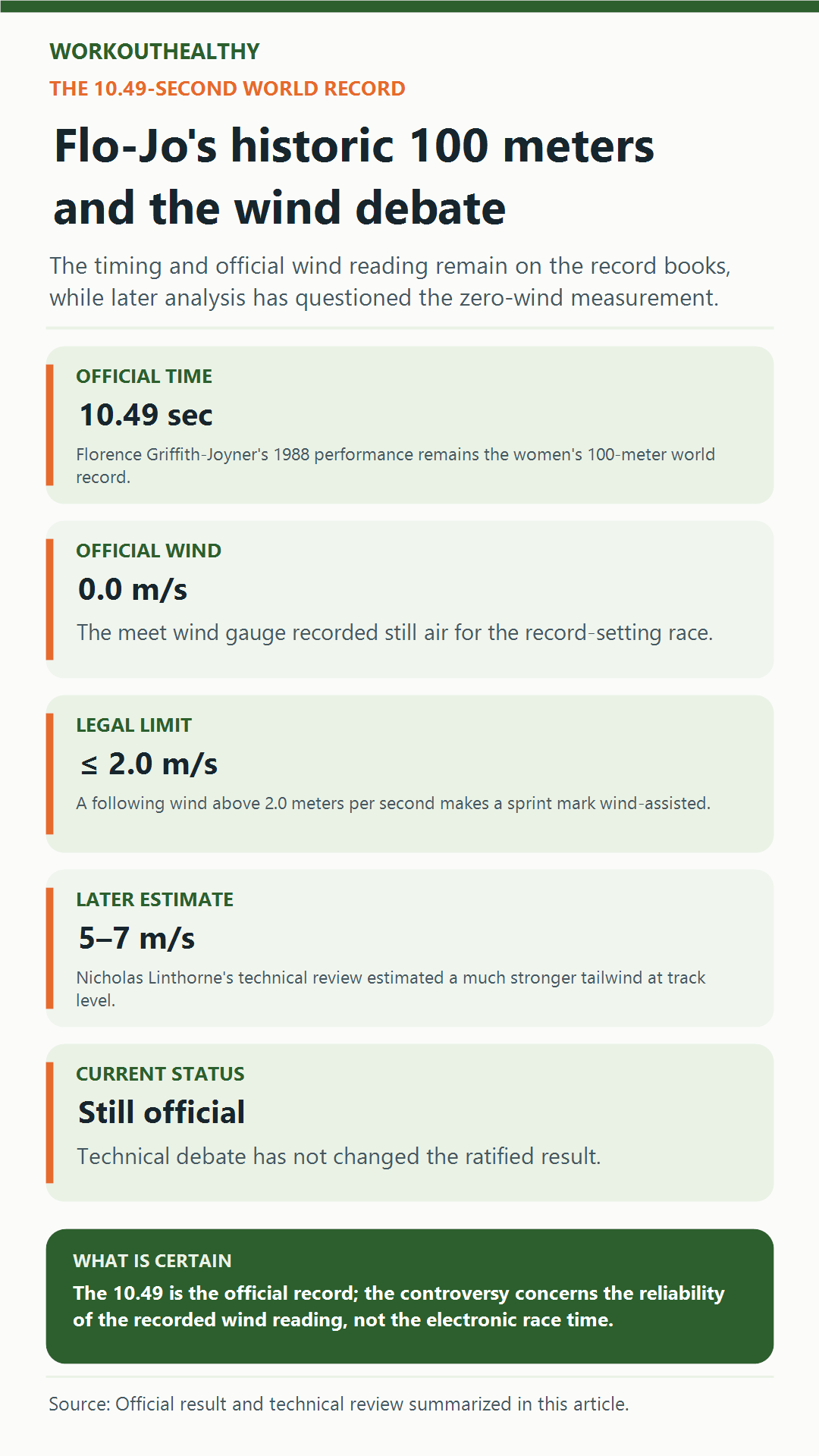
World Athletics has never annulled the 10.49, and its own records still list it as Griffith-Joyner’s personal best and the current world record.
The Association of Track and Field Statisticians, an independent body that tracks marks across the sport, has listed the time since 1997 with a note describing it as probably strongly wind-assisted, while still recognizing it as the standing US and world record.
Some sport historians and outlets, including Track and Field News, have pointed instead to Griffith-Joyner’s 10.61 from the same trials, run in the semifinal under a legal wind reading, as the number they consider more defensible.
That time would still rank as the second fastest a woman has ever run, behind only the 10.49 it is sometimes offered to replace.
Both readings belong to the same athlete, from the same meet, which is part of why this debate has never fully resolved in either direction.
The Gap Nobody Has Closed
Thirty-eight years is a long time for any sprint record to survive untouched.
Shelly-Ann Fraser-Pryce, one of the most decorated sprinters in history, ran 10.60 seconds in 2021, the second fastest time ever recorded by a woman.
Elaine Thompson-Herah ran 10.54 that same year, the third fastest ever.
Both times came closer to 10.49 than anyone had managed in more than three decades, and neither one got there.
Research on sex differences in elite performance offers part of the explanation for why marks like this can be this durable once they are set (Sandbakk et al., 2018).
That research found that world records in shorter, more power-dependent events tend to show a larger and steadier gap between the fastest men’s and women’s marks than longer endurance events do, where the physiological gap narrows over distance.
A 100 meter sprint sits near the power-dependent end of that spectrum, which helps explain why one exceptional performance in this event can hold up for an unusually long time before it gets matched.
What This Record Does Not Prove
A verified world record confirms one specific fact directly.
On one day, under one set of conditions, one athlete covered 100 meters faster than anyone else on record.
It does not resolve the wind question either way, since the readings from that afternoon cannot be re-measured decades later.
It also does not prove that 10.49 is a hard ceiling on human sprint speed.
Records get broken by athletes who eventually combine similar physical gifts with better technique, or by a single outlier performance nobody predicted, the same way Griffith-Joyner’s own performance was largely unpredicted before that season began.
Thirty-eight years without a serious challenge is unusual, but it describes the history of this event so far, not a permanent limit on it.
The Biomechanics Behind an Elite Sprint Start
Sprint scientists who study what separates elite sprinters from fast-but-not-elite ones point to force, not leg speed.
A widely cited biomechanical analysis of world class sprinters found that the athletes who reach the highest top speeds apply the greatest horizontal force into the ground during each brief foot contact, not the ones who simply cycle their legs fastest (Rabita et al., 2015).
That force has to be applied within a fraction of a second, since an elite sprinter’s foot stays in contact with the track for roughly a tenth of a second per stride at top speed.
Griffith-Joyner was known among coaches and competitors for an unusually explosive start and an aggressive early acceleration phase, the portion of a race where fast force production matters most.
Film and split analysis from her 1988 season consistently show her opening a visible lead within the first 30 to 40 meters of her races, well before most competitors reach their own top speed.
Nobody training in a normal gym needs Griffith-Joyner’s genetics to use her mechanics. Force delivered into the ground, quickly, is the same principle whether the goal is a world record or a faster time in a weekend 5K.
A Practical Starting Point for Building Sprint Speed
Ground force production, the quality sprint researchers keep coming back to, is trainable through resistance work and jump training.

It is not something a person simply has or does not have.
General strength work builds the foundation, since a stronger athlete has a higher ceiling for the force they can eventually apply to the ground.
Plyometric exercises, including box jumps and bounding drills, help translate that strength into fast, explosive output, and research on box jumps and plyometric training has found real, measurable benefits from that kind of work.
Short, maximal-effort sprints of 10 to 30 meters train the acceleration phase specifically.
Full recovery between repetitions matters here, since real acceleration training depends on running each rep close to true top effort, not on accumulating fatigue.
Anyone coming back from a hamstring, knee, or ankle issue should rebuild sprint work gradually rather than jumping straight back to maximal efforts.
A qualified coach or personal trainer can also help correct stride mechanics that are difficult to self-diagnose from the inside of a sprint.
None of that training promises anything close to a world record.
It reflects the same underlying physical qualities that made a record like Griffith-Joyner’s possible in the first place, the same force-and-pacing math behind a different verified world record built on repeated maximal effort.
Watch the Record
Footage of Griffith-Joyner’s 1988 Indianapolis run has circulated for decades, including broadcast angles from the original trials.
Curious what other verified world records actually reveal about training and the body. Subscribe to WorkoutHealthy Insider for practical explanations behind popular fitness claims.
References
Linthorne, N. P. (1994). The effect of wind on 100-m sprint times. Journal of Applied Biomechanics, 10(2), 110–131. https://doi.org/10.1123/jab.10.2.110
Rabita, G., Dorel, S., Slawinski, J., Sàez-de-Villarreal, E., Couturier, A., Samozino, P., & Morin, J.-B. (2015). Sprint mechanics in world-class athletes: A new insight into the limits of human locomotion. Scandinavian Journal of Medicine & Science in Sports, 25(5), 583–594. https://doi.org/10.1111/sms.12389
Sandbakk, Ø., Solli, G. S., & Holmberg, H.-C. (2018). Sex differences in world-record performance: The influence of sport discipline and competition duration. International Journal of Sports Physiology and Performance, 13(1), 2–8. https://doi.org/10.1123/ijspp.2017-0196
This article is for general information only and is not medical advice. If you have an injury, ongoing pain, or a medical condition, talk to a doctor or physical therapist before you change how you train or eat.