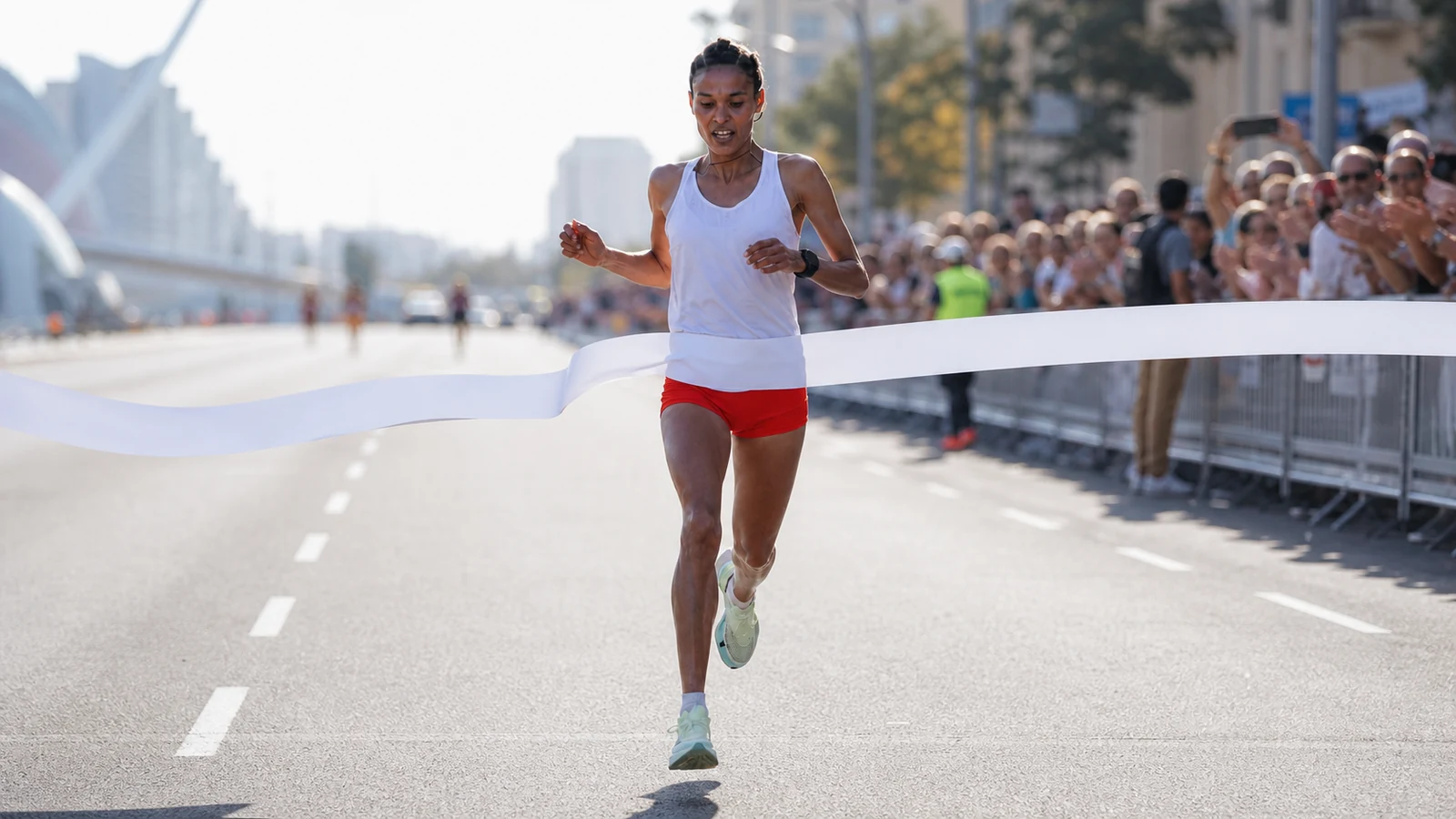

On October 24, 2021, Letesenbet Gidey lined up at the start of the Valencia Half Marathon in Spain.
She had never raced the distance before in her career.
By the finish line, she had covered 13.1 miles in 1 hour, 2 minutes, and 52 seconds.
That works out to roughly one mile every 4 minutes and 48 seconds, repeated more than thirteen times in a row.
Nearly five years later, as of July 2026, no woman has run a half marathon faster.
The Record: 1:02:52, Verified by World Athletics
The claim behind this article came from a workbook entry flagged as not yet independently rechecked.
So we went to the source that actually governs this record.
Road and track running world records are ratified by World Athletics, the sport’s global governing body, formerly known as the IAAF.
That is a different organization than Guinness World Records, which tracks a much wider range of feats but does not set the official standard for competitive athletics marks.
World Athletics’ own report on the Valencia race confirms the details in full.
Gidey ran 1:02:52, on October 24, 2021, at the Valencia Half Marathon Trinidad Alfonso EDP in Valencia, Spain.
The result broke the previous world record of 1:04:02, held by Ruth Chepngetich, by 70 seconds.
World Athletics also noted something unusual about the run.
Gidey had never raced a half marathon before that day, making her the first ever debutante to set a world record at the distance.
The mark went through the organization’s standard ratification process afterward and was confirmed as official.
The Nuance Serious Running Fans Will Ask About
Track and road running keeps two separate kinds of records for events like the half marathon and marathon.
One is the outright world record, open to any race format, including mixed fields where men and women run together.
The other is the women-only world record, restricted to races with no male pacemakers helping the field.
Gidey’s 1:02:52 belongs to the first category.
She ran in a mixed field, and her own pacer for the attempt was a male training partner, Mebrahtu Kiros, running alongside her for large stretches of the course.
That kind of pacing help is completely within the rules for an outright world record, and it is common practice at record-attempt road races.
It is also exactly why World Athletics tracks a second, separate figure.
The current women-only half marathon world record belongs to Kenya’s Peres Jepchirchir, who ran 1:05:16 at the 2020 World Athletics Half Marathon Championships in Gdynia, Poland, a race with no male pacers in the women’s field.
That gap, roughly two and a half minutes over 13.1 miles, is a real and measurable look at how much a mixed-field pacer can help.
Gidey’s time is the fastest a woman has ever covered 13.1 miles, full stop. It is not, on its own, proof of what she can do against only other women with no help pulling her through the field.
The distinction is not a footnote.
Marathon running has the same split, with Ruth Chepngetich holding the outright mixed-race world record and Peres Jepchirchir separately holding the women-only marathon record.
Both figures are real, both are verified, and both measure something slightly different about elite performance.
What a 4:48 Mile, Held Thirteen Times, Actually Requires
A single 4:48 mile is a serious effort for almost any recreational runner.
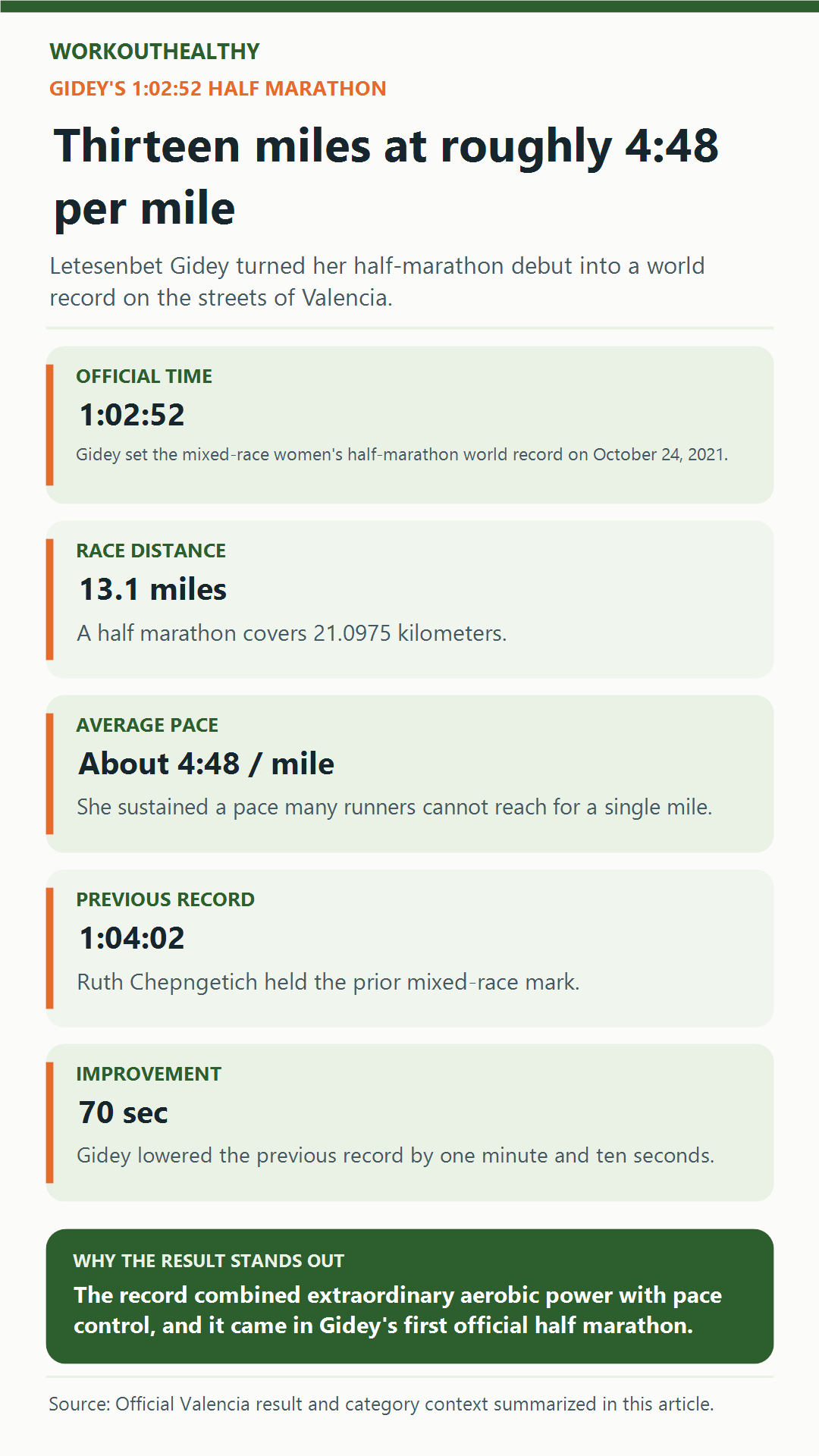
Gidey held that pace, or faster, for more than thirteen miles straight.
Elite half marathon racing does not work like a slow start followed by a late kick.
Most world-class performances are built on an even, sometimes even negative, split, where the second half of the race is run at the same pace as the first, or slightly faster.
Holding a pace like that for over an hour depends on a combination of factors working together at once: a huge aerobic engine, an efficient running stride, and a nervous system that can tolerate sustained, near-maximal effort without letting form break down.
Running Economy: The Efficiency Behind the Speed
Raw aerobic capacity, often measured as VO2 max, gets most of the public attention in endurance sport.
Among elite athletes, though, running economy often matters just as much.
Running economy describes how much oxygen a runner’s body needs to maintain a given pace.
Two athletes can have similar VO2 max scores and still race very differently if one of them simply uses less oxygen to hold the same speed.
A study published in Medicine & Science in Sports & Exercise compared the running economy of African and Caucasian distance runners and found the African runners used meaningfully less oxygen to run at the same submaximal speeds (Weston et al., 2000).
A more recent study focused specifically on Ethiopian distance runners, Gidey’s own national running culture, and measured both running economy and VO2 max at high altitude in high-level male and female athletes (Bayissa et al., 2025).
That research found something worth noting: exceptional running economy appeared able to compensate for a lower VO2 max in producing elite-level performance.
In other words, efficiency, not just raw aerobic horsepower, is doing real work in performances like Gidey’s.
The Ethiopian Highlands and the Case for Altitude Training
Gidey grew up and trains in Ethiopia, a country with a long tradition of distance-running success built in large part at high elevation.
Altitude training is not folklore.
A landmark study in the Journal of Applied Physiology tested a “living high, training low” model, where athletes slept and lived at moderate altitude but did their hardest training sessions at lower elevation (Levine & Stray-Gundersen, 1997).
That combination produced measurable gains in sea-level running performance compared to training entirely at low altitude.
The proposed mechanism centers on the body producing more red blood cells in response to the thinner air at altitude, which can improve how efficiently oxygen gets delivered to working muscles once an athlete returns to sea level.
That physiological backdrop, built over years of training, does not show up anywhere on a results page.
It is part of what makes a time like 1:02:52 possible in the first place.
The Physiology of Pacing a Record Attempt
Running an even pace across 13.1 miles is itself a trained skill, not something that happens automatically at elite speed.
A widely cited review in the British Journal of Sports Medicine examined how the body regulates pacing during sustained exercise, describing it as a continuously adjusted process rather than a single decision made at the start line (Tucker & Noakes, 2009).
The brain appears to regulate effort in real time, factoring in how much distance remains and how the body is responding, to avoid a pace that collapses before the finish.
A pacer running alongside an athlete changes that calculation in a very direct way.
Instead of relying purely on internal pacing judgment, an athlete can lock onto an external, physical target moving at exactly the planned split.
That is the same underlying pacing skill WorkoutHealthy found behind DonnaJean Wilde’s hour-long push-up world record, just applied to a very different sport.
Gidey’s own pacer, Mebrahtu Kiros, effectively did that job for her across Valencia’s flat, fast course.
A Generational Résumé, With One Mark Still Standing
Gidey’s half marathon run did not come out of nowhere.
She has also held the world record on the track at both 5,000 meters and 10,000 meters.
She set the 5,000-meter world record in October 2020, running 14:06.62 in Valencia.
She set the 10,000-meter world record in June 2021, running 29:01.03 in Hengelo, Netherlands.
Both of those track marks have since been broken.
Faith Kipyegon lowered the 5,000-meter record in 2023, and Beatrice Chebet lowered the 10,000-meter record in 2024.
Her half marathon time has not been touched by anyone.
Nearly five years on, it remains the one mark from that run of dominance that no other woman has managed to beat.
Two of Gidey’s world records have already fallen to the next generation of runners. Her half marathon time has outlasted both of them.
What This Means for Anyone Training Toward Their Own Half Marathon
Almost nobody reading this needs to run a 4:48 mile.

The underlying lessons still translate to a much more ordinary race-day goal.
An even pace beats a fast start followed by a slow fade, at any speed and any level.
Runners training for a first half marathon often benefit from practicing goal pace in shorter chunks well before race day, rather than discovering it for the first time at mile 10.
Running with a partner or a pace group creates a version of the same effect a pacer gave Gidey, an external target that takes some of the moment-to-moment pacing decisions off the runner’s own shoulders.
Aerobic base work, the slow, easy mileage that builds the engine over months, matters more than any single hard workout.
That base is exactly what altitude training and years of steady volume were building long before Gidey ever reached the Valencia start line.
Anyone starting a new running program, especially after a long break or with an existing joint or heart condition, should talk to a doctor before ramping up mileage or pace.
What This Record Does Not Prove
A verified world record proves that on one specific day, under one specific set of race conditions, Gidey covered 13.1 miles faster than any woman on record.
It does not prove that 1:02:52 is a hard physiological ceiling for the human body.
Records like this one get broken, and the outright half marathon record has changed hands more than once in the past decade alone.
It also does not erase the meaningful difference between an outright, pacer-assisted mark and a women-only result.
Both numbers are real and both are worth knowing, but conflating them flattens a genuine competitive distinction that serious fans of the sport track closely.
Everyday runners do not need anywhere near a 4:48 mile to get real value from this sport.
Our own readers have shown plenty of enthusiasm for running as a training tool in its own right, something we saw clearly when we asked our audience to weigh in on running versus weightlifting.
And a runner’s aerobic capacity, the same trait underlying Gidey’s performance, is worth tracking at any level, which is part of why simple field tests like the four-flights-of-stairs test have become a popular, low-cost way to get a rough read on it.
Watch the Record
Want the real story behind more records like this one? Subscribe to WorkoutHealthy Insider for practical explanations behind popular fitness claims.
References
Bayissa, M., Haile, D., Afework, D., Jebessa, G., Mooses, K., & Mooses, M. (2025). Association between running economy and VO2max values in high-level Ethiopian male and female distance runners measured at high altitude. BMC Research Notes, 18(1), Article 319. https://doi.org/10.1186/s13104-025-07397-8
Levine, B. D., & Stray-Gundersen, J. (1997). “Living high-training low”: Effect of moderate-altitude acclimatization with low-altitude training on performance. Journal of Applied Physiology, 83(1), 102–112. https://doi.org/10.1152/jappl.1997.83.1.102
Tucker, R., & Noakes, T. D. (2009). The physiological regulation of pacing strategy during exercise: A critical review. British Journal of Sports Medicine, 43(6), e1. https://doi.org/10.1136/bjsm.2009.057562
Weston, A. R., Mbambo, Z., & Myburgh, K. H. (2000). Running economy of African and Caucasian distance runners. Medicine & Science in Sports & Exercise, 32(6), 1130–1134. https://doi.org/10.1097/00005768-200006000-00015
This article is for general information only and is not medical advice. If you have an injury, ongoing pain, or a medical condition, talk to a doctor or physical therapist before you change how you train or eat.