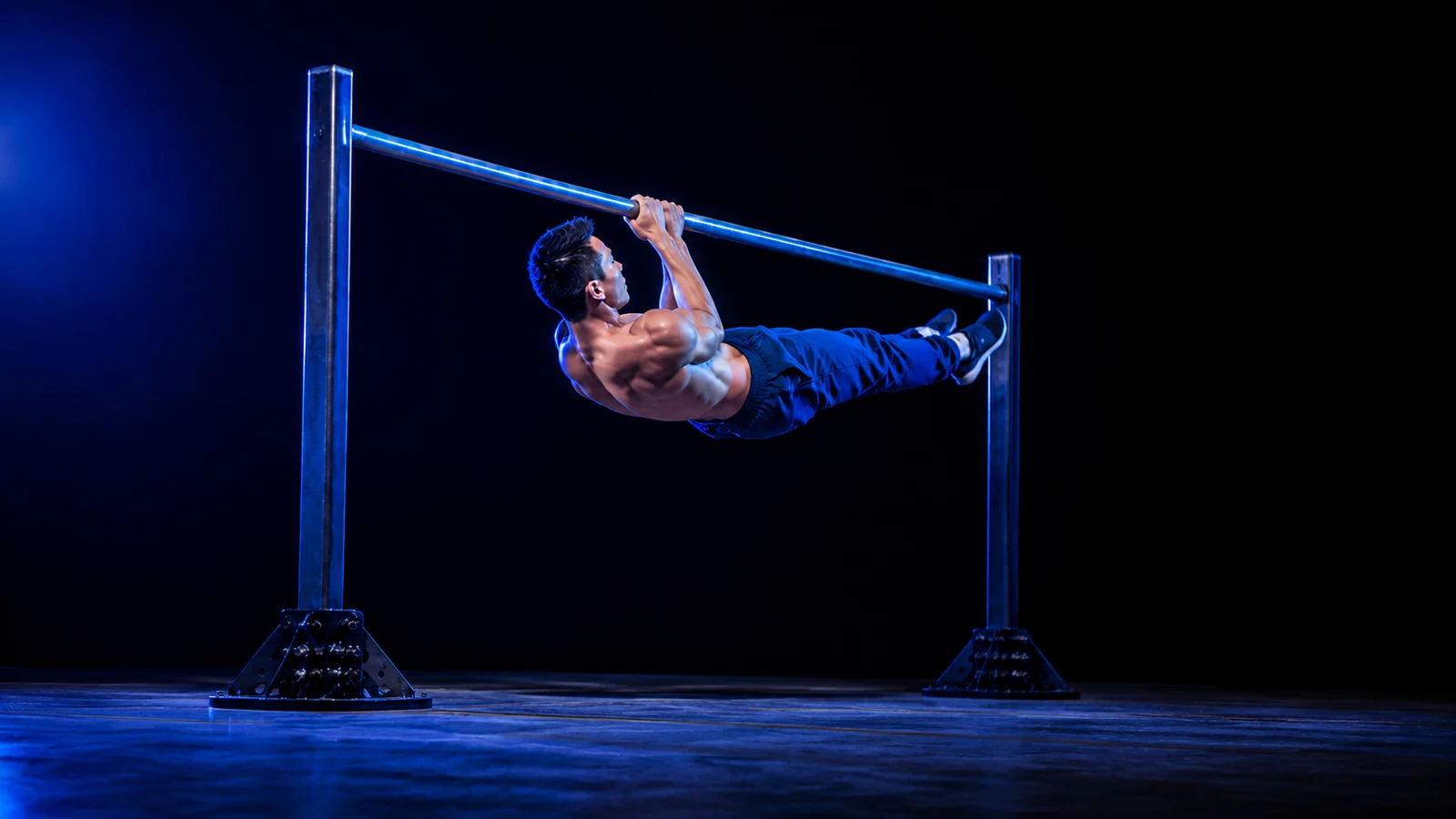

Rayan Onizuka gets on a low yellow pull-up station, locks his body into a dead-flat horizontal line under the bar, and starts pulling himself up to it.
Not once. Not five times.
Thirty times in a row, with his hips, shoulders, and legs never dropping out of that horizontal front lever position.
The clip is short, a few seconds long, built for a phone screen.
What it shows is one of the harder strength endurance feats in calisthenics, a discipline where most people cannot hold a front lever for even a few seconds, let alone pull from one thirty times in a row.
What the Video Actually Shows, and What We Could Confirm
The video carries the title “30 Front Lever Pull Ups | World Record by @oni_astegiano.”
It was posted by CaliBase, a platform that tracks and ranks calisthenics feats across the street workout community.
CaliBase’s own athlete profile for Rayan Onizuka lists exactly one record credited to him.
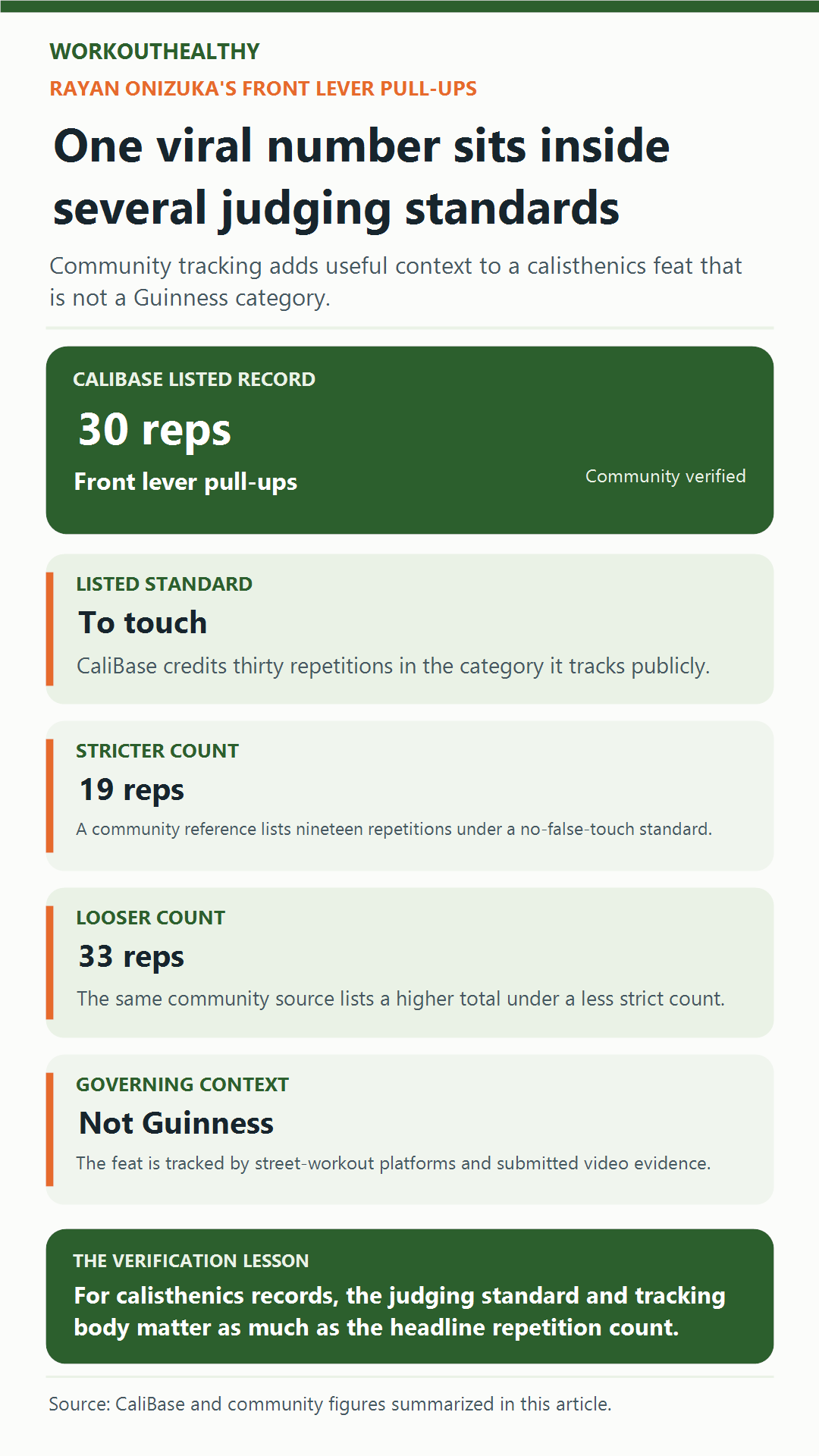
It reads “Most repetitions of Front Lever Pull Ups,” with a listed value of 30 repetitions.
That entry matches CaliBase’s separate public records page, which names Onizuka as the current holder of that exact category among the calisthenics feats it tracks.
A second, independent source backs up the same number.
The Street Workout Wiki, a community-run reference site unaffiliated with CaliBase, describes Onizuka’s performance as “30 frontlever pull ups to touch.”
The wiki adds detail most viral clips leave out.
It lists three separate figures for the same general skill: 30 reps to touch, 19 reps to a stricter “no false touch” standard, and 33 reps under a looser count.
That range matters here.
It shows the calisthenics community tracks its own feats with more nuance than a single viral number suggests, and that 30 is specifically the “to touch” figure CaliBase currently lists as his record.
This Is Not a Guinness World Record
It is worth saying plainly, since the word “record” gets used loosely online.
Guinness World Records has no listing for front lever pull-ups.
This feat sits entirely outside Guinness’s system.
Front lever pull-ups, like most advanced calisthenics skills, are tracked instead by the street workout and calisthenics community itself.
Platforms like CaliBase and community wikis fill that role, not a third-party body with in-person adjudicators on site.
That does not make the number fake.
It means the verification standard is different, built on submitted video evidence and community tracking within a tight-knit sport, rather than a Guinness adjudicator confirming an attempt in person.
This article treats the 30-rep figure as community-verified, not Guinness-certified, and everything below reflects that distinction.
Who Is Rayan Onizuka
Public street workout community sources list Onizuka’s full name as Rayan Astegiano, born in November 1999 in Sartrouville, near Paris, France.
He stands around 5 feet 2 inches tall.
The calisthenics community frequently notes that build as an advantage for lever-style skills, since a shorter torso shortens the lever arm the shoulders have to control.
According to community sources, he discovered calisthenics in 2017 after watching someone perform a front lever at a park.
He moved away from gym training and breakdancing to focus on calisthenics full time not long after.
He now trains and posts under the name Onizuka, and the street workout community frequently describes him as one of the strongest front lever specialists in the sport.
That reputation, built over years and multiple videos, is part of why CaliBase credits him with this specific record rather than treating one clip as a one-off.
What a Front Lever Pull-Up Actually Demands
A front lever alone is already one of the hardest static holds in bodyweight training.
The body stays perfectly horizontal and face up, supported only by the arms gripping a bar overhead.
Nothing else touches anything.
Just holding that position for a few seconds defeats most people who can already do a strict pull-up.
A front lever pull-up adds a second, harder layer on top of the hold.
From that horizontal position, the athlete pulls the body up toward the bar.
The torso and legs stay locked in a straight line the entire time, then the body lowers back down under control before pulling again.
Every rep asks the shoulders, back, and core to perform a controlled row while a separate part of the body works constantly just to keep everything from sagging or twisting.
Thirty of those reps back to back is a strength endurance demand very few people in the sport can even attempt once.
A front lever pull-up is not a harder pull-up. It is a whole-body balancing act that happens to also require one, repeated thirty times.
The Muscles Carrying the Pull
A 2017 study in the Journal of Electromyography and Kinesiology compared muscle activation across several pull-up styles, including wide grip, narrow grip, and different hand positions (Dickie et al., 2017).
The researchers found the latissimus dorsi, the broad back muscle running from the upper arm down toward the lower spine, consistently drove most of the pulling force across every variation tested.
The biceps and the muscles that stabilize the shoulder blade showed high activity too, working alongside the lats rather than instead of them.
A front lever pull-up pulls from a much longer lever arm than a standard vertical pull-up, since the whole body sits out horizontally instead of hanging straight down.
That longer lever multiplies the torque the back and shoulders have to control on every single rep.
It is a large part of why the same muscles that handle a normal pull-up with relative ease start failing far sooner in this position.
Holding a Line: Why the Core Never Gets a Break
Keeping the body dead flat during a front lever pull-up is not a passive side effect of good form.
It takes constant work from the abdominal muscles, hip flexors, and lower back, fighting gravity’s pull to fold the body at the hips.
Research on straight-arm strength holds in gymnastics describes this kind of full-body tension as a defining demand of the entire skill family (Malíř et al., 2023).
That includes skills closely related to the front lever, like the iron cross and the support scale on still rings.
The 2023 systematic review pulled together 37 separate studies on still rings elements.
It found that these holds require very high coordination across the shoulder girdle and trunk at the same time, not just raw pulling strength.
A front lever pull-up asks for that same total-body coordination while also actively moving, not just holding still.
That combination is rare even among trained calisthenics athletes.
Why Pure Pulling Strength Alone Does Not Transfer
It is tempting to assume anyone who can do a heavy weighted pull-up could figure out a front lever pull-up with enough effort.
Research on isometric-style training suggests otherwise.
A 2019 review in the International Journal of Sports Medicine examined how isometric strength training compares to standard dynamic training.
It found that isometric strength gains are largely specific to the joint angle and body position trained (Lum & Barbosa, 2019).
A front lever pull-up blends both qualities in a single movement.
It combines an isometric-style body position with a dynamic pulling action, rather than being purely one or the other.
That blend does not show up in a standard pull-up program, no matter how heavy the added weight gets.
It has to be trained on its own terms, which is a large part of why front lever specialists tend to come from dedicated calisthenics backgrounds rather than general strength training.
The Quiet Limiter: Grip and Forearm Fatigue
Ask calisthenics athletes what actually ends a long front lever pull-up set, and the hands often come up before the back does.
A 2025 study in the journal Sports tested three different eight-week training approaches in previously inactive men working toward more pull-up repetitions.
The group that trained their forearms and grip specifically improved their pull-up repetitions by 222.5 percent.
That was well ahead of a core-focused group and a general interval-training group in the same study (Sepehri Rahnama et al., 2025).
The researchers pointed to a simple mechanism behind that result.
Stronger, more fatigue-resistant forearms let a person stay connected to the bar longer, so the bigger prime-mover muscles can keep doing their job instead of the grip failing first.
Our piece on what unexplained muscle loss actually looks like covers why researchers treat grip strength as one of the simplest markers of general muscle health, not just a niche bar skill.
Across thirty reps in a fixed, gravity-loaded grip, a small edge in forearm endurance compounds fast.
What This Record Does Not Prove
A community-tracked record like this one shows that Onizuka, on the day the video was filmed, completed 30 front lever pull-ups to the standard CaliBase credits him with.
It does not come with the same layer of independent, in-person adjudication a Guinness record carries.
It also does not prove 30 is some fixed ceiling for the skill.
The street workout community itself already tracks the same feat under stricter and looser counting standards, from 19 reps at the tightest form standard to 33 reps at the loosest.
That range is a reminder that “the record” can shift depending on exactly how strictly a rep gets counted.
None of that makes the underlying feat less real.
It just means the exact number deserves to be held a little loosely, the way any community-tracked record does, rather than treated as a fixed, universally agreed figure the way a lab measurement would be.
Who Should Not Try This
Nobody needs to attempt a front lever pull-up to benefit from front lever training.
Even the early stages of this progression put real, sustained load on the shoulders, elbows, wrists, and lower back.
Anyone with a current shoulder injury, a shoulder that clicks or catches under load, elbow pain, wrist pain, or a diagnosed connective tissue condition should treat this entire skill family as something to approach only with professional guidance.
The same caution applies to anyone newer to structured strength training in general.
Working with a qualified coach or trainer before loading a front lever progression is a reasonable, low-risk way to learn how your own shoulders and wrists tolerate this kind of work before pushing further.
Building Toward Your First Front Lever Pull-Up
None of this requires chasing 30 reps, or even one.
It just requires starting in the right place, and most people need months, not weeks, to get there.
Step 1: Build a real dead hang first.
A relaxed, controlled hang from a bar for 20 to 30 seconds should feel completely stable before adding anything harder.
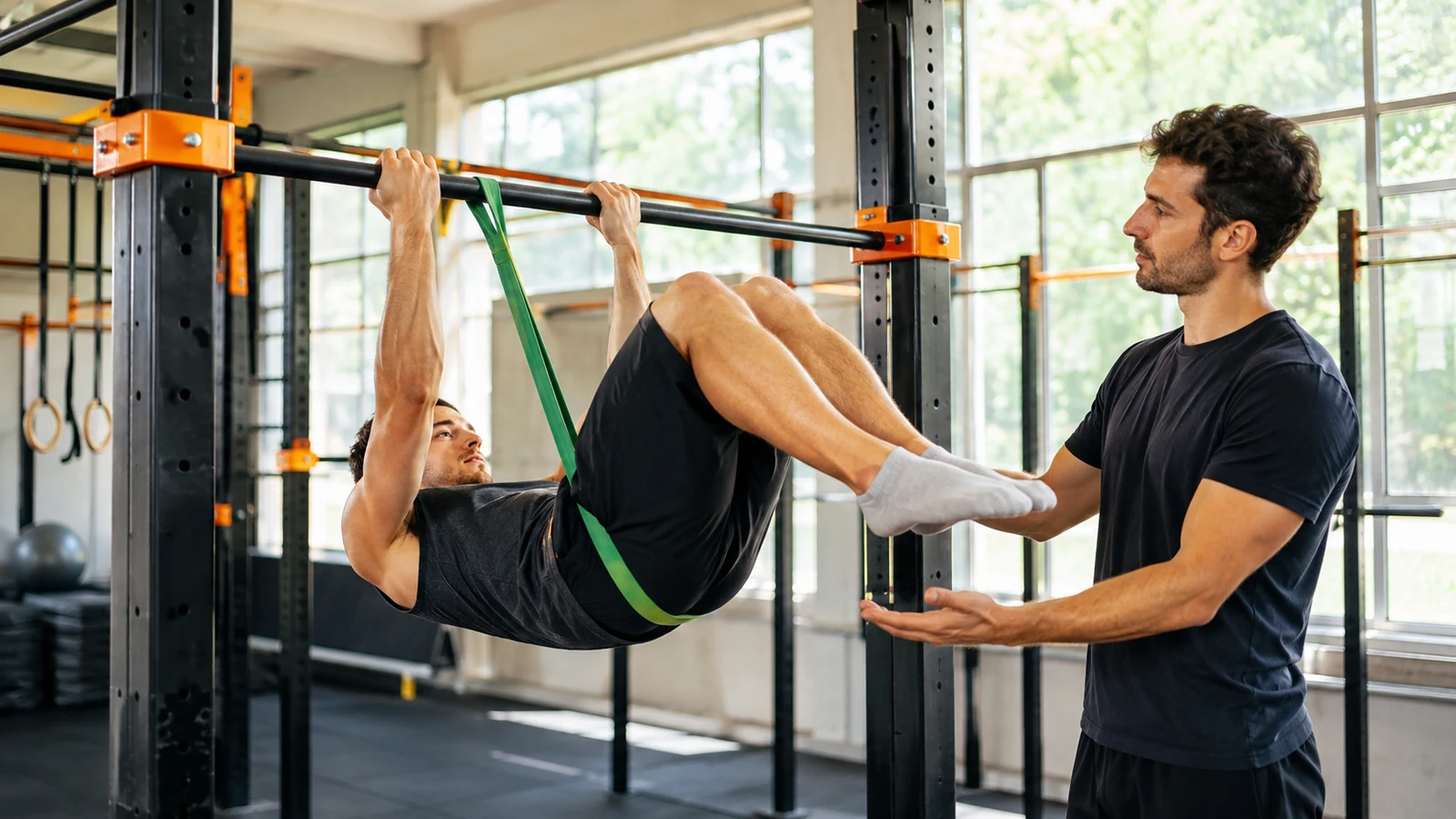
Step 2: Learn the tuck front lever.
Pull the knees tight to the chest while hanging, then lean the shoulders back until the body tips toward horizontal, holding for a few seconds at a time.
Step 3: Build straight-body tension separately.
A strict hollow body hold on the floor, and a strong front plank, both train the same anti-extension core control a front lever needs, without the added grip and shoulder demand.
Step 4: Progress the lever stages slowly.
Move from a tuck, to an advanced tuck, to a one-leg extension, to a straddle, before ever attempting a full, legs-together front lever hold.
Step 5: Add pulling only once the hold is solid.
A front lever pull-up should not be attempted until the matching lever stage can be held motionless for several seconds first.
Step 6: Train grip and forearm endurance on purpose.
Dead hangs, farmer’s carries, and towel or thick-bar hangs build the fatigue resistance the pull-up research points to directly (Sepehri Rahnama et al., 2025).
Expect this progression to take the better part of a year for most dedicated trainees.
Expect the pulling version most people never attempt to take considerably longer than that.
Every rep in a viral thirty-rep clip sits on top of years spent holding much simpler positions, badly, until they stopped being simple.
Watch the Record
CaliBase filmed and posted Onizuka’s 30-rep front lever pull-up set.
Onizuka’s feat is not the only calisthenics record WorkoutHealthy has checked against outside sources rather than repeating at face value.
Our look at DonnaJean Wilde’s Guinness-verified push-up world record covers a different kind of bodyweight endurance feat, one that carries formal Guinness certification rather than community tracking, which makes for a useful contrast in how “record” gets verified across different corners of fitness.
Our piece on what a realistic pull-up habit looks like at a very different level is a good reminder that almost nobody needs anywhere near this much pulling strength to get real benefit from the same basic movement.
Curious how far the science actually stretches behind a viral calisthenics clip. Subscribe to WorkoutHealthy Insider for practical explanations behind popular fitness claims.
References
Dickie, J. A., Faulkner, J. A., Barnes, M. J., & Lark, S. D. (2017). Electromyographic analysis of muscle activation during pull-up variations. Journal of Electromyography and Kinesiology, 32, 30–36. https://doi.org/10.1016/j.jelekin.2016.11.004
Lum, D., & Barbosa, T. M. (2019). Brief review: Effects of isometric strength training on strength and dynamic performance. International Journal of Sports Medicine, 40(6), 363–375. https://doi.org/10.1055/a-0863-4539
Malíř, R., Chrudimský, J., Šteffl, M., & Stastny, P. (2023). A systematic review of dynamic, kinematic, and muscle activity during gymnastic still rings elements. Sports, 11(3), 50. https://doi.org/10.3390/sports11030050
Sepehri Rahnama, H., Ganji, S., Vadasz, K., & Prokai, J. (2025). Comparative effects of core versus forearm training on pull-up repetition performance in physically inactive males. Sports, 13(12), Article 433. https://doi.org/10.3390/sports13120433
This article is for general information only and is not medical advice. If you have an injury, ongoing pain, or a medical condition, talk to a doctor or physical therapist before you change how you train or eat.