
On 28 November 2021, a university student named Xiao Lin walked up to a pull-up bar inside the Ji’an Sports Centre in Ji’an, China.
He did not stop for the next sixty minutes.
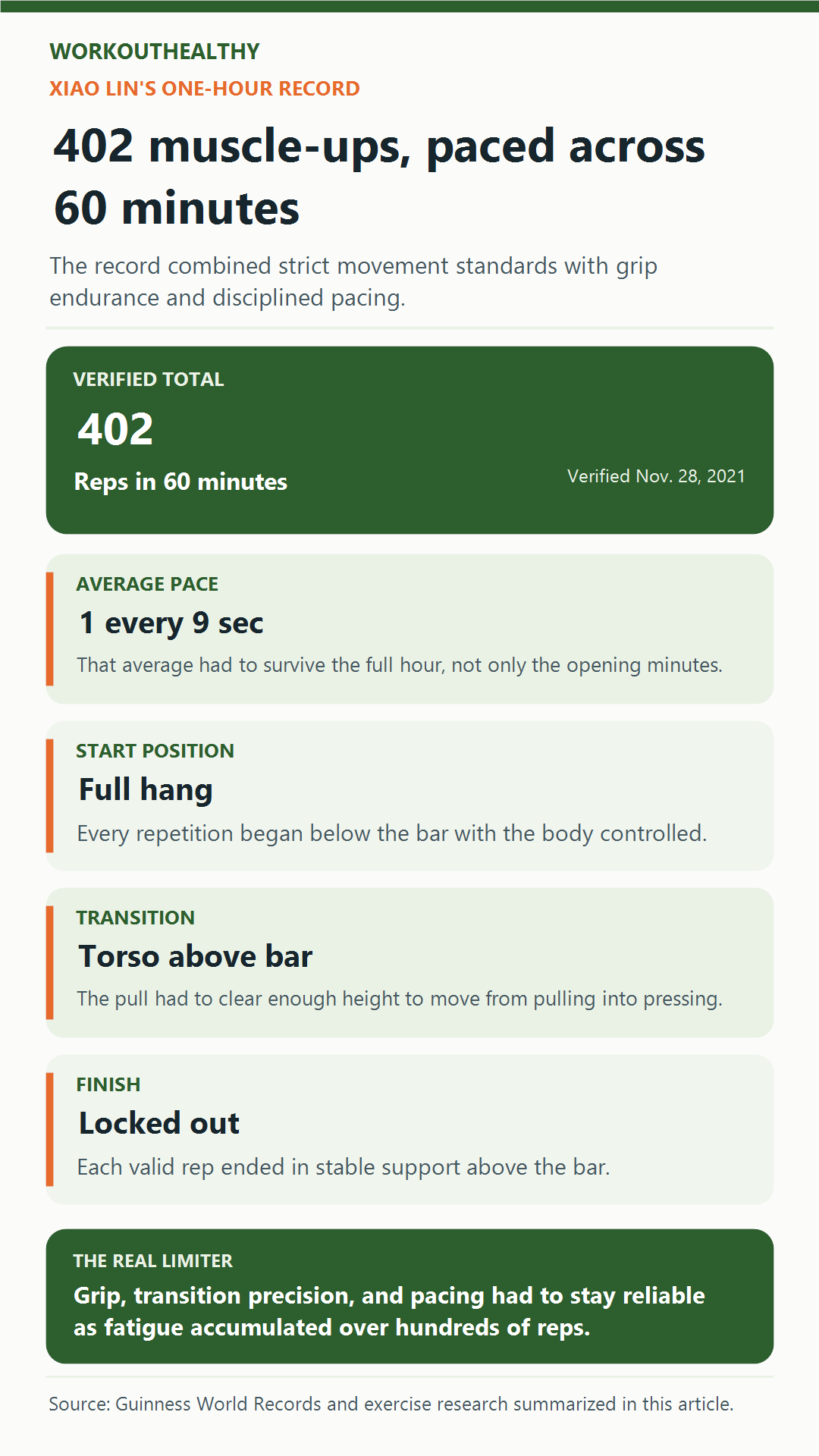
When the clock ran out, he had completed 402 bar muscle-ups, a number Guinness World Records still lists as the current record for most muscle-ups in one hour by a male.
Guinness’s own record page confirms the athlete’s name, the rep count, the date, and the location, all matching the details in the source workbook this article started from.
Do the math on 402 reps across sixty minutes and you land on roughly one completed muscle-up every 9 seconds, for a full hour straight.
That pace, held for that long, is the real story here.
The Record: 402 Reps in One Hour, Verified
The rules Guinness applies to a bar muscle-up are specific.
The body has to stay straight the whole time, with no bending at the waist to cheat momentum.
Each rep has to carry the athlete from a full hanging position to a locked-out position with the entire torso above the bar.
Guinness credits Xiao Lin, described on the record page as a university student and fitness enthusiast, with 402 total reps under those rules.
The date, location, and rep count on the official page match the claim this article set out to check, so there is no discrepancy to flag.
What a Bar Muscle-Up Actually Demands From Your Body
A muscle-up is really two hard movements stacked into one.
The first half looks like a pull-up, pulling the chest toward the bar using the lats, biceps, and upper back.
The second half looks like the top of a dip, pressing the body up and over the bar using the triceps, chest, and shoulders.
Most gym exercises isolate one of those patterns.
A muscle-up chains them together into one continuous, technical movement.
That is part of why most people who can already do a strict pull-up still cannot do a single muscle-up.
Every one of those 402 reps also required Xiao Lin’s hands to stay locked onto the bar through the transition, the moment where the wrists roll over the top.
That transition punishes tired forearms more than almost any other part of the movement.
This Is an Endurance Test, Not a Max-Strength Test
It is tempting to read 402 reps and assume this is mostly about raw pulling power.
It is not.
Muscular strength and muscular endurance are related but genuinely different qualities, and training research treats them as separate targets with separate rep ranges, loads, and rest periods.
The American College of Sports Medicine’s position stand on resistance training describes muscular endurance work as higher-rep, lower-load training, generally built around shorter rest between sets, designed specifically to delay fatigue rather than to move the single heaviest possible load (American College of Sports Medicine, 2009).
A one-rep max muscle-up test asks a completely different question than this record does.
It asks how much extra weight a person can add and still complete one clean rep.
An hour-long test asks something closer to how long the muscles can keep producing enough force before local fatigue makes the movement fail.
Those two qualities do not always travel together.
A very strong lifter with poor muscular endurance might struggle to finish even 100 reps in an hour, while a lighter, more fatigue-resistant athlete can hold a steady pace far longer.
The Real Limiter: Grip and Forearm Fatigue
Ask experienced calisthenics athletes what actually ends a long muscle-up set, and grip usually comes up before the back or chest ever do.
A 2025 study in the journal Sports compared three different eight-week training approaches in previously inactive men working toward more pull-up repetitions.
The group that trained their forearms and grip specifically improved their pull-up repetitions by 222.5 percent, far more than a core-focused group or a general interval-training group (Sepehri Rahnama et al., 2025).
The researchers pointed to a fairly simple mechanism behind that result.
Grip strength directly controls how long a person can stay connected to the bar, and stronger, more fatigue-resistant forearms let the bigger prime-mover muscles keep doing their job instead of the hands failing first.
Grip is not just a calisthenics quirk either.
Our piece on what unexplained muscle loss actually looks like covers why researchers treat grip strength as one of the simplest markers of general muscle health, not just a niche bar skill.
Over 402 reps, a small edge in forearm endurance compounds fast.
Pacing: The Skill Hiding Inside the Number
Anyone who has tried to sprint the first quarter of a long set already knows what happens next.
Fatigue builds fast, form breaks down, and the set ends far short of where a steadier pace could have carried it.
A 2014 study in the European Journal of Applied Physiology tested how people distribute effort across a set of repeated maximal contractions, comparing what happens when they know the total number of reps coming versus when they do not (Halperin et al., 2014).
Knowing the total task length changed how people paced themselves from the very first repetition.
They held something in reserve early on rather than emptying the tank immediately.
That is close to the exact skill an hour-long muscle-up attempt demands.
A world record like this one is not a single hard set. It is hundreds of moderate sets, disguised as one continuous hour.
Guinness’s rules almost certainly meant Xiao Lin knew his target time going in.
That let him plan a pace instead of simply going as hard as possible and hoping to survive the hour.
A rough average of one rep every 9 seconds only works if that pace holds steady from start to finish.
Go out at one rep every 6 seconds for the opening minutes, and the forearms and shoulders build fatigue faster than they can clear it, which collapses the pace long before the hour ends.
Pacing an hour of maximal-pattern reps has more in common with running a marathon than with a single all-out sprint.
How the Body Fuels 60 Minutes of High-Rep Pulling
A single explosive muscle-up draws mostly on the phosphocreatine system, the body’s fastest and most limited fuel source.
That system is good for only a few seconds of maximal output before it needs time to refill.
Sustaining that same movement pattern for an hour is a very different metabolic problem.
Over sixty minutes, the muscles have to lean much more heavily on aerobic metabolism, using oxygen to help regenerate fuel at a rate that roughly keeps pace with how fast it gets used.
Every short burst of a muscle-up still likely calls on some anaerobic contribution too, especially through the transition at the top of the movement.
A record like this one probably blends both systems constantly.
Aerobic metabolism likely supplies the steady background fuel, with brief anaerobic spikes layered on top of each individual rep.
That blend may explain why pure strength athletes, built mostly around short maximal efforts, often struggle the first time they attempt a long, paced set like this one.
Their muscles are simply not as practiced at clearing fatigue byproducts fast enough to keep working an hour later.
How Elite Athletes Train Muscular Endurance on Purpose
Nobody performs 402 muscle-ups in an hour by accident.
Building that kind of capacity takes months, likely years, of training aimed specifically at repetition endurance rather than maximum load.
The ACSM’s guidance for muscular endurance work generally points toward higher rep ranges, shorter rest periods between sets, and a gradual, progressive rise in total weekly volume rather than jumps in added weight (American College of Sports Medicine, 2009).
In practice, that often means building a base of clean, controlled muscle-up technique first.
From there, athletes slowly extend how many reps they can string together across multiple sets, with shrinking rest between each one.
Grip-specific work, like dead hangs, farmer’s carries, and hollow-body holds on the bar, tends to get trained separately from the muscle-up itself.
That separation exists precisely because the forearm-training research above points to grip as such a common limiter (Sepehri Rahnama et al., 2025).
A stronger aerobic base matters too, since better cardiovascular fitness helps the body clear metabolic byproducts faster between reps.
What This Record Does Not Prove
A verified world record proves that Xiao Lin, on that specific day, completed 402 muscle-ups in an hour under Guinness’s rules.
It does not prove exactly how much training that total required, since Guinness’s record page does not publish his training history.
It also does not prove that 402 is some fixed ceiling for a well-trained human body.
It only shows that 402 is the highest verified total on record as of this article.
Records like this one get broken, and Guinness itself notes that listings are not always updated the moment a new attempt is confirmed.
It is worth holding the exact number loosely rather than treating it as a hard physiological limit.
This record also says nothing about whether an average reader should attempt anything close to this volume.
Elite record attempts happen under supervision, after years of specific preparation, with strict rules designed to keep the standard consistent and the attempt safe.
Building Muscle-Up Endurance Safely: A Step-by-Step Path

Nobody needs to chase 402 reps to benefit from this kind of training.
Most adults spend months just working toward their first strict muscle-up, and that is a completely reasonable place to start.
Our profile on what a realistic pull-up progression looks like later in life walks through that kind of starting point in more detail.
Anyone with a shoulder, elbow, or wrist injury, or any condition affecting grip strength or cardiovascular health, should get medical clearance before starting a program like this one.
Step 1: Build the base movements first.
A dead-hang pull-up, a strict pull-up, and a supported dip should all feel controlled before combining them into a muscle-up.
Step 2: Train the transition on its own.
Low, banded, or assisted muscle-up drills let you practice the wrist-roll transition without needing full pulling strength yet.
Step 3: Add dedicated grip and forearm work.
Dead hangs, farmer’s carries, and thick-bar or towel hangs build the fatigue resistance research links to more total pull-up and muscle-up volume (Sepehri Rahnama et al., 2025).
Step 4: Practice sets, not just singles.
Once one clean muscle-up is reliable, shift toward sets of 2 to 5 reps with real rest between them, rather than always testing a single max effort.
Step 5: Shrink the rest gradually.
Over weeks, not days, cut rest between sets while holding the same total rep count, which is the core of building real muscular endurance rather than just strength.
Step 6: Practice pacing on purpose.
Try a timed 5 or 10 minute set at a conservative pace before ever attempting to go longer.
Our guide to how pacing changes total output across a full hour of jump rope covers the same steady-versus-sprint tradeoff in a different movement, and the underlying lesson holds here too.
A well-timed dose of caffeine can offer a small, real boost to muscular endurance for some people.
The effect is modest and highly individual, not a shortcut around actual training, as our deeper look at caffeine timing before a workout explains.
Progress here is slow by design, and rushing it is the most common way an ambitious lifter strains a shoulder or an elbow chasing a bigger number.
A jump from 5 muscle-ups to 50 in a single set does not happen safely in a matter of weeks.
Building toward real muscle-up endurance is closer to training for a race than chasing a one-time personal record.
Watch the Record
Guinness World Records filmed Xiao Lin’s full attempt at the Ji’an Sports Centre.
You can see the record itself on the official Guinness World Records verification page.
Want more feats like this one explained? Subscribe to WorkoutHealthy Insider for practical explanations behind popular fitness claims.
References
American College of Sports Medicine. (2009). Progression models in resistance training for healthy adults. Medicine & Science in Sports & Exercise, 41(3), 687–708. https://doi.org/10.1249/MSS.0b013e3181915670
Halperin, I., Aboodarda, S. J., Basset, F. A., Byrne, J. M., & Behm, D. G. (2014). Pacing strategies during repeated maximal voluntary contractions. European Journal of Applied Physiology, 114(7), 1413–1420. https://doi.org/10.1007/s00421-014-2872-3
Sepehri Rahnama, H., Ganji, S., Vadasz, K., & Prokai, J. (2025). Comparative effects of core versus forearm training on pull-up repetition performance in physically inactive males. Sports, 13(12), Article 433. https://doi.org/10.3390/sports13120433
This article is for general information only and is not medical advice. If you have an injury, ongoing pain, or a medical condition, talk to a doctor or physical therapist before you change how you train or eat.