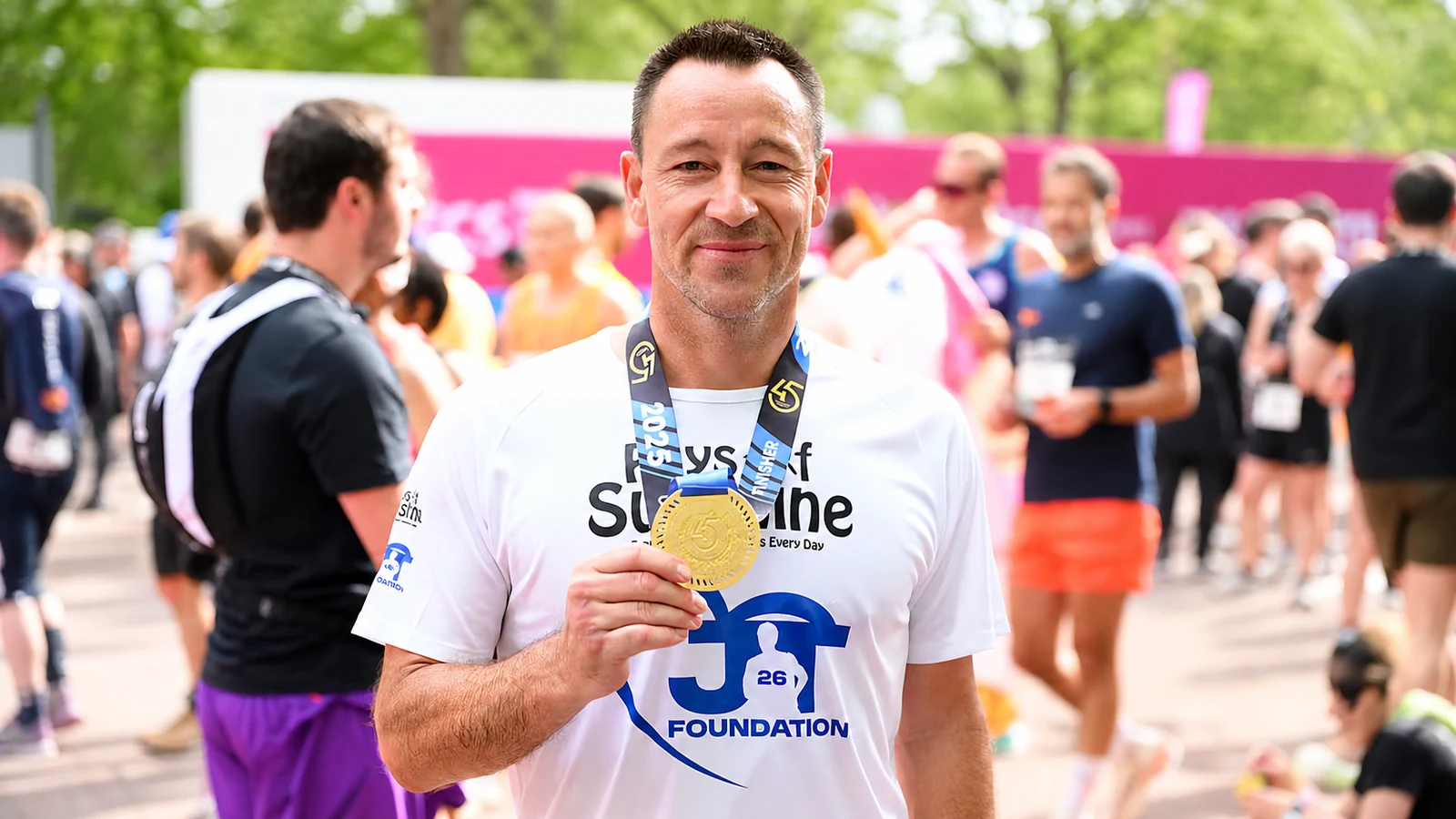

John Terry lifted the Premier League title five times as Chelsea captain.
He also won the Champions League, the Europa League, five FA Cups, and three League Cups across a 19 year career at the club.
By any measure, he was one of the toughest, most decorated defenders of his generation.
So it surprised a lot of people when Terry ran the 2025 London Marathon and, according to reports, called it tougher than any football match he ever played.
That comparison is not just a soundbite.
It points to something real about how different kinds of fitness actually work.
Elite conditioning in one sport does not automatically carry over to a completely different physical challenge.
This article looks at why a professional athlete like Terry can be in outstanding shape for football and still find a marathon genuinely brutal, and what that means for anyone thinking about taking on an endurance event outside their usual training.
What Terry Actually Did
Terry took on the 2025 TCS London Marathon, running the 26.2 mile course through the streets of London.
He ran to support Rays of Sunshine, a charity that grants wishes to seriously ill children.
According to race coverage, Terry has openly described the marathon as harder than anything he faced during his football career, including cup finals and title-deciding matches.
That is a striking statement coming from someone who played at the very top of one of the most physically demanding team sports in the world.
It is also a useful starting point for understanding why football fitness and marathon fitness are not the same thing at all.
Football Fitness Is Built for Bursts, Not Distance
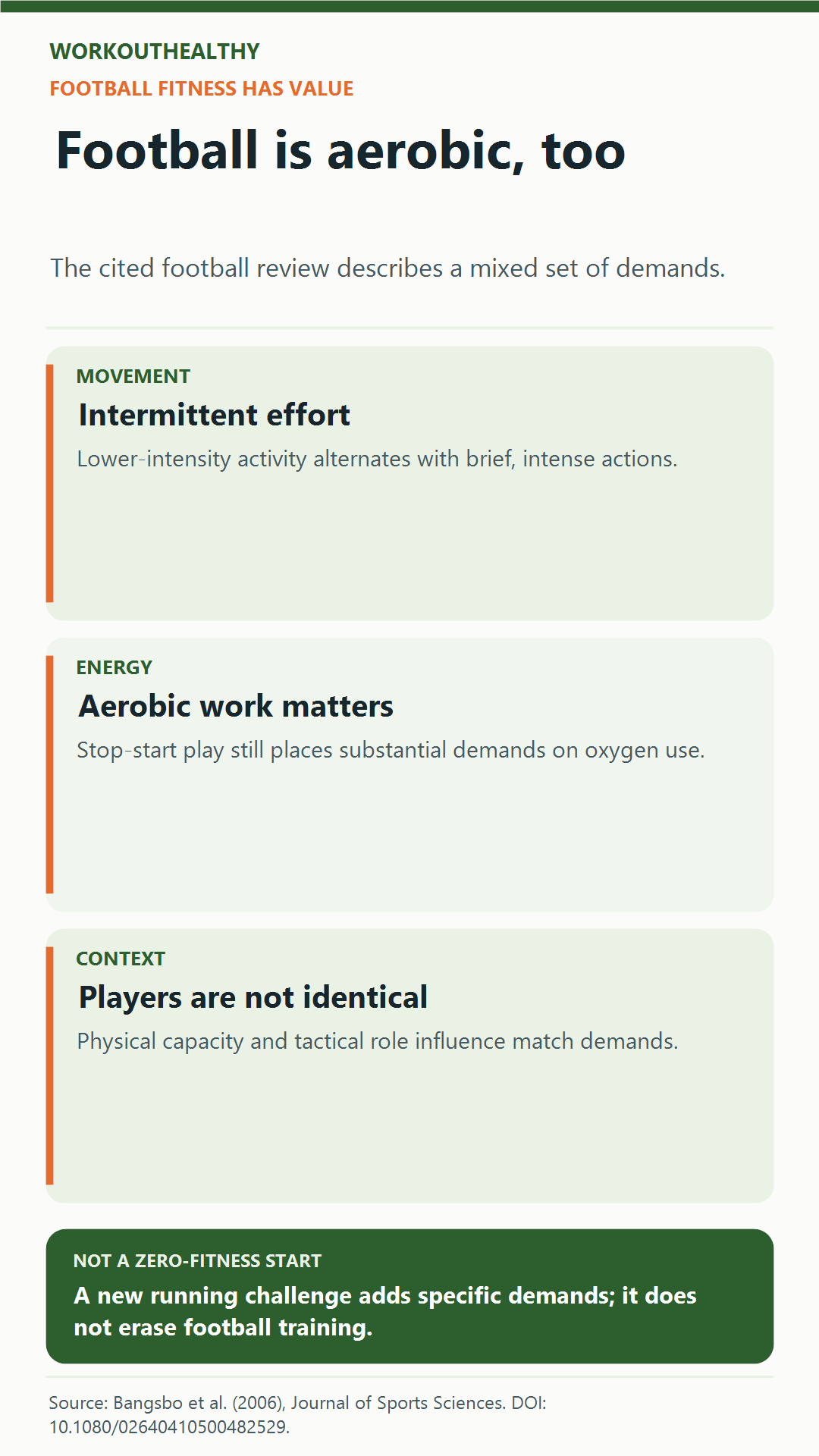
Top level football is an intense, stop-and-start sport.
Research on elite football players has found that a typical match involves repeated short sprints, sudden direction changes, jumps, and tackles, mixed with periods of jogging and walking (Bangsbo, Mohr, & Krustrup, 2006).
A center back like Terry spent his matches reading the game, making short explosive movements to close down attackers, and recovering during the slower stretches of play.
That kind of training builds real strength, real power, and a strong ability to recover quickly between hard efforts.
What it does not build, at least not directly, is the specific type of endurance needed to keep moving at a steady pace for hours without stopping.
Football fitness is often described as interval-based, meaning short bursts of intensity followed by rest.
A marathon flips that model completely.
That gap is part of a bigger debate about which type of training builds the most useful fitness.
See how WorkoutHealthy readers weighed in on weightlifting versus running for more on that ongoing argument.
Marathon Fitness Rewards a Completely Different Skill
Running 26.2 miles is not about being able to sprint fast for a few seconds.
It is about sustaining a steady effort using the aerobic energy system for two, three, four, or more hours in a row.
A well known review of endurance performance physiology describes marathon running as depending heavily on a runner’s aerobic capacity, their running economy, and how efficiently their body can burn fuel over a long period without fatiguing (Joyner & Coyle, 2008).
None of that is something a football career builds particularly well.
Football players rarely, if ever, train their bodies to hold one steady pace for multiple hours.
Their muscles, tendons, and cardiovascular systems have adapted to a completely different rhythm of effort.
That mismatch is a big part of why an elite, well conditioned athlete can still find a marathon genuinely punishing.
Why Building Aerobic Endurance Takes Time
The aerobic adaptations that make marathon running possible do not happen overnight.
Research on endurance performance points to several separate physiological changes that all need to occur together, including a rise in the heart’s stroke volume, an increase in the number of small blood vessels feeding the working muscles, and a shift in how muscle fibers use oxygen and fuel (Joyner & Coyle, 2008).
Each of those changes responds to training, but each one also takes weeks or months of consistent aerobic work to develop meaningfully.
A footballer’s training plan simply does not spend much time in the specific effort zone that drives these changes, since match play and most football drills sit in a different intensity range.
That is not a flaw in football training.
It is just built for a different outcome.
A striker or a defender needs explosive power and repeated sprint recovery far more than they need the ability to hold one steady pace for three hours.
Trying to run a marathon on football fitness alone means asking the body to perform a task its recent training never specifically prepared it for.
The Body Adapts to What You Actually Ask It to Do
This idea has a name in exercise science: specific adaptation to imposed demands.
The body gets efficient at exactly the kind of stress it repeatedly faces, and it does not automatically transfer that efficiency to a different kind of stress.
A sprinter’s muscles look and behave differently than a marathoner’s muscles, even though both athletes are extremely fit.
A footballer’s cardiovascular system is trained for repeated bursts and quick recovery, while a marathoner’s cardiovascular system is trained for one long, sustained push.
Terry’s football career built him an incredible amount of overall fitness.
It just was not the specific kind of fitness a marathon demands.
That is not a criticism of his conditioning.
It is simply how the body works.
What This Evidence Does Not Prove
None of this research can say exactly how hard Terry’s personal marathon experience was, since that depends on his individual training in the months before the race.
Many former team sport athletes do train specifically for a marathon before running one, which can close some of the gap described above.
It is also worth noting that general athleticism, discipline, and mental toughness built through a football career are real advantages, even if they do not replace marathon-specific training.
This research explains a pattern seen across sports, not a guarantee about any single athlete’s experience.
Common Mistakes People Make When Switching Sports
A common mistake is assuming that being fit in one sport means being ready for a completely different physical challenge.
Someone who plays pickup basketball twice a week is not automatically ready to run a half marathon just because they consider themselves athletic.
Another mistake is underestimating how long it takes to build a new kind of endurance, since aerobic adaptations like this typically take many weeks of consistent training, not a handful of sessions.
Skipping a structured buildup and relying on general fitness alone is one of the more common ways new marathon runners end up injured or badly fatigued on race day.
Ignoring the specific demands of a new sport, whether that is distance running, swimming, or cycling, tends to catch even very fit people off guard.
Why Some Athletes Make the Switch Well
Plenty of retired and current professional athletes do take on endurance events like marathons, and many finish them successfully.
What tends to separate a smooth transition from a painful one is usually the training approach, not just the athlete’s overall fitness level.
Athletes who build a real aerobic base first, with weeks of steady, easier running before adding intensity, tend to have a much better experience than those who rely on general fitness and race day adrenaline alone.
Former team sport athletes also often have an advantage in discipline and pain tolerance, which can help them push through the discomfort of a new kind of training.
That mental toughness is real and valuable, but it works best when it is paired with the right physical preparation, not used as a substitute for it.
How to Train For a Sport Outside Your Usual Fitness
Start by being honest about the gap between your current training and the new challenge.
If you are shifting from a stop-and-start sport toward something like distance running, build your aerobic base first with slow, steady mileage before adding speed work.
Increase your weekly training volume gradually, since a common guideline is to raise total distance by no more than about 10 percent a week to reduce injury risk.
Include at least one long, slower session each week that specifically trains your body to hold a steady effort for an extended period.
Keep some strength training in your routine, since it can support the joints and connective tissue that take on new, repetitive stress during distance training.
Give yourself real recovery days, since the new demand you are placing on your body needs time to adapt, not just more volume.
Consider working with a coach or experienced runner if you are new to endurance events, especially if you are training for a specific distance goal.

Our guide on deciding whether you need a personal trainer walks through how to make that call.
Expect the first attempt at a new endurance challenge to feel harder than your regular sport, even if you are already very fit, since that gap is normal and well documented.
The Bottom Line
John Terry’s marathon comment is not really about football versus running.
It is a reminder that fitness is specific, not universal.
Elite conditioning in one sport builds real, valuable capacity, but it does not automatically hand you the exact skills a different physical challenge requires.
Anyone stepping outside their usual sport should train for the actual demands of the new challenge, not just trust their existing fitness to carry them through.
References
- Bangsbo, J., Mohr, M., & Krustrup, P. (2006). Physical and metabolic demands of training and match-play in the elite football player. Journal of Sports Sciences, 24(7), 665-674. https://doi.org/10.1080/02640410500482529
- Joyner, M. J., & Coyle, E. F. (2008). Endurance exercise performance: the physiology of champions. The Journal of Physiology, 586(1), 35-44. https://doi.org/10.1113/jphysiol.2007.143834
- Runner’s World. (2025). Celebrities running the 2025 London Marathon. https://www.runnersworld.com/races-places/g64624598/celebrities-london-marathon-2025/
This article is for general educational purposes and is not a substitute for professional medical or coaching advice. Talk with a doctor before beginning a new, intense endurance training program, especially if you have an existing health condition or have been inactive for a long period.