

Ben Gibbard has spent nearly three decades as the voice of Death Cab for Cutie.
He has also fronted the indie pop project The Postal Service and released a solo album.
Fans know his songwriting.
Fewer know that he has quietly become a serious distance runner.
Gibbard has said he quit drinking in 2008.
That decision coincided with a growing interest in endurance running.
He ran his first trail ultramarathon in 2013.
He has kept finishing them most years since.
In June 2025, he finished the Western States Endurance Run, one of the most demanding ultramarathons in the world.
The race covers just over 100 miles through California’s Sierra Nevada mountains.
It includes roughly 18,000 feet of climbing.
Temperatures on the course can swing from 20 degrees at elevation to well over 100 degrees in the canyons below.
Gibbard has described struggling with symptoms resembling heat stroke during the effort.
Months later, according to Runner’s World’s coverage of the 2025 New York City Marathon, he lined up again.
This time it was for a standard 26.2 mile marathon.
He ran to support the climate advocacy nonprofit Protect Our Winters.
He crossed that finish line in 3 hours, 36 minutes, and 7 seconds.
Finishing one 100 mile race and a marathon in the same year is a serious undertaking on its own.
Doing it on a body that had already been through a genuinely dangerous heat event raises real questions.
How do endurance athletes actually recover from extreme efforts, and what does heat illness really do to the body?
Those questions matter well beyond one musician’s race calendar.
Ultramarathon participation has grown sharply over the past decade, and heat illness remains one of the most common reasons runners drop out of hot-weather races or end up needing medical attention on course.
What Ultramarathon Culture Actually Looks Like
Ultramarathons are any race longer than the traditional 26.2 mile marathon distance.
Distances typically range from 50 kilometers up to 100 miles or more.
The sport has grown quickly over the past two decades, drawing recreational athletes as well as elite competitors.
Western States is one of the oldest and most prestigious 100 mile races in the world.
It began in 1977 and is part of what ultrarunners call the Grand Slam of Ultrarunning.
Entry is limited to a few hundred runners each year, largely because of wilderness area restrictions.
Many qualify through a lottery after completing a qualifying race the year before.
The race’s canyon sections, well below the surrounding ridgelines, are notorious among ultrarunners for trapping heat during the hottest part of the day.
Runners often plan their pacing specifically around reaching those sections during cooler morning or evening hours when possible.
What a 100 Mile Race Does to the Body
Researcher Martin Hoffman and colleague Eswar Krishnan surveyed more than 1,200 ultramarathon runners.
Their work was part of an ongoing project called the Ultrarunners Longitudinal TRAcking study.
It appeared in the journal PLOS ONE.
Their findings painted a detailed picture of what ultra distance running actually costs a body.
Runners in the study reported high rates of exercise related medical issues over their racing careers.
Those issues included musculoskeletal injuries and gastrointestinal problems.
Heat related illness was a notable category as well.
A separate study by researcher Guillaume Millet and colleagues measured neuromuscular function directly.
They tested runners before and after an extreme mountain ultramarathon.
Their work also appeared in PLOS ONE.
They found significant, measurable reductions in muscle force production immediately after the race.
Those changes reflect real physical damage at the level of individual muscle fibers.
They also reflect changes in the nervous system’s ability to activate those fibers.
Recovery from that kind of damage is not quick.
The fatigue an ultramarathon produces is deeper and more complex than the muscle soreness most people associate with a hard workout.
What Heat Stroke Actually Is
Heat stroke is not simply feeling very hot during exercise.
It is a medical emergency.
Researcher William Roberts described exertional heat stroke in a paper published in the journal Sports Medicine.
He defined it as a condition where the body’s core temperature rises to dangerous levels, often above 104 degrees Fahrenheit.
At the same time, the body’s normal cooling mechanisms fail to keep pace with heat production.
Symptoms can include confusion and loss of coordination.
In severe cases, a person can collapse.
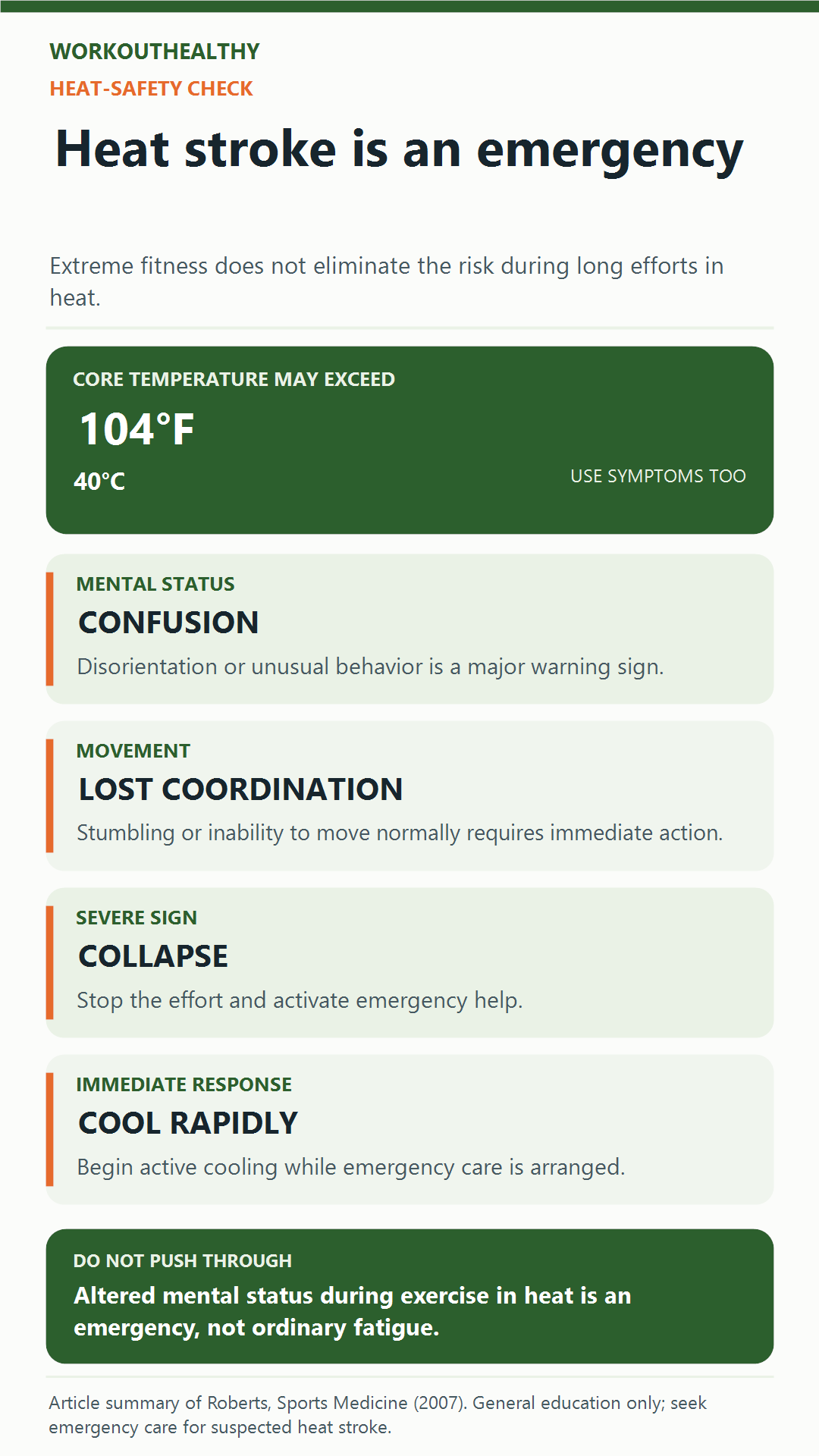
Roberts’s research emphasized that exertional heat stroke can occur even in extremely fit, experienced athletes.
Fitness alone does not fully protect against it during a long enough effort in the wrong conditions.
The Western States course is specifically known for large temperature swings.
Its history includes documented cases of heat related medical emergencies among competitors.
Gibbard’s reported symptoms during the race fit a pattern the race’s own medical staff are trained to watch for closely.
Heat stroke can develop quickly, and the warning signs are easy to dismiss as ordinary fatigue until the situation becomes serious.
Race organizers at major ultramarathons typically station medical staff at aid stations specifically to catch early signs of heat illness before they escalate.
That kind of monitoring is one reason serious complications, while real, are relatively uncommon at well organized events.
What This Evidence Does Not Prove
None of this research proves that recovering from a serious heat event and then training for a marathon months later is a safe template for other runners to copy.
Gibbard had years of ultramarathon experience behind him before attempting Western States.
That experience likely shaped how his body handled and recovered from the effort.
A newer runner attempting a similar extreme event would not have that same training history to draw on.
The research on ultramarathon recovery also cannot say exactly how long any individual needs before another hard endurance effort is safe.
Recovery time depends on the severity of the original event and an athlete’s overall health.
It also depends on factors that are difficult to measure outside a lab.
Who Should Talk to a Doctor First
Anyone who has experienced symptoms of heat illness during exercise, even once, should talk to a doctor before their next intense endurance effort.
People with a history of heat stroke are at higher risk of a repeat episode.
Some evidence suggests heat tolerance can be temporarily altered after a severe event.
A doctor familiar with exertional heat illness can help assess whether that risk has fully resolved.
Anyone with an underlying heart condition should be especially cautious with extreme endurance events.
Heat stress adds significant demand on the cardiovascular system on top of the demands of the exercise itself.
People taking certain medications should also check with a doctor first.
That includes some blood pressure medications, antihistamines, and psychiatric medications.
Some drugs interfere with the body’s ability to regulate temperature during exercise.
Anyone planning to attempt an ultramarathon or an extreme endurance event for the first time should build up gradually.
A medical checkup beforehand is a reasonable step, rather than treating fitness alone as sufficient preparation.
Common Mistakes Endurance Athletes Make With Heat and Recovery
Even experienced athletes make predictable mistakes around heat and recovery.
A common one is underestimating how much fluid and electrolyte intake changes in hot conditions.
Sweat rate and sodium loss both increase substantially in heat.
Standard hydration plans often fall short in those conditions.
Rushing back into hard training after a big race is another frequent error.
The muscle and nervous system damage from an ultramarathon can take weeks to fully resolve, even when a runner feels ready sooner.
Ignoring early warning signs of overheating is a serious mistake.
Confusion, stopping sweating, or a racing heart that will not settle are all signals to stop.
Those symptoms call for cooling down immediately, not pushing through.
Some athletes also skip a real heat acclimation period before a hot race.
They assume general fitness will cover the gap.
Heat tolerance is its own specific adaptation.
It takes one to two weeks of deliberate heat exposure to build.
How Endurance Athletes Build Heat Tolerance Safely
Heat acclimation follows a fairly well established process.
Training in warm conditions for 60 to 90 minutes a day, gradually increasing intensity, builds tolerance over one to two weeks.

Some athletes use sauna sessions after regular workouts as an additional heat stimulus when race conditions cannot be replicated in training.
Electrolyte intake should scale with sweat rate, not follow a fixed daily amount regardless of conditions.
Pre-cooling strategies, like a cold drink or an ice vest before a hot start, can also blunt the early rise in core temperature during a race.
None of these strategies eliminate the risk of heat illness entirely.
They lower it meaningfully for athletes willing to put in the preparation.
Pacing conservatively in the early miles of a hot race also helps, since a fast start leaves less physiological margin once temperatures climb later in the effort.
Many experienced ultrarunners deliberately run the first quarter of a hot race slower than they feel capable of, saving that margin for the hardest, hottest stretch still ahead.
References
- Hoffman, M. D., & Krishnan, E. (2014). Health and exercise-related medical issues among 1,212 ultramarathon runners: Baseline findings from the Ultrarunners Longitudinal TRAcking (ULTRA) study. PLOS ONE, 9(1), e83867. https://doi.org/10.1371/journal.pone.0083867
- Millet, G. Y., Tomazin, K., Verges, S., Vincent, C., Bonnefoy, R., Boisson, R. C., Gergele, L., Feasson, L., & Martin, V. (2011). Neuromuscular consequences of an extreme mountain ultra-marathon. PLOS ONE, 6(2), e17059. https://doi.org/10.1371/journal.pone.0017059
- Roberts, W. O. (2007). Exertional heat stroke in the marathon. Sports Medicine, 37(4), 440-443. https://doi.org/10.2165/00007256-200737040-00044
- Runner’s World. 2025 New York City Marathon celebrities. https://www.runnersworld.com/news/g69178419/2025-new-york-city-marathon-celebrities/
This article is for general educational purposes and is not a substitute for individualized advice from a doctor. Exertional heat stroke is a medical emergency. Anyone experiencing confusion, loss of coordination, or a stop in sweating during exercise in heat should stop immediately and seek medical attention.