
Adele Roberts spent years as a familiar voice on British radio before most listeners knew much about her health.
That changed in October 2021, when doctors diagnosed her with bowel cancer.
Roberts underwent surgery to remove the tumor. She also went through chemotherapy. As part of her treatment, she received a stoma, a surgically created opening that allows waste to leave the body into an external pouch worn outside the abdomen.
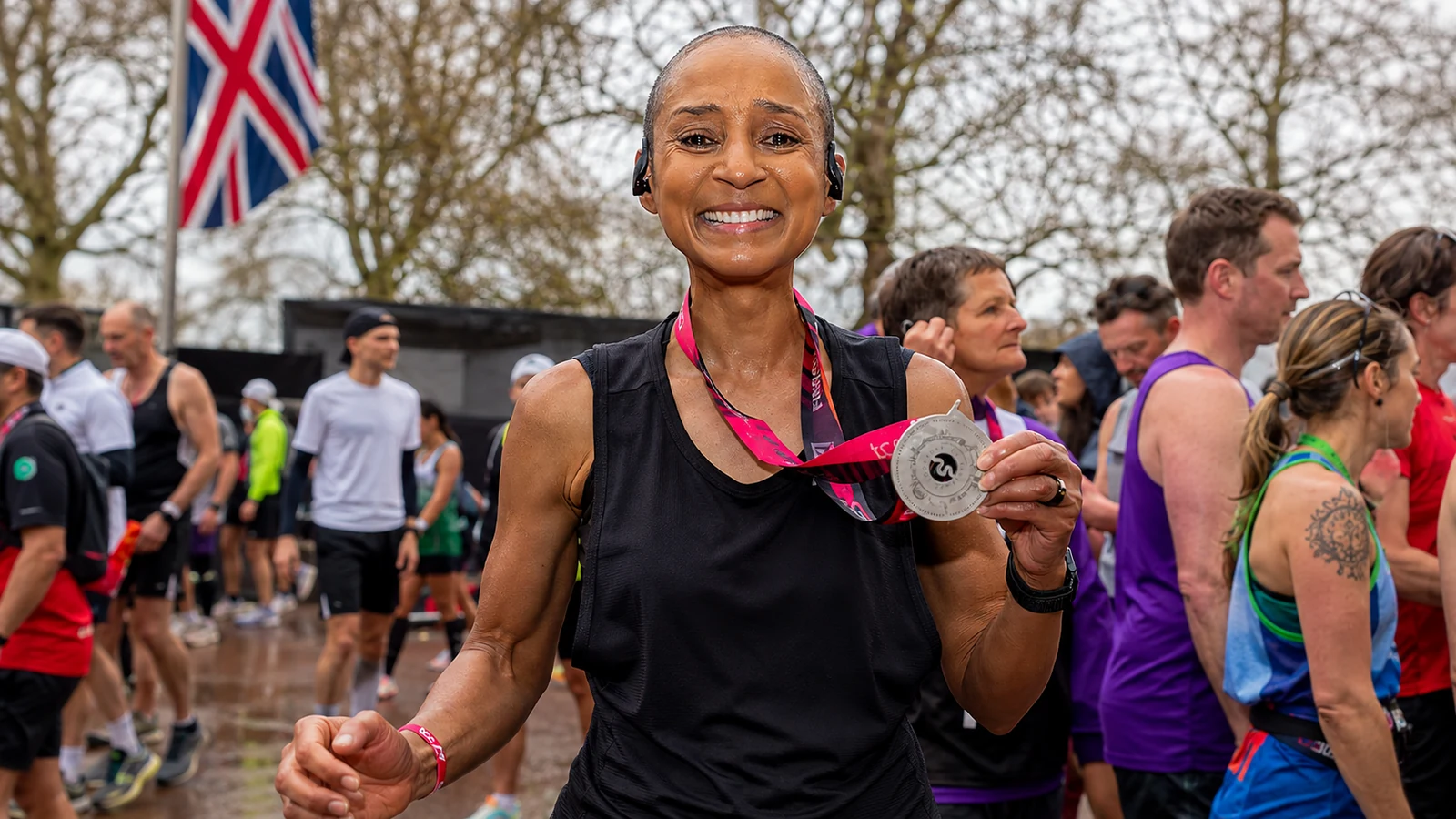
By June 2022, Roberts announced she was cancer free. She did not stop there. She went on to become known in UK running circles for something else entirely, finishing marathon after marathon with a stoma bag along for every mile.
Her story has been described as including a run across all six World Marathon Majors, the six largest and most prestigious marathons in the world.
Tokyo, Boston, London, Berlin, Chicago, and New York, all completed within a single year.
That is a serious athletic achievement for any runner. Doing it while managing a stoma adds a layer most marathoners never have to think about at all.
What Actually Happened
Roberts is a British broadcaster best known for hosting BBC Radio 1’s Early Breakfast Show starting in 2015, and later its Weekend Breakfast Show.
She left Radio 1 in 2023 after eight years there.
Her bowel cancer diagnosis in October 2021 came as a shock, both to her and to listeners who had followed her career for years.
Bowel cancer is one of the more common cancers diagnosed in the UK each year, and treatment often involves some combination of surgery, chemotherapy, and radiation, depending on the stage.
A stoma is one possible outcome of that kind of surgery. It reroutes part of the digestive system through an opening in the abdomen into an external pouch. Some stomas are temporary and get reversed later. Others are permanent, depending on the surgery and the person’s individual case.
Roberts has been open about running the London Marathon multiple times since her diagnosis. In 2023, she set a Guinness World Record as the fastest woman to complete the London Marathon while wearing a stoma bag, finishing in 3 hours, 30 minutes, and 22 seconds.
Her broader story, as it has circulated, includes completing all six World Marathon Majors within a single year, a pace fast enough to set a new record for the achievement.
That framing ties the milestone to a specific stretch of her running career rather than an ongoing, currently updating count.
Along the way, she has raised money for causes connected to mental health and cancer awareness, including Heads Together and the Attitude Magazine Foundation.
What She Has Said About It
Roberts has used her platform to talk openly about life after a stoma, a topic many people rarely discuss in public at all.
She has described her running not as something she does despite her stoma, but as part of proving to herself what her body could still do after treatment.
That framing shows up again and again in how she talks about her recovery.
She has spoken about wanting other people living with a stoma to see her running and racing normally, rather than hiding it.
Visibility, in her telling, is a meaningful part of the point.
She has also connected her running achievements to a larger goal of raising awareness and money for cancer related causes, not just personal fitness milestones for their own sake.
That combination, a public recovery and a public running career built on top of it, has made her story resonate with people who are not runners at all.
Many of them are simply trying to figure out what life looks like after a major diagnosis.
The Science Behind Exercise and Life With a Stoma
For a long time, people living with a stoma were often told to avoid strenuous exercise altogether.
That blanket advice has shifted in recent years.
A 2026 narrative review published in the journal Quality in Sport examined sport and physical activity in people living with a stoma after ostomy surgery (Psiuk, 2026).
The review found that appropriately tailored activity may improve quality of life, reduce fatigue, and support physical fitness in people with a stoma.
The same review noted that inactivity is common among people with a stoma. That inactivity is often driven by fear of a parastomal hernia, a bulge that can form near the stoma site, or by concerns about body image and how a pouch might look or feel during movement.
The researchers concluded that sport appears generally feasible after ostomy surgery when it is individualized and supported by a person’s care team, rather than approached alone without guidance.
That distinction matters. The research does not say every person with a stoma should attempt distance running. It says structured, personalized activity can be both safe and beneficial for many people, once cleared by their medical team first.
Separately, marathon training itself produces measurable changes in the cardiovascular system, regardless of a runner’s other health history.
A 2020 study published in the Journal of the American College of Cardiology followed 138 first-time marathon runners through roughly 17 weeks of beginner level training (Bhuva et al., 2020).
Researchers found meaningful drops in blood pressure after training. They also found increased flexibility in the aorta, the body’s largest artery, equal to reversing about four years of natural arterial aging.
That study did not include participants with a stoma specifically. It does show that the general physiological benefits of marathon training are real, and that they show up even in people who are new to running, not only elite athletes with years of a base already built.
How This Compares to General Guidance
Exercise guidance for cancer survivors more broadly has also shifted over the past decade.
A 2019 consensus statement from an international multidisciplinary roundtable, published in Medicine & Science in Sports & Exercise, reviewed the evidence and recommended regular aerobic and resistance exercise for most cancer survivors, tailored to their specific diagnosis and treatment history (Campbell et al., 2019).
That consensus statement found exercise can improve anxiety, depression, fatigue, and quality of life for people who have gone through cancer treatment, in addition to general physical fitness.
It also stressed that exercise programs should be individualized rather than one size fits all, which lines up with the stoma specific research above.
Stoma care nurses and colorectal surgeons generally encourage a gradual, individualized return to exercise after ostomy surgery, once the surgical site has fully healed.
Core focused exercises and heavy lifting are usually approached more cautiously than cardio like walking or running, since increased abdominal pressure is a known risk factor for parastomal hernia.
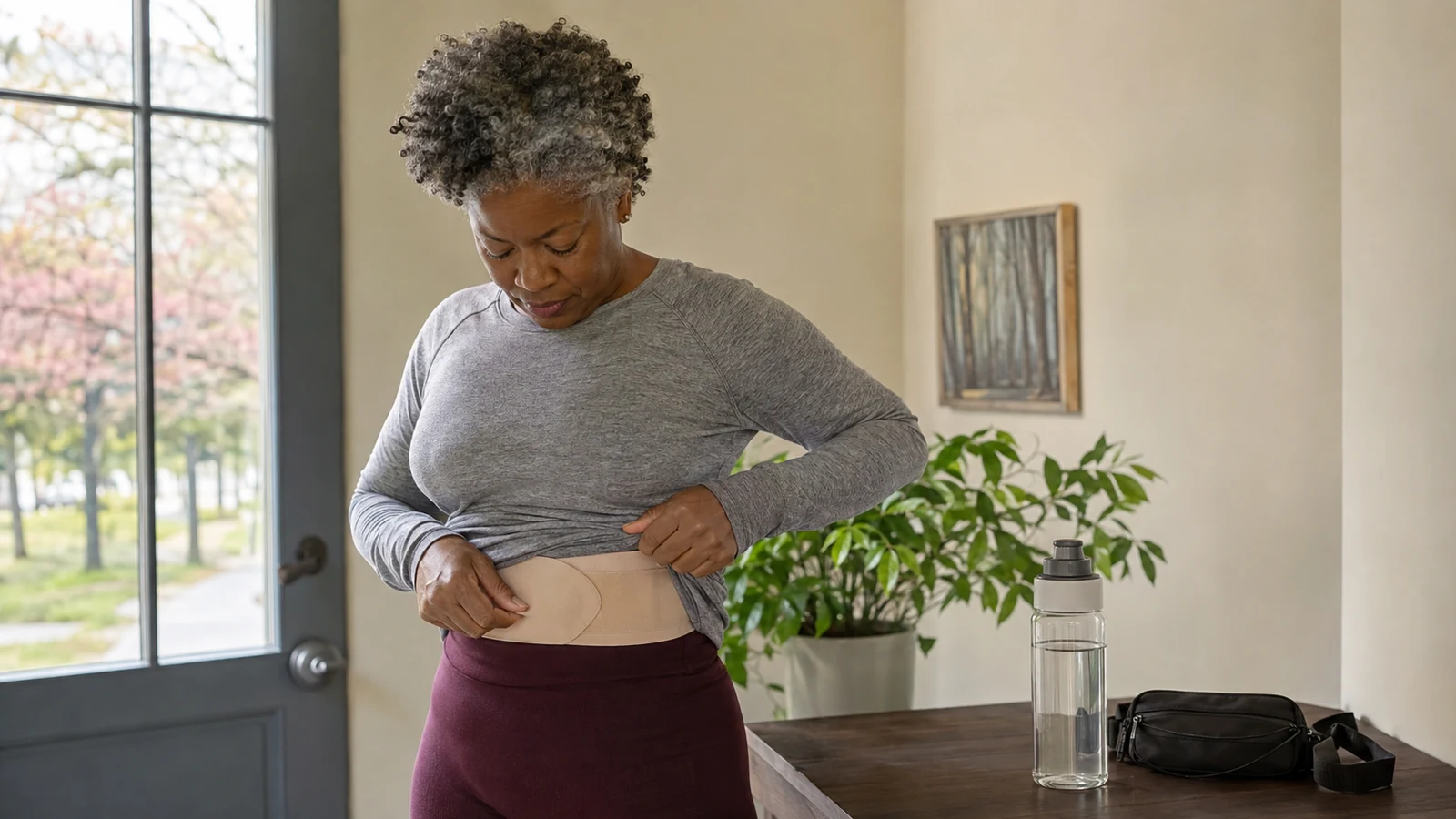
Support garments designed for people with a stoma, sometimes called hernia support belts, are commonly recommended for higher impact activity like running.
They add gentle compression and support around the stoma site during movement.
Hydration and electrolyte planning also tend to get more attention for people with an ileostomy in particular.
That type of stoma can affect how the body absorbs fluid and salt, which matters even more during long endurance efforts like marathon training.
None of this rules out serious athletic goals for people living with a stoma. It does mean the path usually runs through a care team first, not straight from surgery to a starting line without a plan.
Who Should Talk to a Doctor First
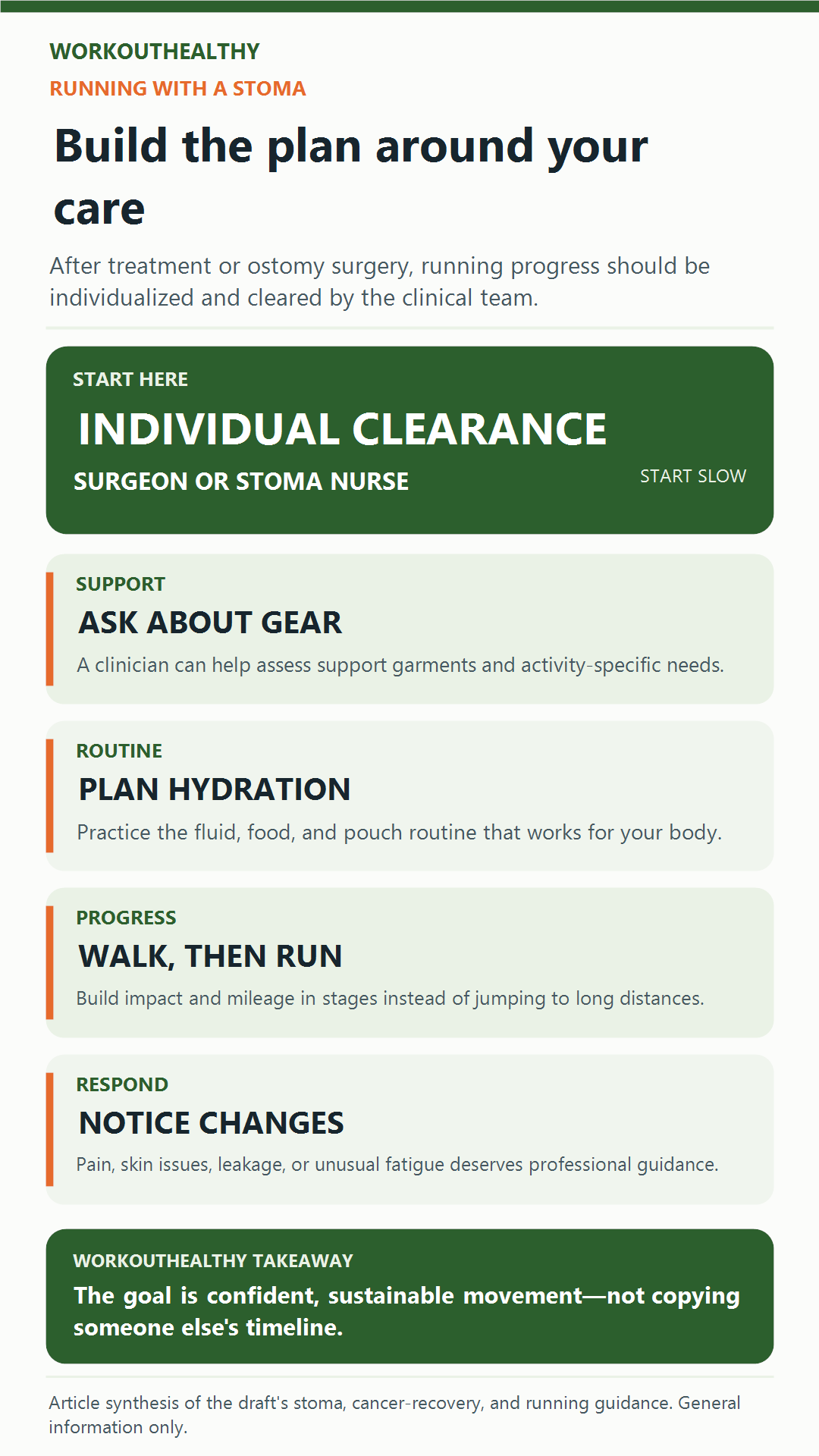
Anyone living with a stoma who wants to start or return to running should talk with their surgeon or stoma care nurse before increasing training intensity.
This matters especially in the months immediately following ostomy surgery, while internal tissue is still healing.
People with a history of parastomal hernia, or known risk factors for one, should get specific guidance on core exercise and impact activity before training for something like a marathon.
Anyone recovering from cancer treatment more broadly, including chemotherapy or radiation, should get medical clearance before starting an endurance training plan.
Treatment can affect energy levels, immune function, and cardiovascular health for months afterward.
People with an ileostomy should also talk to their doctor or a dietitian about hydration and electrolyte strategy before long training runs, since fluid and salt loss can look different than it does for runners without a stoma.
How to Build Toward a Big Physical Goal After Treatment
Get full clearance from your surgical team before beginning any structured exercise plan. Be specific about your goals, including distance running if that is the eventual target.
Start with walking. Our guide on how many miles to walk a day is a reasonable, low pressure starting point for anyone rebuilding fitness after treatment.
Ask about a stoma support garment before increasing to running or higher impact training. Added support can reduce strain around the stoma site during longer efforts.
Build mileage slowly. A common guideline caps weekly increases at around 10 percent to protect against overuse injury, and that guideline applies to any beginner runner, stoma or not.
Plan hydration and fueling around your specific stoma type, with input from your care team, especially before long training runs.
Consider working with a coach or trainer familiar with post-surgical exercise. Our piece on deciding whether you need a personal trainer walks through how to find the right kind of support for your situation.
Attach your training to a cause or goal that matters to you personally. Fundraising and awareness work has been part of Roberts’ own approach, and having a reason beyond the finish line can help carry a long training block.
Track consistency, not just pace. Showing up for months of gradual training is the real foundation behind any big finish line moment, marathon major or otherwise.
References
Psiuk, A. A. (2026). Sport and physical activity in people with a stoma and after ostomy surgery: A narrative review. Quality in Sport, 63, 73463.
Bhuva, A. N., Charidimou, A., et al. (2020). Training for a first-time marathon reverses age-related aortic stiffening. Journal of the American College of Cardiology, 75(1), 60-71.
Campbell, K. L., Winters-Stone, K. M., Wiskemann, J., et al. (2019). Exercise guidelines for cancer survivors: Consensus statement from international multidisciplinary roundtable. Medicine & Science in Sports & Exercise, 51(11), 2375-2390.
This article is for general information only. Details of any individual’s personal medical or athletic history are drawn from public reporting and have not been independently verified in every particular. This is not personal medical advice. Anyone living with a stoma, recovering from cancer treatment, or starting a new exercise program should talk with a qualified healthcare provider first.