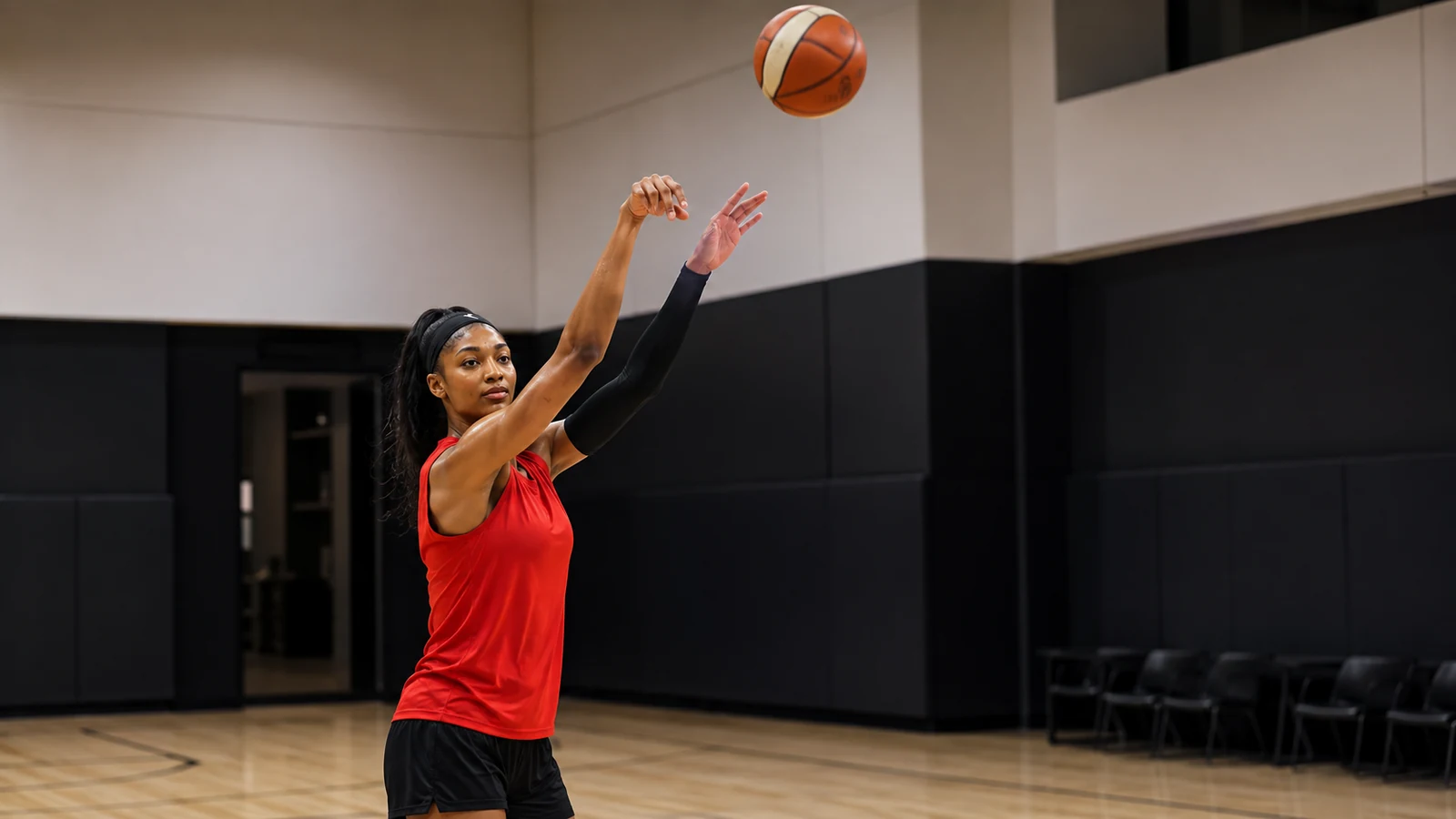

Angel Reese arrived in the WNBA with a reputation already built.
The Chicago Sky forward, drafted seventh overall in 2024, set a WNBA rookie rebounding record that same year and made the All Star team in both of her first two seasons.
By 2025, she led the league in rebounds per game for the second straight year and became the fastest forward in WNBA history to record a triple double.
She was also named to the Unrivaled All Second Team and helped her Unrivaled team, Rose BC, win the league’s inaugural championship.
None of that came from luck.
Reese has built her game around relentless positioning, physicality, and an offseason approach that treats the gap between seasons as work time, not vacation time.
Her 2025 season also included a real setback: a back injury that sidelined her for a significant stretch of the second half.
That combination, elite production and a real injury to manage, shaped how she approached her most recent offseason.
Reese also plays in the Unrivaled league during the WNBA offseason, which means her calendar has less true downtime than many other professional athletes get.
Fitting a serious strength block and a new skill into a compressed window takes real planning, not just motivation.
What Her Offseason Training Actually Looked Like
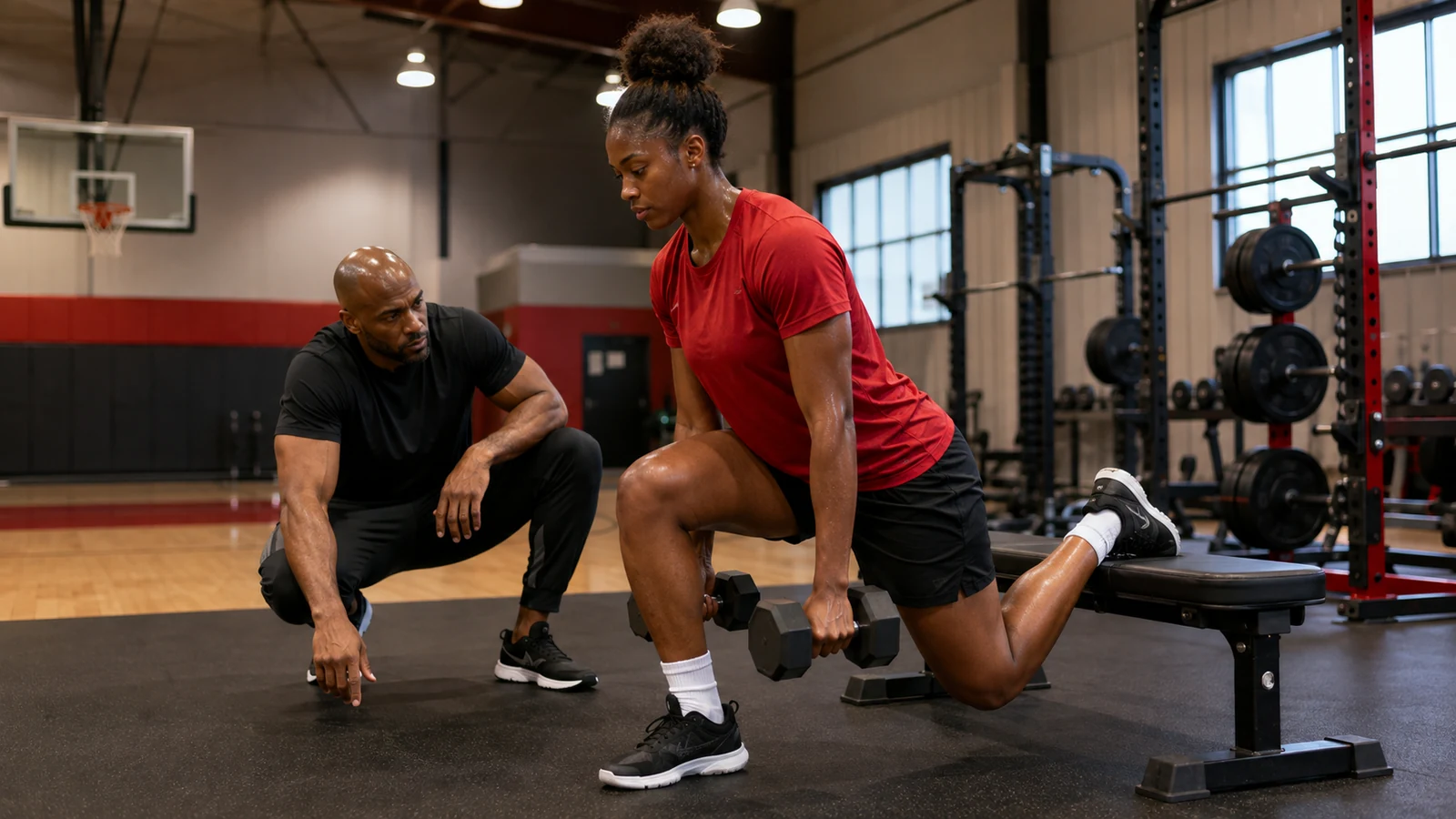
Reese has shared training footage showing an intense focus on lower body strength during her offseason work, the kind of pressing and pulling work covered in a floor press versus bench press comparison.
Lower body strength is the foundation for the two things she does best on the court: rebounding position and physical post play.
Alongside the strength work, she has been developing a three point shot, an area that has not historically been a strength in her offensive game.
Adding a perimeter shot to an already dominant interior game is a common way for post players to extend their careers and expand their offensive value.
Reese has talked about loving offseason training specifically because it is where the unglamorous, unwatched work happens.
Highlight reels capture the rebounds and put backs.
They rarely capture the hundreds of repetitions in an empty gym that make those plays possible.
In Reese’s Own Words
Reese has described the offseason grind as something she genuinely enjoys, not just tolerates.
She has posted about the results that come from consistent offseason work, framing strength training as directly connected to her on court identity as a rebounder, a philosophy that echoes what fitness at 53 looks like for Gabrielle Union’s own strength focused routine.
She has been open about the process of adding a new skill, the three point shot, to a game that has succeeded so far without it.
That openness matters, since it treats skill development as an ongoing process rather than something a player either has or does not have.
Her public framing consistently connects offseason repetition to in season results, rather than treating the two as separate.
The Science Behind Off Season Strength Training
Basketball is a physically demanding sport, and the research backs up why offseason strength work matters so much.
A 2018 systematic review published in Sports Medicine examined the physical and physiological demands of basketball match play.
It found that elite basketball involves frequent high intensity efforts, rapid changes of direction, and repeated jumping, all of which place significant strain on the lower body (Stojanović et al., 2018).
Rebounding specifically depends on a combination of vertical jump power, body positioning, and the strength to hold that positioning against contact, the same explosive quality explored in research on whether box jumps build real muscle.
A 2018 review in the same journal focused specifically on the role of maximal muscular strength in athletic performance.
It found that greater lower body strength is consistently associated with improved jump height, sprint speed, and change of direction ability across a range of sports (Suchomel et al., 2018).
That research lines up directly with why a rebounding specialist would prioritize lower body strength in the offseason rather than deprioritizing it after a strong season.
What the Research Says About Learning a New Skill Like a Three Point Shot
Adding a reliable three point shot to an established game is a skill acquisition problem as much as a physical one.
A landmark 1993 paper in Psychological Review introduced the concept of deliberate practice, structured, repetitive practice aimed at specific weaknesses with feedback built in.
The researchers found that expert level performance across many fields was tied more closely to years of this kind of focused practice than to raw natural talent alone (Ericsson et al., 1993).
Shooting mechanics respond well to that model, since a jump shot is a highly repeatable motion that benefits from thousands of tracked, corrected repetitions.
This does not mean any player can become an elite three point shooter through effort alone.
It does mean that visible improvement in a specific skill like shooting is a realistic goal of structured offseason work, not just a hope.
What This Evidence Does Not Prove
None of this research guarantees that Reese, or any specific player, will turn a known weakness into a strength on a fixed timeline.
The basketball demands research describes the sport’s general physical requirements, not any one player’s individual training response.
The deliberate practice research comes largely from studies of chess players, musicians, and other skill domains, and applying it to shooting is a reasonable but not perfectly direct extension.
Strength gains and skill gains also do not always show up on the same timeline, and a shot can look mechanically better in practice long before it translates into game results.
The honest expectation is gradual, measurable improvement over a full season or more, not an overnight transformation.
How This Compares to General Strength Training Guidance
The core structure of Reese’s offseason lower body work is not exotic compared to general strength training guidance.
Standard recommendations for athletes call for two to four lower body strength sessions a week during an offseason block, built around squats, hinges, and single leg work.
What differs for an elite athlete is volume, load, and the presence of a coaching and medical staff monitoring recovery in real time.
For someone managing a recent injury, like Reese’s 2025 back injury, that monitoring becomes especially important.
Returning to heavy lower body training after a back injury generally follows a graded process, building load gradually rather than jumping straight back to pre injury intensity.
Core stability work, including anti rotation and anti extension exercises, is a common early step in that graded return, since a stronger core reduces stress on the lower back during heavier lifts.
A physical therapist or athletic trainer typically clears each stage of that progression before adding more load, rather than the athlete deciding alone when to push forward.
Common Mistakes People Make With Offseason Strength Training
Trying to add a new skill and rebuild strength at the same intensity at the same time is a common mistake among motivated athletes.
Splitting focus too thin across multiple goals often slows progress on all of them rather than speeding any of them up.
Skipping a proper deload period after a long competitive season is another frequent error.
Muscles, joints, and connective tissue need real recovery time before absorbing a new block of heavy training.
People recovering from an injury, like a back strain, often make the mistake of avoiding the injured area entirely instead of rebuilding it under guidance.
Complete avoidance can leave the area weaker relative to the rest of the body, which sometimes raises re injury risk once full activity resumes.
Finally, treating shooting practice as unstructured, uncounted repetition rather than tracked, deliberate practice tends to produce slower results.
Counting makes, tracking shot location, and reviewing form on video all separate real skill practice from simply shooting around.
How to Structure an Offseason Like This
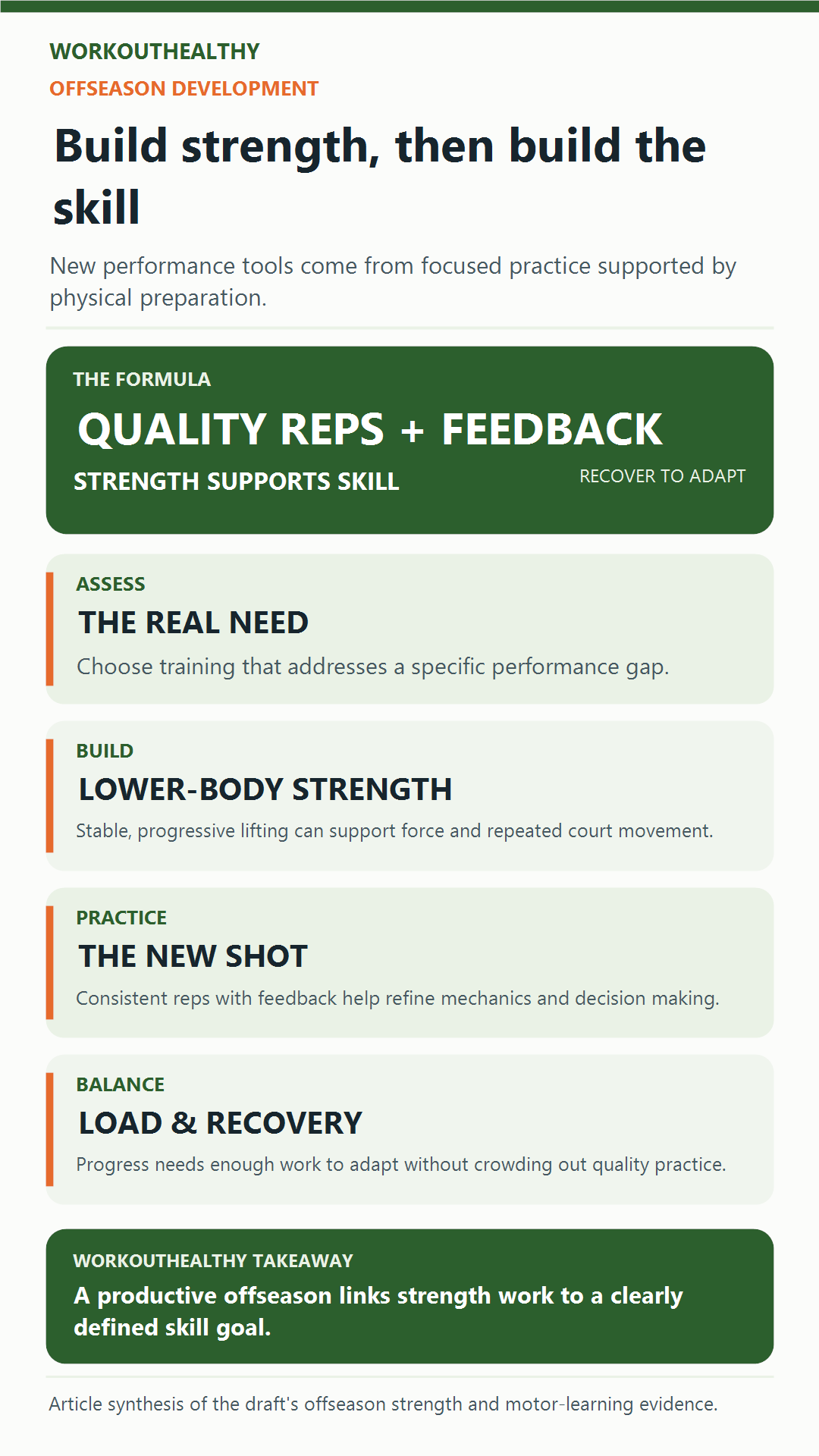
Start any offseason block with an assessment, ideally with a strength coach or physical therapist, especially after an injury during the prior season.
Build a lower body strength program around a few core movement patterns: a squat variation, a hinge variation, a single leg exercise, and direct core work.
Progress load gradually over several weeks rather than jumping to maximum weights in the first sessions back.
Separate skill work, like shooting practice, from heavy strength sessions when possible, so fatigue from one does not degrade the quality of the other.
Track shooting practice with real numbers: attempts, makes, and shot location, reviewed weekly to spot genuine trends.
Schedule at least one full recovery day between heavy lower body sessions to let the nervous system and connective tissue recover.
Reassess every four to six weeks, adjusting the program based on how the body is actually responding, not just the original plan on paper.
Treat the offseason as a season of its own, with its own goals, rather than empty time between the seasons that count.
For recreational athletes borrowing this approach, the same basic order applies at a smaller scale.
Build a strength base first, layer in a specific skill goal second, and give both pieces enough time and rest to actually show progress.
Two focused priorities executed well tend to beat five scattered goals chased at once.
Whether the goal is protecting a rebounding role or simply staying injury free at the local gym, the underlying principle is the same.
Strength built patiently in the offseason tends to show up as durability once the games that count actually start.
References
Ericsson, K. A., Krampe, R. T., & Tesch-Römer, C. (1993). The role of deliberate practice in the acquisition of expert performance. Psychological Review, 100(3), 363 to 406. https://doi.org/10.1037/0033-295X.100.3.363
Stojanović, E., Stojiljković, N., Scanlan, A. T., Dalbo, V. J., Berkelmans, D. M., & Milanović, Z. (2018). The activity demands and physiological responses encountered during basketball match play: A systematic review. Sports Medicine, 48(1), 111 to 135. https://doi.org/10.1007/s40279-017-0794-z
Suchomel, T. J., Nimphius, S., Bellon, C. R., & Stone, M. H. (2018). The importance of muscular strength: Training considerations. Sports Medicine, 48(4), 765 to 785. https://doi.org/10.1007/s40279-018-0862-z
This article is for general informational purposes only and is not medical or training advice.
Talk with a certified strength coach, athletic trainer, or physician before beginning a new strength training program, especially when returning from an injury.