
Theo James built a career on physically demanding roles, from the Divergent film series to recent turns in The White Lotus, The Gentlemen, and The Monkey.
He performed his own stunts across the Divergent trilogy, playing Tobias Eaton, also known as Four, in a series built around action and physical training as part of the story itself.
His performance in The White Lotus earned him a Primetime Emmy Award nomination, showing his range extends well beyond action roles.
His filmography also includes the Underworld franchise, the science fiction film Archive, and a dual lead role in the 2025 comedy horror film The Monkey.
Moving between horror, drama, and prestige television means his body has had to look different for different projects, sometimes within the same year.
That kind of range puts pressure on an actor’s physical preparation in a way a single franchise role does not.
What connects many of his most physical parts is something James himself has talked about openly.
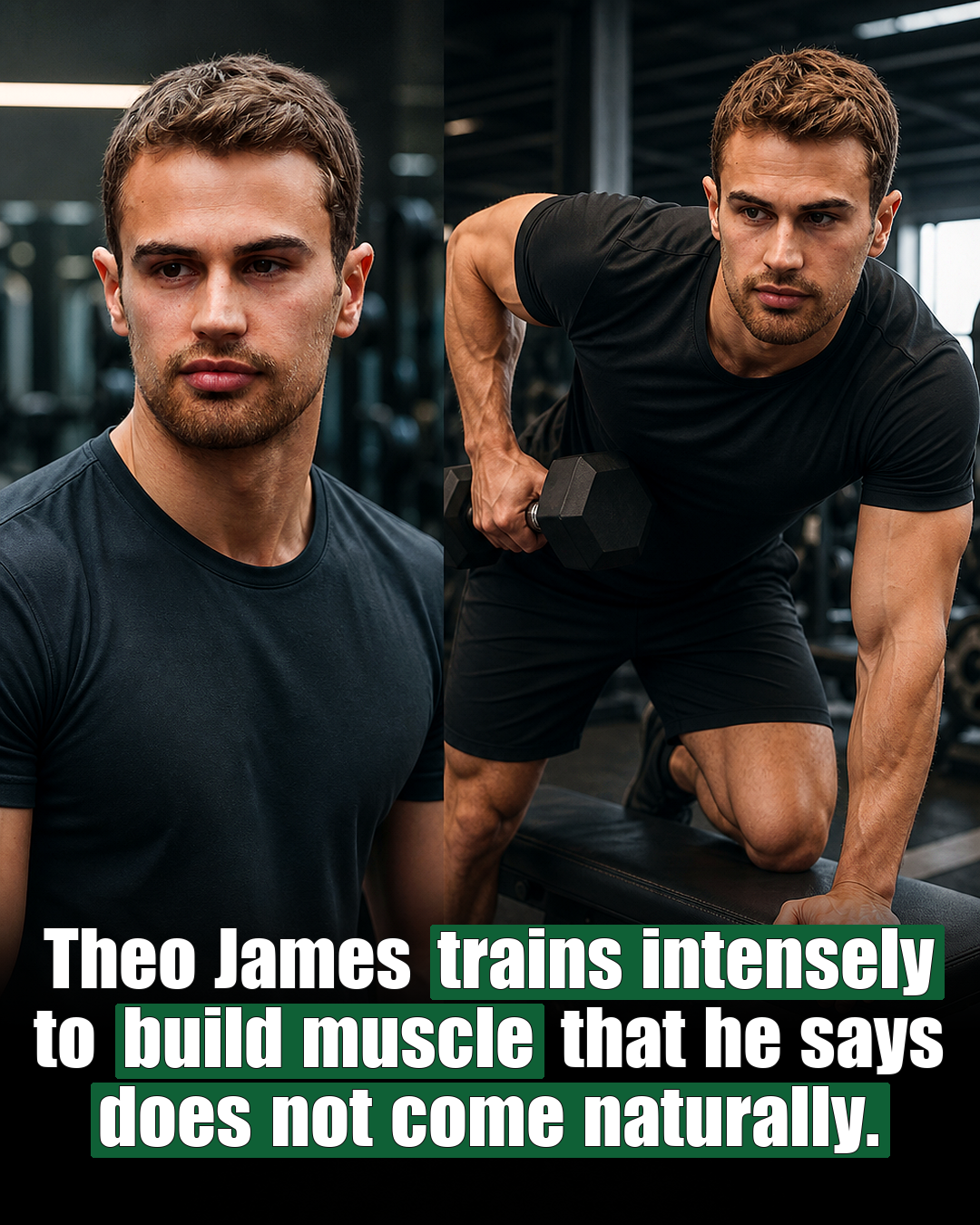
Building muscle has never come easily for him.
What James Has Said About His Body Type
James has described himself as naturally slim, the body type often referred to informally as a hardgainer or ectomorph.
Rather than relying on genetics to build the muscle a physically demanding role requires, he has talked about needing real, structured strength training and disciplined eating to add size when a part calls for it.
That kind of transformation takes months of consistent work, not a quick push in the weeks before filming starts.
He has also described returning to a leaner, more natural baseline once a production wraps, rather than maintaining a bulked up physique year round.
That detail is a useful reality check for anyone comparing their own body to a transformation photo from a movie press tour.
Why Some Bodies Struggle to Add Muscle
People who describe themselves as naturally slim or as having a hard time gaining weight are describing a real, recognized pattern, even if the old somatotype categories of ectomorph, mesomorph, and endomorph are considered outdated as strict scientific classifications.
The more useful modern explanation involves a combination of factors: a naturally fast metabolism, lower baseline appetite, and sometimes a tendency toward more fidgeting or non exercise movement throughout the day, all of which burn extra calories.
For someone with that combination of traits, simply training hard is often not enough to build noticeable muscle.
Muscle growth requires a consistent caloric surplus, meaning the body needs more energy available than it burns, in addition to a structured resistance training program.
Without that surplus, even excellent training can produce disappointing results, which is a common source of frustration for naturally lean people trying to build size.
What the Research Shows About Building Muscle From a Lean Starting Point
A study presented at the American College of Sports Medicine’s annual meeting examined what happens when athletic individuals combine a modest caloric surplus with resistance training (Sanchez et al., 2023).
The researchers found that a modest, controlled caloric surplus combined with structured resistance training led to healthy weight gain in athletic individuals, rather than the kind of excess fat gain people sometimes fear from eating more.
That finding matters directly for someone with a naturally lean build. The surplus does not need to be extreme to work, as long as it is paired with real training.
A modest, well managed caloric surplus paired with structured resistance training is enough to drive meaningful muscle gain, without requiring extreme overeating.
Protein intake plays a central role in that process as well.
A large systematic review and meta-analysis in the British Journal of Sports Medicine examined the effect of protein supplementation on muscle mass and strength gains during resistance training across nearly 2,000 participants (Morton et al., 2018).
The researchers found that additional dietary protein significantly increased both strength and muscle mass gains compared to resistance training without extra protein, though the benefit leveled off beyond a certain intake level.
Consistency over time matters too. Research on resistance training adaptation has found that muscle protein synthesis responses become more efficient with chronic, ongoing training, meaning the body actually gets better at building muscle the longer someone sticks with a structured program (Gasier et al., 2011).
That is a meaningful point for anyone who feels discouraged after a few weeks of visible effort with limited visible results.
Sleep also plays a supporting role in this process that is easy to overlook.
Muscle repair and growth happen largely during recovery periods between training sessions, not during the workout itself, which is part of why consistent sleep is often listed alongside training and nutrition as a pillar of muscle building.
For a naturally lean person already working against a fast metabolism, cutting recovery time short can undermine the surplus and training work happening everywhere else.
What This Research Does Not Prove
None of these studies followed James specifically, so his personal results cannot be attributed directly to any one study’s findings.
The caloric surplus research also focused on already athletic individuals, not complete beginners, so the exact surplus size that works best may differ for someone just starting a training program.
Genetics still plays a real role in how quickly any individual person builds muscle, even with an ideal combination of training, nutrition, and consistency.
What the research does support is the general principle behind James’s described approach: deliberate training plus deliberate eating, sustained over real time, works better than either piece alone.
It is also worth noting that most of this research measures group averages, not the full range of individual responses within a study.
Some people in any given trial gain muscle faster than others, even on the exact same program, and that individual variation is normal rather than a sign that the approach itself is flawed.
How This Compares to General Muscle Building Guidance
Standard strength training guidance for building muscle generally recommends training each major muscle group at least twice a week, with enough total volume to create meaningful mechanical stress on the muscle.
For naturally lean individuals specifically, coaches often recommend prioritizing compound lifts like squats, deadlifts, presses, and rows, since these movements allow for heavier loading and recruit more total muscle mass per session.
Nutrition guidance for this body type usually emphasizes eating enough total calories first, since even a well designed training program cannot build much new muscle without adequate fuel behind it.
James’s described pattern, building up deliberately for a role and then returning to baseline afterward, also reflects a broader truth in strength training.
Muscle built through consistent surplus eating and training can be maintained more easily than it was built, but it is also not automatically permanent without ongoing effort.
Common Mistakes People Make Trying to Build Muscle
The most common mistake naturally lean people make is training hard while eating at maintenance calories, expecting size gains without the fuel behind them.
Without a real caloric surplus, most of that hard training effort goes toward maintaining the muscle someone already has rather than building new muscle.
Another common mistake is chasing variety over consistency, switching workout programs every few weeks before any one approach has time to produce results.
Muscle growth responds to consistent, progressive overload over months, not to constant novelty.
People also frequently underestimate how much protein a muscle building phase actually requires, especially relative to a normal maintenance diet.
Skipping structured strength training in favor of only cardio is another common misstep for someone specifically trying to add muscle rather than lose fat.
Finally, many people give up too early, expecting visible results within a few weeks rather than the months of consistent effort real muscle growth actually requires.
How to Build Muscle From a Naturally Lean Starting Point
Start by establishing your baseline calorie needs, then add a modest surplus on top of that number.
A few hundred extra calories a day is generally enough to support muscle growth without excessive fat gain, based on the research above.
Prioritize compound lifts as the foundation of your training program.
Squats, deadlifts, bench presses, and rows recruit large amounts of muscle and allow for the kind of progressive overload that drives real growth over time.
Our guide on floor press versus bench press is a useful place to compare two common pressing variations as you build a program.
Eat enough protein spread across the day, rather than concentrating it into one meal.
Most research supports somewhere around 0.7 to 1 gram of protein per pound of body weight daily for people actively trying to build muscle.
Track your training volume and progression over weeks, not single sessions.
Our guide on what actually holds up about Mike Mentzer’s training approach covers another perspective on how training intensity and recovery interact for muscle growth.
Be patient with the timeline.
Visible muscle growth from a genuinely lean starting point typically takes several months of consistent training and eating, not weeks, which matches the kind of preparation James has described for physically demanding roles.
If unexpected weight changes happen alongside your training, whether gaining slower than expected or losing muscle unexpectedly, it is worth reading further into what else might be affecting your progress.
Our guide on why someone might be losing weight and muscle mass unexpectedly covers some of those other factors.
References
Sanchez, A. D., Reynolds, J. C., Marinik, E. L., Davy, B. M., Hunter, G. R., & Larson-Meyer, E. (2023). Modest caloric surplus combined with resistance training leads to healthy weight gain in athletic individuals. Medicine & Science in Sports & Exercise, 55(9S), 325.
Morton, R. W., Murphy, K. T., McKellar, S. R., Schoenfeld, B. J., Henselmans, M., Helms, E., Aragon, A. A., Devries, M. C., Banfield, L., Krieger, J. W., & Phillips, S. M. (2018). A systematic review, meta-analysis and meta-regression of the effect of protein supplementation on resistance training-induced gains in muscle mass and strength in healthy adults. British Journal of Sports Medicine, 52(6), 376-384.
Gasier, H. G., Riechman, S. E., Wiggs, M. P., Buentello, A., Previs, S. F., & Fluckey, J. D. (2011). Cumulative responses of muscle protein synthesis are augmented with chronic resistance exercise training. Acta Physiologica, 201(3), 381-389.
This article is for general educational purposes and is not a substitute for personalized advice from a qualified fitness or nutrition professional.
Anyone making significant changes to their diet or training program, especially around calorie intake, should consider consulting a doctor or registered dietitian first.