
Anthony Mackie carried the shield in Captain America: Brave New World, the first film to put him front and center as the character.
Getting there took more than a decade. Mackie first appeared as Sam Wilson, also known as Falcon, in Captain America: The Winter Soldier back in 2014.
He went on to reprise the role across several more Marvel films, including Avengers: Age of Ultron, Captain America: Civil War, and Avengers: Endgame, before finally stepping into the lead role himself.
Playing a physically demanding superhero role for that long requires a training approach built for the long haul, not a quick pre movie push.
According to reporting on his workout routine, Mackie’s training reflects exactly that kind of long term thinking.
Mackie’s career started long before the Marvel Cinematic Universe.
He made his film debut in 8 Mile in 2002, then built critical acclaim in Brother to Brother and The Hurt Locker, the latter earning him award nominations well before he ever put on a wing pack.
He has also taken on roles far outside the action genre.
That list includes portraying Tupac Shakur in Notorious and Martin Luther King Jr. in HBO’s All the Way.
That range matters for understanding his training philosophy. Mackie has never been an actor who trains purely for one physical look.
He has built a body that has to work across drama, biopic, and high action roles, sometimes within the same year.
With Avengers: Doomsday and Avengers: Secret Wars already on his schedule for the coming years, that demand is not going away anytime soon.
How Mackie Reportedly Structures His Training
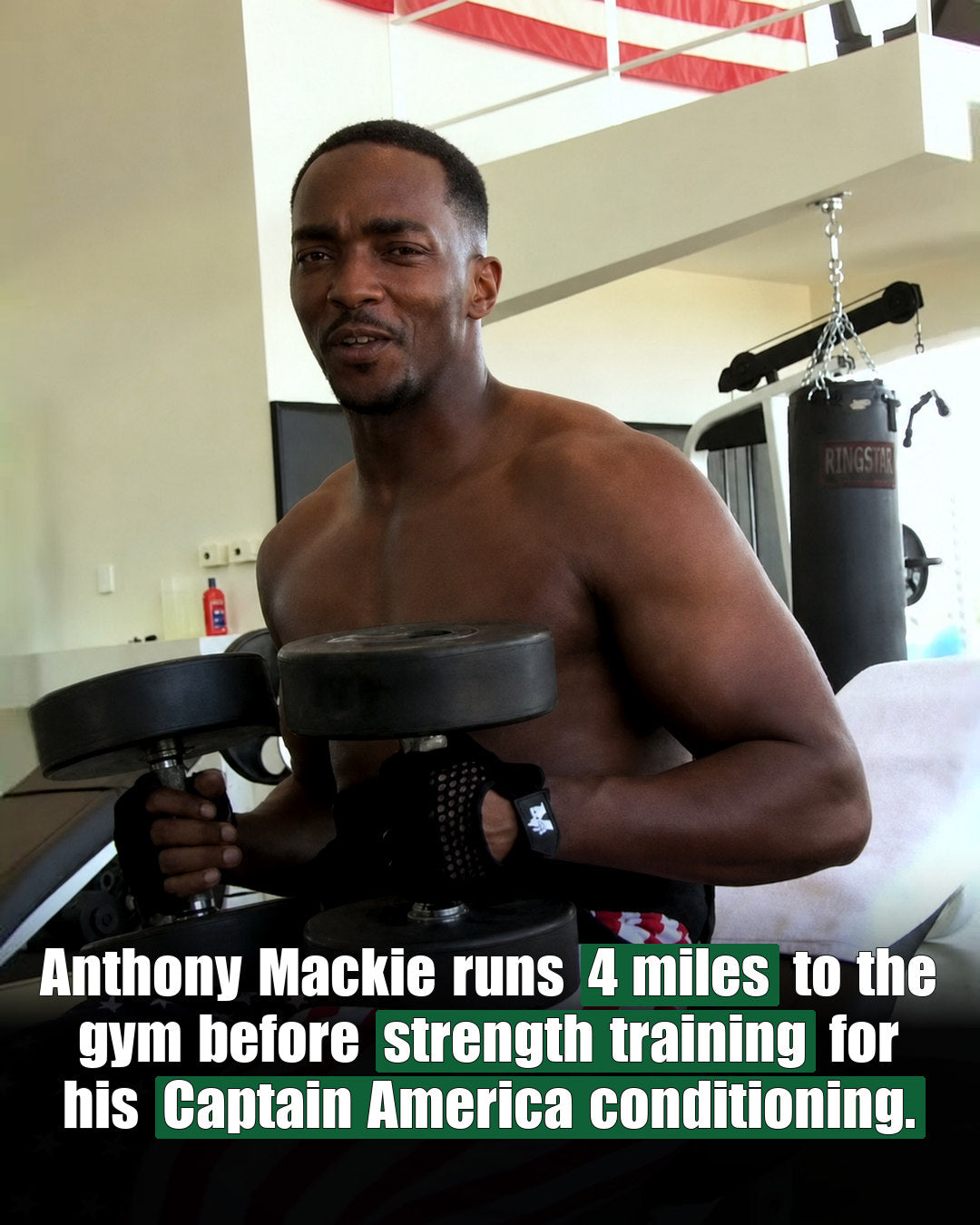
Mackie does not start his training sessions in the weight room.
Reports on his routine describe him running several miles first, then moving into strength work once his heart rate is already elevated.
That order is a deliberate choice, not a random habit. Running first builds an aerobic base that supports the physical demands of stunt work, wire rigs, and long shooting days packed with repeated takes.
The strength portion of his training reportedly follows the same logic, building functional strength rather than training purely for size.
A Marvel role like Captain America involves fight choreography, aerial rigging, and extended action sequences, all of which demand a body that can perform under fatigue, not just look strong in a single photo.
What Mackie Has Said About His Approach
Mackie has spoken in interviews about balancing the physical demands of a superhero role with a long career built on range, not just physicality.
He has described training as something that has to fit around a packed filming and promotional schedule, rather than the other way around.
That reality shapes a lot of how actors like Mackie approach fitness. The training has to be sustainable across months of production, not just intense for a few weeks before cameras roll.
He has also spoken about the responsibility of stepping into a role like Captain America, one with a long legacy attached to it, and how that weighs into his preparation.
Carrying a franchise character means the physical presentation matters, but so does being able to perform the same demanding scenes take after take, day after day.
What the Research Says About Running Before Lifting
The order Mackie reportedly follows, running before lifting, is actually a specific, studied question in exercise science.
A study published in the Journal of Applied Physiology compared the effects of doing aerobic exercise before resistance training against doing it afterward, specifically looking at vascular function (Okamoto, Masuhara, & Ikuta, 2007).
The researchers found that performing aerobic exercise after resistance training helped prevent a temporary decline in vascular function that occurred when resistance training was done first.
In other words, the sequence of combined training sessions can genuinely change the physiological result, not just how a workout feels.
A separate study examined whether the order of resistance and aerobic exercise within a single session affected how many calories the body kept burning afterward (Oliveira & Oliveira, 2011).
The order exercises are performed in during a combined session can measurably change how the body responds, both during the workout and in the hours after it.
That second study found that excess post exercise oxygen consumption, essentially the extra calories burned as the body recovers, was not meaningfully different regardless of which type of exercise came first.
Taken together, this research shows that exercise order matters for some outcomes and not for others, which is a more nuanced picture than a simple better or worse verdict.
The broader body of concurrent training research also applies here. A large meta-analysis in the Journal of Strength and Conditioning Research found that combining aerobic and resistance training can create some interference between the two, though the effect is generally manageable with smart programming (Wilson et al., 2012).
What This Research Does Not Prove
These studies measured specific physiological markers, like vascular function and post exercise calorie burn, not overall athletic performance or on set stunt readiness.
None of the available research tracked Mackie’s own training results directly, so the connection here is about general principles, not a personal case study.
The vascular function study also used a specific population and protocol, and results can vary based on training history, age, and overall fitness level.
What the research supports is a real, physiological reason why the order of combined training sessions can matter, even if the exact size of that effect varies by person and by goal.
It is also worth noting that a wire rig or stunt sequence puts different demands on the body than either a treadmill or a barbell alone.
Neither of the studies used to examine exercise order could fully capture the specific coordination, grip endurance, and full body control that action filmmaking actually requires.
That gap is a reminder that lab research on general training principles is a useful guide, not a perfect substitute for the specific demands of a real job or role.
How This Compares to General Training Guidance
Most strength coaches agree that both orders, cardio first or strength first, are valid depending on the primary goal of a given session.
If building maximum strength or power is the priority, many coaches recommend lifting first, while muscles are freshest and least fatigued.
If building aerobic endurance is the priority, or if the workout is meant to build a long term conditioning base the way Mackie’s reportedly does, running first makes more practical sense.
The core lesson from Mackie’s routine is less about which order is universally correct and more about matching the order to the actual goal of the session.
For someone training for a demanding physical event, whether that is a stunt heavy film role or a real world athletic goal, building the aerobic base early in a training block is a common and reasonable approach.
Common Mistakes People Make With Concurrent Training
A common mistake is treating cardio and strength training as competitors rather than complementary pieces of a complete program.
Skipping cardio to protect strength numbers, or skipping strength work to protect running times, both leave real gaps in how a body performs under real world stress.
Another mistake is doing both types of training at maximum intensity in the same session, every session, without any planned variation.
That approach tends to blunt progress in both areas rather than building strength in either one effectively.
People also commonly ignore recovery needs when combining training types, assuming that because each individual session feels manageable, the combined weekly load is fine too.
Combined training volume adds up across a week, even when no single session feels overwhelming on its own.
Finally, many people skip the aerobic base building phase entirely and jump straight to high intensity intervals, expecting the same result with less time invested.
Steady state aerobic work still plays an important role in building the base that supports harder training later.
How to Balance Running and Lifting in Your Own Routine
Decide your primary goal before deciding your exercise order.
If a specific lift or strength number matters most that day, do the strength work first while you are fresh.
If building aerobic capacity is the priority for that phase of training, running or another form of cardio first makes sense, the way Mackie’s reported routine does.
Separate your hardest cardio and hardest strength sessions across the week where your schedule allows it.
Two to three strength sessions and two to three cardio sessions a week is a reasonable starting structure for most people building general fitness.
Progress the volume of each gradually rather than adding intensity to both at once.
Our guide on floor press versus bench press is a useful place to start if you are building a pressing routine to pair with a new running habit.
Use a simple fitness check to track your starting point before ramping up volume.
Our guide on the four flights of stairs test offers a quick way to gauge your current cardiovascular fitness before building a more structured combined program.
Give your body real recovery between hard sessions of either type.
Combined training only works long term when recovery keeps pace with the added demand, the same balance Mackie’s own long running Marvel commitment has required for over a decade.
References
Okamoto, T., Masuhara, M., & Ikuta, K. (2007). Combined aerobic and resistance training and vascular function: Effect of aerobic exercise before and after resistance training. Journal of Applied Physiology, 103(5), 1655-1661.
Oliveira, N. L., & Oliveira, J. (2011). Excess postexercise oxygen consumption is unaffected by the resistance and aerobic exercise order in an exercise session. Journal of Strength and Conditioning Research, 25(10), 2843-2850.
Wilson, J. M., Marin, P. J., Rhea, M. R., Wilson, S. M. C., Loenneke, J. P., & Anderson, J. C. (2012). Concurrent training: A meta-analysis examining interference of aerobic and resistance exercises. Journal of Strength and Conditioning Research, 26(8), 2293-2307.
This article is for general educational purposes and is not a substitute for personalized advice from a qualified fitness or medical professional.
Always consult a doctor before starting a new exercise program, especially one combining high intensity cardio and strength training.