
Amanda Widener’s channel posted a Friday roundup called “Casual Friday: My Week In Weight Loss, GLP1 & Fitness News, Q&A.”
One line inside it is worth pulling out on its own: a claim that AI calorie tracking apps can miscount daily intake by about 345 calories.
This article looks at where a claim like that could come from, and more importantly, at what real published research says about calorie tracking accuracy.
The short version is that the 345 figure comes from a weekly news and Q&A video, not from a peer reviewed study we could independently confirm.
So it gets treated here as a starting point for a question, not as a verified fact.
The real, published research on this topic is more useful anyway, and it points in a clear direction.
What the Video Claimed, and What We Could Verify
The video’s framing was that a new report found some AI calorie tracking apps miscount daily intake by 345 calories, enough to stall a weight loss goal.
That is a specific, precise sounding number.
We looked for the original report behind it and could not trace that exact figure to a specific, citable study.
Because of that, this article does not repeat 345 as a confirmed fact anywhere below.
What we could confirm is something broader and, frankly, more useful for anyone trying to lose weight or manage a health condition with the help of a tracking app.
There is a real, decades deep body of nutrition research on how accurate calorie tracking actually is, both for traditional food diaries and for newer AI and photo based tools.
That research does not need a dramatic single number to make the point land.
How Calorie Tracking Apps Actually Work
Most calorie tracking apps do the same basic job in three steps.
First, you tell the app what you ate, either by typing it, searching a food database, scanning a barcode, or snapping a photo.
Second, the app matches that entry to a nutrient database, usually built from government or manufacturer data.
Third, it multiplies the serving size you report by the calorie and macronutrient values in that database entry.
The math itself, the third step, is not where most of the trouble happens.
A 2019 review published in JMIR mHealth and uHealth tested seven popular diet tracking apps against the official USDA food composition database.
When researchers logged an identical three day food diary into each app, the average difference in calculated calories was only about 1.4 percent compared to the USDA reference values (Ferrara et al., 2019).
In other words, once the correct food and the correct portion size are entered, the app’s internal math is close to the reference standard.
The Real Source of Error: What You Enter, Not What the App Calculates
That 1.4 percent figure sounds reassuring, and in one narrow sense it is.
But it also reveals where the real problem sits.
The Ferrara et al. (2019) study fed each app a food diary that had already been carefully measured and correctly identified by researchers.
Real life does not work that way.
A person tracking their own meals has to correctly identify the food, correctly estimate the portion, and correctly find the matching database entry, often from memory, in a rush, or while eating out.
Every one of those steps is a place where error can creep in, long before the app does any math at all.
Once the correct food and the correct portion are entered, an app’s own calculations line up closely with reference nutrition data. A major gap between a tracked number and true intake can start earlier, when a person has to identify what they ate and estimate how much of it.
This is why two people using the exact same app can end up with very different accuracy, based entirely on how carefully they log.
What AI and Photo Based Recognition Add, and Where It Still Struggles
Newer apps try to remove some of that manual guesswork by letting a person take a photo of a plate instead of typing everything in.
An AI model is trained to recognize the foods in the image and estimate the portion size from how the food looks in the frame.
This can genuinely save time and lower the barrier to tracking at all, which matters for whether people keep doing it.
But image based recognition carries its own, well documented set of accuracy challenges.
A 2020 review in the IEEE Journal of Biomedical and Health Informatics examined the state of image based food classification and portion size estimation methods used across dietary assessment research (Lo et al., 2020).
The review described portion size and volume estimation from a single photo as one of the harder unsolved problems in the field, since a camera angle, lighting, plate size, and hidden or stacked food can all throw off an estimate.
Mixed dishes, sauces, oils, and foods that are partly hidden under other foods are especially difficult for any photo based system to size up correctly.
None of this means AI powered tracking apps are useless.
It means a photo based calorie estimate should be treated as a fast, rough guess, not as a lab measurement.
The Bigger, Well Established Problem: People Underreport What They Eat
Even before AI or apps existed, nutrition scientists already knew that self reported food intake tends to run lower than actual intake.
This is one of the most consistently replicated findings in dietary research.
A widely cited 2003 review in The Journal of Nutrition examined decades of studies comparing self reported energy intake against objective measures, like doubly labeled water, which tracks actual energy expenditure through isotopes in the body (Livingstone & Black, 2003).
The review concluded that underreporting of energy intake is common across almost every method of dietary self report, including food diaries, recalls, and questionnaires, and that it tends to get worse in people with higher body weight.
That pattern matters directly for calorie tracking apps, because an app cannot correct for a food that was never logged in the first place.
A handful of unlogged snacks, a forgotten splash of cooking oil, or a larger than reported portion at dinner will not show up as an app error at all.
It will simply look like a lower calorie day than the one a person actually had.
What This Evidence Does Not Prove
It is worth being just as clear about what this research does not show.
It does not prove that calorie counting is pointless or that tracking apps are not worth using.
It does not prove that any specific app is worse than any other specific app, since accuracy studies tend to test a handful of apps at a time and results shift as apps update their databases.
It also does not prove a single, universal error number that applies to every user, every meal, and every app, which is exactly why this article avoids repeating the video’s 345 calorie figure as settled fact.
What the research does show is a consistent pattern: tracking tools are reasonably accurate at math, and reasonably inconsistent at capturing exactly what a real person actually ate.
Common Mistakes That Make Tracking Less Accurate
A few habits show up again and again in people whose tracked numbers drift furthest from reality.
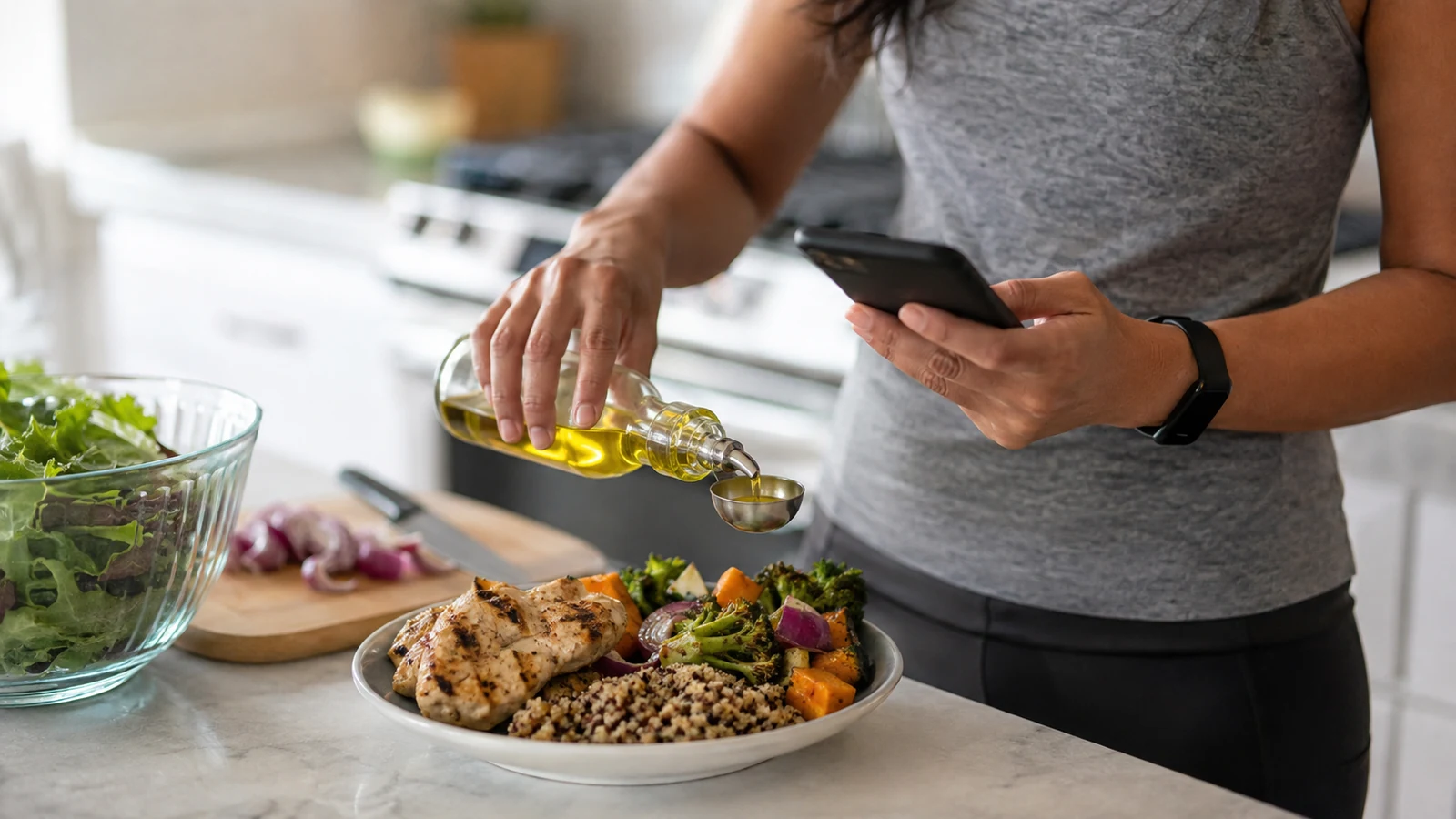
Eyeballing portions instead of measuring them, especially for calorie dense foods like oils, nut butters, cheese, and dressings, is one of the biggest sources of error.
Forgetting to log cooking oil, butter, or sauces added during preparation is another common gap, since these add up fast in small amounts.
Picking the wrong database entry, like a generic “chicken breast” listing instead of the fried or breaded version actually eaten, quietly changes the whole day’s total.
Skipping tracking on weekends, social events, or travel days creates a picture that only reflects the easiest days to log.
Relying entirely on a single AI photo scan for a complex, mixed plate, without ever spot checking it against a scale, lets small errors repeat every single day.
Who Should Be Extra Careful With Calorie Tracking
For most healthy adults using an app as a rough guide, occasional under or overcounting is a minor issue.
The stakes are higher for a few specific groups.
People managing type 1 or type 2 diabetes often use carbohydrate counts from these apps to guide insulin dosing or medication timing, so a meaningful miss can affect blood sugar control, not just weight.
Anyone with a history of disordered eating should talk with a doctor or therapist before using calorie tracking at all, since obsessive logging can worsen that pattern.
People on GLP-1 medications, a topic the same roundup video also touched on, may have reduced appetite; a clinician or dietitian can help assess whether their intake and nutrient needs are being met.
Pregnant women, people recovering from an eating disorder, and anyone with a diagnosed nutrient deficiency should treat app estimates as one input among several, reviewed with a clinician or registered dietitian.
How to Track More Accurately
None of this research means tracking is a waste of time.
It means the habits around tracking matter as much as the app itself.
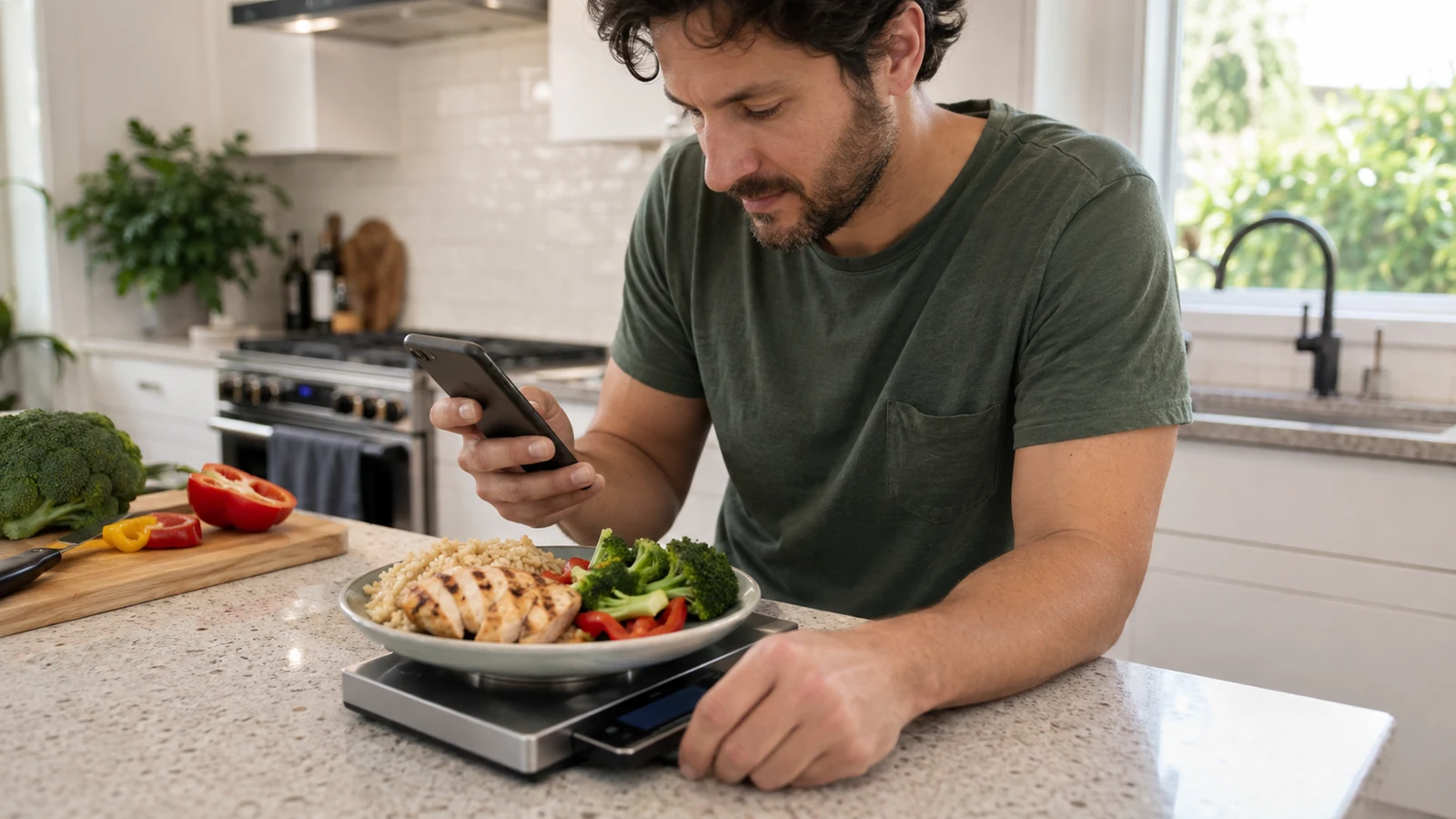
A kitchen food scale can make portion estimates more consistent, especially for calorie-dense ingredients.
Weighing calorie-dense foods such as oils, nut butters, cheese, granola, and dressings can reduce one important source of portion-estimation error.
Logging food before eating it, rather than trying to remember it afterward, cuts down on forgotten items and rounded down portions.
Building a short list of “usual” meals with pre-measured, saved entries removes guesswork on repeat days without sacrificing accuracy.
Spot checking an AI photo estimate against a scale once a week helps a person learn where that specific app tends to run high or low for their own typical meals.
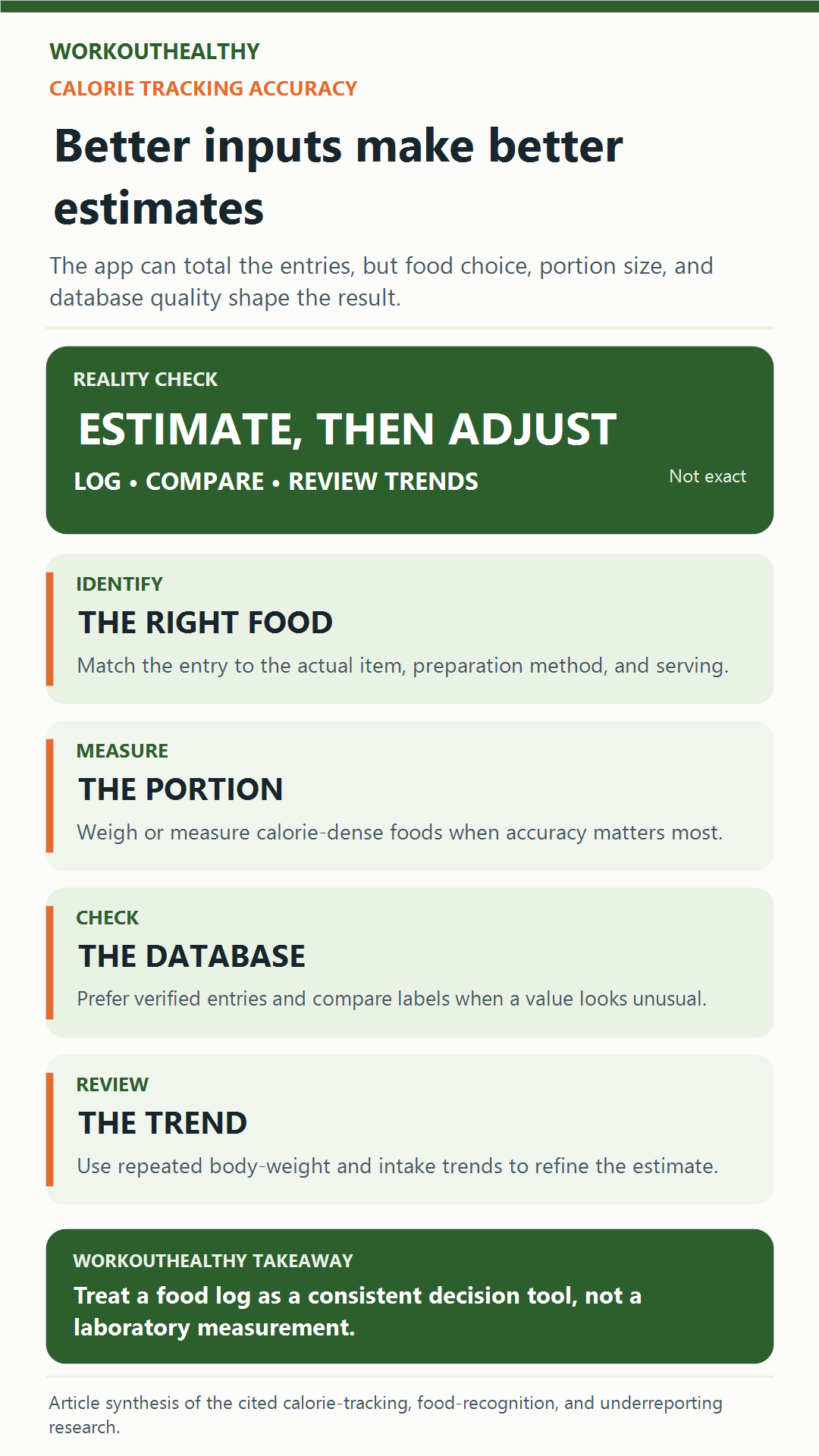
Treating the daily number as a trend line instead of a precise instrument is probably the single most useful mindset shift.
A week’s average, tracked consistently even if imperfectly, tells you far more than any single day’s exact total.
Pairing an app like the Free Macro Calculator with a food scale may help set and track an estimated daily target; neither tool measures individual energy needs exactly.
Setting an estimated protein target with a tool like the Protein Calculator may also help organize meals, while logged amounts remain estimates.
If the scale on the bathroom floor is not moving the way a tracked calorie deficit suggests it should, that gap is useful information, not proof the method has failed.
It is often a sign that logging has drifted, not that calories in and calories out has stopped applying, a pattern covered in more detail in this breakdown of unexpected weight and muscle loss.
Tracking progress with a tool like the Weight Loss Percentage Calculator alongside your food log gives you a second, independent signal that does not depend on getting every entry perfect.
Watch the Original Video
Want the research behind the next viral fitness claim before it hits your feed? Subscribe to WorkoutHealthy Insider for practical explanations behind popular fitness claims.
References
Ferrara, G., Kim, J., Lin, S., Hua, J., & Seto, E. (2019). A focused review of smartphone diet-tracking apps: Usability, functionality, coherence with behavior change theory, and comparative validity of nutrient intake and energy expenditure estimates. JMIR mHealth and uHealth, 7(5), e9232. https://doi.org/10.2196/mhealth.9232
Livingstone, M. B. E., & Black, A. E. (2003). Markers of the validity of reported energy intake. The Journal of Nutrition, 133(3), 895S-920S. https://doi.org/10.1093/jn/133.3.895s
Lo, F. P. W., Sun, Y., Qiu, J., & Lo, B. (2020). Image-based food classification and volume estimation for dietary assessment: A review. IEEE Journal of Biomedical and Health Informatics, 24(7), 1926-1939. https://doi.org/10.1109/JBHI.2020.2987943
This article is for general information only and is not medical advice. If you have an injury, ongoing pain, or a medical condition, talk to a doctor or physical therapist before you change how you train or eat.