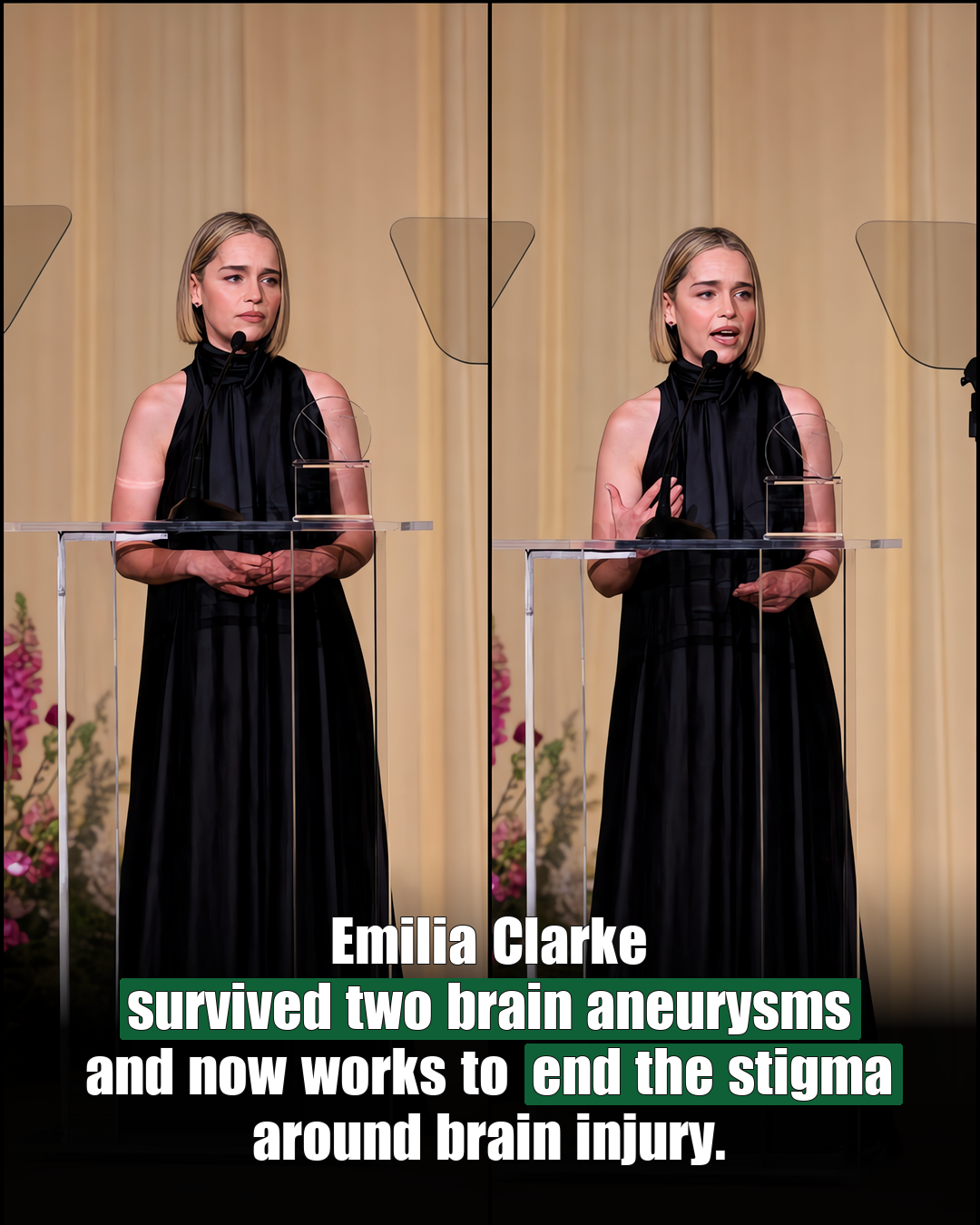

Who Emilia Clarke Is and What She Survived
Emilia Clarke spent eight seasons playing Daenerys Targaryen on “Game of Thrones,” one of the most watched television shows ever made.
What most of that audience did not know at the time was that Clarke nearly died twice while the show was filming.
Clarke is 39 years old as of this writing. She is alive, working, and this year spoke more openly than ever about what those two brain aneurysms actually cost her.
She currently stars in “Ponies,” a Cold War era spy thriller on Peacock, and has several other film projects releasing in 2026 and 2027.
This article looks at what actually happened during her two brain hemorrhages, what she has said about recovery, and what current research shows about rebuilding activity after a serious brain injury.
What Actually Happened: Two Brain Aneurysms in Her Twenties
In February 2011, while she was in her mid twenties and had just begun filming “Game of Thrones,” Clarke had a sudden, severe headache during a workout at a London gym.
She has described the sensation vividly.
“I felt as though an elastic band were squeezing my brain”
Emilia Clarke, quoted by BrainHealth.com
It was a subarachnoid hemorrhage, meaning a ruptured aneurysm was bleeding into the space around her brain.
She needed emergency surgery, a procedure called endovascular coil embolization, to seal off the ruptured blood vessel.
She survived, but the recovery was brutal. She temporarily lost parts of her language ability, a condition called aphasia, and has said the experience left her wanting to give up entirely.
Doctors later found a second, smaller aneurysm during monitoring. In spring 2013, that one had grown, roughly doubling in size, and needed treatment too.
During that second procedure, a complication occurred that required emergency open skull surgery.
She came out of it with a drain in her head, titanium replacing part of her skull, and a scar running from her scalp to her ear.
She kept working through much of this. Millions of fans watched her play a fictional queen while she was privately relearning parts of how her own brain functioned.
Her Own Words, Fifteen Years Later
For years, Clarke kept the full story private, sharing only pieces of it publicly starting around 2019.
In 2026, marking fifteen years since her first bleed, she spoke with more distance and honesty than before.
“In 2011, I didn’t want anyone to know about my brain bleeds. I was ashamed and overwhelmed by a diagnosis I didn’t understand.”
Emilia Clarke, June 2026
She has said it took real time to understand the full scope of what she went through.
“Fifteen years after my first bleed, I have the hindsight to see how difficult that time truly was.”
Emilia Clarke, June 2026
She has also described symptoms she brushed off at the time, not realizing they were connected to her recovery.
“I ignored what was going on with my hormones, or rather my lack of them, my extreme fatigue that no one else I knew in their 20s suffered.”
Emilia Clarke, June 2026
She has described the emotional side of healing in stark terms.
“The journey to healing feels like falling off the edge of a cliff without anyone there to catch you.”
Emilia Clarke, June 2026
She has said it took years to fully process what happened to her, not months.
“It still took years for me to grapple with my truth.”
Emilia Clarke, June 2026
What a Brain Aneurysm and Subarachnoid Hemorrhage Actually Are
A brain aneurysm is a weak, bulging spot in the wall of a blood vessel in the brain.
Most aneurysms cause no symptoms and are never discovered. Worldwide prevalence is estimated at roughly 3.2 percent of the population, according to a clinical review published on the NIH’s StatPearls resource.
The danger comes if one ruptures. In the United States, the annual rate of aneurysm rupture leading to subarachnoid hemorrhage is estimated at about 10 per 100,000 people.
The outcomes when that happens can be severe. Roughly 25 percent of people who experience a ruptured aneurysm die within the first 24 hours, and about half die within three months, according to the same source.
Sex matters too. Aneurysms occur at roughly equal rates in men and women overall, but after age 50 the ratio shifts toward women by nearly two to one, a pattern researchers link partly to declining estrogen and its effect on blood vessel tissue.
Clarke’s case, a rupture in her twenties, was on the younger end of the typical age range, which is part of why her story surprised so many people who assume this is only an older person’s condition.
What Research Says About Movement and Recovery After a Brain Bleed
For a long time, doctors leaned toward extended bed rest after a subarachnoid hemorrhage, out of fear that activity could cause complications.
More recent research has pushed back on that assumption.
A study published in the Journal of Neurosurgery, led by Tanja Karic, looked at outcomes for patients who began mobilization and rehabilitation early after an aneurysmal subarachnoid hemorrhage, compared to those who followed a more traditional, slower approach.
The researchers found that early, carefully supervised mobilization was associated with fewer complications, not more, challenging the older assumption that rest alone was the safer path.
A separate 2023 study in the Journal of NeuroEngineering and Rehabilitation, led by Elisabeth de Vries, looked closely at the relationship between fatigue and physical activity in people recovering from subarachnoid hemorrhage.
Using wearable activity trackers and repeated fatigue check ins over a week, the researchers found a two way relationship: more activity in the 45 minutes before a fatigue check in predicted higher fatigue afterward, and higher than usual fatigue predicted less activity afterward.
The researchers suggested this pattern can create a cycle. Lower fitness makes activity feel harder, which can lead to avoiding activity altogether, which then makes the body even less prepared for movement.
Their recommendation was personalized rehabilitation that addresses fatigue and activity together, rather than pushing a single fixed exercise plan onto every patient.
What This Evidence Does Not Prove
Neither study followed Clarke specifically, and her recovery involved factors, including major open skull surgery, that go beyond what either study measured directly.
The early mobilization research shows a group level association between earlier movement and fewer complications, not a promise that any specific timeline is right for every patient.
The fatigue and activity study involved a relatively small sample, 38 people, over a short observation window of one week, which limits how confidently its findings generalize.
Brain injuries vary enormously in severity, location, and the specific complications that follow, so what worked for one patient’s recovery cannot be assumed to be the right plan for another.
Clarke’s own account also makes clear that recovery was not linear. She has described years, not weeks, of coming to terms with what happened, which lines up with a growing understanding that brain injury recovery does not follow a fixed timeline.
Who Should Talk to a Doctor First
Anyone who has had a subarachnoid hemorrhage or brain aneurysm treatment should follow their neurology team’s specific guidance on when and how to resume activity, rather than a general fitness plan.
Anyone experiencing a sudden, severe headache described as the worst of their life, especially with neck stiffness, vision changes, or confusion, should seek emergency medical care immediately, since that combination can signal a ruptured aneurysm.
People recovering from any brain injury who notice persistent fatigue, hormone changes, or cognitive symptoms should mention them specifically to their doctor, since Clarke’s own account shows how easy it can be to dismiss these as unrelated.
Anyone supporting a loved one through brain injury recovery should know that emotional processing can lag behind physical healing by years, not weeks, and that is a normal part of recovery, not a sign something is wrong.
None of this article is a substitute for a real evaluation and personalized rehabilitation plan from a qualified neurologist or physical therapist.
How SameYou Is Changing Brain Injury Recovery
Clarke’s response to her own experience was to build something for other survivors.
In 2019, she launched SameYou, a charity focused on improving access to neurorehabilitation for young people recovering from brain injury and stroke.
The charity has funded research, including a $1 million grant to the Spaulding Rehabilitation Network, and helped fund a master’s program in neurorehabilitation nursing through the UK’s Royal College of Nursing Foundation.
Clarke has described the charity’s goal in simple terms.
“I want them to get back to a life that they truly recognize as being their own”
Emilia Clarke, quoted by BrainHealth.com
She has also been direct about why she keeps talking publicly about something that was once deeply private.
“A stigma is still attached to it, and this must change”
Emilia Clarke, quoted by BrainHealth.com
For readers who are not recovering from a brain injury themselves, the practical takeaway is still useful.
Building strength and cardiovascular fitness before a health crisis, through activities like resistance training that supports brain health, gives the body more reserve to draw on if recovery is ever needed.
For anyone actually navigating recovery from a major medical event, patience with a slow, nonlinear timeline is not a failure.
It is, based on both the research and Clarke’s own account, closer to the norm than a fast, straightforward bounce back.
Rebuilding basic function after any major surgery, the way our piece on recovery from major surgery covers, tends to move in small, uneven steps rather than a straight line upward.
References
- WISN/Hearst, “Emilia Clarke opens up about suffering 2 brain hemorrhages in her 20s,” June 2026: wisn.com
- BrainHealth.com, “Emilia Clarke Works to End Stigma Around Brain Injury”: brainhealth.com
- SameYou, Emilia Clarke’s brain injury and stroke recovery charity: sameyou.org
- Okal, F., & Foster, D. M. (2026). Cerebral Aneurysm. In StatPearls [Internet]. StatPearls Publishing: ncbi.nlm.nih.gov
- Karic, T., Røe, C., Nordenmark, T. H., Becker, F., Sorteberg, W., & Sorteberg, A. (2016). Effect of early mobilization and rehabilitation on complications in aneurysmal subarachnoid hemorrhage. Journal of Neurosurgery, 126(2), 518 to 526. doi.org/10.3171/2015.12.JNS151744
- de Vries, E. A., Heijenbrok-Kal, M. H., van Kooten, F., Giurgiu, M., Ribbers, G. M., van den Berg-Emons, R. J. G., & Bussmann, J. B. J. (2023). Unraveling the interplay between daily life fatigue and physical activity after subarachnoid hemorrhage: an ecological momentary assessment and accelerometry study. Journal of NeuroEngineering and Rehabilitation, 20, 127. doi.org/10.1186/s12984-023-01241-5
This article is for general informational purposes only and is not a substitute for professional medical advice, diagnosis, or treatment. If you have symptoms of a brain aneurysm or are recovering from one, seek immediate emergency care for sudden severe symptoms and follow up with a qualified neurologist for ongoing care.