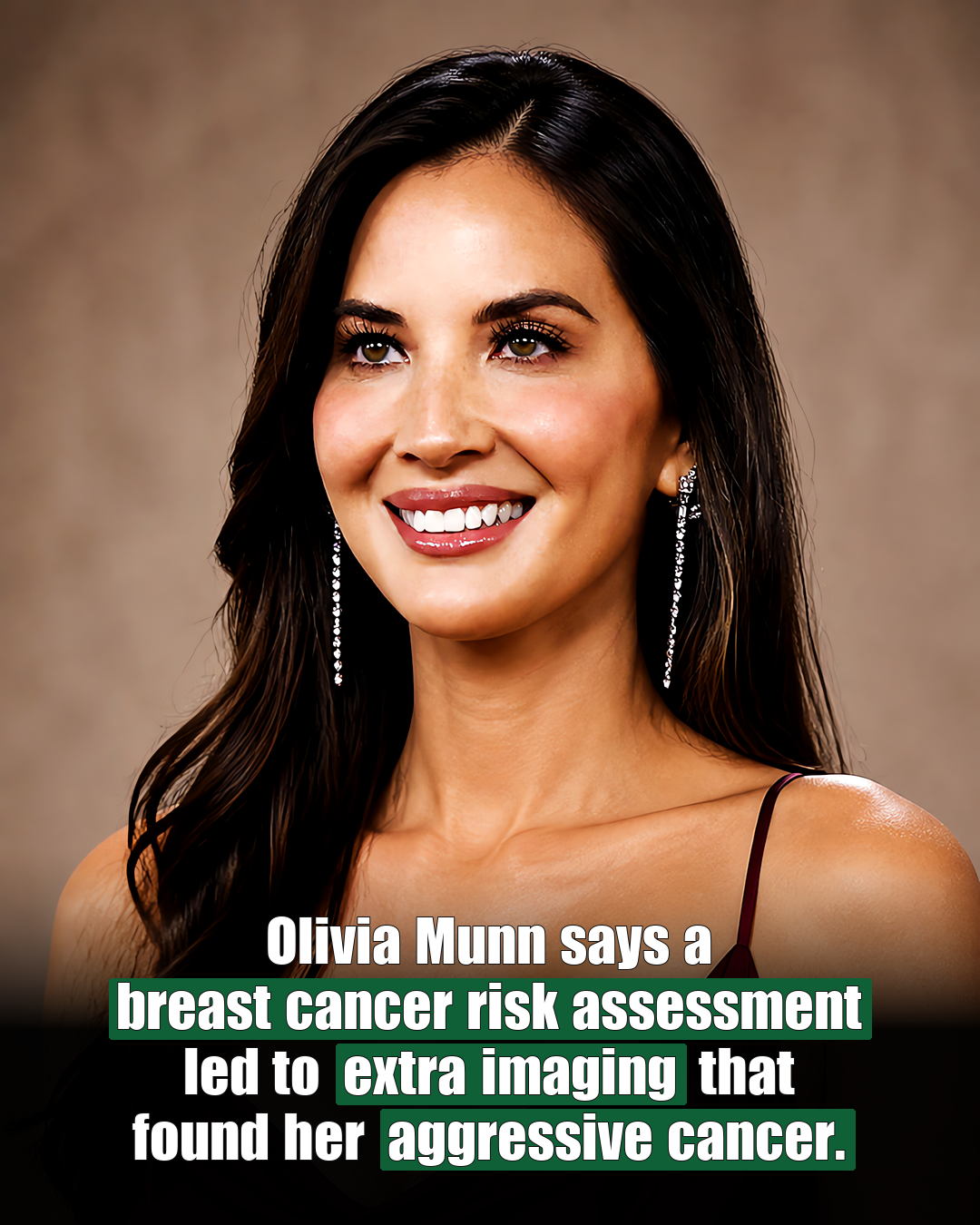

Olivia Munn is an actress known for roles in “X-Men: Apocalypse,” “The Newsroom,” and “Your Friends and Neighbors.”
In March 2024, she publicly shared that she had been diagnosed with breast cancer the year before, in April 2023, at age 42.
She is alive and remains a public advocate for breast cancer awareness today.
She has shared, as recently as 2026, that she is doing well overall while still managing side effects from ongoing medication.
Munn is also a mother of two children with her partner, comedian John Mulaney.
Her son was born before her diagnosis.
Her daughter was born later, in 2025, through a surrogate, after her cancer treatment made carrying a pregnancy unsafe.
That family context matters, because it shows what was actually at stake in her decision to seek extra testing beyond a normal mammogram.
How a Clear Mammogram Still Missed Her Cancer
Munn’s story did not start with a suspicious lump or an alarming scan.
It started with a normal mammogram in early 2023 that came back clear.
It also included genetic testing that found no BRCA gene mutations, the inherited genetic changes most people associate with breast cancer risk.
By every standard signal, Munn looked like a low risk patient.
Her OB-GYN, Dr. Thais Aliabadi, calculated something else during a routine visit: a formal breast cancer risk assessment score using the Tyrer-Cuzick model.
That score came back at 37.3 percent, well above the 20 percent threshold doctors generally consider high risk.
Based on that score, Aliabadi ordered an MRI, even though the mammogram and genetic test had both come back clear.
The MRI found a spot near a lymph node.
A follow up ultrasound found two more areas of concern in the same breast.
A biopsy confirmed an aggressive form of breast cancer called luminal B, and further imaging showed cancer had developed in both breasts.
Munn underwent four major surgeries within about 10 months, including a lymph node dissection, a nipple sparing procedure, a double mastectomy, and reconstruction.
Later, in November 2023, she started hormone suppression therapy, a treatment that blocks the hormones some breast cancers use to grow.
That treatment put her into medically induced menopause.
She also had surgery to remove her uterus, fallopian tubes, and ovaries as part of her overall treatment plan.
Before those surgeries, she froze eggs for a third time, which is part of why she and Mulaney were later able to grow their family through a surrogate.
None of that happens without the risk score prompting the MRI in the first place.
What a Breast Cancer Risk Assessment Tool Actually Is
A mammogram is an imaging test.
It looks for a tumor that already exists in breast tissue right now.
A risk assessment tool is a completely different kind of test.
It does not look at the breast at all.
Instead, it uses a questionnaire covering things like age, family history of cancer, age at first period, whether and when someone had children, and results of any past biopsies.
The Tyrer-Cuzick model, sometimes called the IBIS model, takes those answers and calculates a person’s estimated lifetime risk of developing breast cancer.
The original version of this model was published by researchers Jonathan Tyrer, Stephen Duffy, and Jack Cuzick in 2004 (Tyrer, Duffy, & Cuzick, 2004).
IBIS stands for the International Breast Cancer Intervention Study, the research program that developed and continues to update the tool.
A score above 20 percent lifetime risk is generally considered high risk in breast cancer screening guidelines.
A high score does not mean imaging.
It means a conversation with a doctor about whether more imaging makes sense.
What Current Research Says About These Tools
Guidelines from the American Cancer Society, published by Saslow and colleagues, recommend that women identified as high risk by a validated risk model add an annual breast MRI to their regular mammogram screening (Saslow et al., 2007).
That recommendation exists because MRI and mammography find different things.
A large clinical trial called the DENSE trial, published in the New England Journal of Medicine, tested supplemental MRI screening in a separate group of women with very dense breast tissue, another factor that can hide tumors from a standard mammogram (Bakker et al., 2019).
That trial found MRI caught additional early cancers that mammography alone missed in that specific group.
Munn’s situation involved a high risk score rather than dense breast tissue specifically, but the underlying idea is the same across both situations.
A single screening tool, even a good one, does not catch everything.
Layering a risk based approach on top of standard screening is how doctors try to close that gap for people who fall outside the average risk profile.
This is also why Munn’s aggressive biopsy result mattered so much to her treatment plan.
Luminal B cancers, in plain terms, tend to grow and divide faster than some other common breast cancer subtypes, which is part of why doctors moved quickly from imaging to biopsy to surgery in her case.
Catching a fast growing cancer earlier, before it spreads to lymph nodes or beyond the breast, generally gives doctors more treatment options and a better overall outlook.
Olivia Munn’s Own Words
Munn has spoken publicly, in her own words, about how disorienting the diagnosis felt.
“I went from feeling completely fine one day, to waking up in a hospital bed after a 10-hour surgery the next.”
She has also been direct about crediting the extra testing for giving her real options in how to respond.
“I’m lucky. We caught it with enough time that I had options.”
She has also spoken about what recovery and ongoing treatment actually feel like, well past the initial diagnosis.
“I’m doing great right now. The medication is tough.”
She has said she shares these details specifically to help other people feel less alone in a similar situation, not to present her experience as simple or fully behind her.
What This Evidence Does Not Prove
Munn’s story is a genuinely powerful example of a risk tool catching something a mammogram missed.
It is not proof that every woman needs this specific calculator, or that everyone with a high score will develop cancer.
Risk models estimate probability over a lifetime, not certainty.
Someone with a high score may never develop cancer, and someone with an average score can still be diagnosed.
These models also have known limitations.
The Tyrer-Cuzick model was developed and validated mainly in non Hispanic white women, and research has found it can overestimate risk in Hispanic women specifically (Kurian et al., 2021).
That means the tool works better for some populations than others, a real limitation that deserves honest mention rather than a blanket recommendation.
None of this means the tool is useless.
It means the tool is one piece of information a doctor weighs alongside a person’s full medical picture, not a stand alone verdict.
There is also a real tradeoff worth naming honestly.
More imaging, like an added MRI, can catch cancer earlier, but it can also turn up findings that need a follow up biopsy and turn out to be benign.
That process is stressful and not free, and it is a genuine downside of broader screening that researchers and doctors continue to study and weigh against the benefit of earlier detection.
Who Should Talk to a Doctor First
Anyone with a family history of breast or ovarian cancer, especially in a parent or sibling, should ask their doctor about a formal risk assessment at their next visit.
Anyone who had a first period at an early age, had children later in life or not at all, or has had a previous breast biopsy should also ask, since these are all inputs the risk calculators actually use.
Anyone with a known BRCA1 or BRCA2 mutation in their family should talk to a genetic counselor, not just a general risk calculator, since inherited mutations carry their own separate, more specific screening guidelines.
Anyone who has already had a high risk score should talk with their doctor specifically about whether an annual MRI, in addition to a mammogram, makes sense for their situation.
Anyone currently pregnant, breastfeeding, or managing an existing health condition should loop that context into the conversation before scheduling additional imaging.
This article is general information, not a diagnosis or a personal recommendation, and a doctor who knows a person’s full history is the only one who can give that.
A Practical Section for Readers
Most major risk calculators, including the Tyrer-Cuzick model, are free and available through hospital websites or a doctor’s office.
Before an appointment, it helps to gather some basic family history: which relatives had breast or ovarian cancer, and roughly what age they were when diagnosed.
It also helps to know your own reproductive history, including the age of your first period and, if applicable, the age you had your first child.
Bring any past breast biopsy results to the appointment if you have had one, even if the result was benign.
Ask your doctor directly whether a formal risk score has ever been calculated for you, since it is not always done automatically at a routine visit.
If a risk score comes back high, ask specifically what additional screening, like MRI, your doctor recommends and how often.
Keep going to your regular mammogram screenings regardless of your risk score, since risk assessment is meant to add to standard screening, not replace it.
A single conversation like this, sometimes just a few extra minutes at an annual visit, is what changed the outcome in Munn’s case.
References
- Today.com, “Olivia Munn Shares Detailed Timeline of Breast Cancer Diagnosis and Treatment To Help Others”
- Breastcancer.org, “Olivia Munn: ‘The Lifetime Risk Assessment Saved My Life'”
- CBS News, “Olivia Munn says a breast cancer risk assessment tool helped lead to her diagnosis”
- AOL / ABC News, “Olivia Munn Says She’s ‘Doing Great’ amid Breast Cancer Journey but Admits ‘the Medication Is Tough'”
- ABC7 New York, “Olivia Munn and John Mulaney welcome 2nd child via surrogate after actress underwent double mastectomy”
- Medical News Today, “What is a Tyrer-Cuzick score, and what do the results mean?”
- Tyrer, J., Duffy, S. W., & Cuzick, J. (2004). A breast cancer prediction model incorporating familial and personal risk factors. Statistics in Medicine, 23(7), 1111 to 1130.
- Saslow, D., Boetes, C., Burke, W., Harms, S., Leach, M. O., Lehman, C. D., Morris, E., Pisano, E., Schnall, M., Sener, S., Smith, R. A., Warner, E., Yaffe, M., Andrews, K. S., & Russell, C. A. (2007). American Cancer Society Guidelines for Breast Screening with MRI as an Adjunct to Mammography. CA: A Cancer Journal for Clinicians, 57(2), 75 to 89.
- Bakker, M. F., de Lange, S. V., Pijnappel, R. M., et al. (2019). Supplemental MRI Screening for Women with Extremely Dense Breast Tissue. New England Journal of Medicine, 381(22), 2091 to 2102.
- Kurian, A. W., Hughes, E., Simmons, T., et al. (2021). Performance of the IBIS/Tyrer-Cuzick model of breast cancer risk by race and ethnicity in the Women’s Health Initiative. Cancer, 127(20), 3742 to 3750.
This article shares one person’s publicly reported medical story for general education. It is not personal medical advice and it is not a diagnosis. Talk to your own doctor about your family history and whether a formal breast cancer risk assessment is right for you.