

If you have type 2 diabetes, you have probably been told to exercise more.
But that advice rarely explains which kind of exercise actually works best.
Should you walk more, lift weights, or do both?
Researchers have actually tested this exact question in controlled clinical trials.
A YouTube channel called Powerpoint Health recently tackled this same question.
This article checks that framing against the published research on exercise type and blood sugar control in people who already have type 2 diabetes.
What the Video Claims
The video comes from Powerpoint Health, a channel run by Igor Klibanov.
Klibanov describes himself on the channel as a fitness expert and bestselling author.
His channel focuses on explaining published research behind chronic health conditions common after age 50.
That list includes type 2 diabetes, osteoporosis, fatty liver disease, and high blood pressure.
The channel’s own about page does not list a medical degree, a PhD, or a registered dietitian credential for him.
Its videos are built as slide style breakdowns of published studies, which fits this video’s stated premise.
We could confirm the video’s title, channel, and general focus through public sources.
We could not independently verify every specific claim or study cited inside the video itself.
The title alone frames this as a search for one single best exercise type for type 2 diabetes.
The actual research base paints a more layered picture than a single clear winner.
What Real Research Shows About Aerobic Only Training
Aerobic exercise means sustained activity like walking, cycling, or swimming.
It keeps your heart rate elevated for a continuous period.
A major trial known as HART D put this question to a direct test.
Researchers randomly assigned adults with type 2 diabetes into different exercise groups for nine months (Church et al., 2010).
One group did aerobic training only, with no structured resistance work.
That group lowered their HbA1c, a standard marker of long term blood sugar control, by a real and meaningful amount (Church et al., 2010).
Exact figures vary slightly across summaries of this trial, so this article describes the pattern rather than one precise number.
The aerobic only improvement was smaller than what the combined training group achieved.
Walking is still one of the simplest ways to start building an aerobic base.
Our guide on how many miles you should walk a day is a reasonable starting point for pacing that out.
Daily step totals matter for broader health outcomes too, which we cover in our piece on daily steps and mortality risk.
What Real Research Shows About Resistance Only Training
Resistance training means lifting weights or working against bands or machines.
It builds and preserves muscle tissue over time.
Muscle matters more for blood sugar control than most people realize.
Skeletal muscle is where your body stores much of the sugar you eat, in a form called glycogen.
In the HART D trial, the resistance only group also saw an improvement in HbA1c (Church et al., 2010).
That improvement was smaller and less consistent than the gains seen in the combined group.
A separate randomized trial led by Sigal and colleagues found a similar overall pattern (Sigal et al., 2007).
Resistance training alone improved blood sugar control compared to a non exercising control group.
It simply did not perform as well, on its own, as combining it with aerobic work.
Resistance training carries benefits that reach beyond blood sugar, including for brain health as people age.
Our piece on whether lifting weights keeps your brain young covers that separate body of evidence.
Across the largest trials on this question, combined training beat either aerobic or resistance training alone, but neither single approach was worthless on its own.
What Real Research Shows About Combined Training
Combined training means doing both aerobic and resistance work within the same program.
This is where the research becomes most interesting.
In the HART D trial, the combined group had the largest HbA1c improvement of the three exercise groups (Church et al., 2010).
That improvement was large enough to be considered statistically meaningful, unlike either single modality group alone.
The Sigal trial found a nearly identical pattern (Sigal et al., 2007).
Participants doing both aerobic and resistance work lowered their HbA1c by roughly double what either single modality group achieved.
A large Italian trial called IDES backs this general pattern up with real world style data (Balducci et al., 2010).
That study used a structured, supervised combined training program with several hundred participants.
It found meaningful improvements not just in blood sugar, but across several heart disease risk factors measured at the same time (Balducci et al., 2010).
What Real Research Shows When Studies Are Compared Head to Head
One single trial is never the whole story.
A meta-analysis pooled data across multiple exercise trials in people with type 2 diabetes (Snowling & Hopkins, 2006).
It compared aerobic training, resistance training, and combined programs against each other directly.
The pooled pattern matched what HART D and the Sigal trial each found on their own.
Combined training produced the most consistent improvement in blood sugar control across the pooled data (Snowling & Hopkins, 2006).
Aerobic only and resistance only programs both still beat doing no structured exercise at all.
Neither single modality was useless.
The advantage seen for combined training was real, but it was not enormous.
The Mechanism
Why would combining the two types work better than either alone?
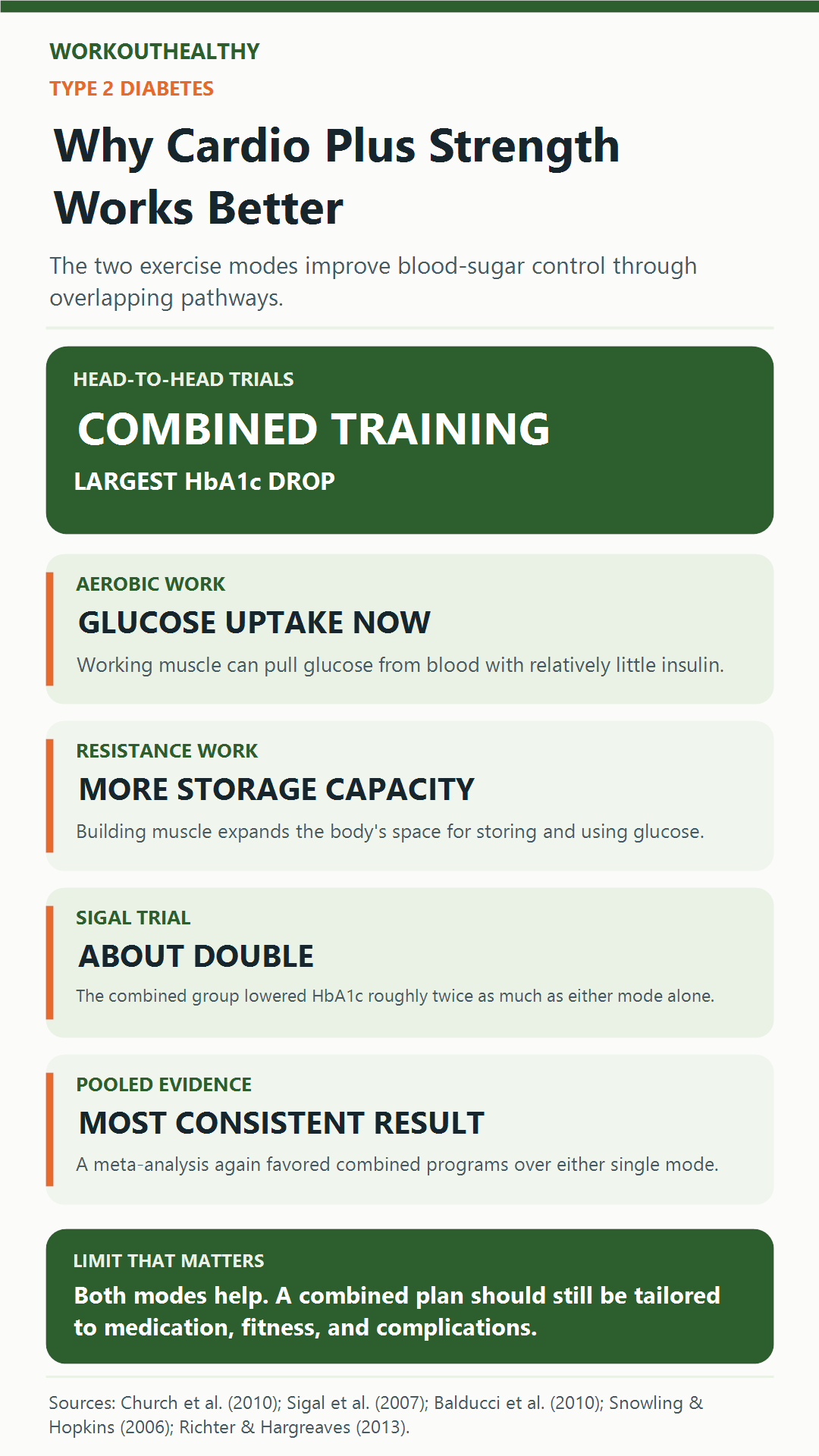
Aerobic exercise and resistance exercise appear to lower blood sugar through partly different pathways in the body.
During aerobic activity, working muscles pull glucose out of the bloodstream through a process that needs relatively little insulin (Richter & Hargreaves, 2013).
That process relies on a transporter protein called GLUT4 moving to the surface of the muscle cell.
Resistance training works somewhat differently.
It builds more muscle tissue over time, and more muscle means more total storage space for glucose.
Building muscle also tends to improve how sensitive your body is to insulin overall (Richter & Hargreaves, 2013).
Combining both approaches may stack these two separate mechanisms together.
That is one reasonable explanation for why combined groups outperformed single modality groups across multiple trials.
Aerobic exercise and resistance exercise appear to lower blood sugar through partly different pathways, which may be why combining them works better than relying on either one alone.
What This Evidence Does Not Prove
These trials do not prove combined training works equally well for every single person.
Most of the major trials enrolled adults who were already reasonably able to exercise safely.
People with advanced diabetic complications were often excluded from these studies from the start.
The trials also used supervised sessions, often three to five times a week, with trained staff present.
That is a different setting than exercising alone at home with no guidance or supervision.
A later follow up study from the same Italian research group looked at what happened after the structured program period ended (Balducci et al., 2022).
It tracked how changes in real world physical activity and sitting time related to fitness and heart disease risk over time.
Keeping activity levels up after a structured program appears to matter for holding onto the gains made during it.
None of these trials prove that exercise alone can replace medication for every person with type 2 diabetes.
Exercise is a powerful tool here, not a guaranteed cure.
Common Mistakes
One common mistake is picking a single exercise type and assuming it covers everything.
Only doing cardio and skipping strength work leaves real, measurable benefits on the table.
Only lifting weights and skipping cardio work does the same thing in reverse.
Another common mistake is starting too hard and too fast, right out of the gate.
A sudden jump in intensity can cause blood sugar swings that feel confusing and discouraging.
Skipping blood sugar checks around exercise sessions is another frequent error, especially on certain medications.
Exercise can lower blood sugar for hours after a session ends, which raises the risk of a low.
Some people also stop their routine as soon as their numbers improve a little.
Consistency over months, not a short burst of effort, is what the trial data actually reflects.
Who Should Be Extra Careful
Anyone starting a new exercise routine with type 2 diabetes should talk to their doctor first.
This matters even more for people with existing heart disease or very high blood pressure.
People with diabetic retinopathy need to avoid certain high intensity or straining movements.
People with significant nerve damage in their feet, called peripheral neuropathy, need proper footwear and careful monitoring for injuries they may not feel right away.
Anyone taking insulin or a medication that can cause low blood sugar should check glucose before, during, and after exercise sessions.
A physical therapist or certified diabetes educator can help build a safe starting plan around these specific risks.
A Practical Takeaway
The research points toward combining aerobic and resistance work when that is realistic for your situation.
That could mean two or three days of strength training plus two or three days of walking, cycling, or swimming each week.

It does not need to start big.
Even shorter sessions, done consistently, showed measurable benefits across these trials.
If combined training is not accessible for you right now, doing one type consistently still beats doing nothing at all.
Something is better than nothing, but real variety appears to be better than relying on one type alone.
Watch the video
Want more like this? Subscribe to WorkoutHealthy Insider for practical explanations behind popular fitness claims.
References
Balducci, S., Zanuso, S., Nicolucci, A., Fernando, F., Cavallo, S., Cardelli, P., Fallucca, S., Alessi, E., Letizia, C., Jimenez, A., Fallucca, F., & Pugliese, G. (2010). Effect of an intensive exercise intervention strategy on modifiable cardiovascular risk factors in subjects with type 2 diabetes mellitus: A randomized controlled trial: The Italian Diabetes and Exercise Study (IDES). Archives of Internal Medicine, 170(20), 1794 to 1803. https://doi.org/10.1001/archinternmed.2010.380
Balducci, S., Haxhi, J., Sacchetti, M., Orlando, G., Cardelli, P., Vitale, M., Mattia, L., Iacobini, C., Bollanti, L., Conti, F., Zanuso, S., Nicolucci, A., & Pugliese, G. (2022). Relationships of changes in physical activity and sedentary behavior with changes in physical fitness and cardiometabolic risk profile in individuals with type 2 diabetes: The Italian Diabetes and Exercise Study 2 (IDES_2). Diabetes Care, 45(1), 213 to 221. https://doi.org/10.2337/dc21-1505
Church, T. S., Blair, S. N., Cocreham, S., Johannsen, N., Johnson, W., Kramer, K., Mikus, C. R., Myers, V., Nauta, M., Rodarte, R. Q., Sparks, L., Thompson, A., & Earnest, C. P. (2010). Effects of aerobic and resistance training on hemoglobin A1c levels in patients with type 2 diabetes: A randomized controlled trial. JAMA, 304(20), 2253 to 2262. https://doi.org/10.1001/jama.2010.1710
Richter, E. A., & Hargreaves, M. (2013). Exercise, GLUT4, and skeletal muscle glucose uptake. Physiological Reviews, 93(3), 993 to 1017. https://doi.org/10.1152/physrev.00038.2012
Sigal, R. J., Kenny, G. P., Boulé, N. G., Wells, G. A., Prud’homme, D., Fortier, M., Reid, R. D., Tulloch, H., Coyle, D., Phillips, P., Jennings, A., & Jaffey, J. (2007). Effects of aerobic training, resistance training, or both on glycemic control in type 2 diabetes: A randomized trial. Annals of Internal Medicine, 147(6), 357 to 369. https://doi.org/10.7326/0003-4819-147-6-200709180-00005
Snowling, N. J., & Hopkins, W. G. (2006). Effects of different modes of exercise training on glucose control and risk factors for complications in type 2 diabetic patients: A meta-analysis. Diabetes Care, 29(11), 2518 to 2527. https://doi.org/10.2337/dc06-1317
This article is for general information only and is not medical advice. If you have an injury, ongoing pain, or a medical condition, talk to a doctor or physical therapist before you change how you train or eat.