
A strength coaching channel called Woolery Strength Systems posted a video titled “Building a Sports Performance Training Program.”
The video promises to show how a real training program gets built for an athlete.
That kind of planning has a specific name in sport science.
It is called periodization.
Periodization means organizing training into phases instead of repeating the same workout week after week.
Coaches usually break those phases into three sizes.
The largest is a macrocycle, often a full season or year.
Inside that sits a mesocycle, usually a few weeks to a couple months.
Inside that sits a microcycle, often just one week.
This article does not try to grade the video’s specific drills or claims, since its exact content cannot be verified in full detail.
Instead it looks at what real, peer reviewed research says about how training programs should actually be structured over time.
What the Video Claims
The video’s title and channel were confirmed using YouTube’s own public embed data.
The channel is named Woolery Strength Systems, and the video is titled “Building a Sports Performance Training Program.”
We tried to verify who runs the channel and what coaching credentials they hold.
The channel’s public “About” page did not list a bio, certifications, or a named coach.
So that part could not be confirmed either way.
Based on the title alone, the video appears to walk through how to plan a sports performance program.
That likely touches on phases, exercise selection, and how training changes over weeks or months.
Because we could not verify the video’s specific numbers or exact instructions, this article does not treat any of them as fact.
Instead, it builds its case entirely from published, verifiable research on periodization.
What Real Research Shows About Linear Periodization
Linear periodization is the oldest and most familiar model.
Training usually starts with higher volume and lower intensity.
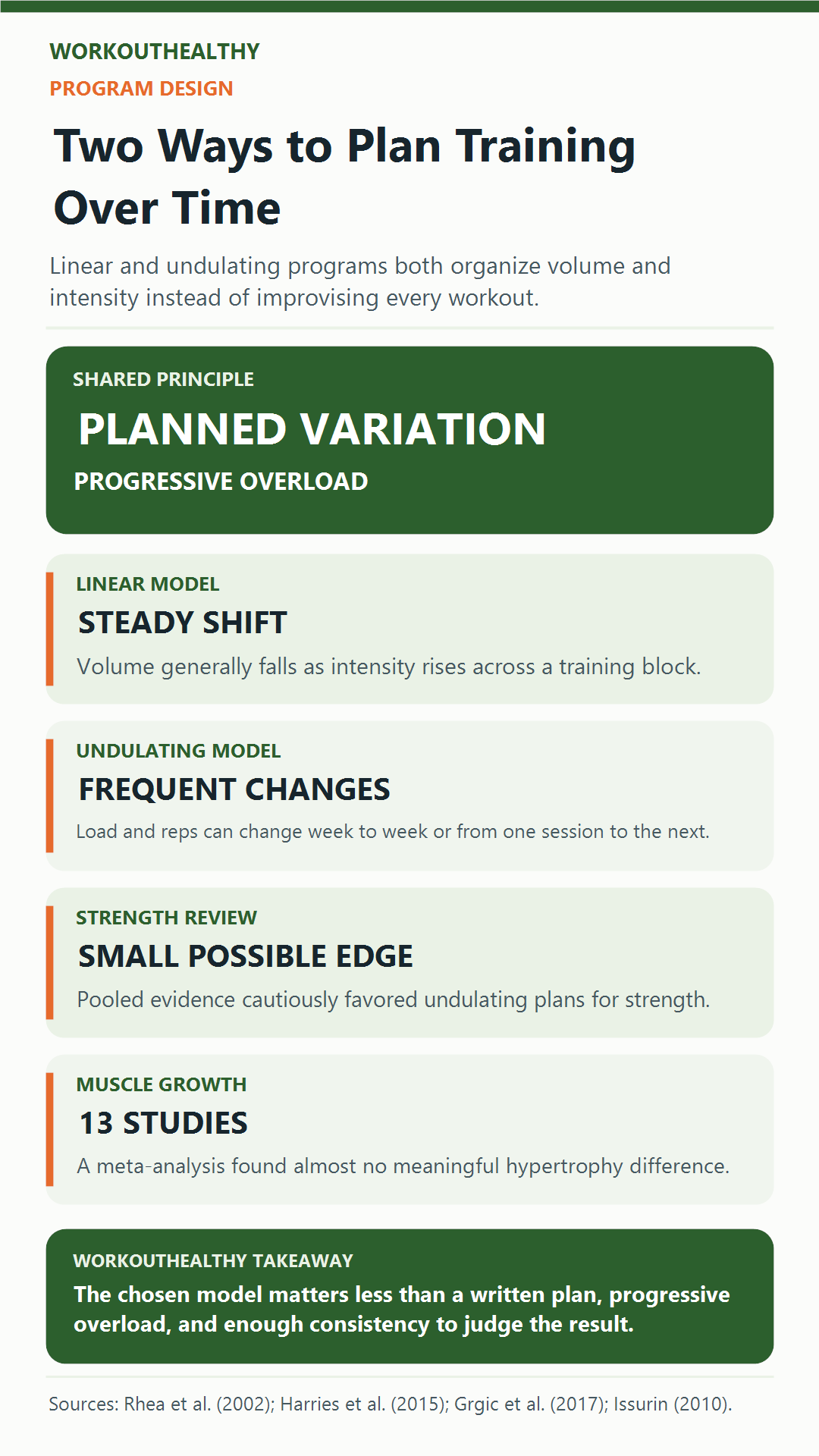
Over the following weeks, volume drops and intensity climbs in a steady, planned line.
A lifter might start a phase doing higher reps with lighter weight, then finish it doing heavier weight for fewer reps.
This structure was borrowed from Soviet era sport science and popularized in Western strength and conditioning textbooks for decades.
One of the most cited comparison studies in this field tested this exact model against an alternative.
Rhea and colleagues put recreationally trained lifters through either a linear program or a daily changing program, with total volume and intensity matched between groups (Rhea et al., 2002).
That study is still referenced in most modern reviews of periodization because it was one of the first to directly compare two structured planning models head to head.
Linear periodization clearly works for building strength over a training block.
The open question researchers kept asking was whether it works better than the alternatives, or just differently.
What Real Research Shows About Undulating and Nonlinear Periodization
Undulating periodization, sometimes called nonlinear periodization, varies volume and intensity much more often.
Instead of one steady line across months, the plan can shift every single week, or even every session.
A lifter might train with lighter, higher rep work on Monday, then heavier, lower rep work on Wednesday, then a moderate day on Friday.
The idea is that the body responds to more frequent variation with less staleness and more consistent progress.
In the same Rhea and colleagues trial mentioned above, the group using a daily undulating plan came out ahead on measured strength gains compared with the linear group (Rhea et al., 2002).
That single result helped spark two decades of follow up research trying to confirm whether undulating training really does outperform linear training, or whether that first result was an outlier.
A separate systematic review pooled multiple studies on undulating training for local muscular endurance and found it performed at least as well as linear plans there too (Harries et al., 2015).
Two of the most studied ways to organize a training program produce strength gains that are more alike than most coaches assume.
What Real Research Shows About How the Two Models Compare
A single study, even a well designed one, is not the same as a settled scientific answer.
That is exactly why researchers ran systematic reviews and meta-analyses combining many trials.
Harries and colleagues pooled results across multiple trials comparing linear and undulating periodization for muscular strength (Harries et al., 2015).
That review is widely summarized as finding a small edge for undulating periodization on strength gains.
This article treats that summary carefully, since the review itself also noted real limits in the quality and consistency of the underlying studies.
A separate meta-analysis focused specifically on muscle growth rather than strength numbers (Grgic et al., 2017).
Pooling data from thirteen eligible studies, that review found almost no meaningful difference in hypertrophy between linear and daily undulating programs.
In plain terms, for building muscle size specifically, how you arrange the ups and downs of volume and intensity may matter far less than whether you train hard and consistently at all.
That finding lines up with other research the site has covered.
Resistance training itself, not just its exact structure, seems to matter most for long term results, including what the research actually shows about lifting weights and brain health.
What Real Research Shows About Macrocycles and Long-Term Planning
Zooming out from any single 12 week study, sport scientists have also studied how training should be organized across a whole season or year.
Vladimir Issurin, a well known researcher in this space, reviewed decades of periodization methodology in a widely cited paper (Issurin, 2010).
He described how classic periodization models try to build broad fitness first, then narrow that fitness toward a specific sport skill closer to competition.
He also described a newer approach called block periodization, which concentrates training on just one or two qualities at a time within short blocks, rather than trying to develop everything at once.
The logic is that concentrating effort on fewer qualities at a time can produce a bigger training effect for each one.
Issurin’s review argued this approach may suit modern athletes better than older, broader models, especially at high levels of competition.
Not every researcher agrees with that conclusion, which the next section covers directly.
A real program often mixes several kinds of phases together.
Strength work, power work like the kind covered in this site’s piece on whether box jumps build muscle, and sport specific skill work can all get their own block.
That mix is, in essence, an attempt to apply macrocycle thinking in practice.
The Mechanism
Why would changing training over time matter at all?
The basic idea traces back to a general principle of how the body adapts to repeated stress.
A new training stimulus produces fatigue first, then a period of recovery, then an adaptation that leaves the body slightly more capable than before.
If the same exact stimulus repeats forever without change, that adaptation tends to plateau.
Periodization tries to keep providing a stimulus the body has to keep adapting to, either by rotating exercises, changing rep ranges, or shifting the balance of volume and intensity.
Progressive overload, gradually asking the body to do a little more over time, is the piece almost every periodization model shares in common.
Whether that overload increases in a straight line, as in classic linear periodization, or bounces around week to week, as in undulating periodization, may matter less than simply making sure it happens at all.
Exercise selection matters too, not just the numbers on the bar.
That is part of why a program might rotate between closely related lifts, the kind of decision explored in this site’s comparison of the floor press and the bench press.
What This Evidence Does Not Prove
This research does not prove that any single periodization model is clearly superior for every goal.
Most comparison studies run for only eight to sixteen weeks, which is far shorter than a real competitive season.
Most of the strongest evidence comes from recreationally trained or moderately trained lifters, not elite athletes.
Whether the same pattern holds for highly trained competitive athletes is much less certain.
One prominent researcher in this space has directly challenged how much of periodization theory actually rests on solid evidence (Kiely, 2018).
Much of classic periodization theory was built on coaching tradition and case studies, not on controlled trials testing it against other ways of planning training.
That same researcher has separately questioned whether newer models like block periodization are a genuine breakthrough or simply an old idea repackaged (Kiely, 2010).
He has also argued that periodization research has not always been evidence led, and has sometimes followed tradition instead (Kiely, 2012).
None of this means periodization is useless or unscientific.
It means the research base is smaller, shorter, and less settled than a confident YouTube title might suggest.
Common Mistakes
One common mistake is treating any single periodization model as a magic formula.
The research suggests structure matters, but no single model has proven itself dramatically superior in every study.
Another mistake is changing too many variables at once.
If volume, intensity, exercise selection, and rest all shift in the same week, it becomes impossible to know what actually drove a result.
A third mistake is copying an elite athlete’s program without adjusting it for a much lower training age.
Most of the comparison research used moderately trained subjects, not elite competitors, so scaling matters.
A fourth mistake is ignoring recovery between phases.
Periodization assumes planned recovery, not just planned intensity, and skipping that half of the plan undercuts the whole idea.
A fifth mistake is assuming that more frequent variation is automatically better simply because it sounds more advanced.
The pooled evidence on hypertrophy specifically found little difference between a steadily changing plan and a frequently changing one (Grgic et al., 2017).
Who Should Be Extra Careful
Anyone new to structured resistance training should not overcomplicate their first year of lifting.
Most of the periodization research studied lifters who already had a training base, not complete beginners.
Younger athletes still growing and developing should have any structured program reviewed by a qualified coach or sport medicine professional.
Anyone returning from an injury should treat a written program as a starting draft, not a fixed rulebook, and adjust it with input from a physical therapist.
Anyone managing a chronic health condition that affects exercise tolerance should talk to a doctor before adopting an aggressive periodized plan.
People training for a specific event with a hard deadline should be cautious about experimenting with an unfamiliar new model too close to competition.
A Practical Takeaway
The research supports a few practical conclusions, even without a single settled winner.
First, some form of planned variation across weeks appears to beat doing the exact same workout indefinitely.

Second, the specific model chosen, whether linear or undulating, seems to matter less than consistently applying progressive overload.
Third, longer term planning across a season, using something like the macrocycle and mesocycle structure Issurin described, gives training a clear direction instead of a random string of workouts (Issurin, 2010).
Fourth, beginners generally get more benefit from consistency than from a complicated periodization scheme.
A simple, honest approach is to pick a structure, whether that is a straightforward linear plan or a rotating undulating one, and stick with it long enough to judge whether it is working.
That kind of patient, structured approach is part of why strength training keeps showing up as a favorite among readers who track their own results.
This site explored that pattern in its piece on why most readers favor weightlifting over running.
Whatever model gets chosen, the evidence favors sticking with a written plan over improvising every session from scratch.
Watch the video
Want more like this? Subscribe to WorkoutHealthy Insider for practical explanations behind popular fitness claims.
References
Grgic, J., Mikulic, P., Podnar, H., & Pedisic, Z. (2017). Effects of linear and daily undulating periodized resistance training programs on measures of muscle hypertrophy: A systematic review and meta-analysis. PeerJ, 5, e3695. https://doi.org/10.7717/peerj.3695
Harries, S. K., Lubans, D. R., & Callister, R. (2015). Systematic review and meta-analysis of linear and undulating periodized resistance training programs on muscular strength. Journal of Strength and Conditioning Research, 29(4), 1113 to 1125. https://doi.org/10.1519/jsc.0000000000000712
Issurin, V. B. (2010). New horizons for the methodology and physiology of training periodization. Sports Medicine, 40(3), 189 to 206. https://doi.org/10.2165/11319770-000000000-00000
Kiely, J. (2010). New horizons for the methodology and physiology of training periodization: Block periodization: New horizon or a false dawn? Sports Medicine, 40(9), 803 to 805. https://doi.org/10.2165/11535130-000000000-00000
Kiely, J. (2012). Periodization paradigms in the 21st century: Evidence-Led or Tradition-Driven? International Journal of Sports Physiology and Performance, 7(3), 242 to 250. https://doi.org/10.1123/ijspp.7.3.242
Kiely, J. (2018). Periodization theory: Confronting an inconvenient truth. Sports Medicine, 48(4), 753 to 764. https://doi.org/10.1007/s40279-017-0823-y
Rhea, M. R., Ball, S. D., Phillips, W. T., & Burkett, L. N. (2002). A comparison of linear and daily undulating periodized programs with equated volume and intensity for strength. Journal of Strength and Conditioning Research, 16(2), 250 to 255. https://doi.org/10.1519/00124278-200205000-00013
This article is for general information only and is not medical advice. If you have an injury, ongoing pain, or a medical condition, talk to a doctor or physical therapist before you change how you train or eat.