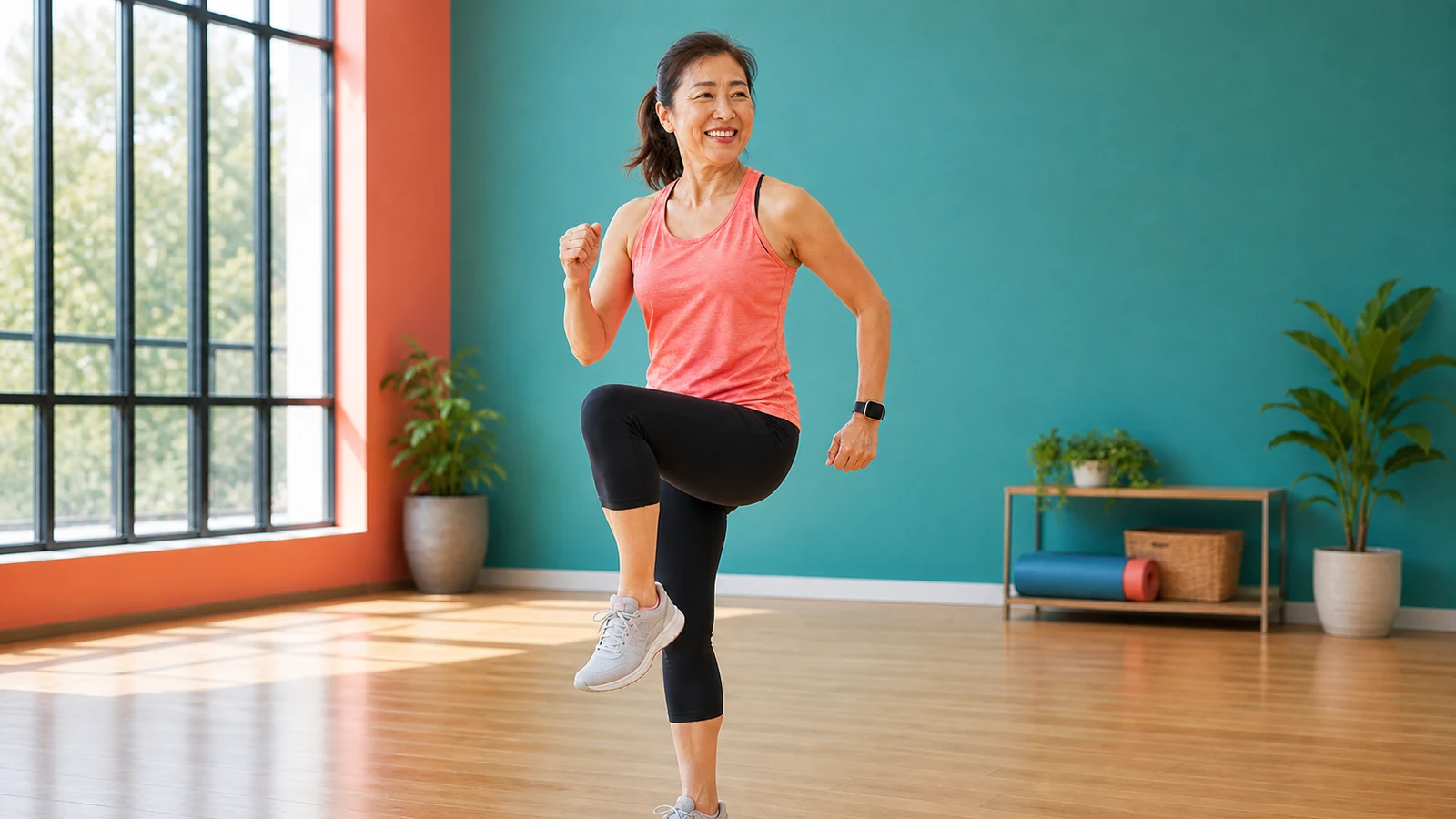

A fitness channel called Improved Health posted a 40-minute cardio workout.
The video promises real results from a routine with no jumping and no hard landings.
It uses a simple step pattern set to music, moving side to side and front to back for the full 40 minutes.
The pitch is simple: burn calories, support weight loss, and go easy on your joints at the same time.
Millions of people search for workouts like this every year, looking for cardio that will not wreck their knees.
The question is whether the science backs up that promise, or whether this is just a clever spin on an old idea.
What the Video Claims
The workout is built around continuous stepping movements instead of jumps or high-impact drills.
The creator frames it as ideal for beginners, people with joint pain, or anyone easing back into exercise.
The core promise is that 40 minutes of low-impact stepping can deliver a real calorie burn.
The video suggests this style of cardio can support weight loss just as well as harder, higher-impact workouts.
That is a big claim, so it is worth checking against actual research instead of taking it at face value.
What Counts as Low-Impact Cardio
Low-impact cardio means at least one foot stays on the ground at all times.
Walking, stepping, and marching in place all fall into this category.
High-impact cardio includes jumping jacks, running, and traditional step aerobics with hops.
The difference matters because impact force is a big part of what stresses joints like the knees and hips.
A workout that skips the jumping can still raise your heart rate for a long stretch of time.
Other common low-impact options include swimming, cycling, rowing, and using an elliptical machine.
Step touch patterns like the one in this video sit in that same low-impact family.
Traditional step aerobics classes often add hops and jumps on top of the stepping to raise the intensity.
Skipping those hops is exactly what keeps a workout like this one gentler on the joints.
Skipping the jumps does not mean skipping the workout.
What the Research Actually Shows About Walking-Based Cardio
Researchers have tested walking programs against weight loss outcomes for decades.
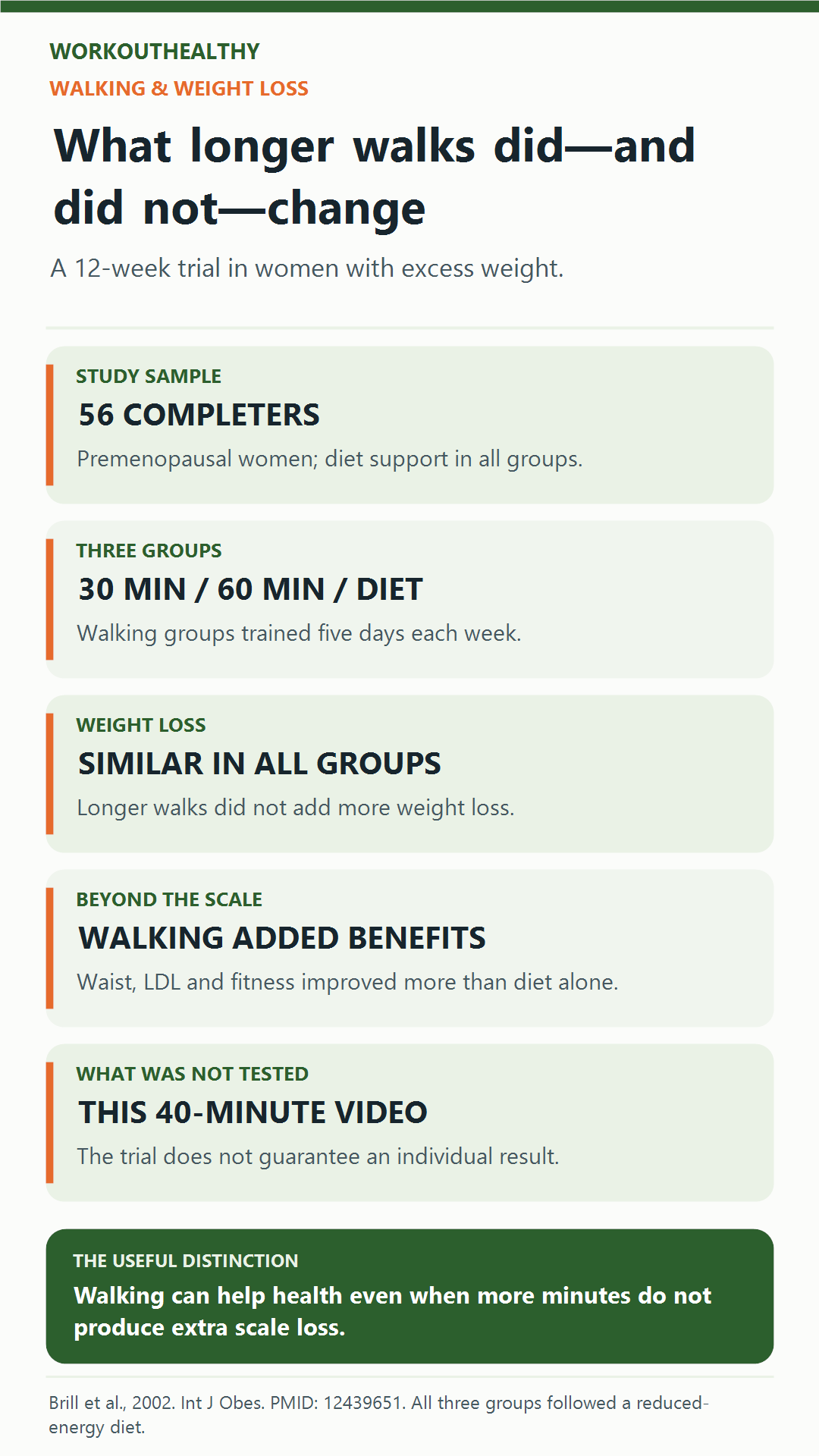
One well-known trial split overweight women into two walking groups and one diet-only group.
One group walked 30 minutes a day, five days a week, while the other walked 60 minutes a day (Brill et al., 2002).
Both walking groups lost similar amounts of weight and body fat over the 12-week study.
Both groups also beat the diet-only group on waist size, cholesterol, and fitness (Brill et al., 2002).
The researchers concluded that 30 minutes of walking most days may work about as well as 60 minutes, as long as diet is part of the plan.
That is encouraging for anyone doing a single 40-minute low-impact session instead of a longer one.
A separate randomized controlled trial tested moderate-intensity walking in postmenopausal women with obesity.
Participants walked between 7,000 and 9,999 steps a day for 12 weeks (Son et al., 2023).
The walking group saw significant drops in body weight, body mass index, and body fat percentage.
They also saw reductions in inflammatory markers linked to heart disease risk (Son et al., 2023).
This suggests walking-paced cardio can do more than just burn calories in the moment.
Together, these two trials suggest that walking-paced effort, sustained consistently, can meaningfully change body weight and body composition.
Neither trial required participants to run, jump, or push into a high heart rate zone to see results.
How Step Workouts Compare to Higher-Impact Cardio
A common question is whether low-impact cardio burns meaningfully fewer calories than high-impact cardio.
The Compendium of Physical Activities is a reference researchers use to estimate calorie burn across different exercises (Ainsworth et al., 2011).
It places low-impact stepping in a similar intensity range to brisk walking, depending on pace and step height.
Faster, higher-impact moves generally burn calories a bit faster per minute of exercise.
But that gap narrows when someone can sustain the low-impact version longer without stopping to rest.
A slower step pace with a shorter step height burns fewer calories per minute than a fast, deep step pattern.
The exact number depends heavily on your body weight, the tempo of the music, and how big your movements are.
A more recent trial compared moderate and higher-intensity interval walking in postmenopausal women with obesity over 10 weeks (Abassi et al., 2026).
Both groups lost body fat and improved their waist measurements.
The higher-intensity group saw slightly larger gains in fitness and body composition (Abassi et al., 2026).
In other words, harder does tend to work a bit faster, but easier still works.
The Mechanism: Why a Low-Impact Workout Still Burns Real Energy
Calorie burn during cardio comes down to how much muscle mass you move and for how long.
Stepping side to side and front to back for 40 minutes keeps your legs, hips, and core working the whole time.
Your heart rate rises to meet that demand, even without any jumping involved.
That is why a sustained 40-minute session can add up to a meaningful calorie total.
Consistency also tends to matter more than intensity for most people losing weight over months, not days.
A workout you can actually finish and repeat several times a week tends to beat a harder one you quit after two sessions.
Moving continuously also keeps your body pulling from both stored fat and quick-access carbohydrate for fuel.
The exact mix shifts with pace, but the total energy you expend still counts toward your daily calorie balance.
A workout you can actually finish and repeat beats a harder one you quit after two sessions.
Cardiovascular Benefits Beyond the Scale
Weight loss is not the only outcome worth tracking from a routine like this one.
In the walking dose study, both exercise groups improved cardiovascular fitness compared to the diet-only group (Brill et al., 2002).
Those same groups also saw better LDL cholesterol numbers after 12 weeks of walking (Brill et al., 2002).
The postmenopausal walking trial found lower levels of interleukin-6 and tumor necrosis factor-alpha, two markers tied to inflammation and heart disease risk (Son et al., 2023).
The interval walking trial found gains on a 6-minute walk test, a simple measure of functional fitness (Abassi et al., 2026).
None of those changes required running or jumping to happen.
That matters for anyone who wants heart health benefits without the joint stress of higher-impact training.
What This Evidence Does Not Prove
None of these studies tested this exact video or this exact 40-minute routine.
The research supports walking-paced and stepping-paced cardio in general, not this specific sequence of moves.
Most of the walking studies enrolled older adults or postmenopausal women, not a broad general population.
Results in a 25-year-old may look different from results in a 65-year-old.
None of these trials tracked weight loss beyond about 12 weeks.
Weight regain after a program ends is common, and it was not the focus of this research.
Any specific calorie number the video mentions for the session itself was not independently verified in these studies.
Common Mistakes People Make With Low-Impact Cardio
The biggest mistake is assuming low-impact automatically means low effort.
Without checking your heart rate or breathing, it is easy to coast through a session without real intensity.
Another mistake is skipping the diet side of the equation entirely.
Every study cited above paired exercise with attention to food intake, not exercise alone (Brill et al., 2002).
Some people also expect a single 40-minute session to undo a week of poor sleep or poor eating.
The research above points to repeated sessions across weeks and months, not one workout doing all the work.
Skipping a warm up and cool down is another common shortcut that raises injury risk over time.
Wearing worn-out shoes with no support is another overlooked mistake during repetitive stepping.
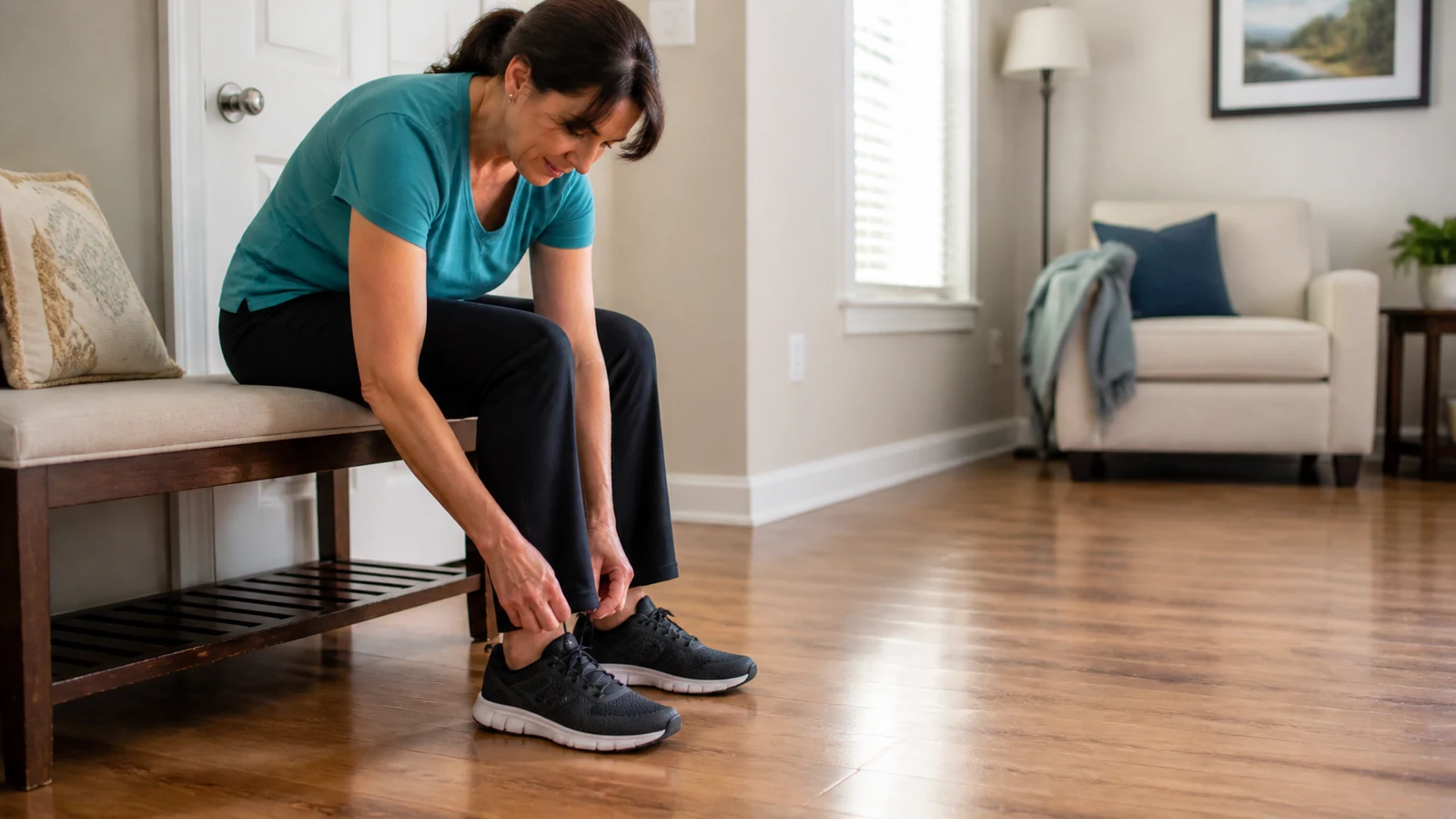
Some people also step on a hard surface like concrete instead of a cushioned floor or mat.
That combination can add unnecessary strain even in a workout that is otherwise low-impact.
Comparing your results to someone doing a completely different workout is rarely a fair or useful comparison.
Who Should Check With a Doctor First
Low-impact does not automatically mean risk-free for everyone.
Anyone with a heart condition should get medical clearance before starting a new cardio routine.
People recovering from a recent injury or surgery should ask a physical therapist before stepping for 40 minutes straight.
Pregnant women should also check with their doctor about appropriate intensity and duration.
Anyone whose joint pain gets worse during or after stepping, not just occasionally sore, should stop and get it evaluated.
People with balance issues or a history of falls should have someone nearby during a new stepping routine.
Anyone managing diabetes should also talk to their care team about exercise timing around meals and medication.
A Practical Way to Use This Kind of Workout
Start at a pace where you can talk in short sentences but could not sing along.
Aim for consistency across the week rather than perfection in any single session.
Three to five sessions of 30 to 40 minutes a week lines up well with what the research above actually tested.
If 40 minutes feels like too much at first, start with 15 to 20 minutes and build up gradually.
Adding one extra song or interval each week is an easy way to progress without overhauling the whole routine.
Rate of perceived exertion is a simple guide here, aim to feel like you are working around a 5 or 6 out of 10.
Hydration and a light snack beforehand can help you finish the full 40 minutes without running out of energy.
Pair the cardio with basic strength work so you protect muscle while you lose fat, since losing weight and muscle mass often happen together if strength training is skipped.
Tracking your daily steps outside of workouts can also add up, and walking more overall is one of the simplest habits to layer on top of a structured routine.
Research on daily step counts has linked higher daily totals to lower long-term mortality risk, which is worth reading in our piece on daily steps and mortality.
If you want a sense of how a higher-impact option compares on calorie burn, our breakdown of calories burned jumping rope shows how impact and pace change the math.
Give any new routine at least four to six weeks before judging whether it is working for you.
Watch the Original Video
Get the next evidence check.
Five practical fitness stories worth your time, every Friday.
One email a week. No product pitches. Unsubscribe in one click.
References
Ainsworth, B. E., Haskell, W. L., Herrmann, S. D., Meckes, N., Bassett, D. R., Tudor-Locke, C., Greer, J. L., Vezina, J., Whitt-Glover, M. C., & Leon, A. S. (2011). 2011 compendium of physical activities: A second update of codes and MET values. Medicine & Science in Sports & Exercise, 43(8), 1575 to 1581. https://doi.org/10.1249/MSS.0b013e31821ece12
Brill, J. B., Perry, A. C., Parker, L., Robinson, A., & Burnett, K. (2002). Dose-response effect of walking exercise on weight loss. How much is enough? International Journal of Obesity, 26(11), 1484 to 1493. https://doi.org/10.1038/sj.ijo.0802133
Son, W. H., Park, H. T., Jeon, B. H., & Ha, M. S. (2023). Moderate intensity walking exercises reduce the body mass index and vascular inflammatory factors in postmenopausal women with obesity: A randomized controlled trial. Scientific Reports, 13, Article 20172. https://doi.org/10.1038/s41598-023-47403-2
Abassi, W., Ouerghi, N., Jabbour, G., Feki, M., Bouassida, A., Deikus, M., Vveinhardt, J., & Muscella, A. (2026). A randomized controlled trial comparing high- and moderate-intensity interval walking on hematological and functional markers in postmenopausal women with obesity. Sports, 14(4), Article 149. https://doi.org/10.3390/sports14040149
Medical disclaimer: This article is for general information only and is not medical advice. If you have an injury, ongoing pain, or a medical condition, talk to a doctor or physical therapist before you change how you train or eat.