

VO2 max measures how efficiently your body uses oxygen during hard effort, and it’s one of the strongest predictors of endurance performance there is.
The good news for runners is that it responds directly to training, not just genetics, especially if you haven’t trained it specifically before.
What VO2 Max Actually Measures
VO2 max is the maximum amount of oxygen your body can take in and use during intense exercise.
A higher number generally means your heart, lungs, and muscles are working together more efficiently to fuel hard effort, which is why it tracks so closely with endurance performance across sports.
VO2 Max as a Longevity Marker, Not Just a Performance Number
Runners tend to care about VO2 max because it predicts race times. It’s worth knowing that it also predicts something bigger.
A 2018 study in JAMA Network Open followed more than 122,000 adults who had completed a treadmill fitness test, tracking them for a median of about 8 years afterward (Mandsager et al., 2018).
People with the highest fitness levels had about an 80 percent lower risk of death during the study compared to people with the lowest fitness levels.
The benefit kept climbing at the very top end of fitness, with no sign of a ceiling where more fitness stopped helping.
The size of that effect is worth sitting with.
The researchers found the mortality risk reduction tied to high fitness was as large as or larger than the risk tied to smoking, diabetes, or existing heart disease.
That treadmill test measures cardiorespiratory fitness rather than a lab measured VO2 max exactly, but the two track closely together, since both reflect how well the heart, lungs, and muscles work together under hard effort.
A number that mostly gets discussed in terms of shaving minutes off a race time is also one of the more consistent predictors of how long you live.
What the Research Actually Shows
A 2015 meta-analysis in Sports Medicine compared high intensity interval training against continuous endurance training across dozens of controlled trials to see which raised VO2 max more (Milanović, Sporiš, & Weston, 2015).
High intensity interval training produced a larger average improvement in VO2 max than continuous training of matched duration, particularly in already trained individuals.
The researchers noted that the size of the benefit depended on how the intervals were structured, with training that pushed heart rate close to its maximum during the hard efforts producing the biggest gains.
Trained runners looking to push VO2 max higher get more out of structured hard efforts than out of simply running more easy miles.
The Mechanism: What Changes Inside Your Body When VO2 Max Rises
VO2 max rises for two broad reasons, and interval training pushes on both of them.
A 2017 review in The Journal of Physiology on how the body adapts to interval training describes this general framework and notes that the balance between the two depends partly on how intense the training is (MacInnis & Gibala, 2017).
The first set of changes are central, meaning they happen in the heart and blood.
Consistent hard training can increase the volume of blood your heart pumps with each beat, called stroke volume, and can increase total blood volume as well.
More blood moved per heartbeat means more oxygen delivered to working muscles for the same effort.
The second set of changes are peripheral, meaning they happen inside the muscles themselves.
Training increases the number and size of mitochondria, the structures inside muscle cells that use oxygen to produce energy, and increases the density of capillaries, the small blood vessels that deliver oxygen directly to muscle fibers.
More mitochondria and more capillaries mean the muscle can pull in and use more of the oxygen the heart is now delivering.
Interval training that pushes effort close to maximum heart rate appears to stress both systems at once, the delivery side and the usage side, which may explain why it tends to outperform steady, moderate paced running for raising VO2 max specifically.
A Closer Look at the Interval Protocol Behind These Numbers
One of the more detailed studies behind this line of research directly compared specific interval structures rather than just interval training as a broad category.
A 2007 study in Medicine & Science in Sports & Exercise tested a protocol of four 4 minute intervals at 90 to 95 percent of maximum heart rate, with recovery between each, against long slow distance runs and against training at the lactate threshold (Helgerud et al., 2007).
The 4 by 4 minute interval group improved VO2 max by about 7.2 percent, raising their average from 55.5 to 60.4 milliliters of oxygen per kilogram per minute.
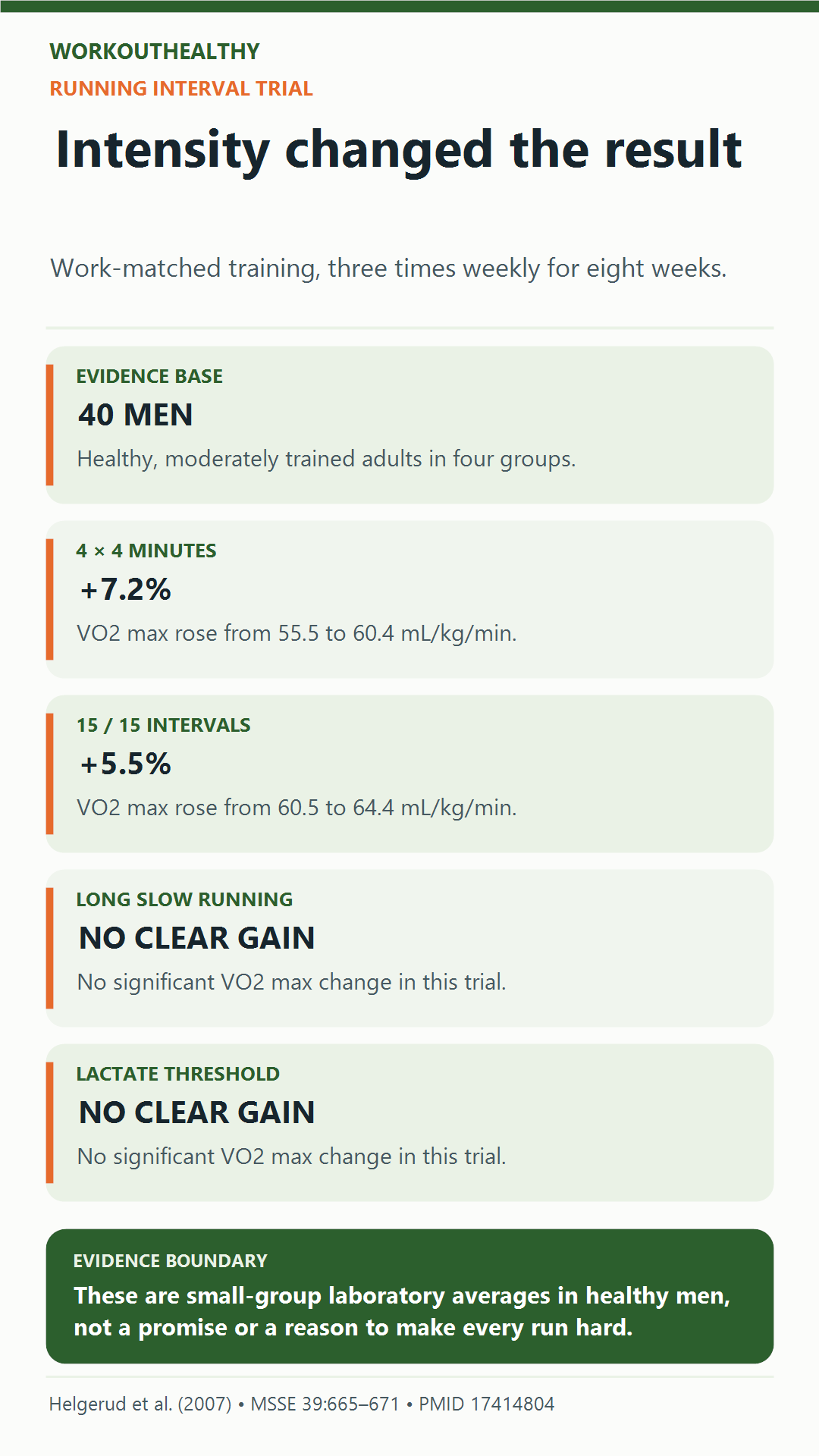
The long slow distance group and the lactate threshold group, despite doing the same total amount of work and training the same number of times per week, did not show a meaningful improvement in VO2 max over the same period.
That’s a striking result, because all three groups worked equally hard by one common measure, total oxygen used during training.
The difference came down to how that effort was distributed.
A small number of sessions spent very close to maximum heart rate did more for VO2 max than a larger volume of moderate effort.
What This Evidence Doesn’t Prove
The Milanović et al. (2015) meta-analysis pooled 28 trials, and the authors were upfront that those trials varied a lot in how the intervals were structured, and that the work to rest ratio that matters most wasn’t clear from the data.
The trials also focused on healthy adults between 18 and 45, so the findings say less about people well outside that range.
The Helgerud et al. (2007) study is a single trial with a specific, healthy, moderately trained group of subjects.
Its exact numbers, a 7.2 percent gain from a specific protocol, shouldn’t be read as a guarantee for every runner.
Response to training varies by starting fitness level, age, and genetics, and some people improve their VO2 max more easily than others doing the identical program.
None of the studies here tested whether raising VO2 max through a specific interval protocol changes long term health outcomes on its own.
The Mandsager et al. (2018) mortality data comes from a different kind of study, an observational look at fitness levels people already had, not a trial that raised VO2 max through training and then tracked survival.
It’s a reasonable inference that improving fitness moves you in a good direction.
It isn’t the same as a trial proving that a specific interval program extends life.
Common Mistakes and Who Should Be Cautious
The most common mistake is treating every hard run as an interval session.
The research behind these gains used a small number of genuinely hard sessions each week, one to two, not five.
Running near maximum effort every day tends to produce fatigue and injury risk without the recovery time the adaptation actually needs.
The second common mistake is doing the easy days too hard.
If your easy runs creep up toward a moderate effort, you lose the contrast between hard and easy that makes interval training work, and you accumulate fatigue that blunts your next hard session.
The third common mistake is skipping the warm up before a hard interval session.
Going from a cold start straight into an effort near maximum heart rate raises the risk of a strain or a cardiac event in someone with undiagnosed heart disease, and it also means your first interval is run below the intensity that actually drives the adaptation.
Anyone with diagnosed heart disease, uncontrolled high blood pressure, or risk factors for cardiovascular disease who hasn’t exercised at high intensity before should talk to a doctor before starting interval training that pushes heart rate close to its maximum.
The same goes for anyone returning from a significant injury or illness.
Interval training at or near maximum effort is a meaningfully bigger stress on the body than easy running, and that stress is exactly the point, which is also why it deserves a bit more caution going in.
How to Structure Your Interval Sessions: A Practical Guide
Start with one hard interval session a week if you’re new to structured training, and no more than two once you’re established.
The rest of your running should stay at an easy, conversational pace, one where you could hold a short conversation without gasping.
A simple starting structure, modeled on the protocol that produced the biggest gains in the research, is 4 intervals of 4 minutes at a hard but sustainable effort, roughly what you could hold for a 20 to 30 minute race if you had to, with 3 to 4 minutes of easy jogging or walking between each one.
If 4 minutes feels too long when you’re starting out, shorter intervals of 2 to 3 minutes at the same effort, with a similar length recovery, are a reasonable place to begin.
Warm up for at least 10 minutes with easy running before the first hard interval, gradually building your pace rather than jumping straight into it.
This gets your heart rate and breathing up gradually and reduces injury risk going into the harder efforts.
Judge your effort by how hard you’re breathing rather than a fixed pace.
Each interval should feel like you could not hold a conversation, and could not maintain the pace for more than a handful of minutes longer than you’re running it for.
If you finish every interval feeling like you had plenty left, the effort was too easy.
If you can’t complete the planned number of intervals at a consistent effort, it was too hard for that day.
Progress by adding one interval to the session every couple of weeks, up to about 5 or 6, before increasing the length of each interval instead.
Avoid increasing both the number and the length of intervals in the same week.
Track your progress with a simple time trial every 6 to 8 weeks rather than judging week to week.
Run a fixed distance, a mile or two, at your best sustainable effort, and compare your time.
A faster time at the same perceived effort is a practical sign that your VO2 max, or at least your ability to use it, is moving in the right direction.
Consistency across weeks and months matters more than any single brutal session. VO2 max moves gradually with training, not overnight.

For more on testing and tracking your fitness, see our article on what a simple four flights of stairs test can tell you, our piece on what daily step counts show about mortality risk, and our look at timing caffeine before a workout.
Watch the Original Video
Get the next evidence check. Subscribe to WorkoutHealthy Insider for practical explanations behind popular fitness claims.
References
Helgerud, J., Høydal, K., Wang, E., Karlsen, T., Berg, P., Bjerkaas, M., Simonsen, T., Helgesen, C., Hjorth, N., Bach, R., & Hoff, J. (2007). Aerobic high-intensity intervals improve VO2max more than moderate training. Medicine & Science in Sports & Exercise, 39(4), 665 to 671. https://doi.org/10.1249/mss.0b013e3180304570
MacInnis, M. J., & Gibala, M. J. (2017). Physiological adaptations to interval training and the role of exercise intensity. The Journal of Physiology, 595(9), 2915 to 2930. https://doi.org/10.1113/JP273196
Mandsager, K., Harb, S., Cremer, P., Phelan, D., Nissen, S. E., & Jaber, W. (2018). Association of cardiorespiratory fitness with long-term mortality among adults undergoing exercise treadmill testing. JAMA Network Open, 1(6), Article e183605. https://doi.org/10.1001/jamanetworkopen.2018.3605
Milanović, Z., Sporiš, G., & Weston, M. (2015). Effectiveness of high-intensity interval training (HIT) and continuous endurance training for VO2max improvements: A systematic review and meta-analysis of controlled trials. Sports Medicine, 45(10), 1469 to 1481. https://doi.org/10.1007/s40279-015-0365-0
This article is for general information only and is not medical advice. If you have an injury, ongoing pain, or a medical condition, talk to a doctor or physical therapist before you change how you train or eat.