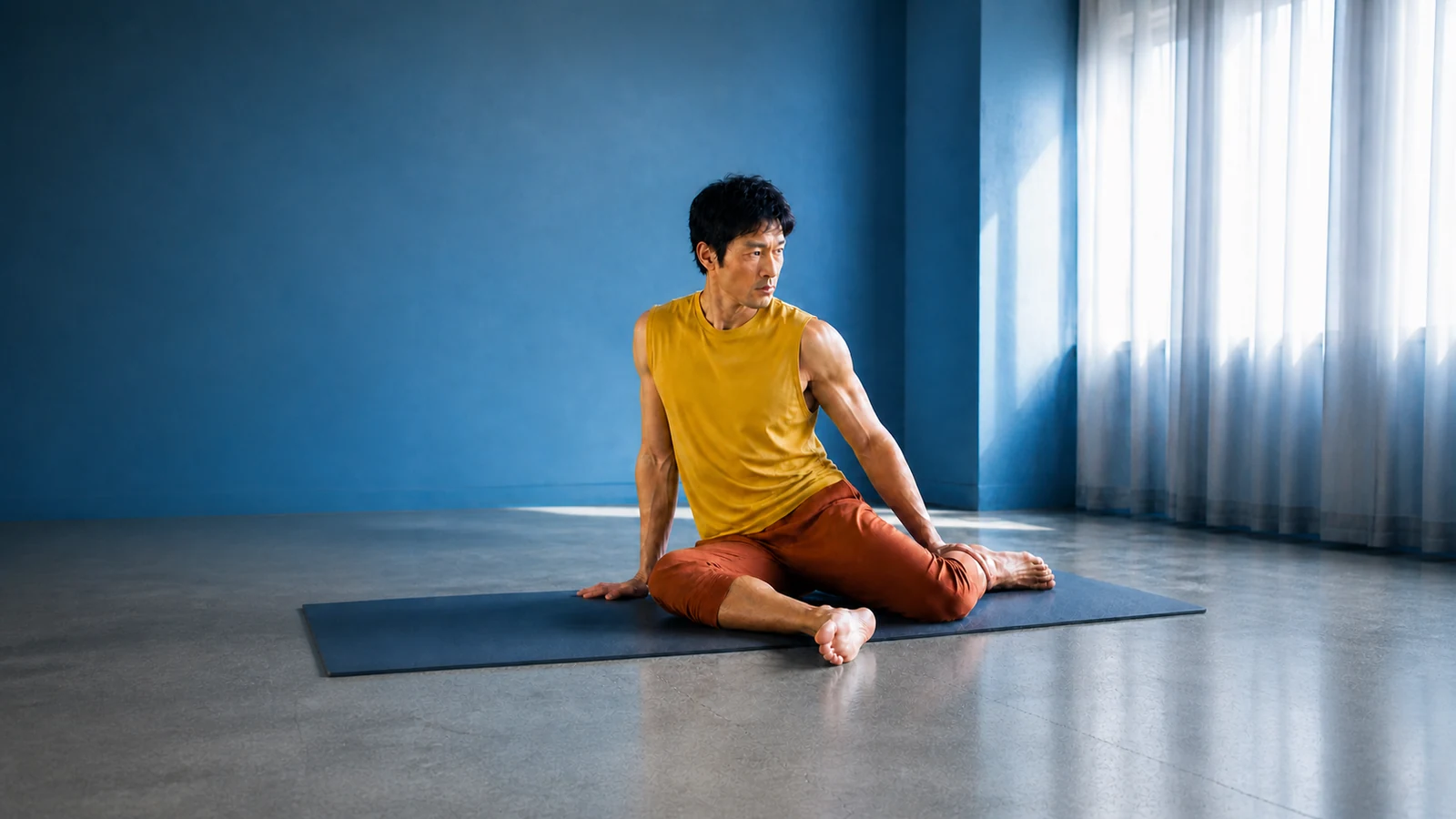

Illustration context: The images accompany this guide; they do not identify research participants, demonstrate a complete movement or establish an individual range of motion.
Start the 90/90 shin-box drill with a version you can manage. The five-level table offers choices; use the anatomy explanation, symptom cautions and evidence limits before deciding what to try.
Treat the levels as choices to discuss and adjust, not a proven fix for every stiff hip. Use the stop-and-seek-advice guidance below whenever a symptom concerns you.
Start Here: The Five-Level Shin Box Progression
Pick the first level you can do while breathing normally and keeping the movement comfortable. The levels are coaching options, not a research-tested treatment protocol or a race toward the loaded version.
| Level | What to do | Choose it when | Move on when |
|---|---|---|---|
| 1. Supported position | Sit on a folded towel or block with both hands behind you. Place one bent leg in front and the other to the side, leaving space under a knee if needed. | The floor position makes you lean far back or press a knee down. | You can sit comfortably on each side and breathe without pushing into a pinch. |
| 2. Lighter hand support | Keep the same leg position and bring your hands closer to your hips, then use only as much support as needed. | You can reach the position but rely heavily on your arms. | You can hold your torso comfortably without straining the knee or low back. |
| 3. Slow switch | Lean back onto your hands, lift both knees through the middle, and lower them gently to the opposite side. | Both static positions feel accessible. | You can switch both ways without throwing your torso or dropping onto a knee. |
| 4. Controlled flow | Join several slow switches, pausing briefly on each side instead of bouncing through the middle. | A single switch is smooth and symptom-free. | You can maintain control even as you get mildly tired. |
| 5. Optional added challenge | Reduce hand support or use a very light load only if the earlier levels are comfortable and you have a reason to add difficulty. | You already control the unweighted flow. | There is no need to progress further just to make the drill useful. |
For a short practice, try a few slow switches per side or a comfortable supported hold, then note how each hip feels. No study cited here establishes one ideal number of repetitions or minutes for shin-box training.
Front Hip Versus Rear Hip: Get the Rotation Right
With your right leg in front, use the front-leg row below; switch rows when that leg goes behind you.
The Cleveland Clinic physical therapist’s guide explains this anatomy and supported positioning.
| Where the leg sits | Hip rotation in the 90/90 position | Simple cue |
|---|---|---|
| Leg in front | External rotation | Front knee bends and the lower leg points across the space in front of you. |
| Leg to the side and behind | Internal rotation | Back knee bends and the lower leg points behind you. |
A right-angle drawing is not a requirement. Support the seat or front knee rather than force the shape.
How to Switch Without Forcing the Hip
- Set up. Sit with both knees bent and feet on the floor, hands behind you for balance. Let the knees lower to one side only as far as you can control.
- Two hips: Front externally rotated, rear internally; feet relaxed, knees never pressed flat by hand.
- Return through the middle. Use your hands to stay balanced while you lift both knees and guide them toward the other side. Let the pelvis move naturally; avoid cranking the low back to gain extra range.
- Pause and compare. Breathe once or twice, then return slowly. Notice differences between sides without assuming they must become perfectly symmetrical.
Use the written sequence to choose a manageable variation; the original source video is offered below as additional context. A demonstration cannot diagnose a blocked or painful hip.
What Research Can and Cannot Say About Hip Rotation
Simoneau and colleagues measured active rotation in 60 healthy college-age adults: 39 women and 21 men. Testing was seated near 90 degrees of hip flexion and prone near 0 degrees.
Seated/prone external-rotation means ± SD were 36 ± 7 and 45 ± 10 degrees, a significant difference; internal-rotation means were 33 ± 7 and 36 ± 9 degrees, without a significant difference. These are measurement findings, not personal targets or evidence for shin-box training, injury prevention or sports performance.
Record the position before comparing ranges; a higher front or rear knee may reflect anatomy or how the position is performed. This measurement study did not test the drill or prove it prevents injury.
Roach and Miles analyzed active hip and knee motion in a population sample. Mean ranges were generally lower in older than younger groups, with most average differences small and hip extension a larger exception.
That was a comparison of groups at one point in time, so it cannot prove that sitting caused someone’s stiffness or that this drill will reverse it. A noticeable new loss of motion, especially with pain, deserves individual assessment rather than an age-based assumption.
Ellison and colleagues found different patterns of passive hip rotation in 100 people without low back pain and 50 with low back dysfunction. This association does not mean an uneven shin-box position caused back pain or that making both sides match will treat it.
What to Change When a Side Feels Stuck
For a backward lean, revisit the supported-position level in the first table before attempting a switch.
For a hovering knee, revisit that table’s support and comfort criteria rather than rating the repetition by appearance.
If your low back twists during a switch: slow down, use hand support, and shorten the range. Some pelvic motion is normal, but forceful trunk rotation is a poor substitute for a controlled hip position.
If one side is different: use the level each side can control and note any pain or catching. Side-to-side differences alone are common enough that appearance is a poor diagnosis.
Desk work may make a new floor position feel unfamiliar, but the research cited here does not show that sitting alone caused a rotation deficit. A brief movement break can change position without forcing a deep stretch.
When to Skip the Drill and Seek Advice
Stop for sharp pain, pinching, catching, numbness or lingering discomfort; ask a clinician or physical therapist about suitable movement.
With hip impingement or a hip/knee replacement, skip this extreme stretch and seek an alternative. Labral injury or a painful knee condition also needs individual guidance.
For related context, see our standing versus sitting evidence review and an article on hip replacement recovery.
Watch the Original Video
Get the next evidence check. Subscribe to WorkoutHealthy Insider for practical explanations behind popular fitness claims.
References
Simoneau, G. G., Hoenig, K. J., Lepley, J. E., & Papanek, P. E. (1998). Influence of hip position and gender on active hip internal and external rotation. Journal of Orthopaedic & Sports Physical Therapy, 28(3), 158 to 164. PubMed abstract.
Roach, K. E., & Miles, T. P. (1991). Normal hip and knee active range of motion: The relationship to age. Physical Therapy, 71(9), 656 to 665. PubMed abstract.
Ellison, J. B., Rose, S. J., & Sahrmann, S. A. (1990). Patterns of hip rotation range of motion: A comparison between healthy subjects and patients with low back pain. Physical Therapy, 70(9), 537 to 541. PubMed abstract.
This article is for general information only and is not medical advice. If you have an injury, ongoing pain, or a medical condition, talk to a doctor or physical therapist before you change how you train.