

Does the early bird really get the worm? We asked readers when they train, then counted every answer.
Mornings won by a wide margin. But the group that refused to pick a side made the most useful point.
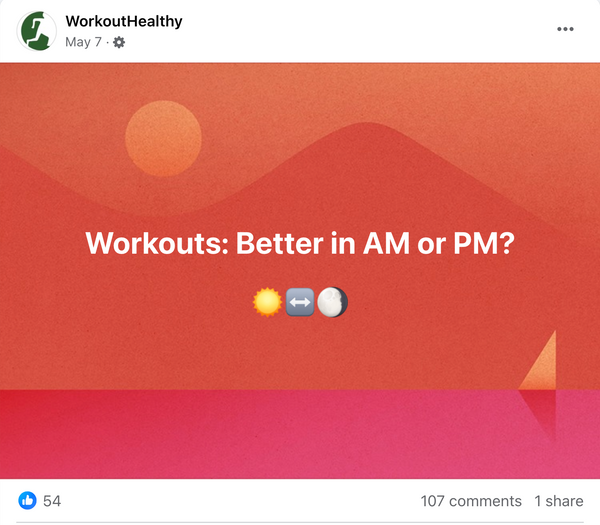
See the original Facebook post
The headline numbers
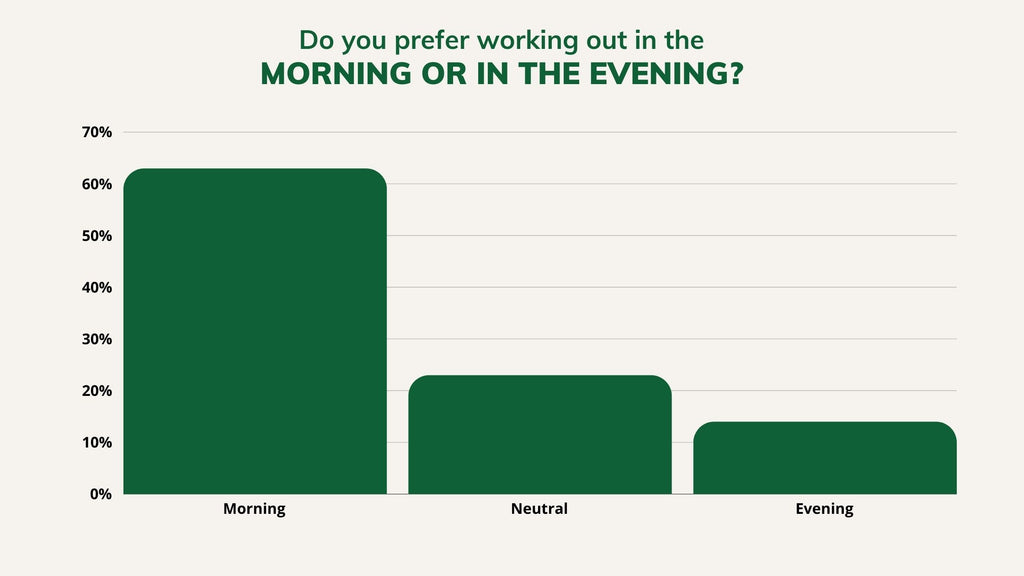
- 63% prefer morning workouts. That is 66 of 105 comments.
- 23% have no set preference and value flexibility. That is 24 of 105.
- 14% prefer evening sessions.
How we collected this
This is a count of 105 public comments on one WorkoutHealthy Facebook post published on May 7, 2024. Each comment was sorted into morning, evening, or no preference based on what the person said, and the reasons they gave were grouped separately.
The limits are the same ones that apply to any comment thread. People who answer a fitness page’s question are self selected, and 105 comments is a small pool. Read these figures as the shape of one conversation, not as a national survey.
Anyone quoting these numbers should cite them that way.
Why mornings won
The reasons people gave fell into four groups, and only one of them was about the workout itself.
Energy for the rest of the day
This came up more than anything else. As one reader put it: “AM. It gets my blood flowing and gives me the energy I need for the day.”
The workout was not the point. What happened in the eight hours after it was the point.
It actually happens
Several people said mornings work because nothing has had a chance to go wrong yet. A workout scheduled for 6 p.m. competes with a late meeting, a sick kid, and the fatigue that has been building since lunch. A workout at 6 a.m. competes with nothing.
Consistency, not intensity, is what most of these comments were really describing.
A clearer head
Early exercise showed up repeatedly as a way to clear mental clutter and steady the mood before the day starts making demands.
Better choices afterward
A few readers described a chain reaction. The morning workout makes the rest of the day’s decisions easier, from what they eat to how much water they drink.
The flexible group made the sharpest point
Roughly a quarter of commenters declined to pick a side, and their reasoning was hard to argue with.
One reader summed it up: “The best workout schedule is the one you will stick with.”
For anyone with unpredictable work hours or young children, a fixed training time is not a discipline problem. It is a scheduling impossibility. “Whenever you can make it happen” was a common answer, and it is a legitimate one.
The case for evenings
The 14% who train at night gave three consistent reasons.
Stress relief. Training after work marks the end of the workday. As one reader wrote: “After work, I just want to relax.” Exercise served as the transition rather than another task.
Better performance. Body temperature rises through the day, and some people simply lift more at 6 p.m. than at 6 a.m. Research supports this: physical performance tends to peak in the late afternoon and early evening, when body temperature is highest.
Company. Gyms are busier at night. For people who train better with others around, that is a feature.
What this does not show
It does not show that mornings are better. It shows that this audience prefers them, mostly for reasons that have nothing to do with physiology.
The research picture is close to the opposite. Strength and endurance measures generally favor later in the day, while adherence favors earlier. Those are two different goals, and the right answer depends on which one is your bottleneck.
If sleep is what is deciding your schedule, our piece on how late is too late for caffeine covers the timing question directly. If you are trying to make sessions stick, training with a partner addresses the same adherence problem from another angle.
Citing this
Journalists and bloggers are welcome to quote these figures with attribution to WorkoutHealthy, provided the sample size and methodology note travel with them. The underlying thread is public and linked above.
This analysis was originally published on workouthealthy.com in October 2024, written by Alexandra Carandang, and moved here in August 2026.
References
- WorkoutHealthy. (2024, May 7). AM or PM Workouts [Facebook post]. Facebook
- Facer-Childs, E. R., Boiling, S., & Balanos, G. M. (2018). The effects of time of day and chronotype on cognitive and physical performance in healthy volunteers. Sports Medicine – Open, 4, Article 47. https://doi.org/10.1186/s40798-018-0162-z
- Teo, W., Newton, M. J., & McGuigan, M. R. (2011). Circadian rhythms in exercise performance: implications for hormonal and muscular adaptation. Journal of Sports Science and Medicine, 10(4), 600 to 606. https://www.jssm.org/hf.php?id=224