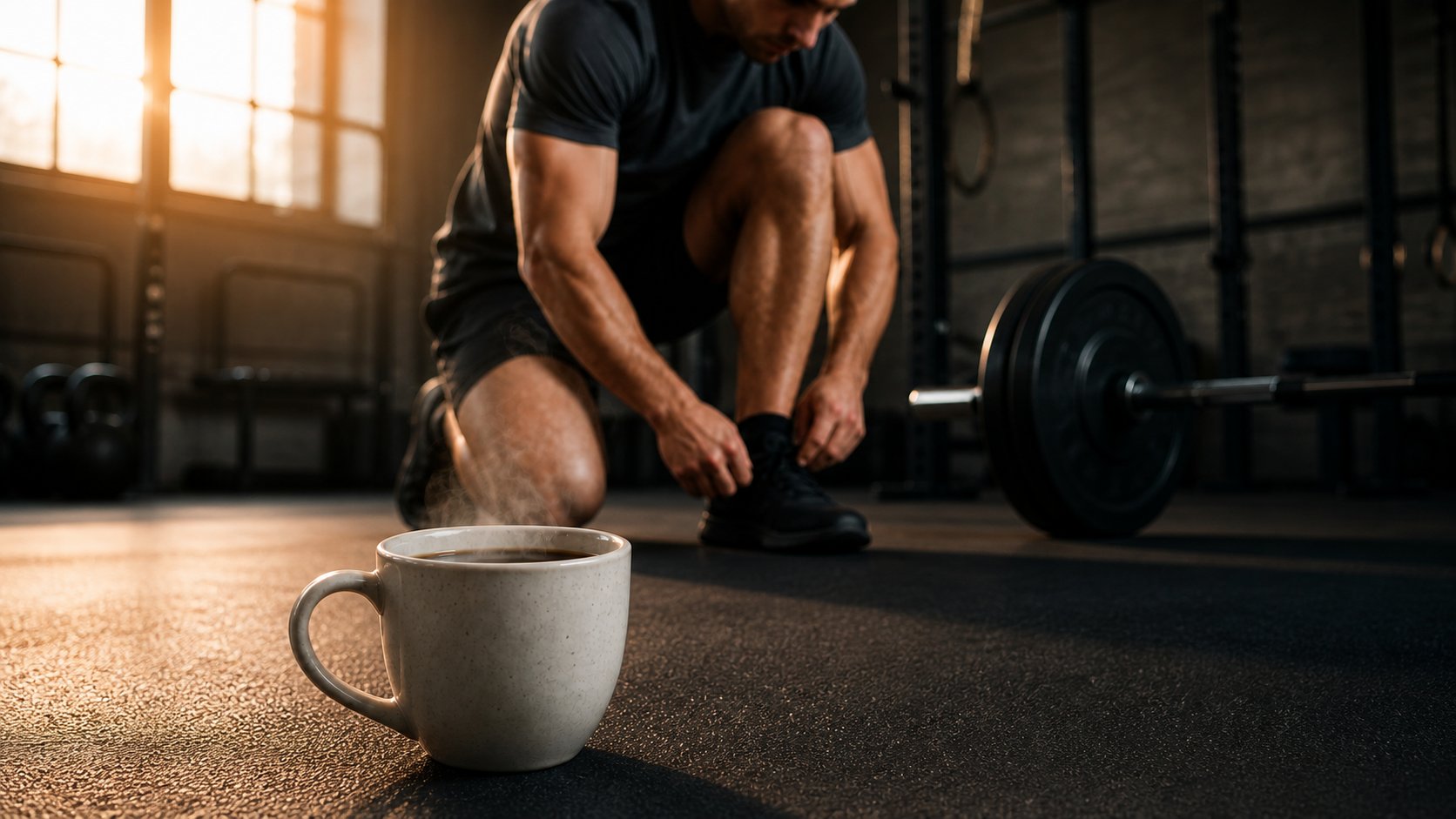

Caffeine before a workout is optional: some people get a modest performance benefit, while others notice little improvement or have side effects. The useful decision is whether a repeatable benefit outweighs the dose, symptoms and effect on that night’s sleep.
Caffeine can improve some kinds of exercise performance, but the viral promise that coffee 30 to 60 minutes before training boosts fat burning by up to 44% is too precise for everyday use. Performance, fat oxidation, dose, timing, exercise type, and individual response are separate questions.
The International Society of Sports Nutrition concluded that caffeine can produce small to moderate benefits across muscular endurance, movement velocity, strength, sprinting, jumping, and aerobic exercise. The effect is real for many people, not universal for everyone (Guest et al., 2021).
A pre-workout boost only helps if it does not borrow too much from sleep, comfort, or recovery.
Why 60 minutes appears so often
About 60 minutes before exercise is the most commonly studied timing for caffeine, especially in capsule form. Other sources can peak differently, so coffee, gum, gels, and pre-workout powders are not interchangeable (Guest et al., 2021).
The position stand reports that 3 to 6 milligrams per kilogram of body mass consistently improved performance in many studies, while effective doses may be as low as 2 milligrams per kilogram. Higher doses are not automatically better and raise the chance of side effects.
Those research ranges are not a personal dosing instruction. Body mass, tolerance, medications, pregnancy, anxiety, heart rhythm concerns, and habitual intake can change what is appropriate.
Performance is not the same as fat loss
Caffeine can alter acute fat oxidation during some exercise sessions, but an acute percentage does not translate directly into long-term body-fat loss. Energy intake, total activity, training consistency, sleep, and adaptation matter over weeks and months.
The “up to 44%” framing highlights an upper result without explaining the baseline, protocol, population, or uncertainty. Even a large relative change during one controlled session may represent a modest absolute difference.
Use caffeine for a clear reason such as alertness or a measurable training benefit. Do not treat it as a substitute for a sustainable nutrition and activity plan.
Individual response is the deciding factor
Some people feel focused and strong after caffeine, while others feel shaky, anxious, nauseated, or unable to pace effort. Genetics, habitual use, and expectations may all contribute to that variation (Guest et al., 2021).
Timing also interacts with sleep. Our guide to how late caffeine may disrupt sleep explains why an afternoon performance boost can be a poor trade when bedtime is close.
If you are relying on caffeine because training always feels flat, review the rest of the routine. A consistent workout partner or a well-chosen personal trainer may solve an adherence or programming problem that another stimulant cannot.
Coffee and pre-workout are not equal doses
A mug of coffee can vary substantially with bean, brew method, and serving size. A labeled pre-workout may state a caffeine amount, but proprietary blends and multiple servings can make the true total harder to follow.
Count caffeine from coffee, energy drinks, gels, tea, soda, supplements, and medications on the same day. Stacking several products can turn a familiar routine into a much larger dose than intended.
For a worked example, suppose a product label lists 100 mg in morning coffee, 80 mg in a midday drink and 150 mg in a pre-workout serving taken before a 4 pm session. The day’s hypothetical total is 330 mg; those amounts are examples from imagined labels, not standard doses for each product.
The FDA cites 400 mg per day as an amount not generally associated with negative effects for most adults, but notes large differences in sensitivity. Being below that population reference does not establish that a late pre-workout will be comfortable or protect sleep.
Do not test a new caffeine strategy before a race, important game, or demanding session. Try it first during an ordinary workout where an unexpected response is easier to manage.
Remember that tolerance can reduce the feeling of stimulation without removing sleep effects or other costs. Needing more caffeine to notice it is a reason to reassess the habit, not proof that a larger serving is required.
The WorkoutHealthy caffeine response log
Keep one simple comparison for three similar workouts: record the caffeine source and time, then rate performance, side effects, and sleep that night. Keep the workout, meal timing, and bedtime as consistent as practical.
This illustrative log shows why a faster-feeling workout is not the only outcome to count. The numbers are invented to demonstrate a decision, not evidence that caffeine caused a change.
| Similar session | Added pre-workout caffeine | Same-load pressing result | Symptoms and that night’s sleep |
|---|---|---|---|
| A | None | 3 sets of 8 reps | No unusual symptoms; usual sleep |
| B | 150 mg from label | 3 sets of 9 reps | Jittery; fell asleep later |
| C | 150 mg from label | 3 sets of 8 reps | Stomach discomfort; fell asleep later |
In that example, the possible performance benefit is inconsistent while the sleep and comfort costs repeat. A reader could reasonably skip the added caffeine, but three self-observed sessions cannot prove cause and effect.
For your own notes, record the full day’s labeled caffeine, workout time, a simple performance measure, side effects and bedtime. Do not raise a dose just to improve a chart or keep experimenting after concerning symptoms.
Continue only if the benefit is repeatable and the costs stay low. If performance improves but sleep, anxiety, stomach comfort, or heart symptoms worsen, the trade is unfavorable.
The best timing is the one that improves the session without damaging the night.
The bottom line
Caffeine taken before exercise can improve performance for many people, and 60 minutes is a common research timing. Skip the guaranteed fat-burning percentage and judge the habit by repeatable performance, tolerability, and sleep.
Get the next evidence check.
Five practical fitness stories worth your time, every Friday.
Weekly email with no product pitches. Unsubscribe in one click.
References
Guest, N. S., VanDusseldorp, T. A., Nelson, M. T., Grgic, J., Schoenfeld, B. J., Jenkins, N. D. M., Arent, S. M., Antonio, J., Stout, J. R., Trexler, E. T., Smith-Ryan, A. E., Goldstein, E. R., Kalman, D. S., & Campbell, B. I. (2021). International society of sports nutrition position stand: Caffeine and exercise performance. Journal of the International Society of Sports Nutrition, 18(1), Article 1. https://doi.org/10.1186/s12970-020-00383-4
US Food and Drug Administration caffeine guidance on the general adult daily reference and variability.
Medical disclaimer: This article is general health and fitness information, not medical advice. Ask a qualified clinician about caffeine if you have a medical condition, take a relevant medication, are pregnant, or develop concerning symptoms.