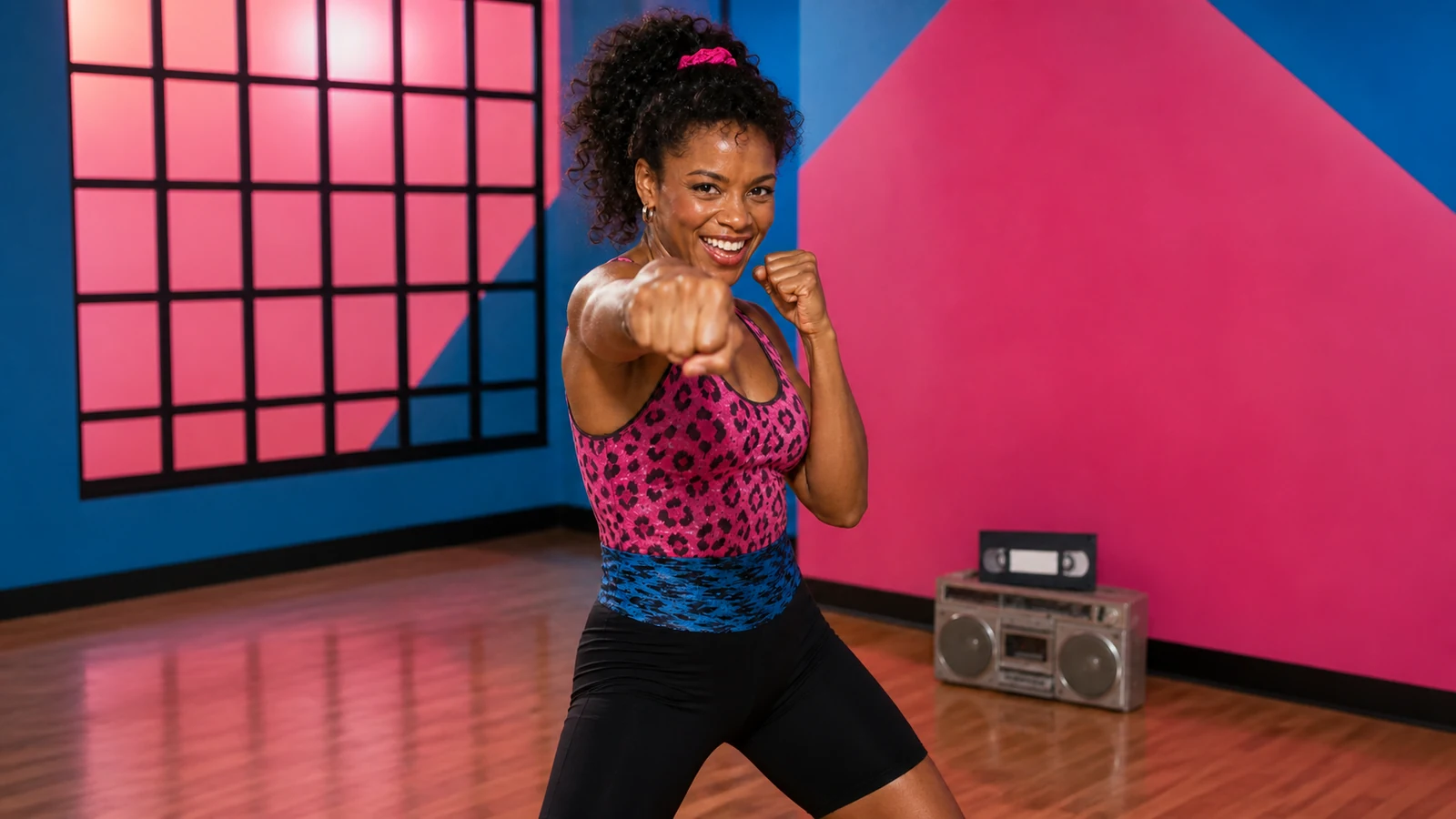
Woman practicing non-contact cardio kickboxing in a pink-and-blue retro studio.

Why Tae Bo Is Making a Comeback, and Whether It Works

Tae Bo and cardio kickboxing are back in the spotlight after a viral news segment. Here is what real exercise science actually says about calorie burn, heart health, coordination, and injury risk.

Tae Bo is back in the headlines.

A recent Good Morning America segment covered the 1990s kickboxing cardio craze making a comeback in gyms and living rooms.

The punches and kicks look nostalgic.

But the workout style underneath them has real exercise science behind it.

Here is what verified research actually says about kickboxing style cardio, apart from the nostalgia.

Why Tae Bo Took Off in the 1990s, and Why It Is Back Now

Billy Blanks created Tae Bo in the early 1990s by blending taekwondo, boxing, and dance.

It became a home workout phenomenon through VHS tapes and infomercials.

Millions of people tried punching and kicking along in their living rooms for the first time.

The format faded from the spotlight as newer fitness trends took over gyms.

Now short clips of kickboxing style workouts are spreading again on social media.

Nostalgia plays a real role in that comeback, the same way other VHS era trends keep resurfacing.

Low equipment needs also help, since a class like this needs almost no gear.

That mix of nostalgia and simplicity is likely part of why GMA covered it as a trend story.

What the Video Claims About Tae Bo’s Comeback

The segment frames Tae Bo as a fun throwback people are rediscovering for cardio.

It shows people punching and kicking along to music in a group class setting.

The framing treats the workout mostly as a nostalgia trend and a fun way to move.

That framing is worth checking against actual exercise research rather than taking at face value.

What the Real Research Shows About Calorie Burn and Body Composition

Kickboxing style cardio has actually been studied directly, not just anecdotally.

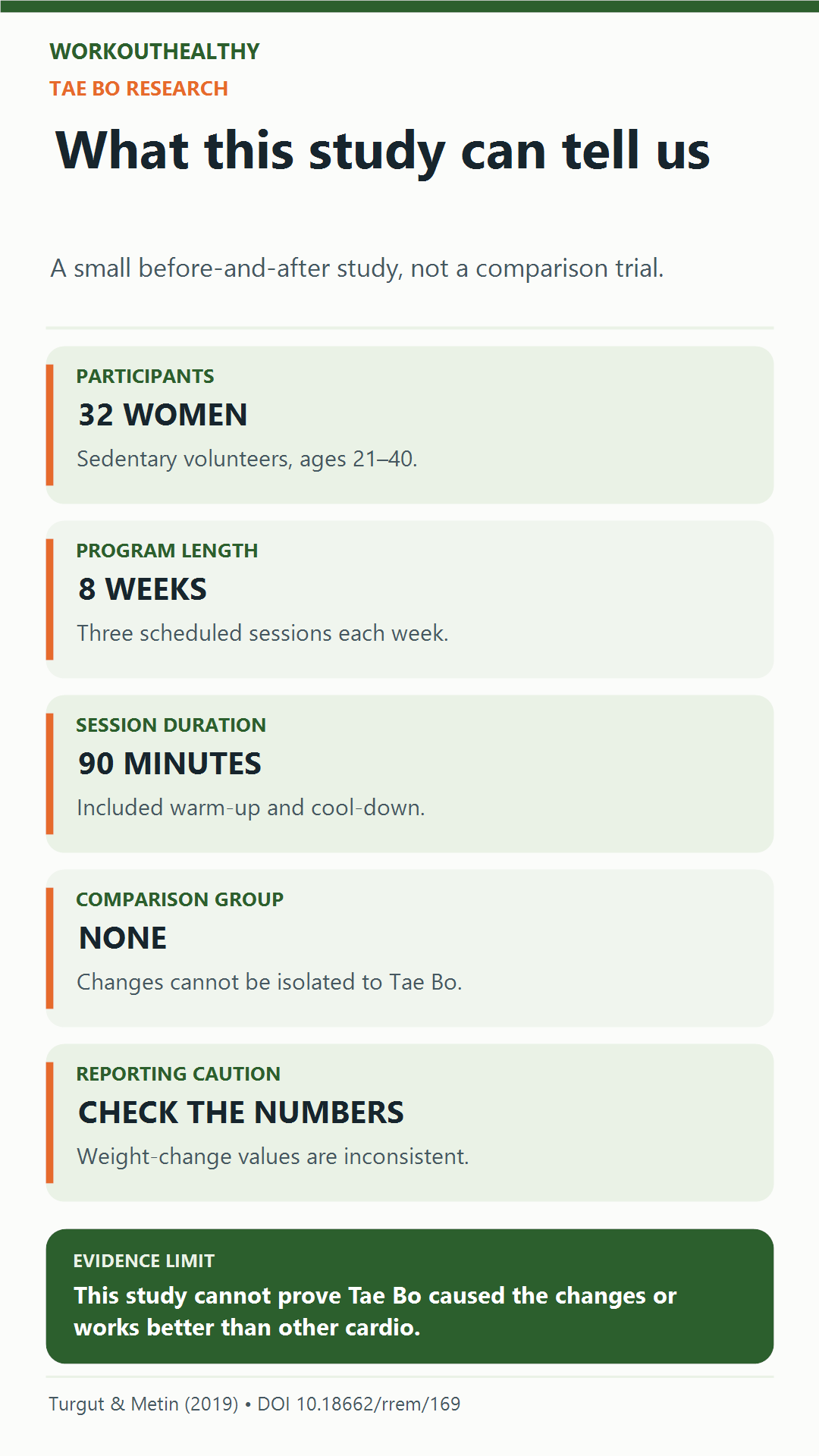
One study followed 32 sedentary women through eight weeks of Tae Bo classes (Turgut & Metin, 2019).

Sessions ran three times a week.

By the end, average body weight dropped by about 2.8 kilograms.

Body fat percentage fell by roughly 5 percentage points over those eight weeks.

Waist circumference shrank by more than 7 centimeters in the same window.

Shoulder circumference dropped the most of any measurement, by nearly 9 centimeters.

Hip, arm, leg, and chest measurements also decreased by smaller but real amounts.

Blood lipid markers improved too, with LDL and total cholesterol dropping and HDL rising.

Those are real, measured, before and after numbers, not projections.

Tae Bo study snapshot: 32 women, eight weeks, three 90-minute sessions weekly, and no control group; the design cannot isolate the program's effects.
Turgut and Metin (2019): 32 sedentary women aged 21–40 completed an eight-week program with three 90-minute sessions weekly. This uncontrolled before-and-after study cannot establish causation or superiority to other cardio. Its table contains inconsistent weight-change values, so no weight-loss estimate is plotted.

Eight weeks of structured kickboxing style cardio produced measurable drops in body fat, waist size, and harmful blood lipids in previously sedentary women.

A separate line of research looked at what happens inside the body during boxing effort itself.

A 2022 systematic review pooled data from 25 studies and 380 participants on amateur boxing (Finlay et al., 2022).

Blood lactate rose sharply during bouts.

Levels reached between about 11.8 and 13.6 millimoles per liter after competition.

That kind of lactate spike signals a hard, glycolytic effort.

It is the same energy system used in fast paced interval cardio.

Cortisol also rose measurably, which fits a genuinely demanding cardiovascular workload.

Interestingly, jump performance did not seem to drop much right after boxing activity.

That suggests the fatigue is mostly metabolic, not a total shutdown of muscle power.

Why Kickboxing Style Cardio Trains More Than Your Heart

Traditional steady cardio like jogging mostly repeats the same movement pattern over and over.

Kickboxing style cardio adds punches, kicks, pivots, and footwork into one session.

That combination recruits your arms, core, hips, and legs together.

It is part of why some readers compare it to other high output cardio tools.

Our breakdown of how many calories jumping rope actually burns covers a similar idea.

Both activities pair fast footwork with a sustained heart rate.

Any activity that keeps your heart rate elevated for a sustained period forces real cardiovascular adaptation.

That is the same basic mechanism behind our look at sauna use and heart health, even though the two activities are very different.

Interval style formats like this one also tend to keep your metabolism a little elevated after the session ends.

Exercise scientists sometimes call this extra calorie burn excess post exercise oxygen consumption, or EPOC for short.

It simply means your body keeps working slightly harder for a while after you stop moving.

How Kickboxing Style Cardio Compares to Other Cardio Formats

Running and cycling are excellent for cardiovascular fitness.

But they repeat a fairly narrow movement pattern for the whole session.

Kickboxing style cardio spreads the work across more muscle groups at once.

That can make the perceived effort feel different even at a similar heart rate.

It may also appeal to people who get bored with steady state cardio machines.

Rowing is one of the few other formats that also trains the whole body together.

None of the research reviewed here directly compares kickboxing style cardio against rowing or cycling in a head to head trial.

So it is fair to call it a genuinely demanding option, not one proven superior to every alternative.

Choosing between formats often comes down to what you will actually do consistently.

Consistency usually matters more than which format burns a few extra calories per session.

The Coordination and Brain Engagement Piece

Kickboxing style workouts also ask your brain to keep up with your body.

You have to track combinations, timing, and balance all at once.

Researchers have studied this kind of coordination demanding exercise in older adults with cognitive frailty (Liao et al., 2025).

In that randomized controlled trial, an interactive boxing and cycling program was compared against usual care.

Researchers measured activity in the prefrontal cortex during walking combined with a mental task.

That is a real world test of coordination under mental load.

This is a different population than a typical Tae Bo class.

So the results should not be assumed to transfer directly to healthy adults.

Still, it points to a real, measurable link between combination based movement and brain engagement.

That link is part of why some readers also ask whether resistance training keeps the brain younger, a related but separate question.

What This Evidence Does Not Prove

None of these studies prove that Tae Bo specifically outperforms other cardio formats.

The Tae Bo study followed only 32 women for eight weeks, a small sample over a short window.

The boxing physiology review looked at boxing training and bouts, not consumer cardio kickboxing classes.

The brain activation study involved older adults with cognitive frailty.

That is not the general fitness population shown in the video.

None of this research proves kickboxing style cardio is safer than running, cycling, or rowing.

It also does not prove that everyone will see the same fat loss or lipid changes.

Individual results depend on starting fitness, diet, consistency, and genetics.

A comeback trend does not automatically mean new science backs it.

In this case, some real evidence does exist, but it is narrower than a viral clip suggests.

Common Mistakes People Make With Kickboxing Style Cardio

People often throw punches and kicks with locked joints.

Locked elbows and knees raise injury risk with every repeated strike.

Rounding the back during punches strains the lower back over time.

Kicking above a safe range of motion before the hips are warmed up is another common error.

Many beginners also skip a proper warm up and jump straight into fast combinations.

Copying an instructor’s speed before learning correct form leads to sloppy technique fast.

Sloppy technique is where most injuries in these classes actually start.

Wearing running shoes with little lateral support is another overlooked mistake.

Kickboxing style movement needs more ankle and midfoot support than straight line running shoes provide.

Injury Risk and Who Should Check With a Doctor First

Kickboxing style fitness classes generally do not involve striking a real opponent.

That makes them very different from competitive boxing.

Still, it helps to understand what the higher impact version of this movement can look like.

A 2023 meta-analysis pooled 14 studies covering more than 733,000 boxers and over 10,000 recorded injuries (Mao et al., 2023).

Soft tissue bruising was the single most common injury type, at just over 30 percent of cases.

Sprains and muscle strains made up about 15 percent of that pooled injury data.

Those numbers come from real competitive boxing, not a cardio class with no opponent and no strikes landed.

A class without any contact still carries real risk for the shoulders, knees, and lower back.

Anyone with an existing shoulder, hip, or knee injury should talk to a doctor or physical therapist before starting.

People with high blood pressure, heart disease, or joint problems should get medical clearance first too.

Pregnant women should also check with their doctor before adding fast kicking or twisting movements.

Anyone new to intense exercise after a long break should ease in slowly.

The injury data on actual competitive boxing is a warning about impact, not a verdict on a music driven cardio class with no contact at all.

How to Try Kickboxing Style Cardio Safely

Start with a beginner class or a slower paced video before jumping into an advanced session.

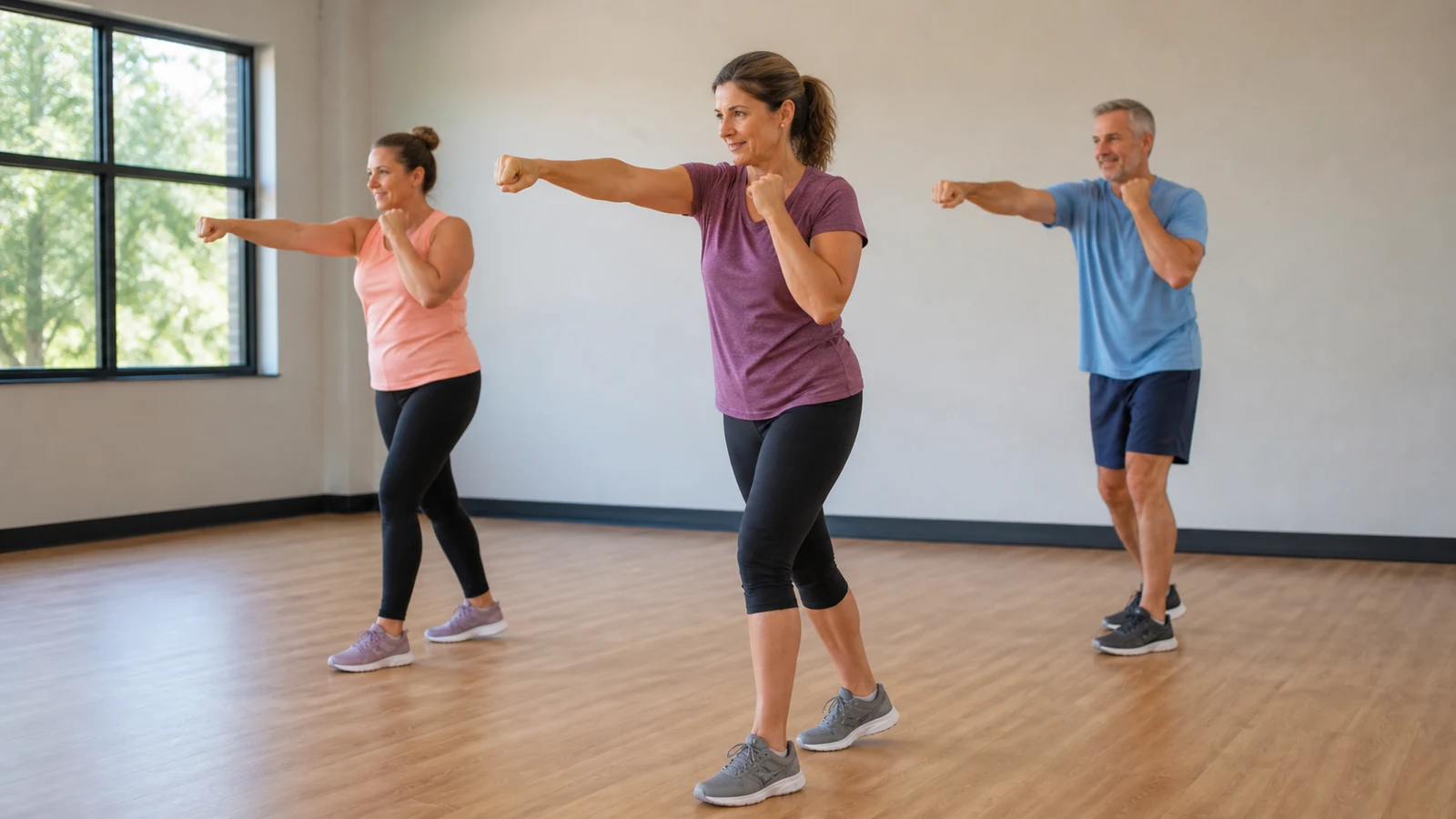
Adults practicing a controlled non-contact jab in a spacious beginner cardio kickboxing class.
Illustrative beginner class, not study participants. Non-contact practice leaves space to learn the movements at a manageable pace.

Warm up your hips, shoulders, and ankles for at least five minutes first.

Throw punches with a slight bend in the elbow, never fully locked out.

Keep kicks below shoulder height until your hip mobility and balance genuinely improve.

Pace yourself the way you would for any other interval cardio session.

Some readers wonder how this compares to strength training for overall results.

Our readers weighed in heavily on weightlifting versus running, a debate with real overlap here.

Many people get the best results from pairing a class like this with resistance training during the week.

Hydrate well, since sessions can get hot and sweaty fast.

Listen to your joints, not just your heart rate monitor.

Stop a combination early if your form starts to break down from fatigue.

Add one more class per week only after your form stays solid through a full session.

Pay attention to how your joints feel the next day, not just how tired you felt during class.

Watch the Original Video

The original segment, from Good Morning America’s channel on YouTube.

Want more like this? Subscribe to WorkoutHealthy Insider for practical explanations behind popular fitness claims.

References

Finlay, M. J., Greig, M., Page, R. M., & Bridge, C. A. (2022). Acute physiological, endocrine, biochemical and performance responses associated with amateur boxing: A systematic review with meta-analysis. European Journal of Sport Science, 23(5), 774 to 788. https://doi.org/10.1080/17461391.2022.2063072

Liao, Y. Y., Hsu, W. C., Wang, K. C., Liu, C. L., Tseng, W. Y., & Lin, Y. J. (2025). Effects of interactive boxing-cycling on dual-task walking and prefrontal cortex activation in older adults with cognitive frailty: A randomized controlled trial. Geriatric Nursing, 61, 654 to 661. https://doi.org/10.1016/j.gerinurse.2024.12.010

Mao, Y., Zhao, D., Li, J., & Fu, W. (2023). Incidence rates and pathology types of boxing-specific injuries: A systematic review and meta-analysis of epidemiology studies in the 21st century. Orthopaedic Journal of Sports Medicine, 11(3), Article 23259671221127669. https://doi.org/10.1177/23259671221127669

Turgut, M., & Metin, S. N. (2019). Effect of Tae-bo exercises implemented on sedentary women, on some physical and physiological parameters. Revista Romaneasca pentru Educatie Multidimensionala, 11(4), 278 to 287. https://doi.org/10.18662/rrem/169

This article is for general information only and is not medical advice. If you have an injury, ongoing pain, or a medical condition, talk to a doctor or physical therapist before you change how you train or eat.

Share your love
Chris Pruitt, certified personal trainer and WorkoutHealthy founder
Chris Pruitt

Chris Pruitt is a certified ASFA personal trainer and the founder of WorkoutHealthy, a fitness equipment retailer serving customers since 2007. He has more than 16 years in the fitness business, and he writes and fact checks everything published on Insider.

The Insider Five

Five stories worth your time, every Friday. One email a week, no pitches.