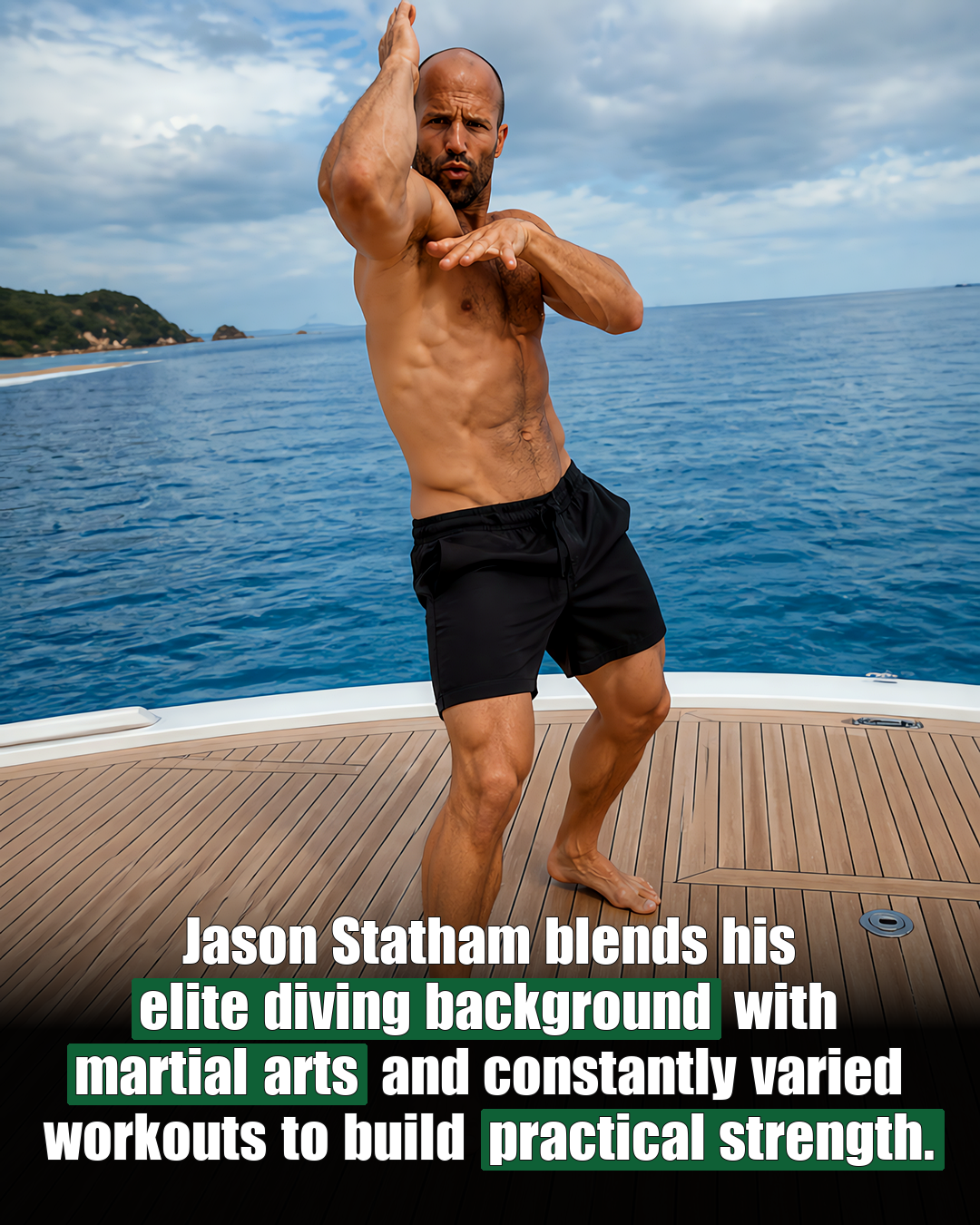

Jason Statham is a British actor known for playing tough, physically capable characters in films like “The Transporter,” “Crank,” and “The Beekeeper.”
He was born in 1967, which puts him at 59 years old in 2026.
He still headlines action movies at that age, with a new film called “Shelter” set for a January 2026 release.
Before acting, Statham was a competitive athlete, not a gym hobbyist.
He trained with Great Britain’s National Swimming Squad for 12 years as a diver.
He competed for England at the 1990 Commonwealth Games in three diving events, placing 10th, 11th, and 8th.
He also holds a black belt in karate and has practiced kickboxing and judo recreationally over the years.
In his own words, describing that side of his background, he has said this.
“I did a little bit of jiu-jitsu. I did a little bit of kickboxing. A little bit of judo I did for a while.”
He has also been clear that he never chased formal competition in those sports, saying he has no plans to get in a ring or chase belt rankings.
That combination, a former Olympic level diver with real martial arts exposure, is the actual foundation behind his on screen physicality.
He has worked with a rotating group of trainers and stunt professionals over his career, including Eddie J. Fernandez, a stunt coordinator who has worked on eight of his films, including “The Expendables.”
That kind of long term relationship with the same fight and stunt team is part of why his on screen movement reads as genuinely trained, not just performed.
What His Trainer Learned From Watching Prison Inmates Train
One of Statham’s key trainers is Logan Hood, a former Navy SEAL who prepared him for the 2008 film “Death Race.”
According to a Men’s Journal profile, Hood’s training philosophy was shaped partly by watching inmates train at Corcoran State Prison.
“They didn’t have big machines. These guys used their own bodies for lifts, pullups, situps, and squats.”
That observation became a core idea in how Hood built programs for Statham.
Heavy machines were not the point.
Real strength, built through the body’s own natural movement patterns, was the point.
Statham has echoed that same idea when describing his own approach to training.
“My workout is constantly changing, which for me is the best thing in the world, because variety is what keeps me interested.”
He has described his overall style as a mix of “power stuff, static holds, functional strength, bodyweight training, circuits, pyramids, conventional cardio, interval cardio and plyometrics.”
What Combat Inspired Training Actually Looks Like
Reporting on Statham’s training describes sessions six days a week, often built around eight week intensive cycles ahead of a film.
A sample session reported by Men’s Journal includes 10 minutes of rowing, followed by pushups, pull ups, squats, and barbell front squats.
For “The Beekeeper,” trainer James Moontasri, a two time national taekwondo champion, built Statham a specific ab and core session.
That session paired pull ups, 1,000 meters of rowing, and three minutes of shadow boxing in one block.
A second block used stability ball hamstring curls, rotational knee tucks, plank variations, and static holds.
Moontasri has spoken about Statham’s work ethic outside of scheduled sessions.
“He’s got a routine he’ll do on his own before we work together, and it’s pretty intense. I think being able to push yourself in isolation is a massive advantage.”
Specific verified numbers from Statham’s training include a documented 365 pound deadlift and a front squat of 175 pounds for five sets of five.
He has also been documented completing roughly 100 pushups in three minutes, with the first 75 done unbroken.
For fight heavy roles, Statham has also trained through stunt teams that specialize in screen combat, adding hours of choreographed fight practice on top of his strength sessions.
The Exercise Science Behind Constant Variation
Statham’s own description of his training, constantly changing and rarely repeated, sounds like it could work against building real strength.
Research suggests otherwise, at least for someone already well trained.
A 2019 study in PLOS ONE compared two groups of experienced lifters over eight weeks (Baz-Valle et al., 2019).
One group used the same fixed set of exercises the whole time.
The other group had its exercises randomly varied throughout the study.
Both groups saw large, statistically similar increases in muscle thickness and in bench press and squat strength.
The varied group did show one clear advantage, a significant boost in intrinsic motivation to keep training, something the fixed group did not show.
That result lines up closely with what Statham has said in his own words about why variety matters to him.
It is not that variety builds more muscle than repetition.
It is that variety keeps a person actually showing up, year after year, which matters more than any single workout choice over the long run.
Kettlebell work, a regular part of Statham’s reported training, has its own separate research support.
A randomized controlled trial in the Journal of Strength and Conditioning Research found that six weeks of kettlebell training improved both postural coordination and vertical jump performance in trained subjects (Jay et al., 2013).
That kind of full body, ground based training fits naturally into a program built around functional movement rather than isolated machine work.
How This Compares to a Fixed, Structured Program
A program like Statham’s trades some of the precision you get from repeating the exact same lifts over months.
Repeating a specific lift builds refined motor skill on that exact movement, which is part of why powerlifters train the same few lifts for years.
A constantly varied program will generally build slightly less specialized skill on any one movement.
What it gains instead is broader, more transferable athleticism and, based on the research above, better long term adherence.
For an actor who needs to convincingly move like a fighter, a driver, and a brawler across different roles, that tradeoff makes sense.
For someone with one specific performance goal, like a powerlifting meet or a single max lift number, a more fixed program usually makes more sense.
Statham’s own diet reflects a similar mix of structure and flexibility.
He has described his approach as having “cheat months,” not cheat days, built around a consistent daily pattern of eggs for breakfast, brown rice and vegetables for lunch, and lean protein for dinner, with nothing eaten after 7 p.m. most nights.
That structure gives him room for genuine flexibility without losing the daily habits that actually matter most.
Common Mistakes People Make Copying Combat Inspired Training
The biggest mistake is treating martial arts drills like shadow boxing as a full substitute for structured strength training.
Statham’s shadow boxing rounds are paired with real strength work, not used instead of it.
A second mistake is chasing constant novelty so hard that basic technique never gets practiced enough to become safe and automatic.
Some repetition on fundamental patterns, like a pull up or a squat, is still necessary even inside a varied program.
A third mistake is skipping the martial arts conditioning piece entirely and assuming lifting alone builds the same coordination and reaction speed.
Strength training and combat sport conditioning develop genuinely different qualities, and Statham’s background includes real years in both.
Who Should Be Cautious
Anyone new to combat sports drills like shadow boxing or bag work should get basic instruction first, since poor shoulder mechanics under repeated punching volume can lead to overuse injury.
People with a history of shoulder impingement or rotator cuff issues should talk to a doctor or physical therapist before adding heavy punching or overhead plyometric volume.
Anyone with a heart condition or uncontrolled high blood pressure should get medical clearance before starting high intensity interval work like rowing sprints or shadow boxing rounds.
People new to kettlebell training should learn the hip hinge pattern from a qualified coach before swinging heavy weight, since poor form on a kettlebell swing puts real stress on the lower back.
Beginners in general benefit from more structure and less constant variation than Statham’s program uses, at least until basic technique is solid.
A Practical How-To for Building Combat Inspired Strength
Start with three or four sessions a week, mixing strength work with conditioning rather than separating them completely.
Pick two or three fundamental movements to keep consistent, like a squat, a pull up, and a push up pattern, so your body actually gets to practice them.
Rotate everything else, the accessory exercises and conditioning finishers, every couple of weeks to keep training interesting.
Add one rowing or shadow boxing interval block per week, kept to three to five minutes of real effort with rest built in.
Include stability ball or core focused work at the end of a session, when your body is already warm.
Learn a hip hinge and a basic kettlebell swing from a qualified coach or personal trainer before adding kettlebells to your routine.
Give yourself real rest days, even if you train frequently, since six days a week only works with proper recovery built in.
Track your basic lifts, like your squat and pull up numbers, even inside a varied program, so you can tell if you are actually progressing.
Eat consistently, with a focus on lean protein and whole foods most of the time, since no training program overcomes years of poor nutrition.
Give a new routine at least eight weeks before judging whether it is working, matching the intensive cycles reportedly used to prepare for a film role.
What This Approach Does Not Prove
Statham’s varied, combat inspired training is backed by real research showing that variety supports long term motivation without sacrificing strength or muscle gains.
It does not prove that variety itself is what builds his physique.
His base of 12 years as a competitive diver and years of martial arts practice gave him a level of general athleticism most people starting out simply do not have yet.
His training also includes real strength numbers, like a 365 pound deadlift, that came from years of consistent effort, not from novelty alone.
The honest takeaway is that combat inspired training works well as a long term style once real strength and skill are already in place.
It is not a shortcut past building that foundation in the first place.
References
- Men’s Journal, “Jason Statham on The Expendables” (Karl Greenfeld, 2018)
- Men’s Journal, “The Exact Ab Workout Jason Statham Does to Maintain His Shredded Six-Pack”
- Lift Big Eat Big, “Jason Statham’s Workout Routine”
- BoxLife Magazine, “Jason Statham’s Ultimate Functional Fitness Guide”
- Wikipedia, “Jason Statham”
- Baz-Valle, E., Schoenfeld, B. J., Torres-Unda, J., Santos-Concejero, J., & Balsalobre-Fernandez, C. (2019). The effects of exercise variation in muscle thickness, maximal strength and motivation in resistance trained men. PLOS ONE, 14(12), e0226989.
- Jay, K., Jakobsen, M. D., Sundstrup, E., Skotte, J. H., Jorgensen, M. B., Andersen, C. H., Pedersen, M. T., & Andersen, L. L. (2013). Effects of kettlebell training on postural coordination and jump performance. Journal of Strength and Conditioning Research, 27(5), 1202 to 1209.
This article is for general information and is not personal medical or training advice. Talk to a doctor or a qualified strength coach before starting a new training program, especially if you have an injury or a health condition.